Demolition Worker Resume Examples: the lines they read
Write a Demolition Worker Resume That Highlights Safe Teardowns
By Mustafa Tarabya, founder of CVBooster · Published · Updated
Demolition worker resume example with selective demo bullets, hazard training keywords and a guide to writing every resume section.
Sample resumes for a demolition worker
The same demolition worker content laid out in three CVBooster templates, so you can see what the finished document looks like before you write a word.
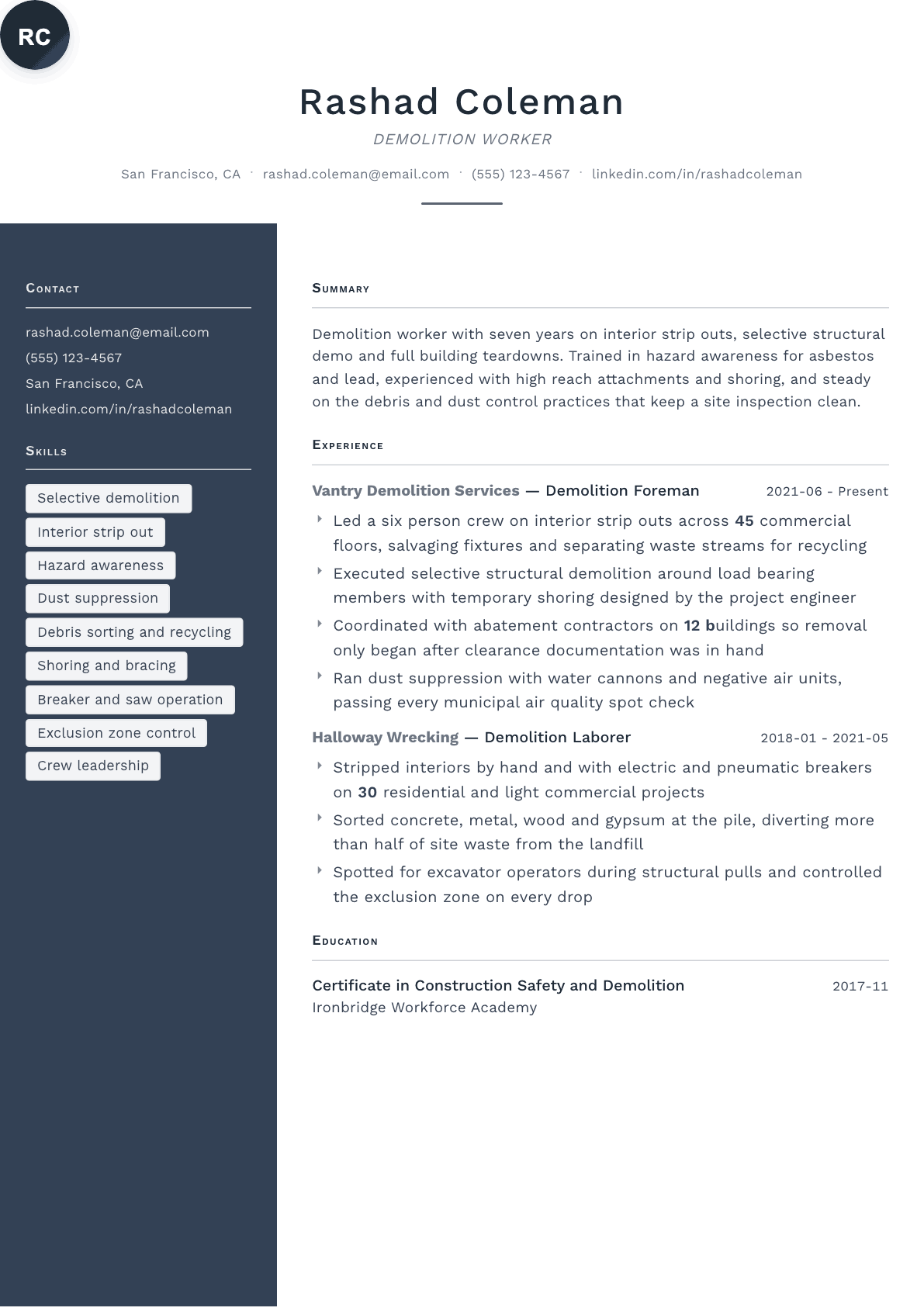
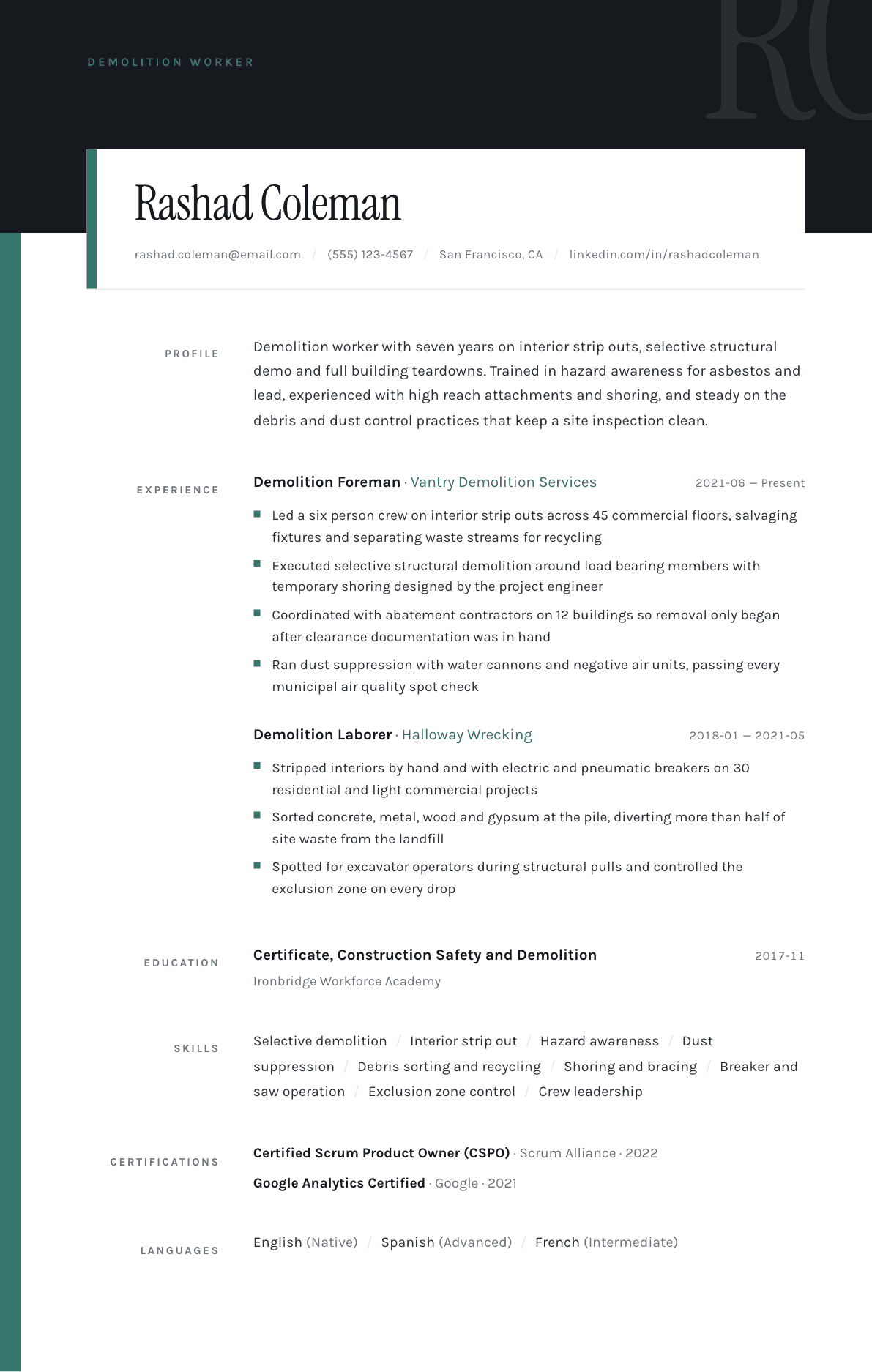
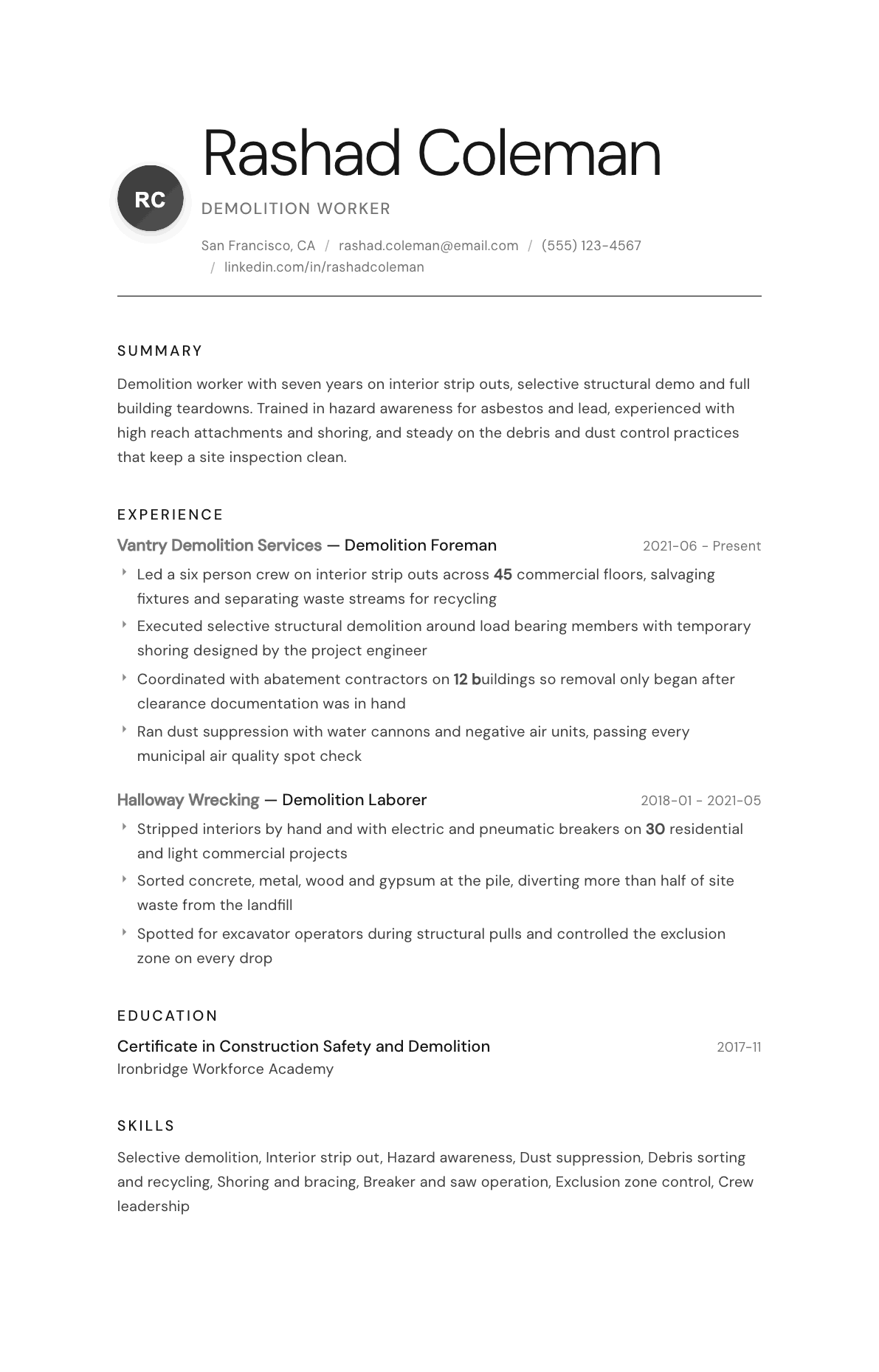
Example Demolition Worker summary
Demolition worker and crew foreman with seven years on interior strip outs, selective structural demolition and full teardowns. Trained in asbestos and lead awareness, respirator use and confined space entry. Runs breakers, concrete saws and skid steers, coordinates abatement clearance before removal starts, and keeps dust suppression and exclusion zones tight. Looking for a foreman role with a commercial demolition contractor.
Skills to list on a Demolition Worker resume
- Selective demolition
- Structural demolition
- Interior strip out
- Concrete cutting and breaking
- Shoring and bracing
- Asbestos and lead awareness
- Respirator use
- Dust and noise control
- Waste sorting and recycling
- Skid steer operation
- Rigging and spotting
- Site exclusion zones
- Hand and power tools
- Crew supervision
What actually gets this resume read
- Split interior strip out work from structural demolition, because contractors staff those two scopes with different people.
- List your hazard training in full, including asbestos awareness, lead awareness and any respirator fit testing you hold.
- Name the tools and machines you use: breakers, concrete saws, skid steers, high reach excavators and grapple attachments.
- Show waste diversion results, since demolition bids increasingly carry recycling targets the client has to report on.
- Describe how you protect what stays standing: shoring, bracing, protection boards and monitoring on adjacent structures.
- Give your safety record and any toolbox talks you lead, because demolition insurance rides on incident history.
How to write a demolition worker resume
Demolition hires on trust before it hires on muscle. A wrecking contractor is putting someone inside a building that is being taken apart, often next to occupied structures, sometimes above hazardous material that has to be cleared by a licensed abatement crew first. The resume that gets a call shows you understand the sequence, not just the sledgehammer.
The reader is a project manager or a demolition superintendent who cares about three things: what scopes you have worked, what hazard training you hold, and whether anyone has been hurt around you. Everything else on the page is background.
This guide breaks the resume into the sections that answer those questions, with example summaries for a laborer, an experienced hand and a foreman, before and after bullets, and the questions people ask when they try to move from general labor into demolition or from residential work into commercial teardowns.
Format: one page, training block up front
One page, single column, no photographs or graphics. Demolition contractors are often small offices where a coordinator collects resumes by email, and a plain document is easier to forward to the safety manager who has to approve you.
Place a hazard training block directly under the summary. Awareness training, respirator clearance and any accreditation you hold decide which buildings you can enter, so a manager wants that visible before your work history.
- Header: name, city and state, phone, email, driver license class.
- Section order: summary, safety and hazard training, experience, tools and equipment, education.
- Someone entering the trade leads with general construction labor, tool experience and any warehouse or salvage work.
Summary: scope, building type, and your role on the crew
Say what you take apart and where. Interior strip out in occupied office towers, selective structural work inside a renovation, full teardowns of industrial buildings, or residential gut work all read differently to a contractor with a specific backlog.
Then say what you do on the crew. Hand demolition, breaker and saw work, spotting for machines, rigging, sorting at the pile, or running a small crew. If you have a foreman or lead history, put it in the first line.
Experience: sequence, protection and what stayed standing
Good demolition bullets follow the sequence a job actually runs. Survey and isolation of utilities, hazardous material clearance, soft strip, selective removal, structural takedown, then load out and site cleanup. Placing your work inside that sequence tells a superintendent how much of the process you have seen.
Protection is where the skill shows. Temporary shoring and bracing, protection boards and hoarding, monitoring adjacent structures, controlling dust with water and negative air, and holding an exclusion zone around any drop are all worth naming individually.
Waste is now part of the scope on most commercial jobs. Sorting concrete, metal, wood and gypsum at the pile, salvaging fixtures for reuse, and hitting a diversion target the client reports on are lines that separate a modern demolition hand from a laborer with a hammer.
If you have worked around abatement, describe the coordination honestly. Waiting for clearance documentation before removal starts is the correct answer and it shows you will not put a contractor in front of a regulator.
- Scope: floors stripped, square footage cleared, buildings taken down.
- Method: hand tools, breakers, saws, skid steers, high reach machines, grapples.
- Control: dust suppression, shoring, exclusion zones, waste diversion.
Hazard training and personal protective equipment
List the training by name: construction safety course hours, asbestos and lead awareness, silica exposure control, confined space entry, fall protection, and hazardous waste operations training if you have it. Add respirator fit testing and medical clearance, because a worker who is already cleared can be assigned the day he starts.
Note any accreditation for abatement work separately. Awareness training and worker accreditation are not the same thing, and a contractor will check which one you actually hold before assigning you to a regulated area.
Keywords in demolition postings
Postings repeat a small set of terms: selective demolition, interior demolition, strip out, structural demolition, debris removal, hazardous material awareness, dust control, shoring, salvage and recycling. Use the words that describe work you have really done.
For industrial and plant work, the vocabulary changes toward decommissioning, equipment removal, torch cutting, confined space and process isolation. Adjust the resume when you apply to that side of the business.
Demolition Worker resume summary examples
New to demolition
Construction laborer with two years on renovation crews, experienced with hand tools, electric breakers and debris haul out. Completed construction safety course hours plus asbestos and lead awareness training, fit tested for a half face respirator, and reliable on early starts and night work.
Four years on the pile
Demolition worker with four years on interior strip outs and light structural work across commercial and residential buildings. Runs breakers, concrete saws and skid steers, sorts waste streams at the pile for recycling targets, and spots for excavator operators during structural pulls.
Demolition foreman
Demolition foreman leading crews of six on office strip outs and selective structural removal. Coordinates abatement clearance before work begins, sets shoring with the project engineer, runs dust suppression and exclusion zones, and closes out municipal air quality inspections without a stop work order.
Work experience bullets: before and after
Before: Tore out walls and ceilings in old buildings.
After: Stripped out 45 commercial floors of partitions, ceiling grid, flooring and fixtures, salvaging reusable items and separating waste streams as the pile was built.
Volume, materials and the salvage discipline show a controlled strip out rather than general destruction.
Before: Did demolition around structural parts of the building.
After: Executed selective demolition around load bearing columns and beams under temporary shoring designed by the project engineer, checking bracing before each shift.
Shoring, engineering involvement and the pre shift check are what make structural work defensible.
Before: Kept the dust down on site.
After: Ran dust suppression with water cannons and negative air units on occupied building work, passing every municipal air quality spot check during the project.
Naming the equipment and the inspection outcome makes dust control a compliance result, not a chore.
Before: Recycled materials from the job.
After: Sorted concrete, metal, wood and gypsum at the pile and diverted more than half of the site waste stream from landfill, with tickets recorded for the client report.
A diversion figure with documentation supports the reporting a commercial client contractually requires.
Before: Worked with the machine operators.
After: Spotted for excavator operators during structural pulls, controlled the exclusion zone before each drop, and called the machine down when a bystander entered the perimeter.
The stop work decision is the detail that proves real spotting judgment under pressure.
Hard skills
- Interior strip out
- Selective demolition
- Structural demolition support
- Concrete cutting and breaking
- Shoring and bracing installation
- Dust and noise control
- Waste sorting and diversion
- Skid steer and mini loader operation
- Rigging and machine spotting
- Torch cutting and metal removal
- Hand and pneumatic tool use
- Site cleanup and load out
Soft skills
- Following a controlled work sequence
- Hazard reporting
- Crew coordination in noise
- Physical stamina across long shifts
- Respect for exclusion zones
Certifications worth listing
- OSHA 30-Hour Construction Outreach Training (Occupational Safety and Health Administration)
- HAZWOPER 40-Hour Training (OSHA-authorized training provider)
- AHERA Asbestos Abatement Worker Accreditation (Environmental Protection Agency)
- Lead Renovator Certification (Environmental Protection Agency)
Mistakes that cost demolition worker candidates the interview
- Writing demolition as one word with no scope, so a contractor cannot tell strip out work from structural takedown.
- Listing awareness training as if it were abatement accreditation, which a safety manager will catch immediately.
- Leaving out dust, noise and waste controls on a resume aimed at commercial work where those are contract terms.
- Describing yourself as a hard worker instead of naming the tools, machines and methods you have used.
- Omitting any mention of shoring or protection of adjacent structures, which reads as unsupervised experience.
- Skipping the safety record when incident history is a large part of what makes a demolition hire expensive.
Demolition Worker resume questions
Do I need asbestos training to work in demolition?
Awareness training is expected on almost every commercial job because older buildings contain regulated materials. Full worker accreditation is only needed if you will be inside a regulated abatement area, which is normally a separate licensed crew.
How do I get into demolition with only general labor experience?
Lead with tool and machine time, willingness to work nights, and any awareness training you have completed on your own. Contractors train entry crew constantly, so the training block often matters more than the work history.
Should I list every building I have worked on?
No. Group them by type and give totals, such as floors stripped or buildings taken down, then describe two or three projects with unusual constraints. That reads as experience rather than as a long list of addresses.
Is a commercial driver license useful for demolition work?
It helps on smaller crews where debris haul off and equipment moves are done in house. Note the class and endorsements, plus any experience with roll off containers, dump trailers or water trucks on site.
How do I move from residential gut work to commercial demolition?
Translate what carries: hand demolition, waste sorting, tool skill and hazard awareness. Then name the commercial elements you have touched, such as ceiling grid, mechanical removal or protection of occupied areas, and say you are ready for scaled up work.
Related resume examples
- Heavy Equipment Operator Resume example
- Excavator Operator Resume example
- Masonry Worker Resume example
- Construction Laborer Resume example
- Roofer Resume example
- Construction Worker Resume example