Hospitality Manager Resume Examples: what gets the call
Build a Hospitality Manager Resume That Covers Rooms and Service
By Mustafa Tarabya, founder of CVBooster · Published · Updated
Hospitality manager resume examples, keywords and a writing guide covering guest scores, department scope, staffing and property systems.
Sample resumes for a hospitality manager
The same hospitality manager content laid out in three CVBooster templates, so you can see what the finished document looks like before you write a word.
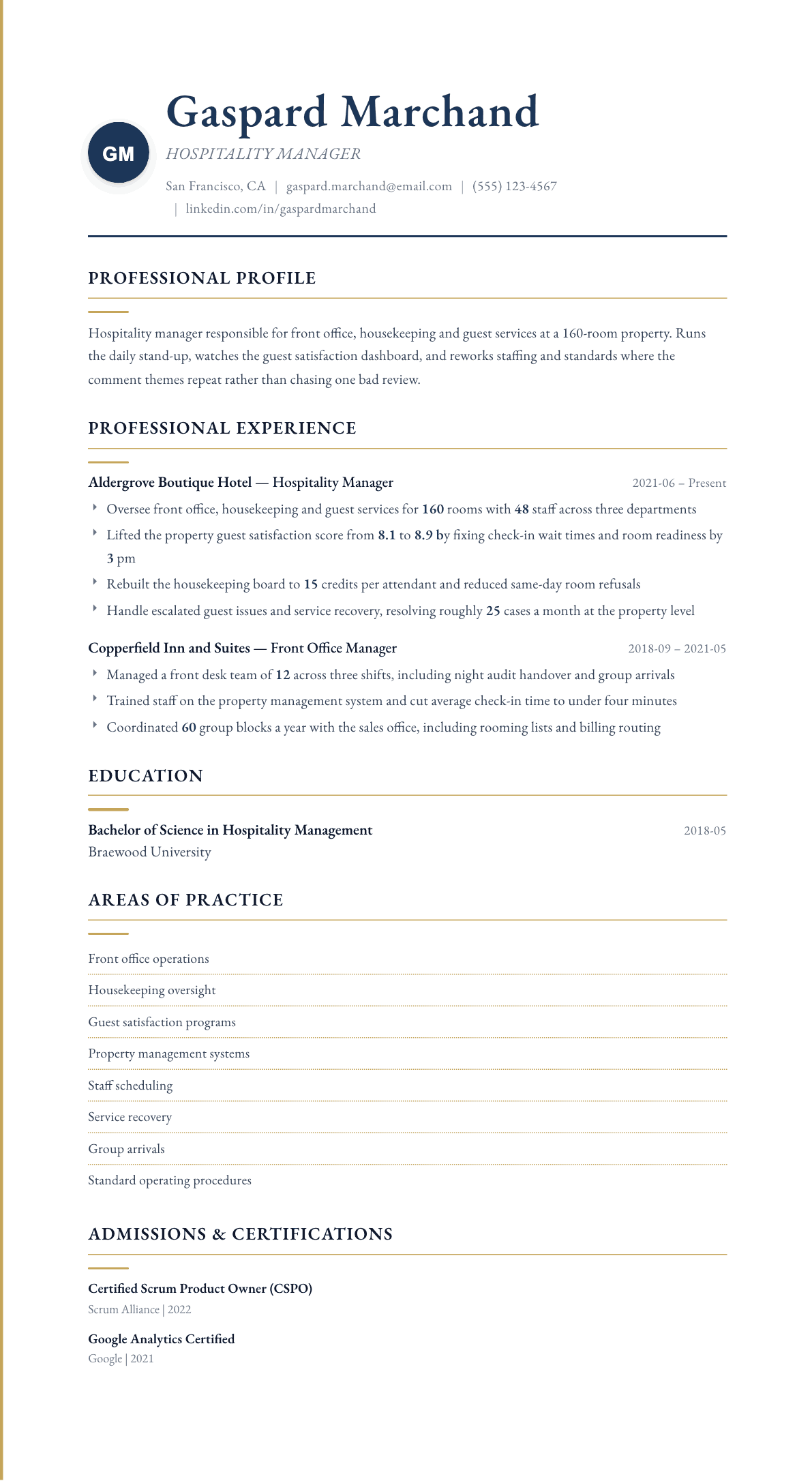
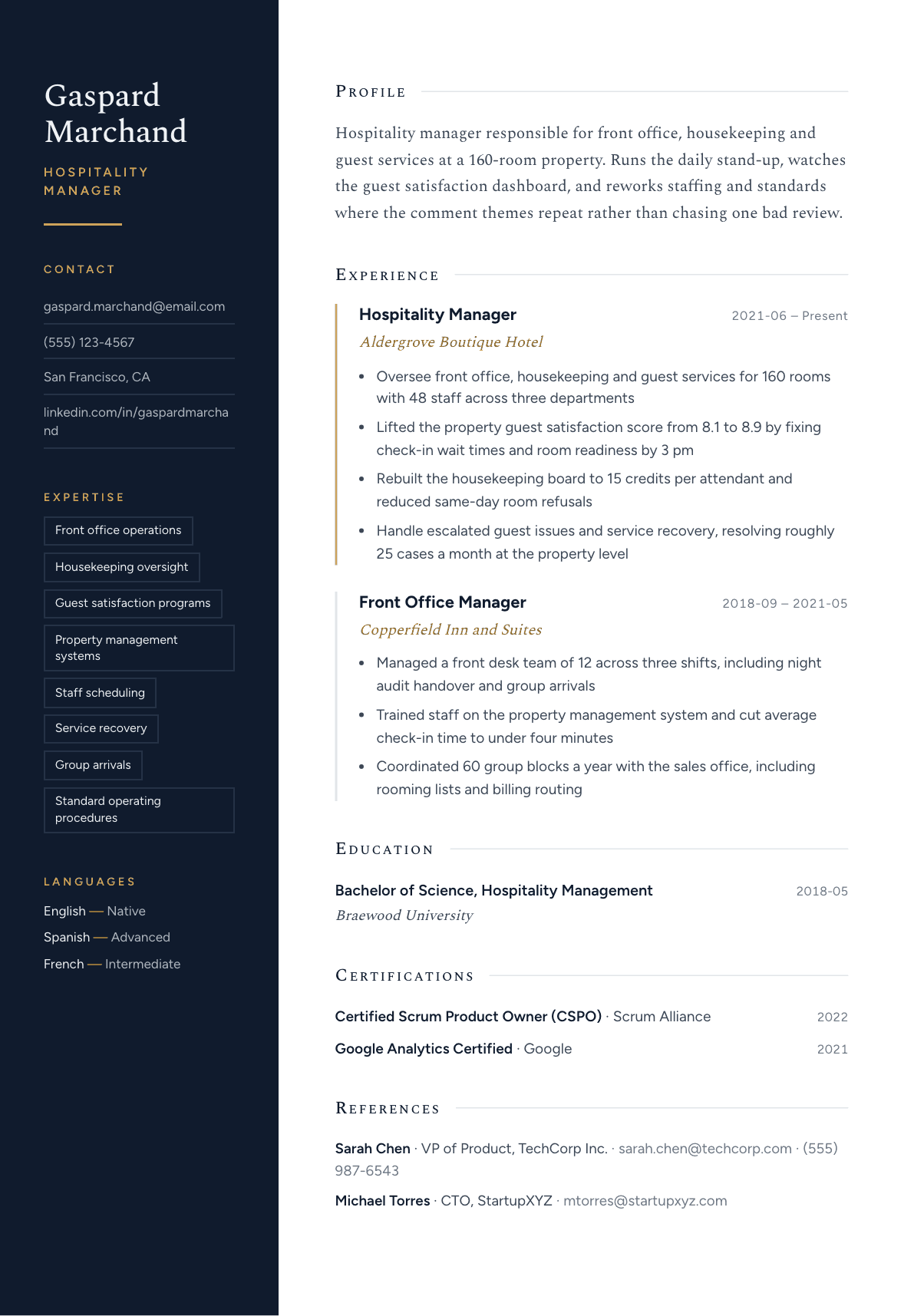
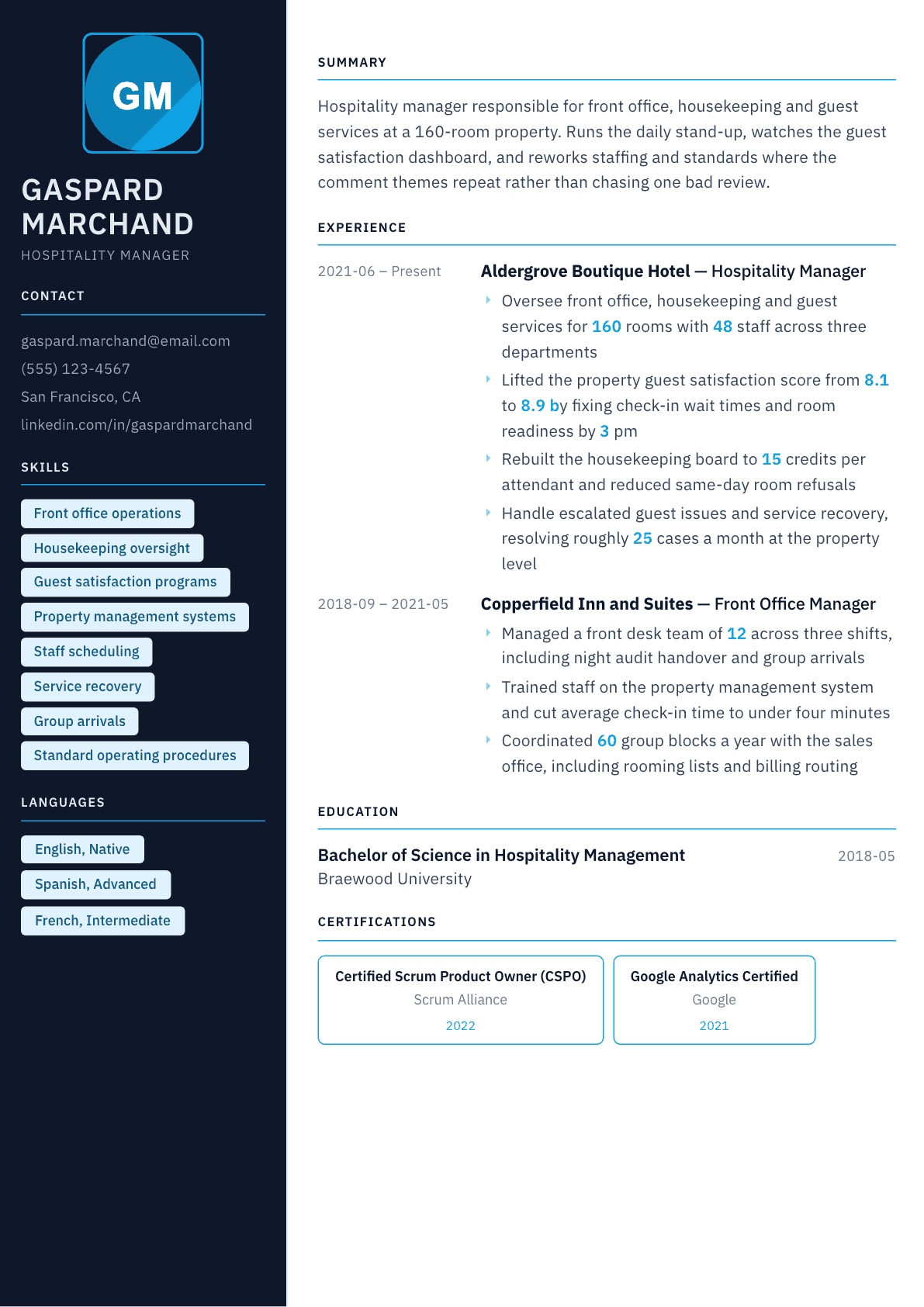
Example Hospitality Manager summary
Hospitality manager with seven years across front office and rooms division at boutique and select-service properties, currently leading three departments and 48 staff at a 160-room hotel. Moves guest satisfaction by fixing check-in flow and room readiness, and builds checklists that hold the standard on nights and weekends. Seeking a rooms division or assistant general manager role.
Skills to list on a Hospitality Manager resume
- Front office operations
- Housekeeping oversight
- Guest satisfaction scores
- Service recovery
- Property management systems
- Opera PMS
- Staff scheduling
- Group arrivals and rooming lists
- Night audit oversight
- Standard operating procedures
- Quality audits
- Budget management
- Training and onboarding
- Vendor coordination
- Health and safety compliance
What actually gets this resume read
- Name every department you covered, because hospitality manager means rooms at one property and outlets at another.
- Give the property size in rooms or covers so a reader can place your experience against their own operation.
- Use the guest satisfaction metric your brand tracked and show the movement, not just that you watched it.
- List the property management system by name, since front office hiring often screens on Opera or a direct competitor.
- Show service recovery volume and how you resolved cases without pushing everything to the general manager.
- Include the standards work: checklists, audits and training that made results repeat after you left the shift.
How to write a hospitality manager resume
Hospitality manager is one of the least standardized titles in the industry. At a boutique hotel it means front office and housekeeping. At a stadium or a private club it means service teams and events. At a senior living community it means dining and guest experience. Because the title travels so widely, the first job of the resume is to say exactly which departments reported to you and how large the operation was.
The reader is usually a general manager or a regional director of operations. She wants the property size, the departments in your scope, the guest satisfaction measure your brand used and what you did to move it, and evidence that standards held on the shifts you were not there. A guest score with no explanation behind it reads as luck.
This guide covers how to define your scope in a line, how to write about guest satisfaction without sounding like a brand brochure, three summaries across career stages, rewrites of the bullets that show up most often, and the questions managers ask when moving between property types.
Format: define the scope before anything else
Single column, reverse chronological, one page under about eight years. Because the title is ambiguous, put a scope line at the top of each job: property type and size, departments covered, head count and who you reported to. Without it the reader has to infer your job from your bullets, which slows every screen.
Add the brand or management company if it is recognized, because standards, audit programs and systems differ between them, and a regional director will assume a shorter ramp for someone from a comparable operation.
- Header: name, city and state, phone, email.
- Sections in this order: summary, operations experience, certifications, education, systems and skills.
- Every job opens with a scope line, then bullets grouped by department rather than mixed together.
Guest satisfaction: name the measure and the fix
Every brand tracks guest sentiment differently, so name the measure you worked to and give the movement. Then, and this is the part most candidates skip, say what you changed. Check-in wait times, room readiness by a fixed hour, a housekeeping board that stopped overloading attendants, a written escalation path for the front desk.
Comment themes are more useful than a single score. Showing that you read the verbatim feedback, found the repeating complaint and rebuilt the process behind it is far stronger evidence than reporting a number that went up while you were employed.
Rooms operations: the numbers a rooms director checks
If your scope included front office and housekeeping, give the operating figures. Room count, credits per attendant, average check-in time, arrival volume on a peak day, group blocks handled, and how the night audit handover worked. Those figures are the working language of a rooms division.
Include the systems by name. The property management system is the hard filter on most front office postings, and experience with the revenue, housekeeping and guest messaging tools around it shortens your training considerably.
Standards, audits and service recovery
Standards work is what makes results repeat once you go home. Write about the checklists you built, the quality audits you passed or ran, and the training you gave so a new desk agent handled an overbooking the same way you would.
Service recovery deserves its own bullet. Give the volume of escalated cases you resolved at the property level and the authority you held, such as compensation limits or the point at which you involved the general manager. That tells a reader how much of the load you take off her desk.
People, cost and the keywords the posting uses
Show head count, schedule ownership and any payroll or department budget you controlled. Hospitality managers who understand labor against occupancy get promoted faster than those who only understand service.
Mirror the posting language once each: rooms division, front office, guest services, service recovery, standard operating procedures, quality audit, group arrivals and the property management system name. Attach each to a real piece of work rather than listing them together.
Hospitality Manager resume summary examples
Supervisor stepping up
Front desk supervisor at a 110-room select-service hotel, leading a team of eight across three shifts, handling group arrivals and covering night audit review. Trained the desk on the property management system and cut check-in time on peak arrival days. Ready for a hospitality manager role.
Multi-department manager
Hospitality manager responsible for front office, housekeeping and guest services at a 160-room property with 48 staff. Lifted the guest satisfaction score from 8.1 to 8.9 by fixing check-in waits and room readiness, and resolves about 25 escalated cases a month without involving the general manager.
Rooms division leader
Rooms division manager at a 340-room full-service hotel, overseeing front office, housekeeping, guest services and the night audit team above 90 people. Owns the department budget and the annual brand quality audit, and has developed four supervisors into managers across two properties.
Work experience bullets: before and after
Before: Oversaw hotel operations and guest services.
After: Oversaw front office, housekeeping and guest services for 160 rooms with 48 staff across three departments, reporting to the general manager.
Naming the departments and the room count removes the ambiguity that this job title always carries.
Before: Improved guest satisfaction scores.
After: Lifted the property guest satisfaction score from 8.1 to 8.9 by cutting check-in waits at peak arrival and guaranteeing room readiness by 3 pm.
Two endpoints and two specific process changes turn a claim into something a regional director can test.
Before: Managed the housekeeping department.
After: Rebuilt the housekeeping board to 15 credits per attendant and cut same-day room refusals, which removed the recurring cleanliness theme from guest comments.
Credits per attendant is the real unit of housekeeping work and it links directly to the comment theme it fixed.
Before: Handled guest complaints.
After: Resolved roughly 25 escalated guest cases a month at the property level within a set compensation authority, escalating only cases involving safety or legal exposure.
Volume plus authority shows exactly how much weight you take off the general manager.
Before: Trained new employees on procedures.
After: Wrote shift checklists for front office and guest services and trained 20 new hires against them, so overbooking and late arrival handling stayed consistent overnight.
It shows standards that survive your absence rather than training that happened once.
Hard skills
- Front office operations
- Housekeeping oversight and credit boards
- Guest satisfaction programs
- Service recovery and compensation authority
- Property management systems
- Group arrivals and rooming lists
- Night audit oversight
- Standard operating procedures
- Brand quality audits
- Labor scheduling against occupancy
- Department budgeting
- Health and safety compliance
Soft skills
- Reading comment themes
- Cross-department coordination
- Coaching supervisors
- Composure with an angry guest
- Delegation
- Standard setting
Certifications worth listing
- Certified Hospitality Supervisor (CHS) (American Hotel and Lodging Educational Institute)
- Certified Hotel Administrator (CHA) (American Hotel and Lodging Educational Institute)
- Certified Rooms Division Executive (CRDE) (American Hotel and Lodging Educational Institute)
- ServSafe Food Handler (National Restaurant Association)
Mistakes that cost hospitality manager candidates the interview
- Leaving the scope undefined, so the reader cannot tell whether you ran a front desk or a whole rooms division.
- Reporting a guest satisfaction number without naming the measure or the change that moved it.
- Omitting the property management system, which is the hard filter on most front office and rooms postings.
- Writing about service philosophy where an operator is looking for room counts, head count and schedules.
- Ignoring the standards work, which is the only evidence that results held when you were off property.
- Using the same summary for a boutique hotel, a club and a stadium role when each defines the title differently.
Hospitality Manager resume questions
What exactly should a hospitality manager resume claim?
Claim the departments that reported to you and nothing wider. If you covered front office and guest services but housekeeping had its own manager, say that. Regional directors check reporting lines during reference calls, and an inflated scope is the easiest thing for them to catch.
How do I move between property types?
Lead with the parts that transfer, which are scheduling against demand, service recovery, standards and staff development. Then name the specific gap and how you plan to close it, such as learning a new property management system or a different brand audit program.
Should I list the brand I worked for?
Yes, when the property was flagged. Brand standards, audit programs and systems differ enough that a hiring manager uses the flag to estimate your ramp time. For independents, describe the positioning instead, such as a boutique property or an upscale resort.
How do I write about guest scores if my property was below target?
Give the honest starting point, the direction you moved it and the specific process you changed. A manager who inherited a struggling property, diagnosed the recurring complaint and improved the trend is more credible than one reporting a strong score at a property that was already strong.
Do I need a hospitality degree for this role?
Not usually. Properties promote from supervisor roles on demonstrated results, and a degree matters most for corporate or brand track positions. If you have one, keep it to a single line and let the operating figures in your experience section do the persuading.
Related resume examples
- Hotel General Manager Resume example
- Front Desk Manager Resume example
- Guest Services Manager Resume example
- Hotel Manager Resume example
- Front Office Manager Resume example
- Food and Beverage Manager Resume example