Food and Beverage Manager Resume Examples: free score
Craft a Food and Beverage Manager Resume That Shows Cost Control
By Mustafa Tarabya, founder of CVBooster · Published · Updated
Food and beverage manager resume examples, keywords and a guide to writing cost percentages, outlet scope and staffing into every bullet.
Sample resumes for a food and beverage manager
The same food and beverage manager content laid out in three CVBooster templates, so you can see what the finished document looks like before you write a word.
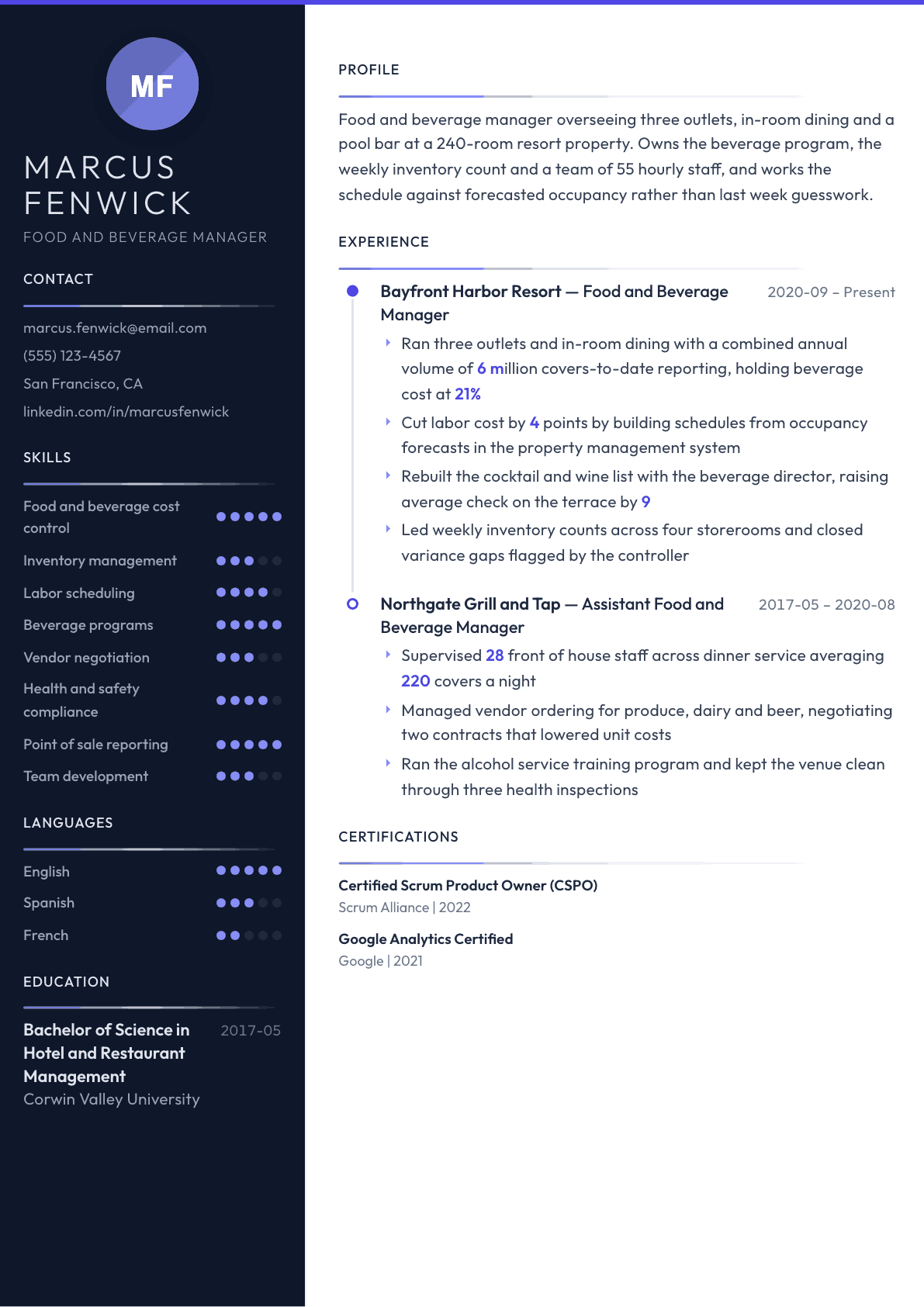
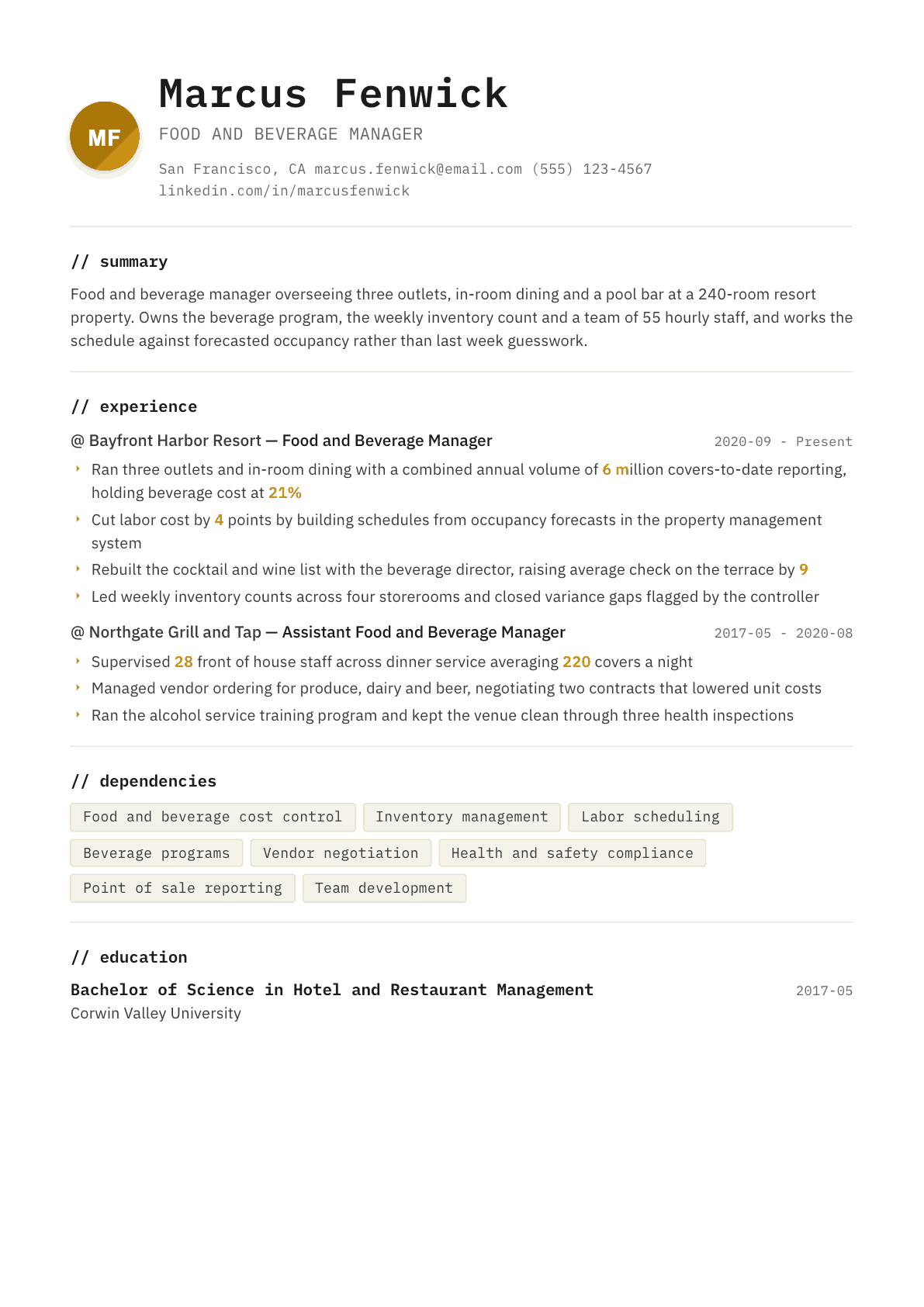
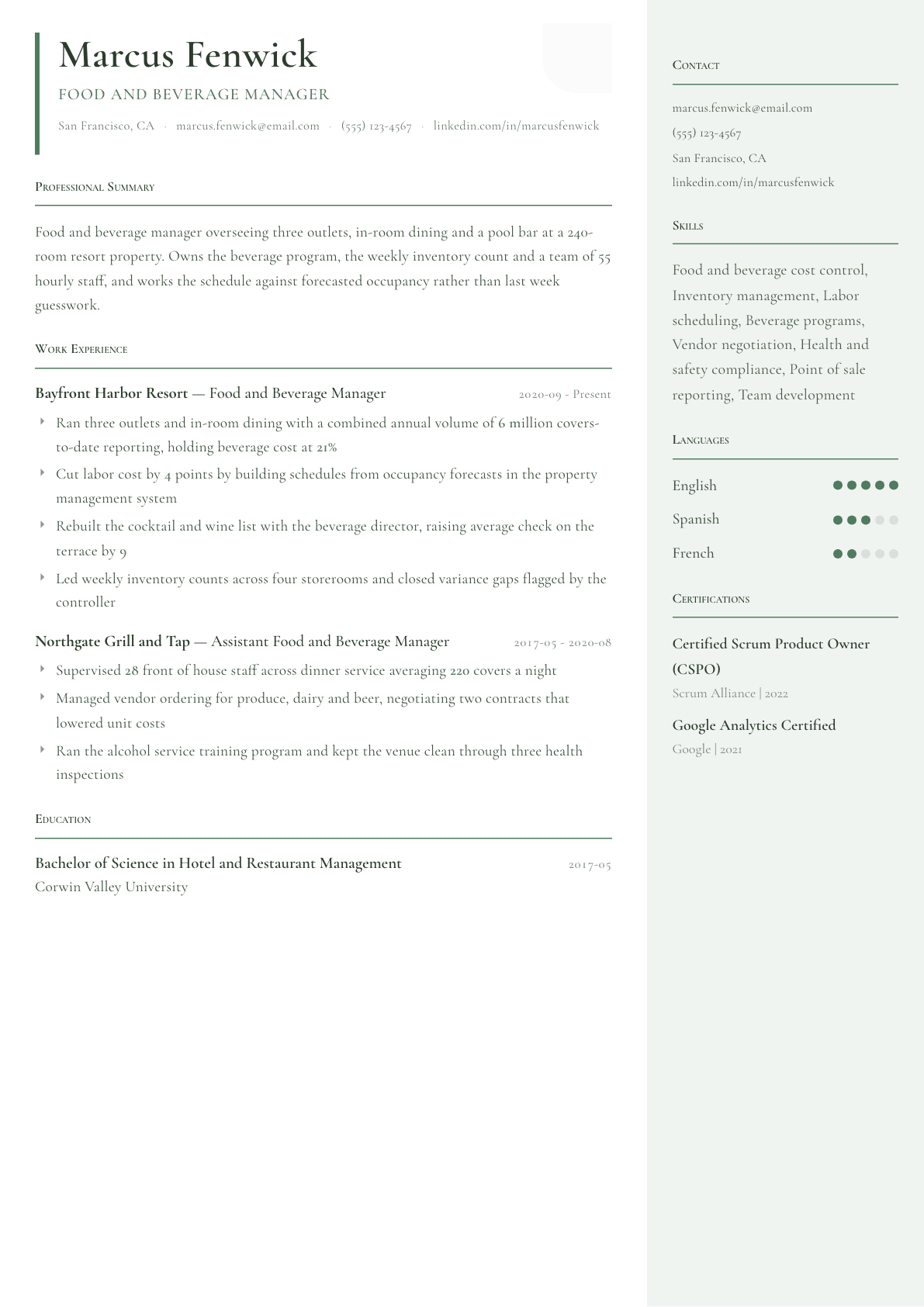
Example Food and Beverage Manager summary
Food and beverage manager with eight years running multi-outlet operations at resort and conference properties, most recently three outlets plus in-room dining and a team of about 50. Holds beverage cost near target through weekly counts, builds schedules from occupancy forecasts, and rebuilds lists that lift average check. Seeking a director track role at a full-service hotel.
Skills to list on a Food and Beverage Manager resume
- Food cost control
- Beverage cost control
- Inventory and par levels
- Labor scheduling
- Outlet operations
- Beverage list design
- Vendor negotiation
- Point of sale reporting
- Health and safety audits
- Alcohol service compliance
- Menu engineering
- Staff training
- Guest recovery
- Budget and forecasting
- In-room dining
What actually gets this resume read
- Open each job with the scope: number of outlets, room count, cover volume, and how many staff reported to you.
- Put food cost, beverage cost and labor cost figures in your bullets, because operators read those three lines first.
- Name the systems you ran, from the point of sale to the inventory and scheduling tools you actually used.
- Show the beverage program work: list design, pour cost, supplier relationships and the training that protects it.
- Include health inspection results and alcohol compliance, since a manager who fails those is a liability.
- Describe how you built schedules against forecasted occupancy or covers rather than repeating the previous week.
How to write a food and beverage manager resume
A food and beverage manager resume is read as a cost document first and a service document second. The director or general manager screening it wants to know how many outlets you carried, how much volume ran through them, what your food and beverage cost lines looked like, and whether you built schedules from a forecast or from habit. Everything else is supporting material.
The trap is that the title covers wildly different jobs. At a select-service hotel it means one restaurant and a breakfast buffet. At a resort it means three outlets, in-room dining, a pool bar and banquets. A resume that does not state the scope forces the reader to guess, and guessing usually lands you in the smaller pile.
This guide covers the structure operators expect, the numbers they check before anything else, three summaries across career stages, rewrites of the bullets that appear on almost every food and beverage resume, and the questions managers ask when they are trying to move from one outlet to a whole division.
Format: two pages once you carry multiple outlets
Single column, reverse chronological. One page is right while you still run one outlet. Once you carry several venues plus banquets, two pages is normal and expected, because each venue needs its own scope line and the reader is comparing operations, not counting sheets.
Open each job with a scope line before the bullets: property type, room count, outlets covered, seat or cover volume, and reports. That single line does more work than any summary sentence, and it lets an operator place you in about four seconds.
- Header: name, city and state, phone, email.
- Sections in this order: summary, operating experience, certifications, education, systems and skills.
- Each job starts with a scope line, then three to five bullets built on cost, labor, program and compliance.
The three cost lines an operator checks first
Food cost, beverage cost and labor cost are the vocabulary of this job. Put real figures against them and say what you did to move them. An operator does not need the number to be spectacular; she needs to see that you know your own numbers and can explain the levers behind them.
Tie every cost claim to a mechanism. Holding beverage cost through a weekly count across four storerooms is credible. Reducing labor by building the schedule against forecasted occupancy is credible. A cost figure with no method behind it reads as something the property achieved while you were present.
Program work: menus, lists and average check
Cost control keeps the job. Program work gets the promotion. Show where you rebuilt a cocktail list, ran a menu engineering pass with the chef, changed a pour standard, added a happy hour that did not cannibalize dinner, or repositioned an outlet that was losing its daypart.
Where you have it, connect the program change to average check, cover counts or an outlet's share of total revenue. Those are the measures a director uses when deciding which manager gets the flagship venue.
Compliance and the things that can close a venue
Health inspection results, alcohol service compliance and allergen procedure belong on the resume, briefly and without drama. Give the inspection outcome and the practice behind it, such as the closing checklist you rewrote or the line check you added at each shift change.
Name your food protection manager certification and your alcohol service training with the issuing body. In many jurisdictions the venue must have a certified manager present, so this is a scheduling fact, not a nice extra.
Systems, keywords and the team you built
List the point of sale, the inventory and ordering platform, the scheduling tool and the property management system by name. Postings screen on them, and an operator reads the list to estimate how long it takes to make you useful.
Finish with people. Head count supervised, hourly turnover, how many supervisors you developed and where they went. A manager who grows leaders is the one who gets handed a second outlet, and no cost figure communicates that on its own.
Food and Beverage Manager resume summary examples
Supervisor stepping up
Restaurant supervisor with three years in a hotel outlet doing 220 covers a night, running the floor, the weekly beverage count and the schedule for 28 hourly staff. Certified food protection manager, trained on the point of sale and the ordering platform. Ready for an assistant food and beverage manager role.
Multi-outlet manager
Food and beverage manager covering three outlets, in-room dining and a pool bar at a 240-room resort with 55 hourly staff. Holds beverage cost at 21% through weekly counts across four storerooms and builds schedules from occupancy forecasts rather than the previous week.
Assistant director
Assistant director of food and beverage at a full-service convention hotel, responsible for four outlets plus banquet operations and a team above 120. Rebuilt the beverage program with the executive chef and beverage director, cut labor cost by four points, and developed three supervisors into outlet managers.
Work experience bullets: before and after
Before: Managed restaurant operations and staff.
After: Ran three outlets and in-room dining at a 240-room resort with 55 hourly staff and four supervisors reporting in, covering every daypart from breakfast to late bar.
Outlet count, room count and head count let an operator place your scope instead of imagining it.
Before: Controlled food and beverage costs.
After: Held beverage cost at 21% through weekly counts across four storerooms and closed the variance gaps the controller flagged in two consecutive quarters.
A named cost line, a real routine and an outside check make the claim verifiable.
Before: Created staff schedules each week.
After: Built weekly schedules from occupancy forecasts in the property management system rather than the prior week, cutting labor cost by four points without reducing service standards.
The scheduling method is the skill; producing a schedule is a task every manager performs.
Before: Updated the drinks menu.
After: Rebuilt the cocktail and wine list with the beverage director around a revised pour standard, raising average check on the terrace and clearing three slow-moving cases from inventory.
Connecting the list change to check average and inventory turns a menu edit into a commercial decision.
Before: Ensured health and safety standards were met.
After: Rewrote the closing checklist and added a line check at every shift change, then passed three consecutive county inspections without a critical violation.
The practice plus the inspection outcome shows a system, not an intention.
Hard skills
- Food cost and beverage cost control
- Inventory counts and par levels
- Labor forecasting and scheduling
- Menu engineering
- Beverage list and pour standards
- Vendor negotiation and ordering
- Point of sale reporting
- Property management system integration
- Health inspection readiness
- Alcohol service compliance
- Budget preparation and variance review
- In-room dining and banquet support
Soft skills
- Standing a line check
- Coaching supervisors
- Guest recovery
- Vendor relationships
- Cost conversations with owners
- Calm during a rush
Certifications worth listing
- ServSafe Food Protection Manager (National Restaurant Association)
- ServSafe Alcohol (National Restaurant Association)
- TIPS Certification (Health Communications, Inc.)
- Certified Hospitality Supervisor (CHS) (American Hotel and Lodging Educational Institute)
- Certified Food and Beverage Executive (CFBE) (American Hotel and Lodging Educational Institute)
Mistakes that cost food and beverage manager candidates the interview
- Writing the title without the scope, so a reader cannot tell one breakfast outlet from a full resort division.
- Claiming cost control with no figure and no method behind it.
- Leaving out the point of sale, inventory and scheduling systems that the posting screens on.
- Listing guest satisfaction as an achievement without naming the measure or the change.
- Ignoring compliance entirely, which reads as carelessness in a job that signs for the health inspection.
- Filling the page with service adjectives while the reader is looking for three cost lines and a head count.
Food and Beverage Manager resume questions
How do I move from one restaurant to a full food and beverage division?
Show breadth before you ask for it. Volunteer for banquet coverage, in-room dining or the pool bar, then write those into your bullets as separate scopes. A director hires the manager who has already carried a second venue, even temporarily, over one who only promises to.
Should I include cost percentages if my property missed target?
Yes, when you can show the direction and the reason. A manager who inherited a high food cost, named the cause and moved it toward target tells a better story than one who reports a comfortable number at a property that was never under pressure.
How long should a food and beverage manager resume be?
One page while you run a single outlet, two once you carry multiple venues or banquet operations. Two pages is normal in this field because every venue needs its own scope line, but a third page always means the earliest jobs have not been trimmed.
Does hotel experience transfer to a standalone restaurant group?
It transfers well on cost control, scheduling and compliance, and less well on standalone marketing and local guest building. Address that directly by leading with the cost and labor results and adding any outlet where you drove covers without a hotel filling the seats.
What certifications do operators actually look for?
A current food protection manager certification and alcohol service training are the practical ones, since many jurisdictions require a certified manager on shift. The hospitality educational institute credentials help for corporate hotel tracks but rarely decide an independent restaurant hire.
Related resume examples
- Food & Beverage Director Resume example
- Restaurant Manager Resume example
- Bar Manager Resume example
- Hospitality Manager Resume example
- Barback Resume example
- Lifeguard Resume example