Hotel Receptionist Resume Examples: the lines they read
Write a Hotel Receptionist Resume That Reads Like Front Office Strength
By Mustafa Tarabya, founder of CVBooster · Published · Updated
Hotel receptionist resume example with check in, upselling and night audit bullets, the keywords hotels screen for, and a section by section guide.
Sample resumes for a hotel receptionist
The same hotel receptionist content laid out in three CVBooster templates, so you can see what the finished document looks like before you write a word.
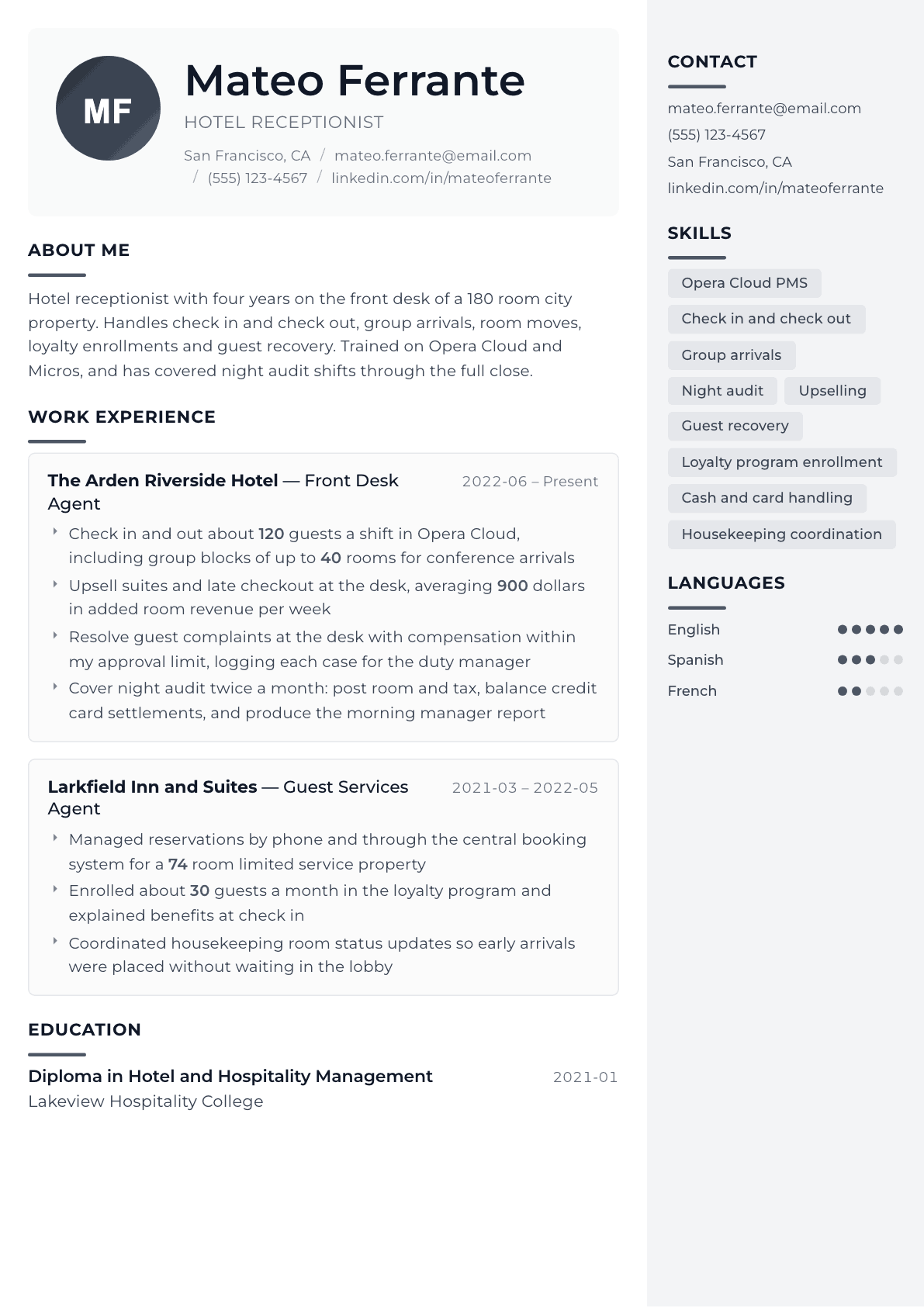
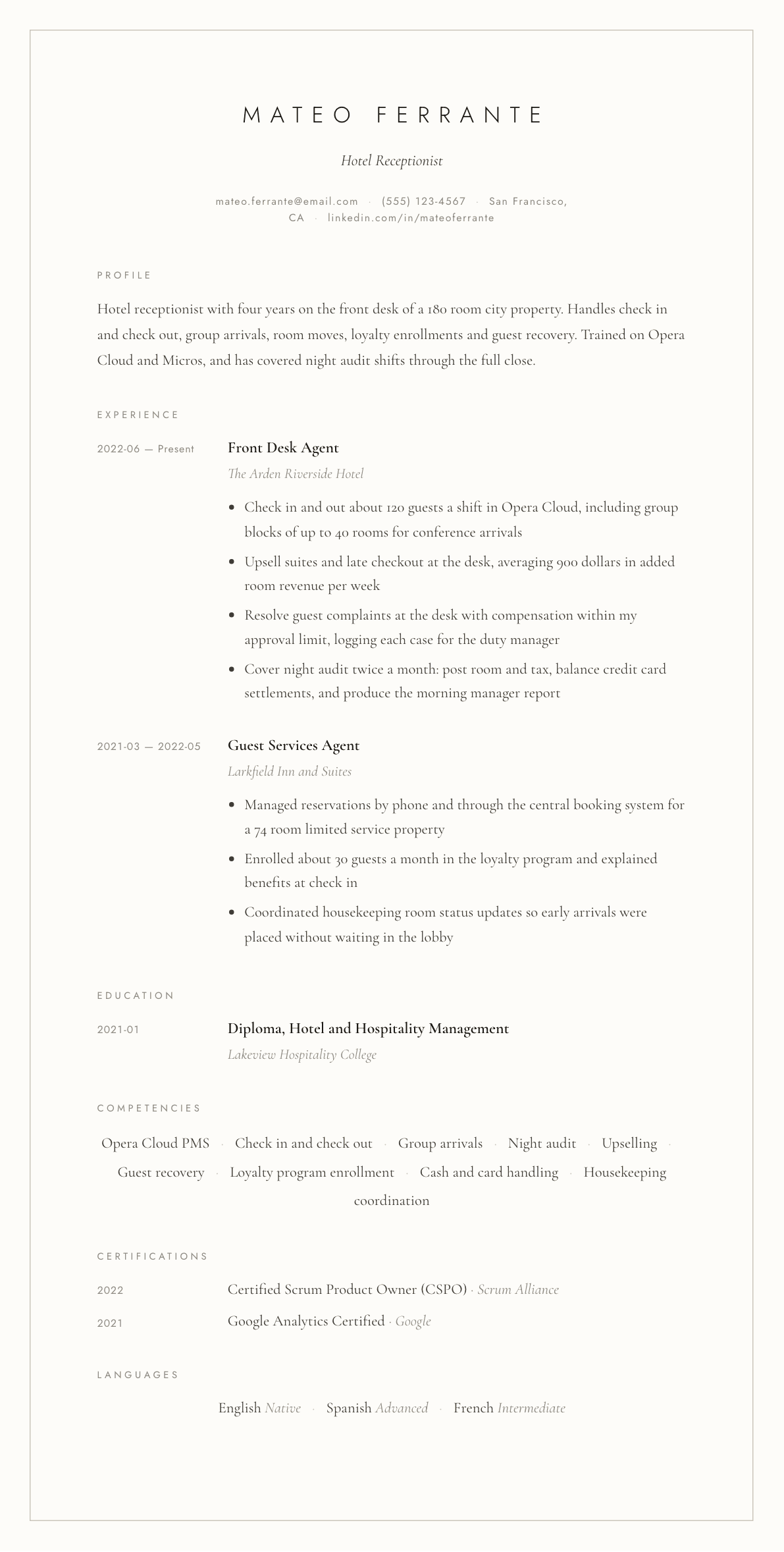
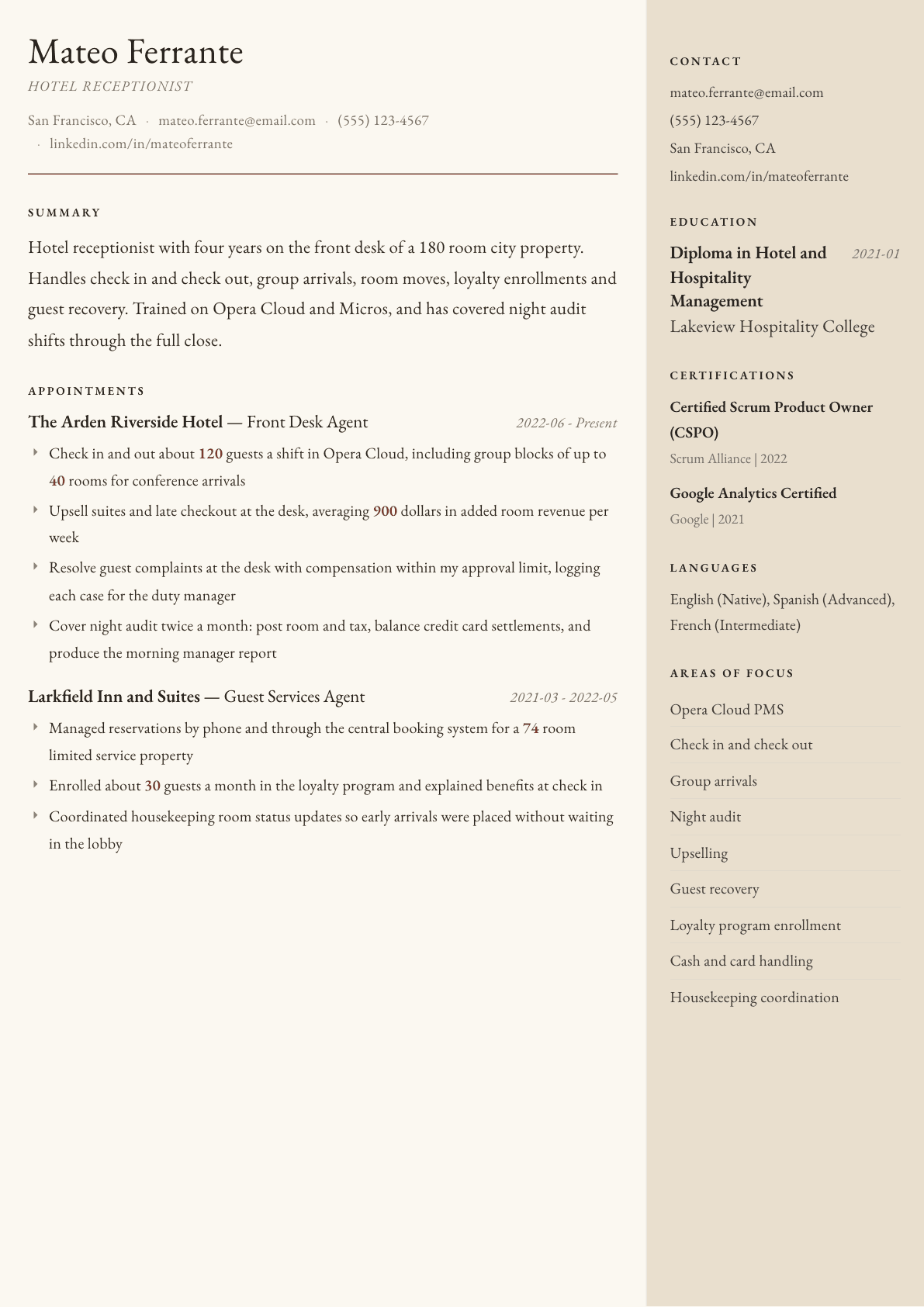
Example Hotel Receptionist summary
Hotel receptionist with four years on the front desk of a 180 room city property. Checks in about 120 guests a shift in Opera Cloud, handles conference group blocks, and upsells suites and late checkout for steady added room revenue. Covers night audit twice a month through room and tax posting and card settlement. Handles guest recovery within a set approval limit. Seeking a front office supervisor track.
Skills to list on a Hotel Receptionist resume
- Opera Cloud PMS
- Guest check in and check out
- Reservations management
- Group and block arrivals
- Night audit and daily close
- Upselling and rate offers
- Loyalty program enrollment
- Guest complaint recovery
- Cash float and card settlement
- Housekeeping status coordination
- Concierge and local recommendations
- Multi line phone handling
- Foreign language service
What actually gets this resume read
- Name the property management system, because Opera, Cloudbeds, Mews and RoomKeyPMS are the first thing a front office manager checks.
- State the property size in rooms and whether it is full service, limited service or resort, since the pace differs enormously.
- Put upselling revenue on the page if you have it, because front desk upselling is the one number the revenue manager watches.
- Mention night audit experience explicitly, as agents who can cover the overnight close are worth more to a scheduling manager.
- Show guest recovery with your approval limit and how you logged the case, rather than saying you resolved complaints professionally.
- List every language you speak with an honest level, since front desk hiring in city hotels often turns on language coverage.
How to write a hotel receptionist resume
A front office manager reads a hotel receptionist resume looking for three things she can schedule around: the property management system you know, the size and service level of the property you came from, and whether you can cover the overnight close. An agent who can run night audit is worth more to her rota than one who cannot, and most candidates never mention it.
The rest of the read is about pressure. A group of forty rooms arriving at once, a guest whose room is not ready, a card that declines at check in, and a lobby watching how you handle all three. Bullets that name the arrival volume, the block size and your compensation approval limit tell that story. Bullets that say provided excellent guest service do not.
This guide covers how to describe the property, how to present upselling revenue and loyalty enrollment, why housekeeping coordination belongs on the page, how to write the guest recovery bullet, and how language coverage is read in city hotel hiring.
Format: one page, property details in the job header
One page, plain and chronological. Hotel groups run large applicant tracking systems and brand recruiters filter on the property management system and the brand experience, so plain text and product names beat design every time.
Put the property facts in the job header line, not inside a bullet. Room count, service level and property type, such as a 180 room full service city hotel or a 74 room limited service select property, are the fastest way to communicate the pace you are used to. A resort, an airport hotel and a downtown convention property all run differently.
- Order: summary, systems, experience, education, then languages and certifications.
- Name the property management system by product for every job.
- State shift patterns you have worked, including overnight and weekend coverage.
- List every language with an honest working level.
Summary: property, system, volume, night audit
Open with years and the property. Then the system, since Opera and the cloud platforms used by independent hotels each carry their own arrival, folio and posting workflows. Then a shift volume: guests checked in and out per shift is the front desk equivalent of a workload measure.
Finish with night audit if you have covered it, because that single fact changes how a scheduling manager values you. Mention group arrivals too, since agents who have worked conference blocks handle a very different arrival pattern from those who have only checked in individual travelers.
Experience: arrivals, revenue, recovery, the overnight close
Arrival bullets should include the difficult version. Checking guests in and out is routine. Handling a conference block of up to forty rooms, coordinating with housekeeping on room status so early arrivals were placed without waiting in the lobby, and processing room moves during a full house is the work that gets you hired.
Revenue belongs on the page. Upselling suites and late checkout at the desk is one of the few directly measurable contributions a receptionist makes, and loyalty program enrollment is the other. Give the weekly or monthly figure your property tracked, and describe how you offered rather than just claiming that you upsold.
Night audit needs its own bullet with the steps: posting room and tax, balancing credit card settlements, running the daily close and producing the morning manager report. Those specifics prove you have actually done it, and a manager who is short of audit cover will read them carefully.
- Give guests checked in and out per shift, and the largest group block you handled.
- Include upsell revenue and loyalty enrollment numbers where your property tracked them.
- Describe night audit as a sequence of steps rather than as a job title.
- Show housekeeping coordination and how it affected the guest waiting in the lobby.
Guest recovery: the approval limit and the log
Complaints are the part of the job most candidates write about worst. Resolved guest complaints professionally tells a manager nothing. What she wants is your authority and your process: the compensation limit you could offer without calling anyone, what you offered, and how you logged the case so the duty manager could follow up.
A logged case is the difference between recovering a guest and hiding a problem. Saying that every recovery went into the log the duty manager reviewed shows that you understand the desk sits inside a management system, not on its own.
Languages, brand standards and cash accountability
In city hotels, language coverage at the desk is an operational requirement and often decides a shortlist. List each language with an honest level. Overstating is easy to expose in an interview conducted partly in that language.
Cash accountability and brand standards round out the page. A float you are responsible for, card settlement at the end of shift, and any brand service training you completed are all concrete. If you have worked a brand with a formal service standard or a recognition program, name the training and the issuing brand so it is checkable.
Hotel Receptionist resume summary examples
First front desk job
Hospitality management diploma holder with a year of guest services experience at a 74 room limited service property. Manages reservations by phone and through the central booking system, enrolls about 30 guests a month in the loyalty program, and coordinates housekeeping room status for early arrivals. Seeking a city hotel front desk position.
Four years in
Hotel receptionist with four years on the front desk of a 180 room city property. Checks in about 120 guests a shift in Opera Cloud, handles conference group blocks, and upsells suites and late checkout for steady added room revenue. Covers night audit twice a month through room and tax posting and card settlement.
Shift leader
Front office shift leader with eight years across full service and airport properties, now leading a team of four agents on evenings and overnights. Owns the night audit rota, the guest recovery log and arrival planning for blocks of up to 90 rooms. Trains new agents on Opera and brand service standards.
Work experience bullets: before and after
Before: Checked guests in and out at the front desk.
After: Checked in and out about 120 guests a shift in Opera Cloud, including conference group blocks of up to 40 rooms arriving within a two hour window.
Shift volume, the system and the block size show the arrival pressure you have actually worked under.
Before: Upsold rooms when possible.
After: Offered suite upgrades and late checkout at check in using a rate comparison the guest could see, adding several hundred dollars in room revenue in a typical week.
Describing the offer method alongside the revenue makes upselling a repeatable technique rather than luck.
Before: Resolved guest complaints professionally.
After: Handled guest complaints at the desk with compensation within my approval limit, then logged each case with the cause and the resolution for the duty manager to review.
Naming the authority and the log shows recovery inside a management process instead of an unverifiable claim.
Before: Did night audit shifts sometimes.
After: Covered night audit twice a month: posted room and tax, balanced credit card settlements, ran the daily close and produced the morning manager report for the front office manager.
Listing the audit steps proves you have run the close, which is the scarcest skill on a front desk rota.
Before: Worked with housekeeping about rooms.
After: Coordinated housekeeping room status updates through the shift so early arrivals were placed on ready rooms rather than waiting in the lobby during a full house.
Connecting the coordination to the guest waiting time shows why the communication mattered operationally.
Hard skills
- Opera Cloud property management system
- Guest check in and check out
- Reservations management
- Group and block arrivals
- Night audit and daily close
- Room and tax posting
- Upselling and rate offers
- Loyalty program enrollment
- Cash float and card settlement
- Housekeeping status coordination
- Multi line phone handling
- Guest complaint recovery
- Concierge and local recommendations
- Foreign language guest service
Soft skills
- Composure during a full house arrival
- Reading a guest before they complain
- Accuracy on folios at speed
- Alertness on overnight shifts
- Handover discipline between shifts
- Genuine warmth with repeat guests
Certifications worth listing
- Certified Front Desk Representative (CFDR) (American Hotel and Lodging Educational Institute)
- Certified Hospitality Supervisor (CHS) (American Hotel and Lodging Educational Institute)
- Certified Guest Service Professional (CGSP) (American Hotel and Lodging Educational Institute)
- ServSafe Food Handler (National Restaurant Association)
- First Aid and CPR certification (American Red Cross)
Mistakes that cost hotel receptionist candidates the interview
- Leaving the property management system off the page when it is the first thing a front office manager checks.
- Omitting room count and service level, so the reader cannot tell a small inn from a convention property.
- Never mentioning night audit, which is the coverage a scheduling manager struggles hardest to fill.
- Writing that you resolved complaints professionally instead of naming your approval limit and your logging habit.
- Skipping upsell revenue and loyalty enrollment, the two contributions the revenue manager can actually see.
- Overstating language ability, which is exposed within minutes in a city hotel interview.
- Treating housekeeping coordination as work for another department when it decides whether arrivals wait in the lobby.
Hotel Receptionist resume questions
How important is naming the property management system?
It is the strongest single keyword on the resume. Front office managers filter on it because system familiarity cuts training time on a busy desk. Name every platform you have used and mention the modules, such as reservations, folios and the daily close.
Should I mention night audit if I only covered it occasionally?
Yes, and say how often. Occasional audit cover is still valuable to a manager building a rota, and describing the close steps you performed proves the experience is real rather than a shift you observed once.
How do I show upselling if my hotel did not track it?
Describe the technique and the offer points instead of inventing a figure. Naming when you offered upgrades, how you presented the rate difference, and which room types you moved gives a revenue focused manager enough to judge you on.
Does hospitality experience outside hotels count?
Restaurant, cruise, airline and events work all transfer when you translate the vocabulary toward arrivals, folios and room status. Add any property management system exposure you have, since that is the specific gap a hotel manager worries about.
How do I get promoted from front desk agent to supervisor?
Build the bullets a supervisor is judged on: night audit cover, group arrival planning, training new agents, and owning the guest recovery log. Then add a recognized hospitality supervisory credential, which gives the promotion decision something formal to rest on.
Related resume examples
- Receptionist Resume example
- Front Office Manager Resume example
- Front Desk Receptionist Resume example
- Reservation Agent Resume example
- Medical Receptionist Resume example
- Medical Front Desk Resume example