Organizational Development Consultant Resume Examples
Build an OD Consultant Resume That Demonstrates Transformation Impact
By Mustafa Tarabya, founder of CVBooster · Published · Updated
Create a compelling Organizational Development Consultant resume showcasing change management expertise, culture transformation, and measurable organizational improvements.
Sample resumes for a organizational development consultant
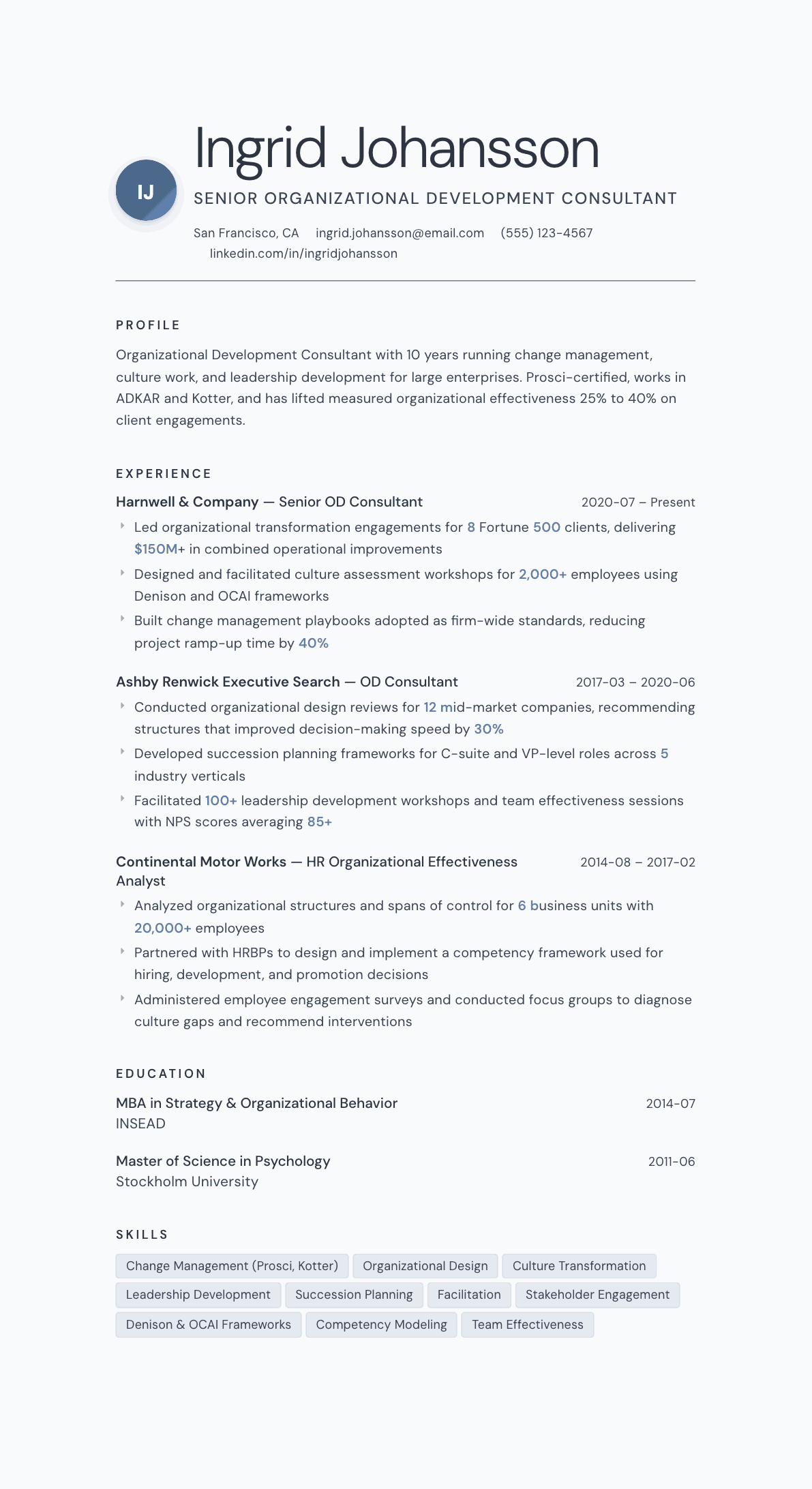
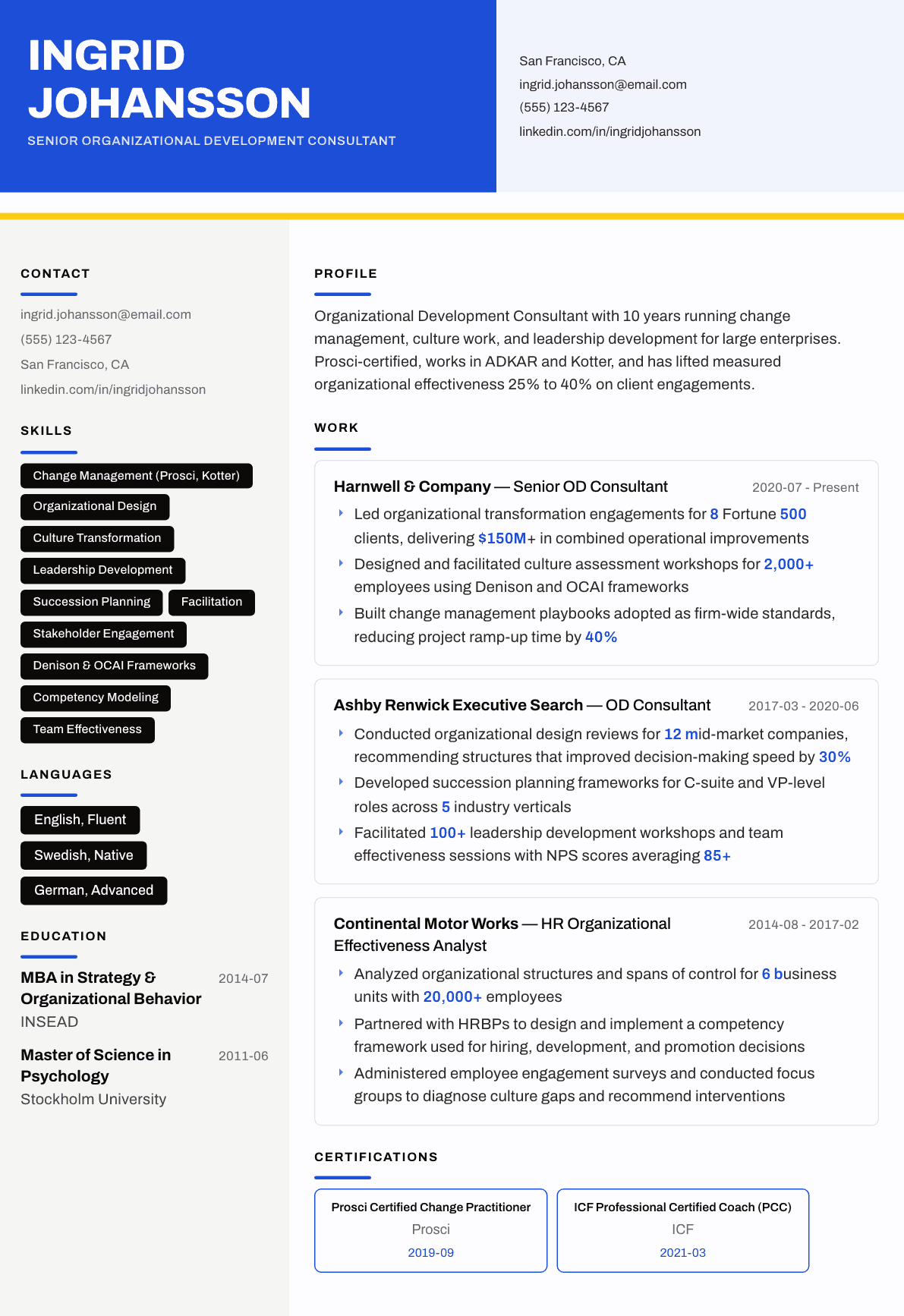
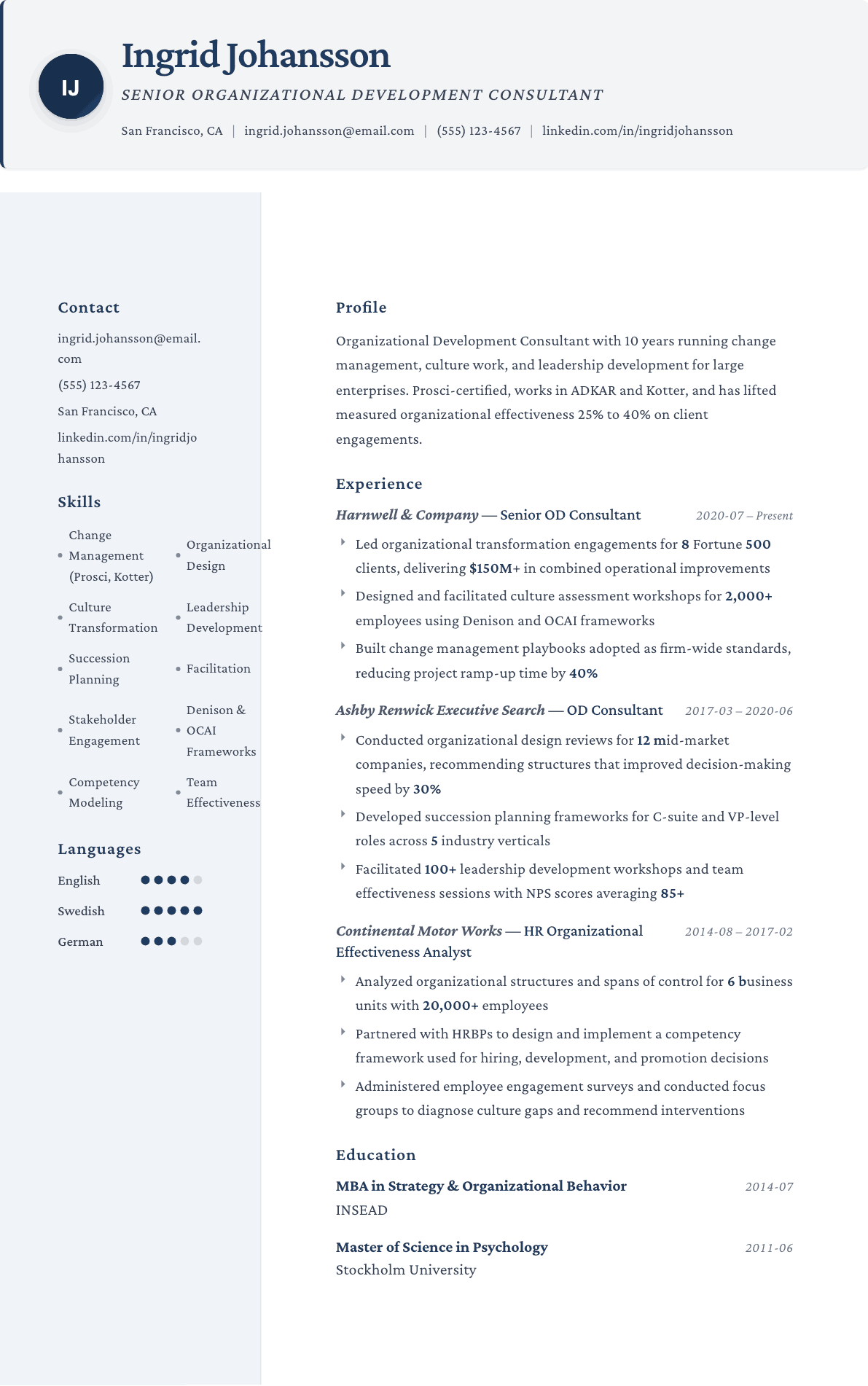
The same organizational development consultant content laid out in three CVBooster templates, so you can see what the finished document looks like before you write a word.
Example Organizational Development Consultant summary
Organizational Development Consultant, 10 years of transformation work with large enterprises. Runs Prosci change programs, culture assessments, and org design reviews, and has delivered $150M in combined operational improvement. ICF PCC coach.
Skills to list on a Organizational Development Consultant resume
- Change Management
- Organizational Design
- Culture Transformation
- Leadership Development
- Succession Planning
- Facilitation & Workshop Design
- Stakeholder Management
- Executive Coaching
- Competency Modeling
- Team Effectiveness
- Engagement Surveys
- Prosci ADKAR
- Strategic Planning
- Process Improvement
What actually gets this resume read
- Frame your impact in business terms: revenue growth, cost savings, and operational efficiency gains tied to OD interventions.
- Highlight specific methodologies (Prosci ADKAR, Kotter, Bridges, Lewin) and assessment tools (Denison, OCAI, Gallup Q12).
- Showcase large-scale transformation experience with scope metrics: employees affected, departments involved, and timelines.
- Include executive coaching and facilitation credentials to demonstrate senior stakeholder influence.
- Describe culture assessment and diagnosis work with measurable before-and-after outcomes.
- Mention published thought leadership, conference presentations, or internal playbooks that demonstrate subject matter expertise.
How to write a organizational development consultant resume
Organizational development is a field where everyone sounds impressive and very few resumes are specific. The reader, usually a head of talent or a consulting partner, has seen dozens of files promising culture transformation and organizational effectiveness. What they are actually hunting for is method plus evidence: a diagnostic you ran, an intervention you designed off the back of it, and a measured state afterward that is not just a survey score.
The other thing that separates a strong OD file is the ability to name the unit of change. Consultants who write about transforming a company are hard to believe. Consultants who write that they redesigned a 900-person operations function into five regional teams, moved two layers of management out, and held attrition steady through the transition are believable immediately, because the sentence contains a real structure.
This guide covers how to structure an OD consultant resume for internal and external roles, three summaries at different levels of seniority, five rewritten bullets, the credentials that carry weight in this field, and the questions consultants ask when they need to prove influence without owning headcount.
Format: engagements as the unit, methods stated openly
Two pages. Structure the experience as engagements rather than as duties, because that is how the work is bought and sold. Each engagement needs a client or business unit, the presenting problem, the population affected, your role, the method you applied, and the result. Four well-described engagements beat twenty lines of activity.
Name your methods where they belong, inside the engagement rather than in a floating skills list. A change model applied to a system implementation reads as practice; the same model listed alone reads as a course you attended. If you work as an external consultant, add a short client sector line, since sector experience is often the first filter a partner applies.
- Engagement header: sector or business unit, population affected, and the duration.
- Method: the change framework, the diagnostic instrument, and the workshop design used.
- Your role: lead consultant, facilitator, designer, or member of a larger team, stated honestly.
- Outcome: the measured state after, with the baseline you started from.
Summary: the kind of change you do, and at what scale
OD covers structural work, cultural work, leadership capability work and team effectiveness work, and consultants usually specialize even when they claim not to. State your center of gravity in the first sentence, then the scale you operate at, then one engagement worth naming.
Avoid the abstraction trap. Phrases like driving organizational excellence and enabling high performing cultures are the wallpaper of this profession and they carry no information. Replace them with the actual work: organizational design, culture diagnosis, change adoption, leadership assessment, or team intervention.
Diagnosis: show that you measure before you intervene
The credibility of an OD consultant rests on diagnosis. Say what instruments you use and how you interpret them. Culture assessment tools, engagement instruments, structured leader interviews, focus groups, network analysis, and performance data review are all legitimate. Naming the instrument tells the reader you have a repeatable method rather than a strong opinion.
Then show the link between diagnosis and design. The reason many OD resumes read as vague is that the intervention appears without a cause. When a workshop series, a role redesign or a leadership program is written as the answer to something the diagnosis surfaced, the whole file becomes concrete.
Change management: framework, adoption, and resistance
Change work is bought on adoption, not on plans. State the framework you use, then the artifacts you produced with it: stakeholder maps, impact assessments, sponsor coalitions, communication plans, readiness surveys and reinforcement mechanisms. Then state adoption evidence, such as usage of a new system, compliance with a new process, or the reduction in support escalations after go-live.
Write about resistance directly. Every real change program meets it, and a consultant who describes how they surfaced and worked with resistance among a specific group, such as middle managers losing scope, is more convincing than one whose programs all appear to have gone smoothly.
- Sponsorship: which executives you coached, and how visible their involvement became.
- Middle management: the mechanism used to bring supervisors along, since this is where change usually stalls.
- Adoption measurement: what you counted, when you counted it, and what you did with a poor early reading.
- Reinforcement: what kept the change in place after the project team left.
Facilitation, coaching, and the keywords a screener searches
Facilitation is a core deliverable here, so give it scale and difficulty: workshop counts, participant numbers, whether sessions were executive or frontline, and any multi-day offsite design you owned. Executive coaching should say how many leaders, at what level, over what period, and against which assessment or feedback input.
The vocabulary that recruiters and search tools use in this field is stable: change management, organizational design, culture transformation, leadership development, succession planning, facilitation and workshop design, stakeholder management, executive coaching, competency modeling, team effectiveness, engagement surveys and strategic planning. Use them precisely, attached to work you did rather than as a block.
Organizational Development Consultant resume summary examples
OD analyst moving into consulting
Organizational development professional with 3 years supporting culture and engagement work inside a 2,000-person employer. Runs survey administration and analysis, facilitates action planning sessions with department leaders, and supports competency model updates across four job families.
Six years in
Organizational Development Consultant with 6 years leading change and culture engagements across financial services and healthcare. Prosci certified, experienced with Denison and OCAI culture assessments, and led a restructuring of a 900-person operations function that held attrition steady through transition.
Senior consultant
Senior Organizational Development Consultant with 10 years driving transformation across large enterprises. Certified in Prosci ADKAR and trained in Kotter methods, facilitated culture assessment workshops for 2,000 employees, and built change playbooks adopted as firm-wide standards across eight client engagements.
Work experience bullets: before and after
Before: Led culture transformation initiatives for clients.
After: Diagnosed culture across a 4,000-person division using the Denison survey and 30 leader interviews, then designed a two-year intervention covering leader behaviors, meeting practice and recognition, with pulse remeasurement each quarter.
The instrument, the interview count and the remeasurement rhythm turn an abstract claim into a method a client could buy.
Before: Managed change management for a system rollout.
After: Ran change management for an enterprise system rollout affecting 3,000 users: built the stakeholder impact assessment, coached nine executive sponsors, trained 120 local champions, and tracked adoption weekly through the first quarter after go-live.
Naming the sponsor coaching, the champion network and the adoption tracking shows the parts of change work that actually determine success.
Before: Facilitated workshops for leadership teams.
After: Designed and facilitated 24 leadership offsites of one to three days for executive and director teams, covering strategy alignment, team effectiveness and conflict repair, including two sessions with teams in open disagreement.
Volume, duration, audience level and the difficult case make facilitation a demonstrated skill rather than a claim.
Before: Helped redesign the organizational structure.
After: Redesigned a 900-person operations function from twelve country teams into five regional units, removing two management layers, rewriting 40 role profiles and running a placement process that redeployed 85% of affected managers.
The before and after structure and the redeployment figure make organizational design work concrete and defensible.
Before: Built competency models and succession plans.
After: Built a competency model for 6 leadership levels validated through interviews with 25 senior leaders, then used it to run a succession review that produced ready-now candidates for 18 of 22 critical roles.
Validation method and succession coverage show a model that was used rather than a document that was written.
Hard skills
- Organizational design and role architecture
- Change management (Prosci ADKAR, Kotter)
- Culture assessment and diagnosis
- Engagement survey design and analysis
- Competency modeling
- Succession planning and talent review
- Workshop and offsite design
- Executive coaching
- Team effectiveness interventions
- Stakeholder and impact assessment
- Leadership assessment instruments
- Strategic planning facilitation
Soft skills
- Diagnostic listening
- Executive credibility
- Handling resistance
- Neutrality in conflict
- Storytelling with data
- Contracting expectations with sponsors
Certifications worth listing
- Prosci Change Management Certification (Prosci)
- Certified Change Management Professional (CCMP) (Association of Change Management Professionals)
- Professional Certified Coach (PCC) (International Coaching Federation)
- Hogan Assessment Certification (Hogan Assessments)
- SHRM Senior Certified Professional (SHRM-SCP) (Society for Human Resource Management)
- Certified Professional in Talent Development (CPTD) (ATD Certification Institute)
Mistakes that cost organizational development consultant candidates the interview
- Writing in abstractions such as driving organizational excellence, which every competing file also claims.
- Presenting interventions with no diagnosis behind them, which makes the work look like a preference rather than a method.
- Claiming transformation of an entire company instead of naming the function, population and structure that changed.
- Leaving out adoption evidence after a change program, so the reader only sees the plan and never the result.
- Listing frameworks in a skills block without a single engagement showing one applied.
- Overstating your role on a large engagement, which collapses quickly when a client-side interviewer asks who ran which workstream.
Organizational Development Consultant resume questions
How do I show impact when I do not own the outcome?
Report the measure the client agreed to before the work began, along with your specific contribution. Adoption rates, survey movement, retention through a transition and completed structural changes are all attributable to the engagement without claiming you personally delivered the business result.
Does an internal OD role need a different resume than external consulting?
The evidence is the same but the framing differs. Internal roles want sustained partnership with named functions and long-run measures, while consulting roles want engagement variety, sector coverage and the ability to enter a client cold and diagnose quickly.
Which change management certification is worth listing?
Prosci is the most widely recognized by client organizations and is often named in postings. A CCMP credential and coaching certification through a recognized coaching body also carry weight. List training you have genuinely applied, since interviewers ask for an example immediately.
How do I write about culture work without sounding vague?
Anchor it in an instrument and a behavior. Name the assessment you used, the specific behaviors you targeted, the mechanisms you changed such as meeting practice, recognition or promotion criteria, and the remeasurement you ran afterward.
Should I list client names on an OD consultant resume?
Only when your agreements allow it. Otherwise describe clients by sector, size and situation, which conveys nearly the same information. Fabricating recognizable logos or implying access you did not have is the fastest way to lose credibility in a reference check.
Related resume examples
- HR Business Partner Resume example
- Learning & Development Manager Resume example
- Chief People Officer Resume example
- Employee Engagement Manager Resume example
- Chief Human Resources Officer Resume example
- Talent Development Manager Resume example