Talent Development Manager Resume Examples: free score
Write a Talent Development Manager Resume That Connects to Succession
By Mustafa Tarabya, founder of CVBooster · Published · Updated
Build a talent development manager resume with a worked example, the succession and mobility detail HR leaders check, keywords and a full guide.
Sample resumes for a talent development manager
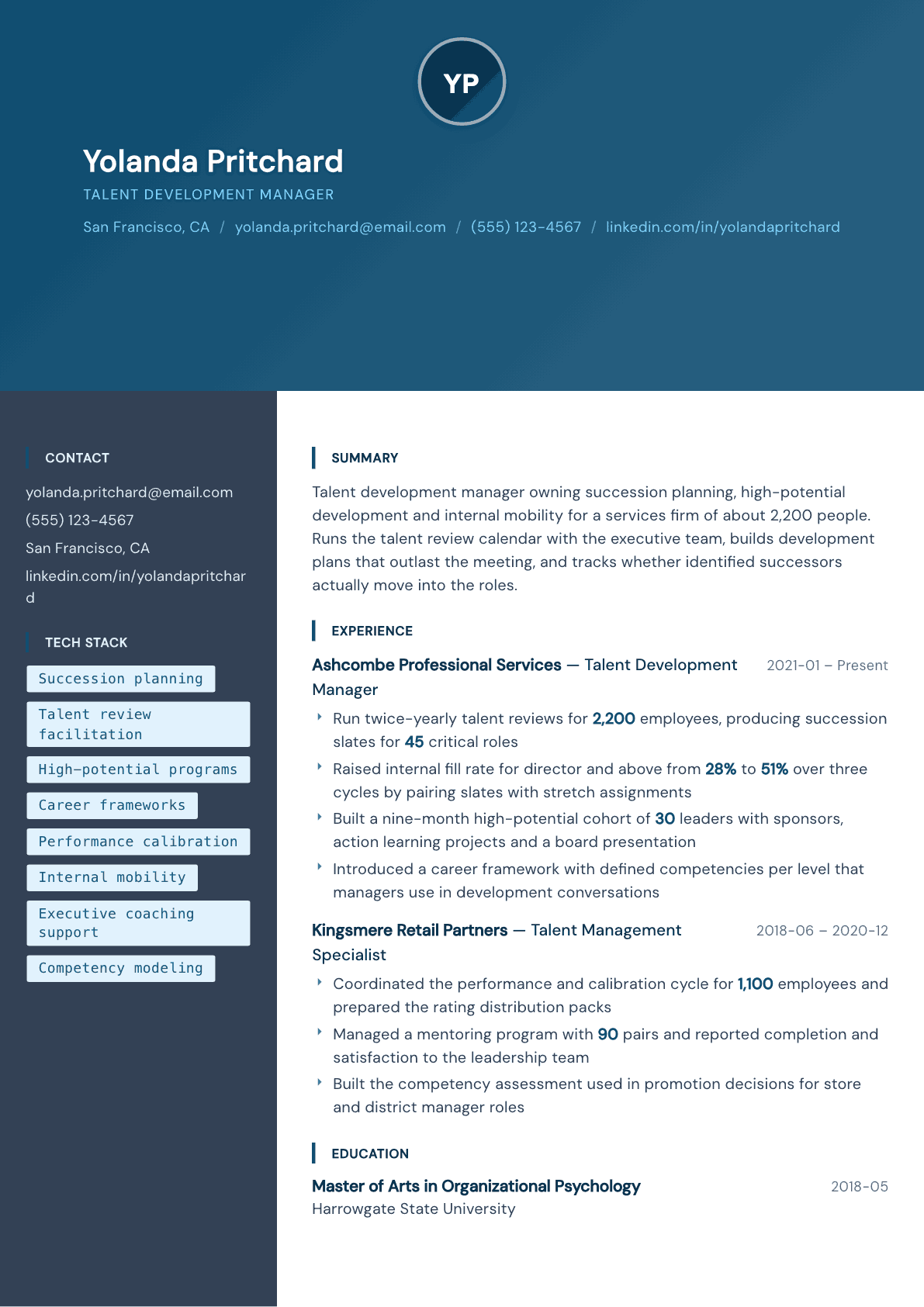
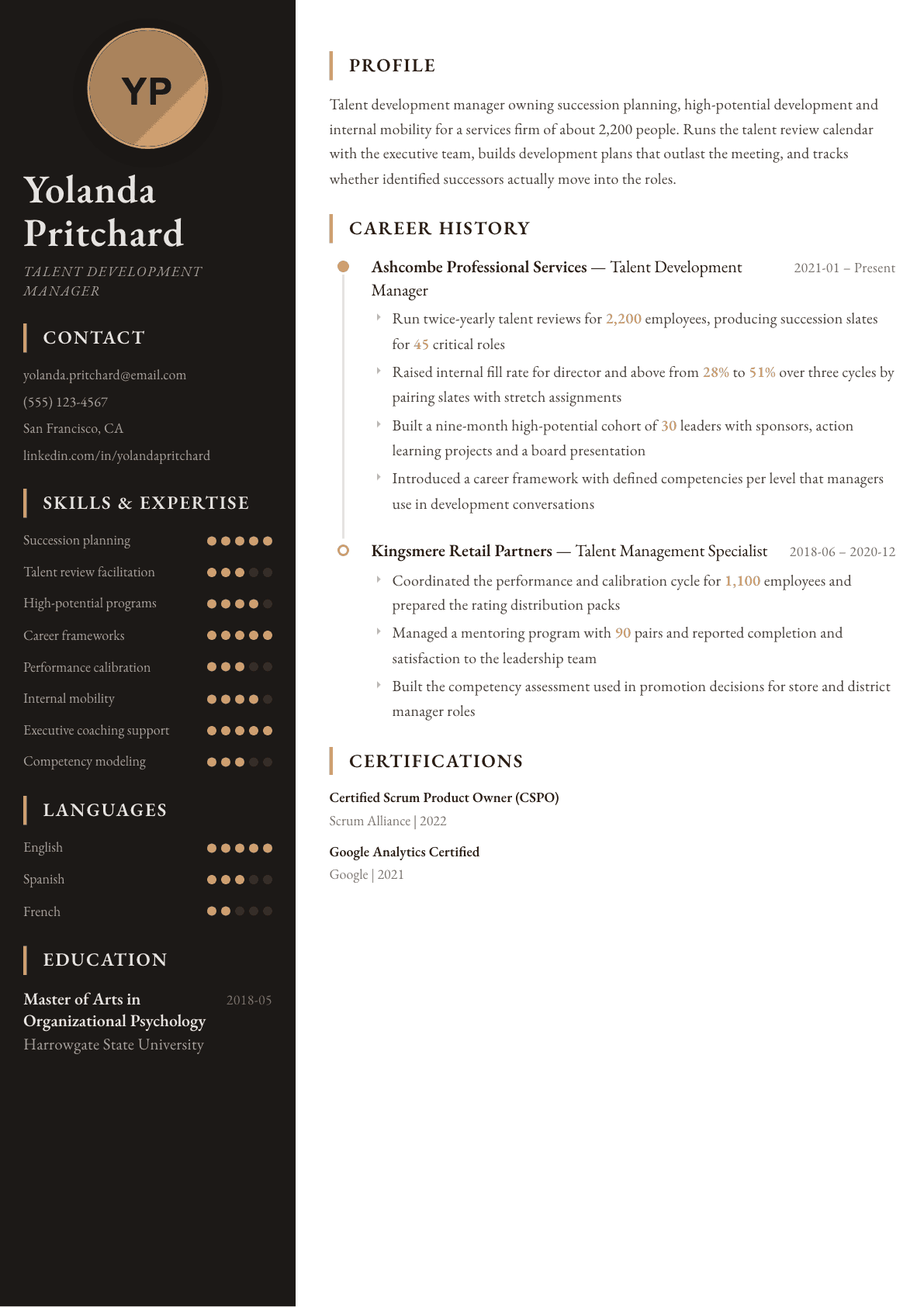
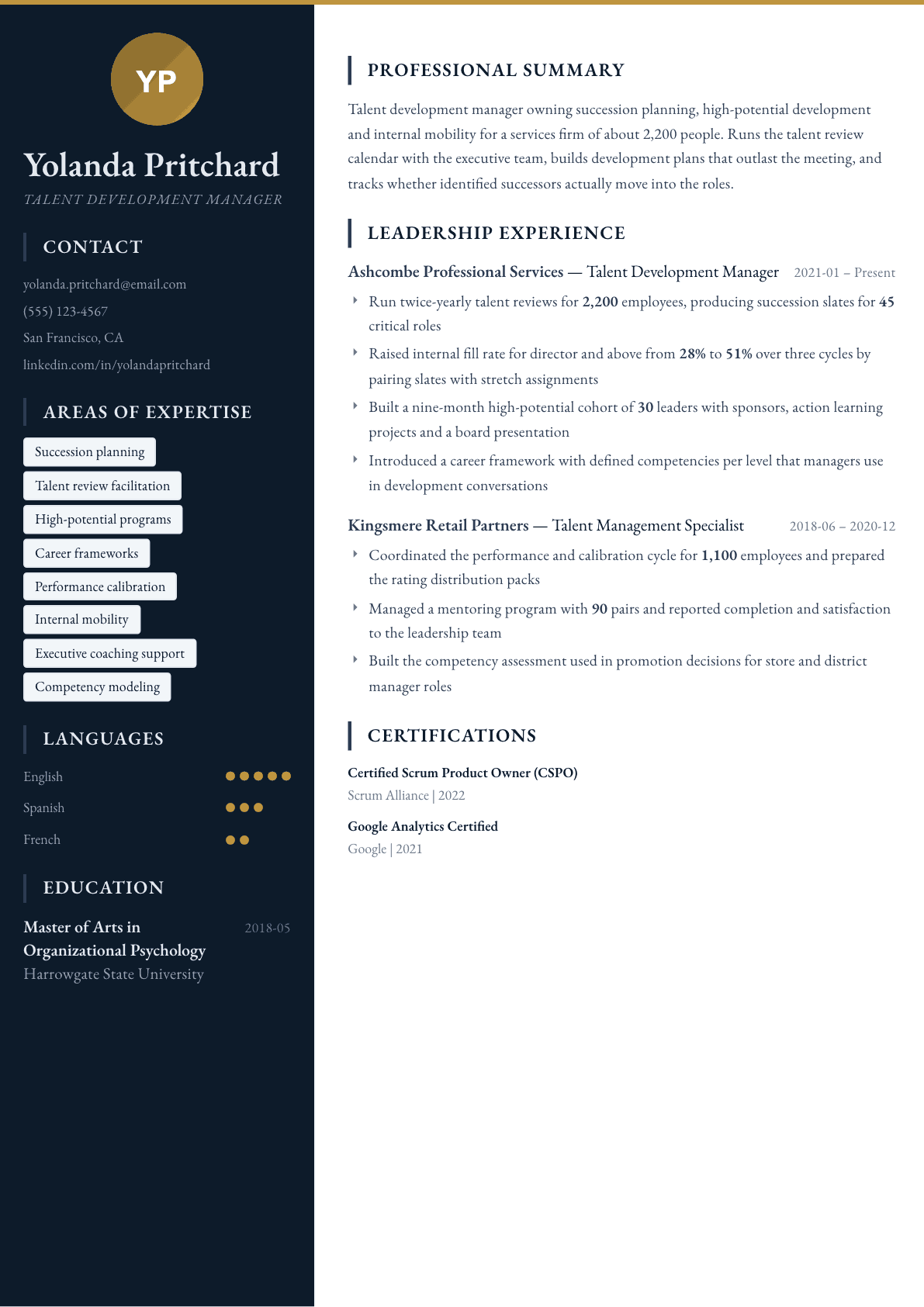
The same talent development manager content laid out in three CVBooster templates, so you can see what the finished document looks like before you write a word.
Example Talent Development Manager summary
Talent development manager owning succession, high-potential development and internal mobility for a services firm of more than two thousand people. Runs twice-yearly talent reviews that produce succession slates for forty-five critical roles, then pairs each slate with stretch assignments and sponsors. Doubled the internal fill rate for director-level openings across three review cycles.
Skills to list on a Talent Development Manager resume
- Succession planning
- Talent review facilitation
- High-potential development
- Career and competency frameworks
- Internal mobility
- Performance calibration
- Nine-box assessment
- Mentoring program design
- Leadership assessment
- Coaching program management
- Workday Talent
- Action learning design
- Executive stakeholder management
- Talent analytics
What actually gets this resume read
- Put succession and mobility numbers first, such as critical roles with ready successors and the internal fill rate.
- Describe the talent review you ran, including who sat in the room and what the meeting produced on paper.
- Show the development mechanism behind a program: sponsors, stretch assignments, coaching or action learning.
- Name the assessments you are qualified to use and the platform where talent profiles and plans were stored.
- Connect performance calibration work to development, since the two cycles are usually managed together.
- Track outcomes over more than one cycle, because succession credibility comes from placements, not slates.
How to write a talent development manager resume
Talent development sits closer to the executive table than most HR roles, because its subject is who runs the company next. The reader of your resume wants to know whether your talent reviews produced anything durable: named successors who were actually ready, development that happened after the meeting, and roles filled from inside instead of from a search firm.
The weak version of this resume is a list of ceremonies. Ran the talent review. Managed the nine box. Coordinated the mentoring program. None of that says whether a single person moved. The strong version follows people through cycles and reports what happened to them.
This guide covers the structure the role expects, three summaries by stage, before-and-after bullets from succession and development work, credentials worth listing, and the questions candidates ask when writing about confidential talent decisions.
Format: two pages, with population and governance stated up front
Reverse chronological, two pages once you have run multiple review cycles. Under each employer give the population covered, how many critical roles were in scope, the review cadence, the executive forum you facilitated, and the systems where talent profiles and plans lived. That line establishes altitude immediately.
Keep the layout restrained. Your resume is a proxy for the talent review pack you would build, and dense graphics suggest a candidate who decorates data rather than clarifies it.
- Header: name, city and state, phone, email, and credentials such as SHRM-SCP or an accredited assessment qualification.
- Order: summary, experience, education, certifications and assessment qualifications, systems.
- Name the assessment instruments you are qualified to administer, since that is a hard filter on many postings.
Summary: population, critical roles, cadence, and a placement number
State the headcount and the number of critical roles you cover, the review rhythm, and then one outcome that involves people moving: internal fill rate, ready-now successor coverage, or promotion rate out of a development cohort. Placement evidence is the currency of this discipline.
If you also own performance, engagement or learning, mention it in a short clause. Many talent development managers carry more than one process, and a reader planning a small team wants to know how much of the cycle you can hold.
Succession: slates are the output, placements are the proof
Describe the review process you run: how critical roles are identified, how candidates are assessed against them, how readiness is defined, how disagreement between leaders is resolved in the room, and what the pack looks like when it goes to the executive team or the board.
Then follow through. Successor coverage for critical roles, how many identified successors were placed, how many left, and what you changed when a slate proved thin. A manager who reports the failures alongside the fills is far more credible than one who reports only slates produced.
Development: the mechanism after the meeting
Show the machinery that turns a talent review into growth: stretch assignments with a named sponsor, cross-functional projects with a real deliverable, coaching engagements, cohort programs with a defined duration, and mentoring pairs with a scope and an end date. Say who held people accountable for the plan and how often it was reviewed.
Cohort work needs numbers and design. Cohort size, selection criteria, program length, what participants produced, and where they are now. A high-potential program is only convincing when the resume shows what happened to the participants after it ended.
Frameworks, data and the keywords
Career and competency frameworks are the infrastructure this role builds: levels, competencies per level, the promotion criteria managers use, and the career paths employees can actually see. Say how many roles you covered and how managers were trained to use it in development conversations.
Add the data side: readiness reporting, mobility rates, promotion equity checks, retention of identified talent, and the platform where it all sits. Keywords that appear in postings include succession planning, talent review, high potential development, internal mobility, career framework, competency model, performance calibration, leadership assessment and talent analytics.
Talent Development Manager resume summary examples
Talent management specialist
Talent management specialist coordinating the performance and calibration cycle for 1,100 employees and preparing rating distribution packs for leadership. Managed a mentoring program of 90 pairs and built the competency assessment used in promotion decisions for store and district manager roles.
Running talent reviews
Talent development manager running twice-yearly reviews for 2,200 employees and producing succession slates for 45 critical roles. Raised the internal fill rate for director and above from 28% to 51% over three cycles by pairing every slate with a sponsored stretch assignment.
Enterprise talent lead
Enterprise talent development leader for a 8K-employee group across four business units, with two specialists reporting in. Owns succession for the executive population, the career framework, and a nine-month high-potential cohort whose participants supply most senior internal placements.
Work experience bullets: before and after
Before: Managed the succession planning process.
After: Run twice-yearly talent reviews for 2,200 employees, producing succession slates for 45 critical roles with defined readiness levels and a written development plan behind each name.
Cadence, population, role count and the deliverable turn a process claim into a described operating cycle.
Before: Improved internal promotion rates.
After: Raised the internal fill rate for director and above from 28% to 51% across three review cycles by pairing each successor with a sponsor and a stretch assignment.
A multi-cycle movement plus the mechanism proves the succession work produced placements, not paperwork.
Before: Ran a high potential program.
After: Designed a nine-month cohort of 30 leaders with executive sponsors, action learning projects and a final board presentation; two thirds have since moved into larger roles.
Program design detail and participant outcomes answer the question every reader has about cohort programs.
Before: Created a career framework.
After: Built a career framework with competencies defined at each level, trained 120 managers to use it in development conversations, and tied promotion criteria to it.
Adoption work and the link to promotion decisions show a framework people use rather than a document that exists.
Before: Supported the performance review process.
After: Facilitate calibration sessions for 1,100 employees, prepare distribution and consistency analysis for each leader, and feed the outputs directly into talent review inputs.
Connecting calibration to succession shows the two cycles running as one system, which is how the role is scoped.
Hard skills
- Succession planning
- Talent review facilitation
- High-potential program design
- Career and competency frameworks
- Internal mobility strategy
- Performance calibration
- Leadership assessment
- Coaching and mentoring program management
- Action learning design
- Workday Talent
- Talent analytics and readiness reporting
- Organizational design support
Soft skills
- Executive facilitation
- Confidential judgment
- Candid feedback to leaders
- Influence without authority
- Long-horizon follow-through
- Coaching
Certifications worth listing
- SHRM Senior Certified Professional (SHRM-SCP) (Society for Human Resource Management)
- Senior Professional in Human Resources (SPHR) (HR Certification Institute)
- Certified Professional in Talent Development (CPTD) (Association for Talent Development)
- Hogan Assessment Certification (Hogan Assessment Systems)
- Associate Certified Coach (ACC) (International Coaching Federation)
Mistakes that cost talent development manager candidates the interview
- Describing the talent review as a meeting you coordinated instead of a decision forum you facilitated.
- Producing slates with no placement data, which leaves a reader unable to tell whether succession worked.
- Naming a high-potential program without cohort size, selection criteria or where participants ended up.
- Publishing internal names or ratings, which is a serious confidentiality failure in a role built on trust.
- Treating a career framework as a document delivered rather than a tool managers were trained to use.
- Reporting only one cycle, when credibility in this discipline comes from what held up over several.
Talent Development Manager resume questions
How is talent development different from learning and development?
Learning builds capability across a population through courses and curricula. Talent development targets specific people against specific future roles, using succession slates, assessment, stretch assignments and sponsorship. Write to whichever the posting describes, since the metrics differ completely.
What metrics prove succession planning worked?
Ready-now coverage for critical roles, internal fill rate at the levels you cover, retention of identified successors, and time to fill for senior openings. Track them across at least two cycles, because a single snapshot says nothing about durability.
How do I write about talent decisions confidentially?
Stay at the level of process, scope and aggregate outcome. Describe how many roles were in scope, how readiness was defined and what share of slates produced placements. Never name individuals, ratings or the specific roles a person was slated for.
Do I need an assessment qualification?
It is not universal, but it helps when the role includes leadership assessment or coaching. Certification in an established instrument shows you can interpret results responsibly rather than hand a report to a manager and hope it is read well.
How do I get from HR generalist into talent development?
Lead with the talent work already in your history: calibration sessions you facilitated, development plans you built with managers, internal moves you brokered and promotion criteria you helped define. Then take on the talent review preparation for your client group before you apply.
Related resume examples
- Organizational Development Consultant Resume example
- Human Resources Resume example
- Learning and Development Specialist Resume example
- Employee Engagement Manager Resume example
- HR Director Resume example
- HR Business Partner Resume example