HR Coordinator Resume Examples: the lines they read
HR Coordinator Resume: Human Resources Coordinator Examples
By Mustafa Tarabya, founder of CVBooster · Published · Updated
Human resources coordinator resume examples and samples for career changers, working coordinators and generalist candidates, with bullets and HRIS keywords.
Sample resumes for a hr coordinator
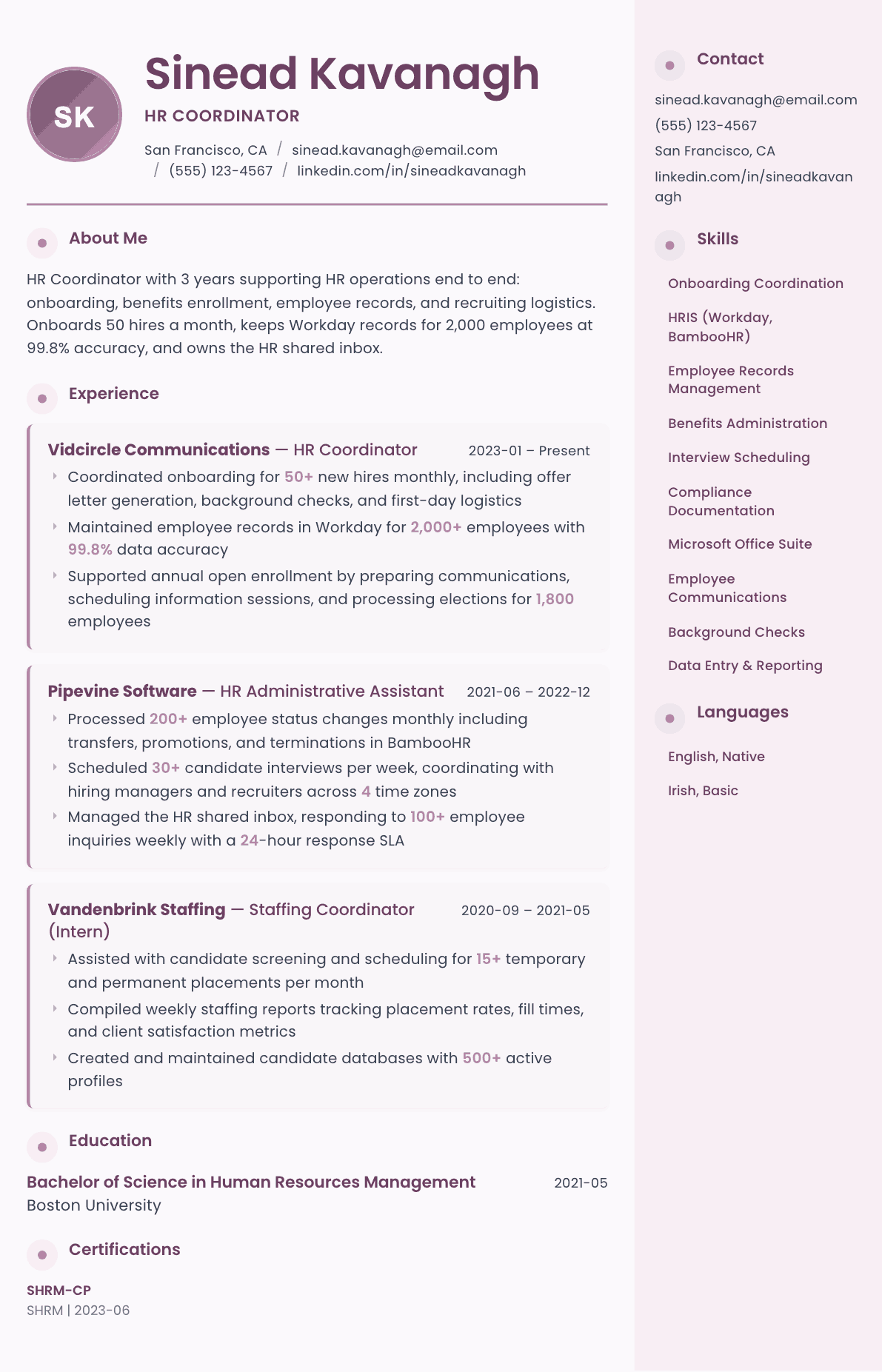
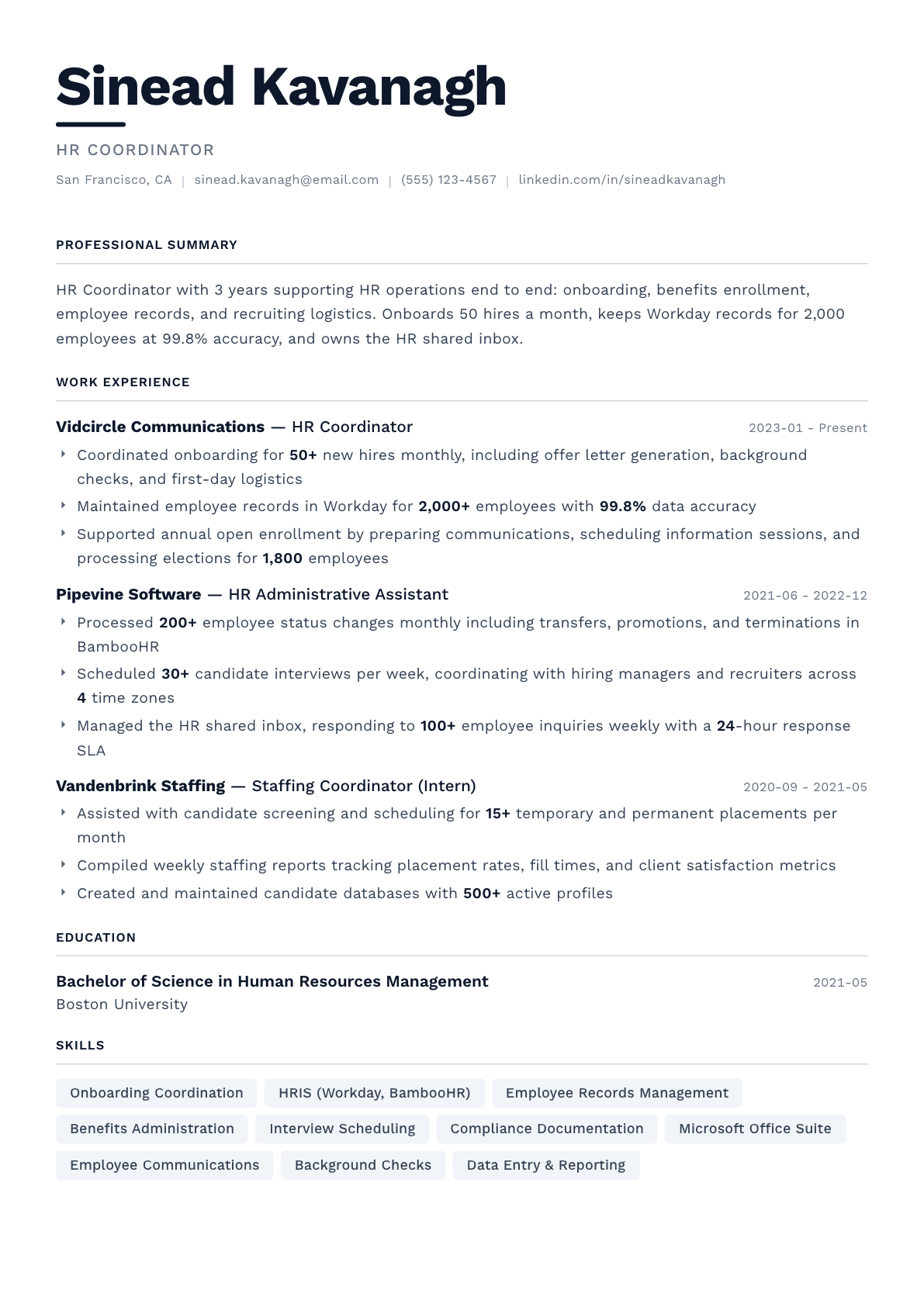
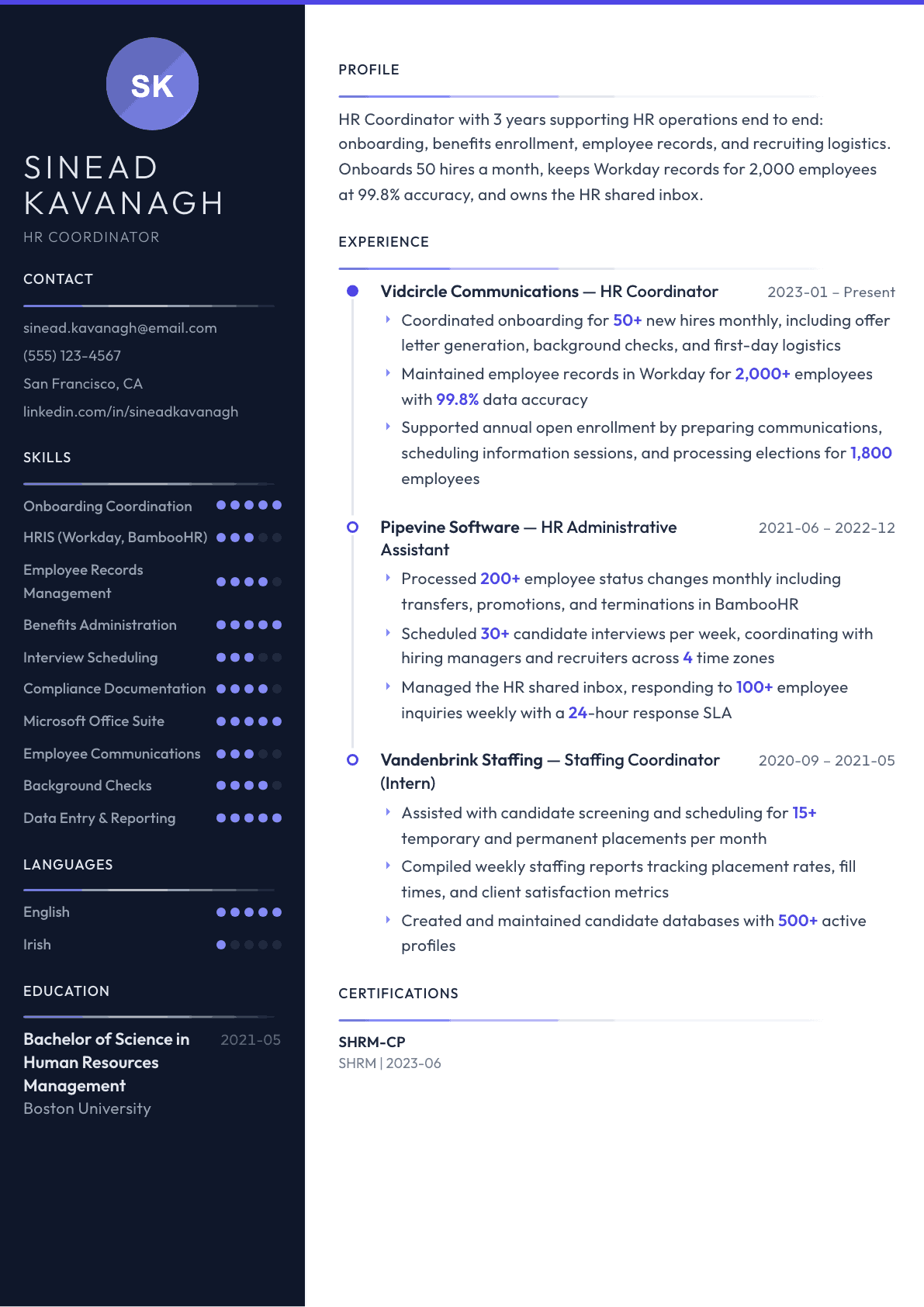
The same hr coordinator content laid out in three CVBooster templates, so you can see what the finished document looks like before you write a word.
Example HR Coordinator summary
HR Coordinator, 3 years supporting HR operations at growing technology companies. Onboards 50 hires a month, holds 99.8% data accuracy in Workday, and ran open enrollment support for 1,800 employees. SHRM-CP certified, ready to step into an HR generalist role.
Skills to list on a HR Coordinator resume
- Onboarding Coordination
- HRIS Data Entry
- Employee Records Management
- Benefits Enrollment Support
- Interview Scheduling
- Compliance Documentation
- Background Checks
- I-9 & E-Verify
- Microsoft Office Suite
- Employee Communication
- Report Generation
- Filing & Organization
- Calendar Management
- Payroll Support
What actually gets this resume read
- Quantify your administrative impact: number of new hires onboarded, employee inquiries resolved, records maintained, and data accuracy rates.
- Highlight HRIS experience with specific platforms (Workday, BambooHR, ADP, UKG) to demonstrate technical readiness.
- Showcase process improvement contributions even at the coordinator level, such as SLA improvements or template standardization.
- Include compliance and documentation skills relevant to I-9, E-Verify, and employee file management.
- Demonstrate strong communication skills through examples of employee-facing interactions and internal HR campaigns.
How to write a hr coordinator resume
The HR coordinator resume is screened by an HR team reading its own kind of resume, which makes it a harder audience than most. They know exactly how long an offer letter takes to generate, how messy an I-9 audit gets, and how much of the job is chasing a hiring manager for interview availability. They can tell within a paragraph whether you have actually run an onboarding week or only watched someone else run it.
What they are screening for is throughput and accuracy. A coordinator is the operational floor of the people function: new hires per month, tickets closed, records touched, enrollment elections processed, background checks cleared. Name the HRIS by product, name the volume, and name the error rate you held, because those three numbers are the ones a people operations manager uses to decide whether you can carry the queue alone.
This guide covers the section order that works for an early-career HR file, three summary examples from first HR job to senior coordinator, five before-and-after bullets built from real coordinator work, and the questions coordinators ask most when they try to make administrative work read as impact.
Format: one page, single column, HRIS named in the header area
Keep it to one page. A coordinator resume that runs to two pages is usually padding out task lists, and an HR reader spots that instantly because they wrote those task lists themselves. Reverse chronological, plain single column, no icons and no skill rating bars. You are applying to a team that runs an applicant tracking system and knows how badly it parses graphics.
Put a short technical line directly under the summary listing your systems: the HRIS, the ATS, the payroll platform and the ticketing tool. Recruiters filter coordinator applications on the platform name more than on anything else, because a Workday shop wants someone who already knows what a business process transaction looks like.
- Header: name, city and state, phone, email, and any HR credential such as SHRM-CP or aPHR.
- Order: summary, systems line, experience, education, skills, certifications.
- Career changers coming from admin or customer support should keep the same order and reframe the bullets around employee-facing service volume.
Summary: volume, systems, and the part of the employee lifecycle you own
Three lines. Say how many employees the HR team supports, which parts of the lifecycle you personally handle, and the systems you handle them in. A coordinator supporting a two hundred person startup and a coordinator supporting a multi-site company with union sites are doing different jobs, and the reader cannot guess which one you are without the headcount.
Avoid opening with adjectives. Organized, detail oriented and proactive appear on nearly every coordinator resume submitted, which means they carry no signal at all. Replace them with the concrete scope: onboarding, benefits enrollment support, records, and recruitment coordination.
Experience: turn tasks into cycles, queues and audits
Coordinators lose the resume race because their work is genuinely repetitive, so the trick is to describe the cycle rather than the task. Do not write that you scheduled interviews. Write that you coordinated interview loops across time zones for a set number of open requisitions, and that you held a scheduling turnaround the recruiting team could plan against.
Anchor every job with a scope line before the bullets: company, employee population supported, the HR team size you sat in, and the systems of record. Then three or four bullets covering the four pillars a coordinator is judged on: onboarding, records and compliance, benefits administration support, and recruiting coordination.
Compliance work belongs in its own bullet. I-9 completion inside the legal deadline, E-Verify cases, personnel file retention, and clean audit results are the parts of the job that carry real risk, and an HR manager reading your resume knows it. A coordinator who has survived an I-9 audit is more valuable than one who has processed twice the hires without one.
Show process improvement even without a title that implies it
The gap between a coordinator who stays a coordinator and one who becomes an HR generalist is documented improvement. You do not need authority to have improved something. A standardized offer letter template, a checklist that cut first-day gaps, a shared inbox with response targets, a report that replaced a manual spreadsheet count: all of these are legitimate improvement bullets and all of them are within a coordinator's reach.
Write the improvement as a small before and after. What the process cost in time or errors, what you changed, and what it costs now. Keep it honest and small. An inflated claim about redesigning company-wide people operations from a coordinator seat reads as invented, and HR readers are unusually good at catching that.
- Template or checklist standardization with the number of steps or documents affected.
- Response time targets you set or met on the HR shared inbox or ticket queue.
- Data cleanup projects: duplicate records merged, missing fields backfilled, job code corrections.
- Reporting you automated out of a manual spreadsheet count.
Skills and keywords the HR screener searches on
Coordinator postings repeat a small vocabulary: onboarding, HRIS data entry, employee records management, benefits enrollment, interview scheduling, compliance documentation, background checks, I-9 and E-Verify, employee communication and report generation. Use those exact terms once in the skills block and again inside a bullet where you did the work, because the second appearance is what convinces the human.
Name products, not categories. Workday, BambooHR, ADP, UKG, Greenhouse and Lever are searchable strings. The phrase HR software is not. If you have only used one HRIS, say so plainly and add the modules you touched, since module familiarity transfers between platforms and hiring managers know it.
Human resources coordinator resume examples: three samples
Human resources coordinator resume examples differ less by industry than by where the candidate is coming from. The three samples below show the summary and the first two bullets for an administrative assistant moving into HR, a working HR coordinator with a few years in one company, and a coordinator ready for a generalist title.
Postings write the title three ways, HR coordinator, human resources coordinator and human resource coordinator, and a parser matches the exact phrase, so copy the advert's version into your header and summary. Use each human resources coordinator resume sample as a pattern, not a script. Keep the order the rest of this guide recommends: the part of the employee lifecycle you own, the volume, the system, then the fix you made to a process.
- Sample one, moving in from administration: Administrative assistant with two years supporting a forty person office, including new hire paperwork, I-9 verification and benefits enrollment reminders. Keeps personnel files current and schedules interviews for three hiring managers.
- Sample one, second bullet: Built a simple onboarding checklist in a shared tracker so every new hire had equipment, system access and a first day schedule before arrival, and no start date slipped in the last year.
- Sample two, HR coordinator: HR coordinator with three years at a four hundred employee manufacturer, owning onboarding, leave tracking and HRIS data in UKG. Processes around fifteen new hires a month and answers the first line of employee questions on pay, benefits and policy.
- Sample two, second bullet: Audited employee records against payroll every quarter and cleared a backlog of mismatched job codes, so the annual benefits file went to the carrier without corrections.
- Sample three, ready for generalist: Senior HR coordinator with five years across two companies, running open enrollment logistics, leave of absence cases and exit interviews. Trained two new coordinators and drafts the policy updates the HR manager approves.
- Sample three, second bullet: Turned exit interview notes into a quarterly summary for department heads, which led to a revised schedule policy in the warehouse team.
HR Coordinator resume summary examples
First HR role
HR Coordinator with 1 year supporting a 6-person people team at a 250-employee company. Handles onboarding for 15 hires a month, maintains employee records in BambooHR, and runs I-9 and E-Verify to completion inside the legal deadline. aPHR certified.
Three years in
HR Coordinator with 3 years supporting end-to-end HR operations for a 2,000-employee technology company. Onboards 50 new hires a month in Workday, holds 99.8% record accuracy, and supported open enrollment elections for 1,800 employees across two benefit plan years.
Senior coordinator moving to generalist
Senior HR Coordinator with 6 years across two multi-site employers, owning onboarding, records, and benefits support for 3,000 employees in Workday and ADP. Runs quarterly I-9 self-audits, trains two junior coordinators, and is moving into a generalist scope covering employee relations intake.
Work experience bullets: before and after
Before: Responsible for onboarding new employees.
After: Ran onboarding for 50 hires a month end to end: offer letters, background check adjudication, I-9 verification on day one, and system provisioning coordinated with IT before start date.
The volume and the named steps show which parts of onboarding you personally own rather than implying you observed the process.
Before: Maintained employee records in the HRIS.
After: Maintained Workday records for 2,000 employees at 99.8% field accuracy across job changes, transfers and terminations, correcting 300 legacy job code errors during a data cleanup.
An accuracy figure and a named cleanup project turn routine data entry into evidence of data stewardship.
Before: Helped with open enrollment.
After: Supported annual open enrollment for 1,800 employees: built the communication calendar, scheduled four information sessions with the broker, and processed elections with zero missed deadlines.
Naming the population, the deliverables and the deadline outcome shows you carried a piece of enrollment rather than attending it.
Before: Scheduled interviews for recruiters.
After: Coordinated interview loops for 30 open requisitions across four time zones, holding a same-day scheduling turnaround that let recruiters commit to candidate timelines.
A turnaround target reframes scheduling as a service level the recruiting team depends on.
Before: Improved HR processes.
After: Rebuilt the new-hire checklist into a single tracker covering 22 tasks across HR, IT and payroll, cutting first-day setup gaps to zero over two quarters.
The specific artifact and the countable outcome make a coordinator-level improvement believable.
Hard skills
- Onboarding coordination
- HRIS data entry (Workday, BambooHR, ADP, UKG)
- Employee records management
- Benefits enrollment support
- I-9 and E-Verify processing
- Background check administration
- Interview scheduling and loop coordination
- Compliance documentation and file retention
- HR report generation
- Payroll change submission
- Offer letter preparation
- HR ticket queue management
Soft skills
- Employee-facing discretion
- Queue prioritization
- Written follow-up
- Cross-team coordination
- Attention to detail under volume
- Confidentiality judgment
Certifications worth listing
- Associate Professional in Human Resources (aPHR) (HR Certification Institute)
- SHRM Certified Professional (SHRM-CP) (Society for Human Resource Management)
- Professional in Human Resources (PHR) (HR Certification Institute)
- Workday HCM Pro (Workday)
Mistakes that cost hr coordinator candidates the interview
- Listing duties copied from the job description instead of the volume you carried through them.
- Writing HRIS without naming the platform, which removes you from the keyword search a people operations recruiter runs first.
- Leaving compliance work off entirely, so the reader cannot tell whether you have ever handled an I-9 correction or a records audit.
- Claiming ownership of company-wide strategy from a coordinator seat, which reads as inflated to anyone who has held the role.
- Using a graphical two-column template with skill rating bars, which parses badly and looks out of place in an HR application.
- Burying the certification at the bottom when SHRM-CP or aPHR is often the filter that separates two otherwise identical files.
HR Coordinator resume questions
How do I make administrative HR work sound like achievement?
Attach a number and a standard to each task. Hires onboarded per month, records maintained and their accuracy, tickets closed and the response time you held. The work is repetitive by design, so scale and reliability are the achievement a hiring manager is buying.
Do I need SHRM-CP to get an HR coordinator job?
No, most coordinator postings do not require it, and aPHR is the credential built for people early in HR. That said, listing either one near the top separates you from a large pile of similar files, and many employers will fund the exam later.
What should a human resources coordinator resume sample include?
A summary naming the part of the employee lifecycle you own, your volume and your HRIS, then bullets with onboarding numbers, records you keep accurate, leave or benefits work, and one process you improved. Add a certification line if you hold one. The three human resources coordinator resume examples above show the pattern at each stage.
Should I include recruiting coordination on an HR coordinator resume?
Yes, because most coordinator roles absorb some scheduling and candidate communication. Give it one bullet with requisition volume and turnaround, and keep the rest of the resume weighted toward onboarding, records and benefits so you are not mistaken for a recruiting coordinator.
How do I move from administrative assistant to HR coordinator on paper?
Lead with the employee-facing and confidential work you already did: scheduling, records, document handling, and any onboarding or payroll support. Then add the HR vocabulary the posting uses and one credential in progress, so the reader sees a short training gap rather than a career jump.
Related resume examples
- HR Manager Resume example
- Benefits Administrator Resume example
- Talent Acquisition Specialist Resume example
- Onboarding Specialist Resume example
- HR Specialist Resume example
- HR Intern Resume example