HR Specialist Resume Examples: free ATS score and gap list
Craft an HR Specialist Resume Around One Deep Discipline
By Mustafa Tarabya, founder of CVBooster · Published · Updated
An HR specialist resume example with focused bullets, the compliance and HRIS keywords recruiters screen for, and a full section writing guide.
Sample resumes for a hr specialist
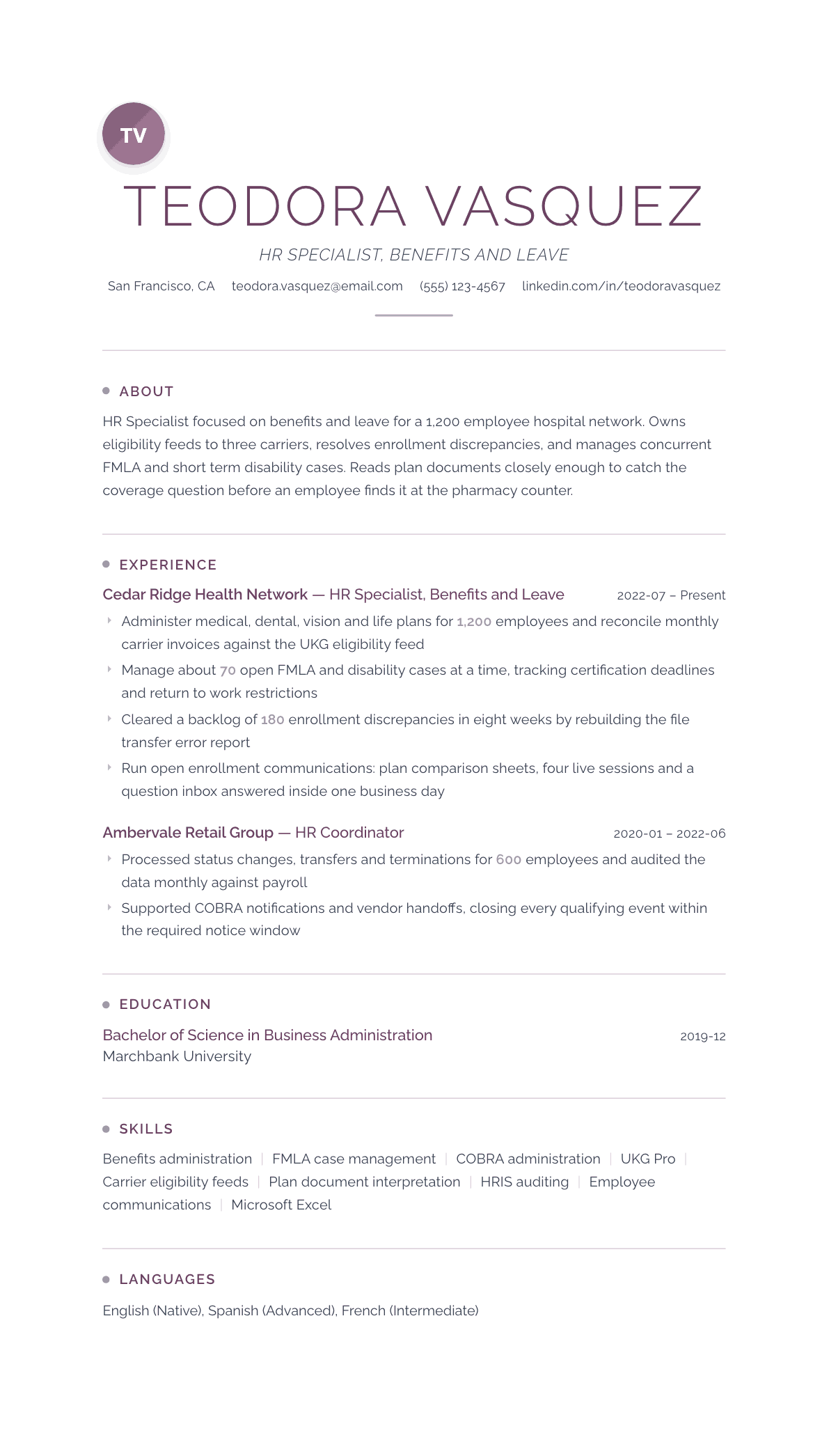
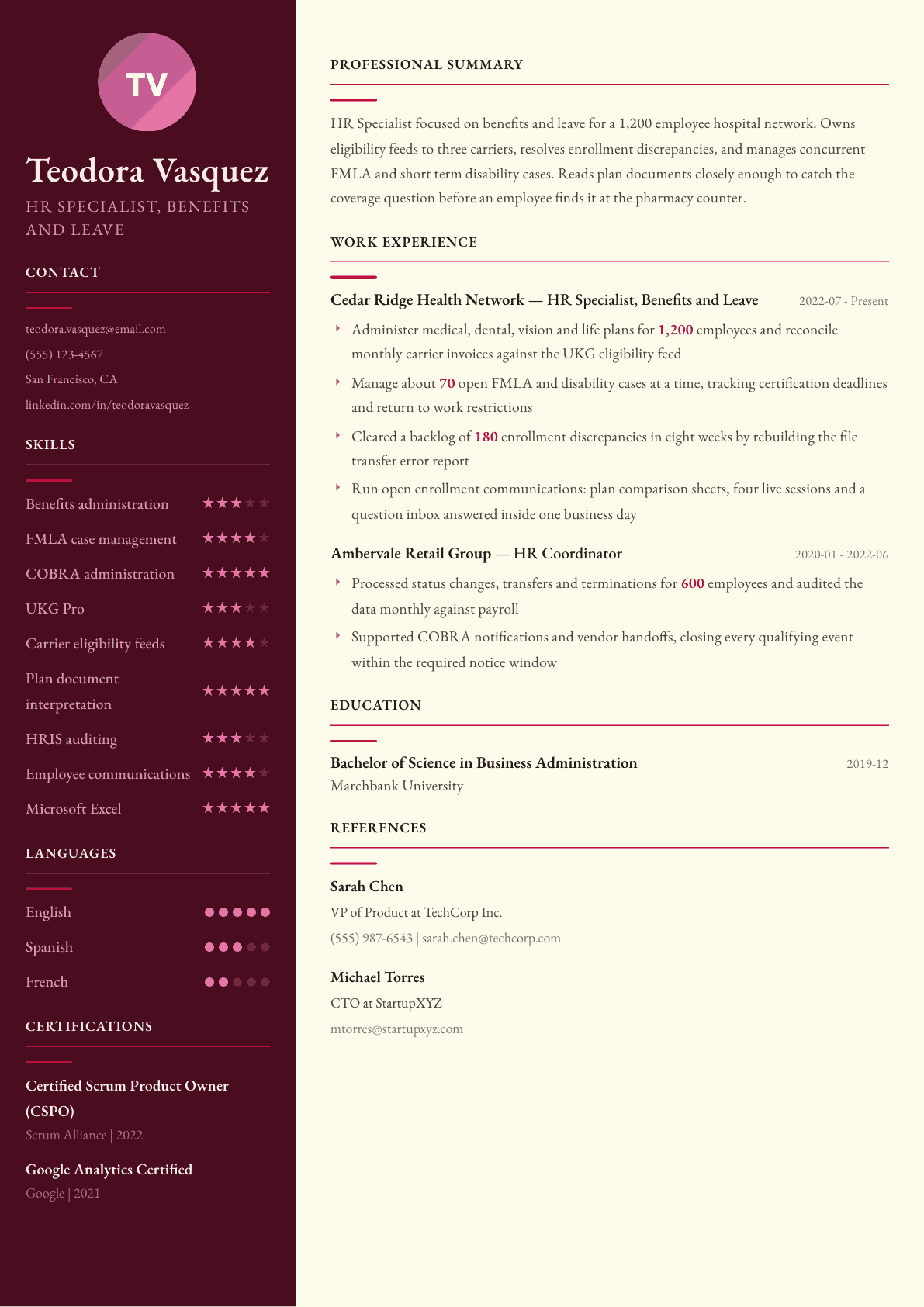
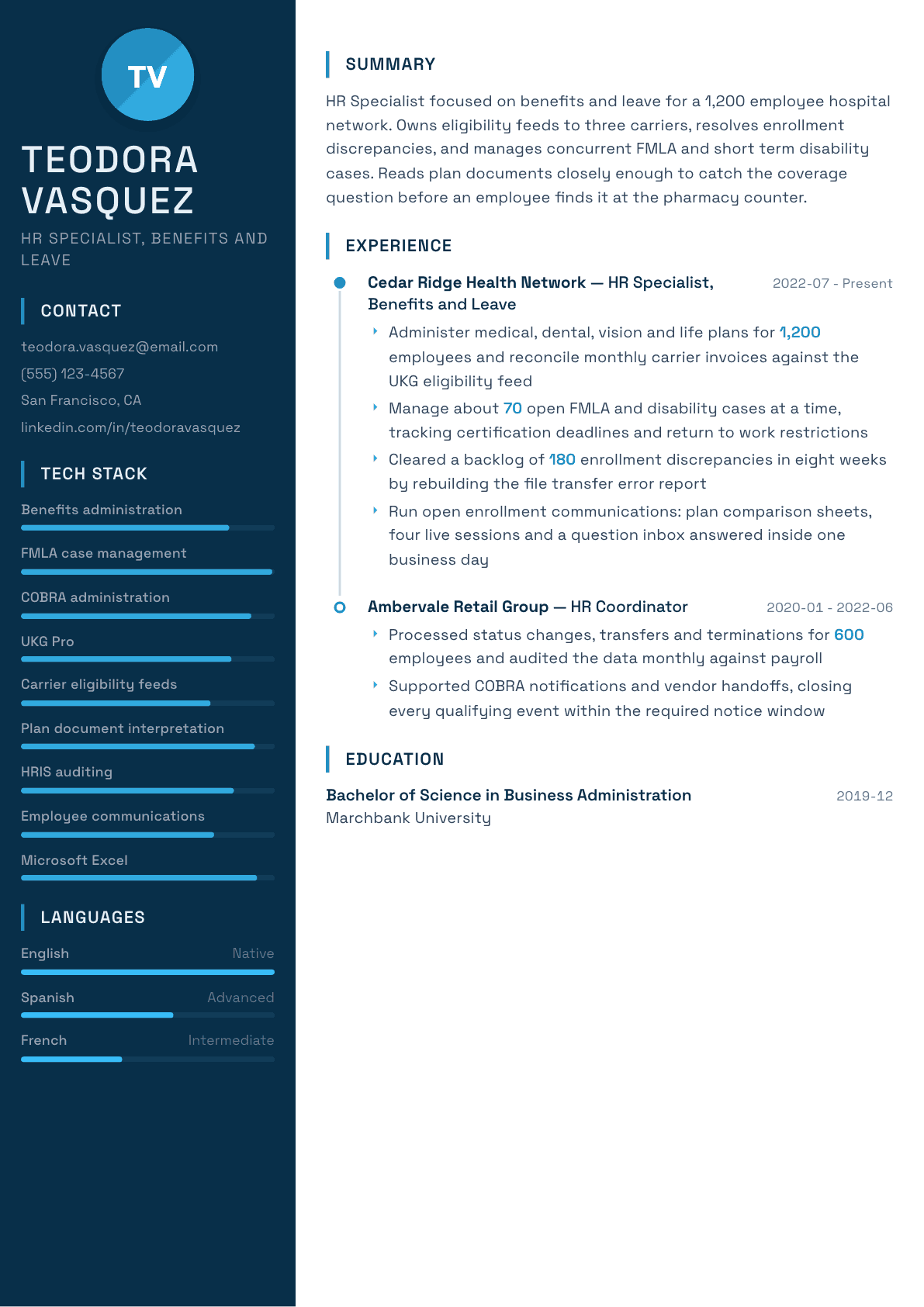
The same hr specialist content laid out in three CVBooster templates, so you can see what the finished document looks like before you write a word.
Example HR Specialist summary
HR Specialist with five years in benefits and leave administration for a hospital network of roughly 1,200 employees. Owns carrier eligibility feeds, monthly invoice reconciliation and a steady caseload of FMLA and disability files. Cleared a large enrollment discrepancy backlog by rebuilding the error reporting process. Seeking a specialist role with room to take on absence program design and vendor selection.
Skills to list on a HR Specialist resume
- Benefits administration
- Leave of absence case management
- FMLA and ADA accommodation support
- COBRA administration
- Carrier eligibility file reconciliation
- UKG Pro
- Workday
- Open enrollment planning
- HRIS data auditing
- Employee benefits communications
- Plan document interpretation
- Vendor management
- Microsoft Excel reporting
- Compliance notices
- Confidential case documentation
What actually gets this resume read
- Name your specialty in the job title line, because HR specialist alone tells a screener nothing about what you actually do.
- Show case or transaction volume: open leave cases, enrollments processed, invoices reconciled, or discrepancies cleared per cycle.
- Quote the systems and the carriers side by side, since the integration between them is where specialist work actually lives.
- Give one bullet to a clean up project, because specialists are usually hired to fix a backlog someone else created.
- Keep compliance references accurate and specific, such as COBRA notice windows or FMLA certification tracking.
- If you have covered a second discipline, list it last so the resume still reads as depth rather than a scattered generalist profile.
How to write a hr specialist resume
HR specialist is a title that hides its own meaning. One specialist administers benefits and leave, another handles compensation surveys, a third owns compliance filings, a fourth runs training logistics. The hiring manager reading your resume has one of those jobs open and needs to know within a few seconds whether your depth sits in her area or somewhere else entirely.
That is why the strongest specialist resumes qualify the title on the very first line, then spend the page proving depth rather than range. Where a generalist resume wins on breadth, a specialist resume wins on case volume, system fluency, plan or program knowledge, and the cleanup projects that follow someone who really understands the mechanics.
This guide covers how to declare your specialty, how to show volume without turning the page into statistics, what compliance detail belongs on the resume and what does not, plus summaries and rewritten bullets you can measure your own drafts against.
Format: qualify the title, then go deep on one lane
Write the title as HR Specialist followed by the discipline: benefits and leave, compensation, compliance, talent, or HR systems. Do it in the summary and in each job heading where it is accurate. An unqualified specialist title forces the reader to reconstruct your focus from the bullets, and readers who have twenty resumes to review will not do that work for you.
One page is right for the first several years. Two pages become reasonable when you have carried multiple plan years, a system implementation and a compliance calendar, because each of those needs its own evidence rather than a summary line.
- Job heading example: HR Specialist, Benefits and Leave, twelve hundred employees, three carriers.
- Sections: summary, areas of depth, professional experience, systems, education, certifications.
- Keep an adjacent skills line short so the resume does not drift back toward generalist positioning.
Summary: the population, the plans, the caseload
Name the employee population, the programs you administer and the concurrent caseload you carry. A benefits and leave specialist who says she manages roughly seventy open leave cases at a time and reconciles three carrier feeds every month has said more in one sentence than a page of duty statements would.
Then say what you are known for inside your lane. Perhaps it is reading plan documents closely, perhaps it is clearing eligibility errors before the carrier notices, perhaps it is writing enrollment communications that cut the question volume in half. Specialists get hired for a specific competence, so choose the one you would defend in an interview.
Experience: volume, cycle and the mechanics between systems
Specialist work is mostly the space between systems. Eligibility feeds from the HRIS to the carrier, deduction files back to payroll, leave dates that must match both the case file and the timekeeping record. Write bullets that live in that space, because they are the ones no generalist can write and no reader can dismiss.
Use volume as the spine: enrollments processed, cases open at once, invoices reconciled, discrepancies cleared, notices issued within a required window. Then attach the cycle. Monthly reconciliation, quarterly audits, an annual enrollment period with its own communication plan. A reader who sees both volume and cadence understands your job without asking.
Reserve one bullet for a repair. Most specialists are hired into a mess: a feed that has been erroring for months, a backlog of unprocessed status changes, a set of notices going out late. Describe what was broken, what you changed and how long it took. That story is the single most persuasive thing on a specialist resume.
Compliance: precise, current and only what you have handled
Compliance detail is where credibility is won and lost. COBRA notice windows, FMLA certification tracking, ACA reporting support, nondiscrimination testing coordination with a vendor and required plan notices are each concrete work. Name the ones you have performed and describe your actual part, whether that was preparing the data, issuing the notices or coordinating the outside administrator.
Do not paraphrase legal requirements on the page. Stating a deadline slightly wrong is worse than not mentioning it, and reviewers in this field notice immediately. Say that you closed every qualifying event within the required notice window rather than quoting a number of days from memory.
Systems and vendors: the pair that proves the depth
List the HRIS or benefits administration platform you work in, then list the counterparties: carriers, a leave administrator, a COBRA vendor, a payroll provider. Specialists are judged partly on how well they manage vendors, so a bullet about holding a carrier to a correction timeline or leading a vendor implementation carries real weight.
Spreadsheet skill still matters more here than people expect. Reconciliation, audit files and eligibility comparisons run on lookups, pivot tables and variance checks, so say what you build rather than listing Excel as a bare keyword.
HR Specialist resume summary examples
First specialist role
HR professional moving from coordinator into a benefits focused specialist seat after two years processing status changes, enrollments and COBRA notifications for six hundred employees. Comfortable auditing HRIS data against payroll and closing qualifying events within the required window. Seeking a benefits specialist role with plan year ownership.
Benefits and leave, five years
HR Specialist in benefits and leave for a hospital network of roughly twelve hundred employees. Administers medical, dental, vision and life plans, reconciles three carrier feeds monthly against UKG, and manages about seventy concurrent leave and disability cases. Cleared a large enrollment discrepancy backlog by rebuilding the error report.
Senior specialist
Senior HR Specialist with nine years across benefits administration and absence management for multistate employers. Has led two benefits platform implementations, owns vendor performance reviews, and writes the enrollment communications used at every site. Mentors two coordinators and is moving toward absence program design.
Work experience bullets: before and after
Before: Administered employee benefits programs.
After: Administered medical, dental, vision and life plans for twelve hundred employees and reconciled monthly carrier invoices against the UKG eligibility feed.
Naming the plan types, the population and the reconciliation shows the actual administrative loop.
Before: Managed leave of absence cases.
After: Carried about seventy concurrent leave and disability cases, tracking certification deadlines, intermittent usage and return to work restrictions with each employee manager.
Concurrent caseload plus the three tracked elements makes the workload and the complexity visible.
Before: Fixed data issues in the benefits system.
After: Cleared a backlog of one hundred eighty enrollment discrepancies in eight weeks by rebuilding the carrier file error report so failures surfaced the day they occurred.
The repair story names the size, the timeframe and the mechanism that stopped the problem recurring.
Before: Communicated benefits information to employees.
After: Produced the open enrollment package including plan comparison sheets and four live sessions, and answered the question inbox within one business day throughout the window.
Deliverables and a response standard turn communication from a claim into a service level.
Before: Worked with benefits vendors.
After: Held the leave administrator to a five business day case decision standard through a monthly performance review, escalating aged cases directly to the account manager.
A standard and an escalation path show vendor management rather than routine correspondence.
Hard skills
- Benefits administration
- Leave of absence case management
- FMLA and ADA accommodation support
- COBRA administration
- Carrier eligibility file reconciliation
- UKG Pro
- Workday
- Open enrollment planning
- HRIS auditing
- Plan document interpretation
- Vendor performance management
- Advanced Excel reconciliation
Soft skills
- Patience with complicated employee questions
- Precision
- Vendor assertiveness
- Confidential case handling
- Clear written explanation
- Calm during enrollment season
Certifications worth listing
- Certified Employee Benefit Specialist (CEBS) (International Foundation of Employee Benefit Plans)
- Certified Benefits Professional (CBP) (WorldatWork)
- Professional in Human Resources (PHR) (HR Certification Institute)
- SHRM Certified Professional (SHRM-CP) (Society for Human Resource Management)
Mistakes that cost hr specialist candidates the interview
- Leaving the title unqualified so a benefits manager cannot tell whether your depth is in benefits or in training logistics.
- Writing broad coverage across every HR discipline, which converts a specialist resume into a weaker generalist one.
- Omitting caseload or transaction volume, the numbers that let a reader compare you with the person currently in the seat.
- Quoting statutory deadlines from memory instead of stating that you met the required window.
- Skipping vendor management, even though a poorly managed administrator creates most of the escalations in this job.
- Listing Excel with no indication of what you build, when reconciliation work is the core of the daily routine.
HR Specialist resume questions
How do I choose which specialty to lead with?
Lead with the one you have carried through at least one full annual cycle, since that is the depth an interviewer can test. If you have two, put the one matching the posting first and give the second a shorter block later in the experience section.
Is HR specialist a step up from HR generalist?
It is a step sideways into depth rather than up. Specialists usually earn more within their lane over time and often move into management of that lane, while generalists more commonly move toward business partner or HR manager roles.
Should I list the carriers and vendors I have worked with?
Mention the vendor type and your role with them rather than a list of brand names. Saying you managed a leave administrator to a decision standard tells the reader more than naming three carriers whose plan designs she cannot see.
How do I show that I understand plan documents?
Give an example where reading the document changed an outcome, such as catching an eligibility rule that a proposed change would have violated or resolving a coverage question before it reached the employee. Understanding is only visible through a decision.
What if my specialist role also includes generalist duties?
Keep them, but place them last and give them one compact bullet. The resume should read as depth with some breadth attached, not as a generalist role that happens to carry a specialist title on the organizational chart.
Related resume examples
- Benefits Administrator Resume example
- Human Resources Resume example
- Benefits Specialist Resume example
- HR Generalist Resume example
- Labor Relations Specialist Resume example
- Onboarding Specialist Resume example