Talent Acquisition Specialist Resume Examples: free score
Create a Talent Acquisition Specialist Resume That Stands Out
By Mustafa Tarabya, founder of CVBooster · Published · Updated
Build an impressive Talent Acquisition Specialist resume with recruiter-approved templates, sourcing metrics, and hiring funnel achievements.
Sample resumes for a talent acquisition specialist
The same talent acquisition specialist content laid out in three CVBooster templates, so you can see what the finished document looks like before you write a word.
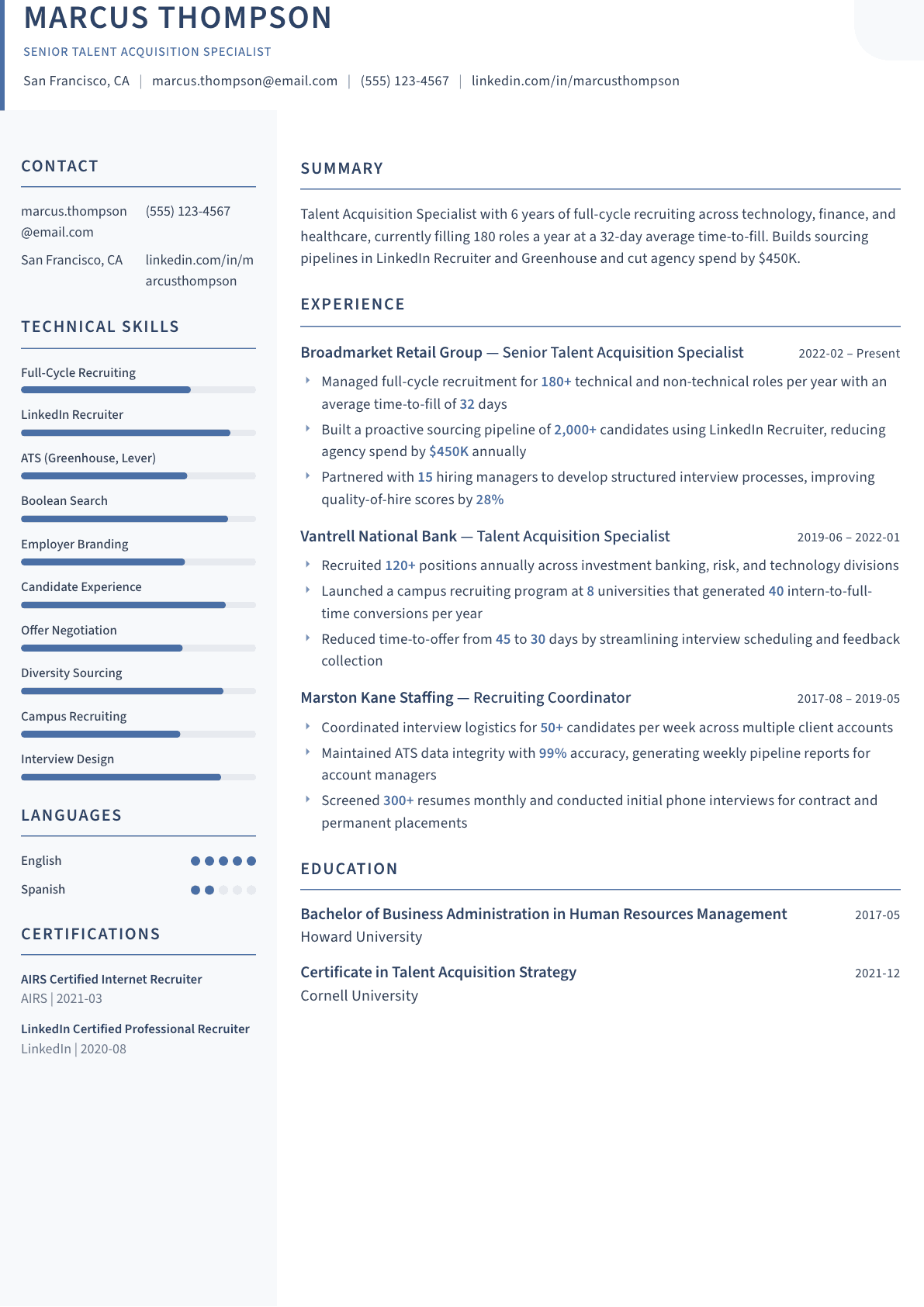
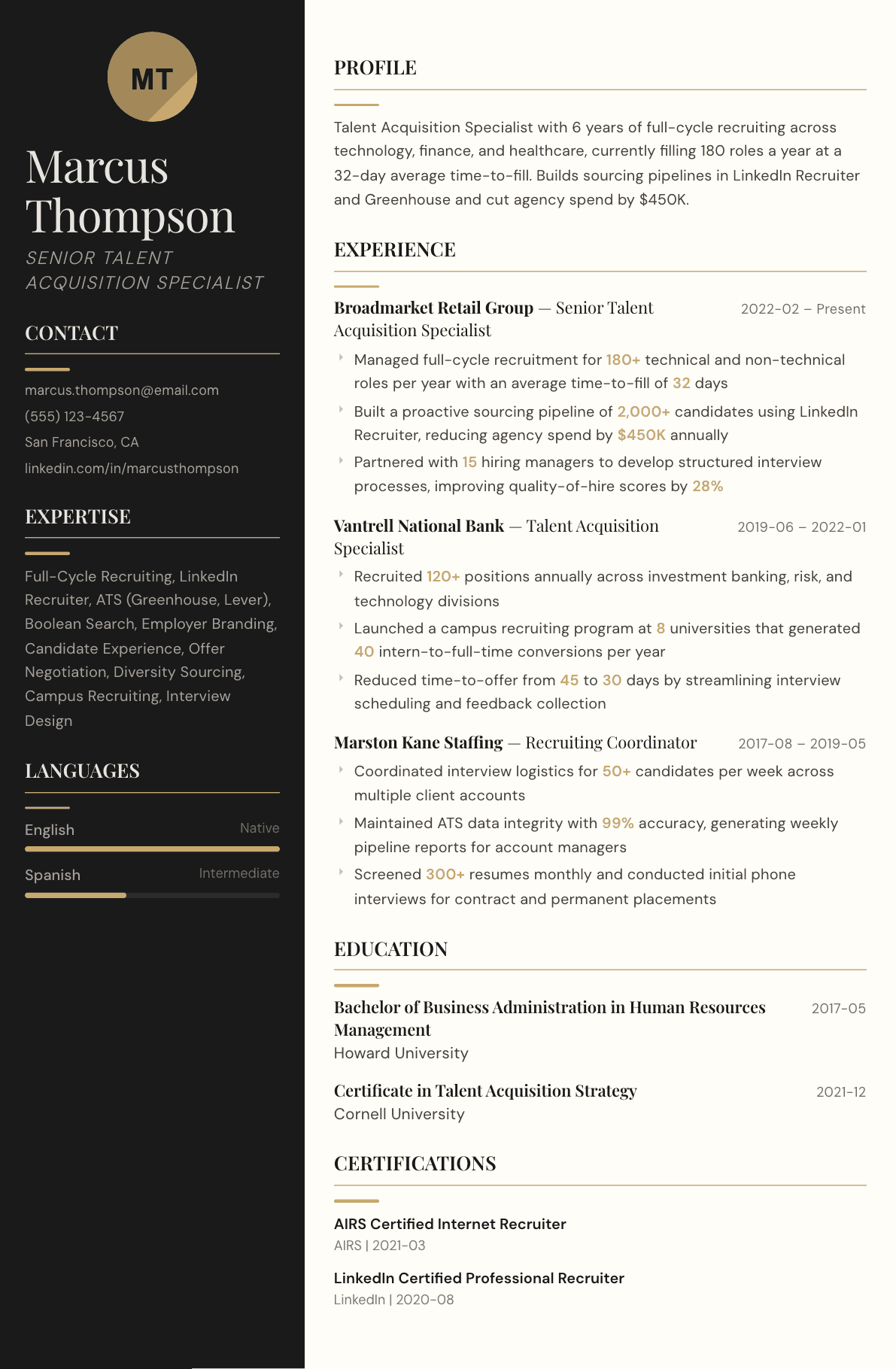
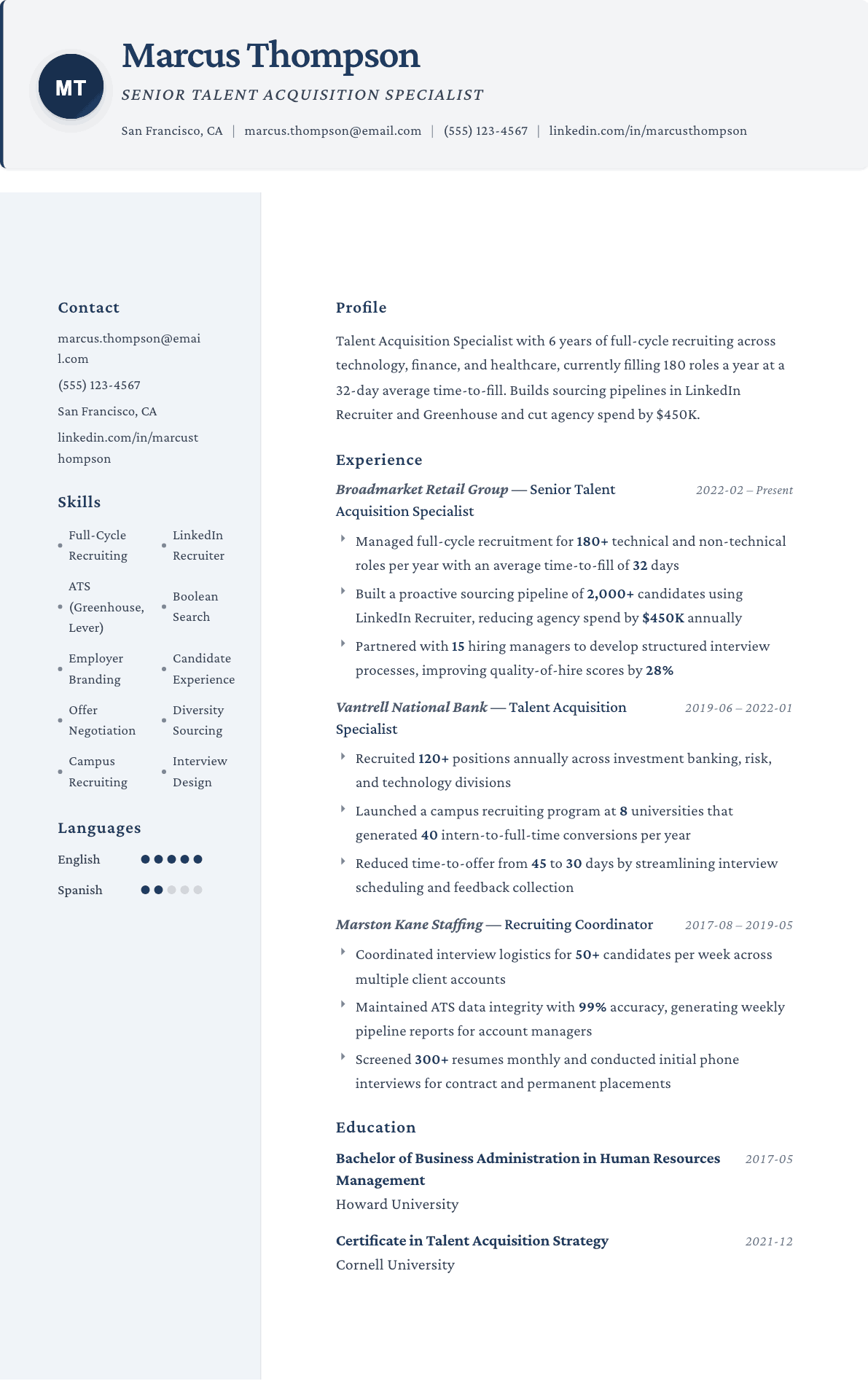
Example Talent Acquisition Specialist summary
Data-driven Talent Acquisition Specialist with 6 years of experience filling 150+ roles annually across technology, finance, and healthcare sectors. Expert in proactive sourcing, employer branding, and ATS optimization. Reduced agency spend by $450K and improved quality-of-hire by 28% through structured interviewing frameworks.
Skills to list on a Talent Acquisition Specialist resume
- Full-Cycle Recruiting
- Sourcing Strategy
- LinkedIn Recruiter
- Boolean Search
- ATS Management
- Employer Branding
- Candidate Experience
- Offer Negotiation
- Diversity Recruiting
- Campus Recruiting
- Interview Design
- Pipeline Analytics
- Stakeholder Management
- Onboarding
What actually gets this resume read
- Lead with volume and velocity metrics: roles filled per year, time-to-fill, cost-per-hire, and offer acceptance rates.
- Highlight sourcing tools and platforms (LinkedIn Recruiter, Greenhouse, Lever, SeekOut) to pass ATS filters.
- Showcase diversity recruiting accomplishments and inclusive hiring initiatives with measurable outcomes.
- Include employer branding contributions such as career page redesigns, recruitment marketing campaigns, or social media strategies.
- Demonstrate partnership with hiring managers by mentioning structured interviews, scorecards, and calibration sessions.
How to write a talent acquisition specialist resume
Talent acquisition specialist is an in-house title, and that matters for how the resume should be written. The reader is a talent acquisition manager or head of people who is buying more than a pair of hands on requisitions. They want someone who builds the machinery: sourcing pipelines that exist before the role opens, structured interview kits that make hiring decisions defensible, employer brand material that pulls inbound applications, and reporting that tells leadership where the funnel is leaking.
That is why a talent acquisition file that reads purely as a requisition log underperforms. Volume matters and belongs near the top, but the differentiator is the programs behind the volume: a proactive pipeline that shortened a repeat search, an agency reduction achieved by building internal sourcing, a campus program that produced a class of hires, a scorecard rollout that stopped hiring managers arguing about gut feel.
Below: the structure that shows both throughput and program building, three summaries from associate to senior specialist, five before-and-after bullets, the credentials worth carrying, and the questions talent acquisition professionals ask when their resume needs to demonstrate influence over hiring managers.
Format: funnel numbers high, program work close behind
One to two pages, reverse chronological, single column. Directly under the summary put a funnel line: roles filled per year, time to fill, cost per hire if you have a defensible figure, and offer acceptance. Then a tools line naming the applicant tracking system, sourcing platforms, and the scheduling or analytics tools you use.
Within each job, split the bullets into two visible groups: the requisition work, and the program work. That split is the whole argument of a talent acquisition resume, because a specialist who only closes requisitions is replaceable by an agency, while a specialist who builds pipelines, kits and brand assets is not.
- Funnel line: annual role volume, time to fill, offer acceptance, cost per hire where defensible.
- Tools line: Greenhouse or Lever, LinkedIn Recruiter, SeekOut, Gem, and any assessment platform.
- Group A bullets: the searches you own, by function and level.
- Group B bullets: pipelines, scorecards, campus, brand, reporting and agency strategy.
Summary: functions covered, hiring volume, and the program you built
Say which business functions you hire for, the annual volume, and one thing you built that outlived a single search. Talent acquisition specialists who cover technology, finance and healthcare simultaneously should say so, because multi-function coverage is genuinely harder and employers hiring across a mixed workforce screen for exactly that.
Keep the summary free of adjectives that every applicant uses. Replace data-driven with the actual data you produce, such as weekly funnel reporting by stage, and replace proactive with the pipeline you maintained before roles opened.
Proactive sourcing and pipeline building
The strongest talent acquisition bullets describe candidates you had before you needed them. A talent pool built for a repeat role, a nurture sequence run through the talent customer relationship platform, a community you maintained relationships in, or a silver medalist list that later converted are all evidence of a specialist working ahead of demand.
Give each pipeline a purpose and a result. A pool of two thousand names is only interesting when it produced hires or cut the time to first submission on the next opening. Tie pipeline building to a business consequence such as reduced agency dependence, since that is how a talent acquisition manager justifies your headcount internally.
Hiring manager partnership: intake, scorecards, calibration
This is the section that separates a talent acquisition specialist from a sourcer. Describe your intake practice: what you extract from a hiring manager before opening a search, how you push back on a role profile that will not hire in the market, and how you set the submission expectation. Then describe the structure you introduced, such as interview kits, competency-based questions and scorecards in the applicant tracking system.
Calibration deserves a bullet of its own. Sessions after the first few candidates, decision debriefs run to a defined format, and interviewer training all show that you shape how the company hires rather than just moving candidates through it. Add the effect, such as fewer rejected finalists or improved consistency across panels.
- Intake: what you capture, and the market reality check you give hiring managers.
- Scorecards: how many roles have structured kits, and who built them.
- Debriefs: the format you run and how disagreement is resolved.
- Interviewer training: how many panelists trained and on what.
Employer brand, campus, and the keywords that get you found
Employer branding work is under-reported on these resumes and it is often the thing a growing employer needs most. Careers page content, employee story campaigns, social recruiting posts, event presence and interview experience improvements are all concrete deliverables. Say what you produced and what it changed in inbound application volume or candidate feedback.
For keywords, use the vocabulary these postings share: talent acquisition, full-cycle recruitment, sourcing strategy, Boolean search, employer branding, candidate experience, diversity hiring, campus recruiting, interview design, pipeline analytics, time to fill and cost per hire. Each one should sit next to something you did, so the human reader and the search both find what they came for.
Talent Acquisition Specialist resume summary examples
Associate talent acquisition specialist
Talent acquisition specialist with 2 years hiring for corporate and operations roles at a growing employer, filling 60 positions a year in Lever. Runs intake meetings, builds Boolean searches, and launched the first structured scorecards for the three most frequently hired roles.
Six years in
Talent Acquisition Specialist with 6 years filling 150 roles a year across technology, finance and healthcare. Built a proactive sourcing pipeline of 2,000 candidates that cut agency dependence sharply, and improved quality of hire scores by 28% through structured interviewing.
Senior specialist and program owner
Senior Talent Acquisition Specialist with 9 years in high-growth and enterprise environments. Owns technical hiring for 180 requisitions a year at a 32-day average time to fill, runs the campus program across six universities, and leads interviewer training for 120 panelists.
Work experience bullets: before and after
Before: Recruited for technical and non-technical roles.
After: Managed full-cycle recruitment for 180 technical and non-technical requisitions a year across engineering, finance and operations, holding an average time to fill of 32 days measured from requisition approval.
The volume, the functions and a stated measurement point make the throughput claim usable rather than decorative.
Before: Built a candidate pipeline.
After: Built and maintained a proactive pipeline of 2,000 candidates in LinkedIn Recruiter and the talent CRM, segmented by role family, which produced first submissions within 48 hours of a repeat role opening.
Segmentation and a submission speed outcome show a pipeline that works, not a list that exists.
Before: Reduced recruiting agency costs.
After: Replaced agency support on 40 roles a year by building internal sourcing for two hard-to-fill engineering families, cutting external recruiting spend to a fraction of the prior year while holding time to fill flat.
Naming the roles brought in house and the unchanged time to fill proves the saving did not come at the cost of hiring speed.
Before: Worked with hiring managers on the interview process.
After: Partnered with 15 hiring managers to design structured interview kits and scorecards for 12 role families, then ran calibration sessions after the first three candidates in each search, raising quality of hire scores by 28%.
Concrete artifacts and a defined calibration rhythm show you changed how the company hires.
Before: Improved the candidate experience.
After: Rewrote the careers page and interview preparation emails, introduced a two-business-day feedback standard after final interviews, and collected candidate survey feedback that moved the process rating up across two quarters.
A named standard and a measured survey result replace a phrase that means nothing on its own.
Hard skills
- Full-cycle recruitment
- Proactive sourcing strategy
- Boolean and semantic search
- LinkedIn Recruiter and SeekOut
- ATS management (Greenhouse, Lever)
- Talent CRM and nurture campaigns
- Structured interview and scorecard design
- Employer branding content
- Campus and early careers recruiting
- Pipeline and funnel analytics
- Offer negotiation
- Diversity recruiting practice
Soft skills
- Hiring manager influence
- Candidate advocacy
- Market storytelling
- Negotiation
- Organized follow-through
- Comfort with pushback
Certifications worth listing
- LinkedIn Certified Professional, Recruiter (LinkedIn)
- Certified Diversity and Inclusion Recruiter (CDR) (AIRS)
- Professional Recruiter Certification (PRC) (AIRS)
- SHRM Certified Professional (SHRM-CP) (Society for Human Resource Management)
- Talent Acquisition Specialty Credential (Society for Human Resource Management)
Mistakes that cost talent acquisition specialist candidates the interview
- Writing the file as a requisition log with no program work, which makes the role look outsourceable to an agency.
- Quoting cost per hire without saying what it includes, since the definition varies enough that the number invites a challenge.
- Describing sourcing without naming platforms, communities or search techniques.
- Omitting hiring manager partnership, which is the main difference between a talent acquisition specialist and a sourcer.
- Claiming an improved candidate experience with no artifact, standard or survey behind it.
- Blending high-volume and specialized hiring into a single average that flatters neither.
Talent Acquisition Specialist resume questions
What is the difference between a talent acquisition specialist and a recruiter resume?
The recruiter file leads with searches closed. The talent acquisition file leads with searches closed and then proves program building: proactive pipelines, structured interviewing, employer brand and funnel reporting. Keep both halves visible and clearly separated within each job.
Should I include cost per hire?
Only if you know the components your employer counted, such as agency fees, advertising, tooling and events. State the direction of change and the driver behind it rather than a bare figure, because an interviewer will ask how it was calculated.
How do I show influence over hiring managers?
Describe the mechanisms you introduced: intake templates, market reality conversations that changed a role profile, scorecards, calibration sessions and interviewer training. Influence is only visible through the artifacts it produced, so name them.
Is campus recruiting worth a separate section?
If you own it, yes. Give the number of schools, the events run, the intern class size and the conversion to full-time offers. Early careers hiring is a distinct competency and many employers screen specifically for someone who has run a full campus cycle.
How do I write about diversity hiring without sounding performative?
Describe the practice, not the intention. Sourcing channels added, job description language reviewed, structured evaluation introduced, and panel composition changed. Then give the funnel movement it produced and the period over which it held.
Related resume examples
- Recruiter Resume example
- HR Manager Resume example
- Diversity & Inclusion Manager Resume example
- Talent Acquisition Manager Resume example
- Campus Recruiter Resume example
- Corporate Recruiter Resume example