HR Intern Resume Examples: free ATS score and gap list
Write an HR Intern Resume With No HR Experience Yet
By Mustafa Tarabya, founder of CVBooster · Published · Updated
An HR intern resume example with coursework and project bullets, the entry level keywords screeners look for, and a guide to every section.
Sample resumes for a hr intern
The same hr intern content laid out in three CVBooster templates, so you can see what the finished document looks like before you write a word.
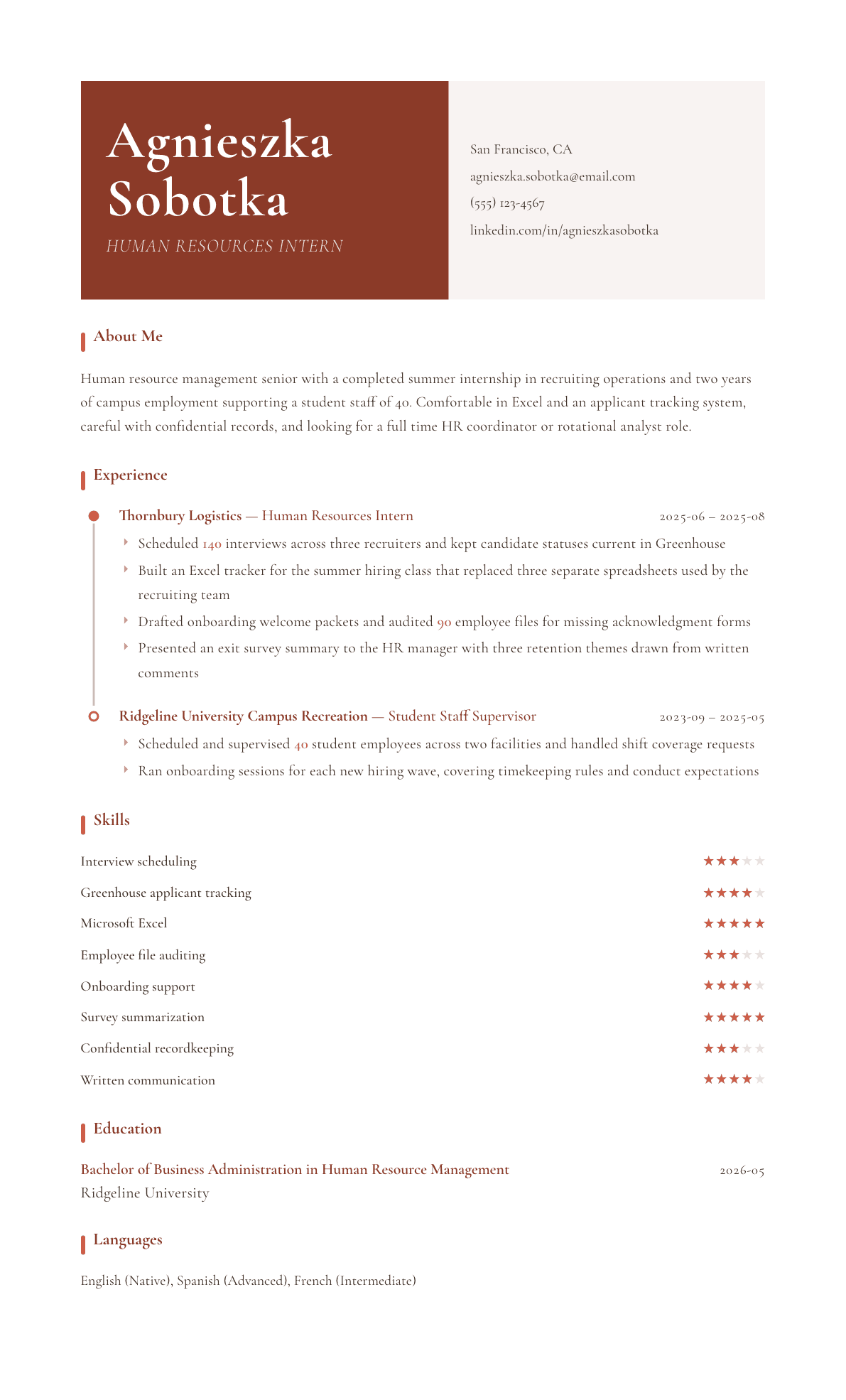
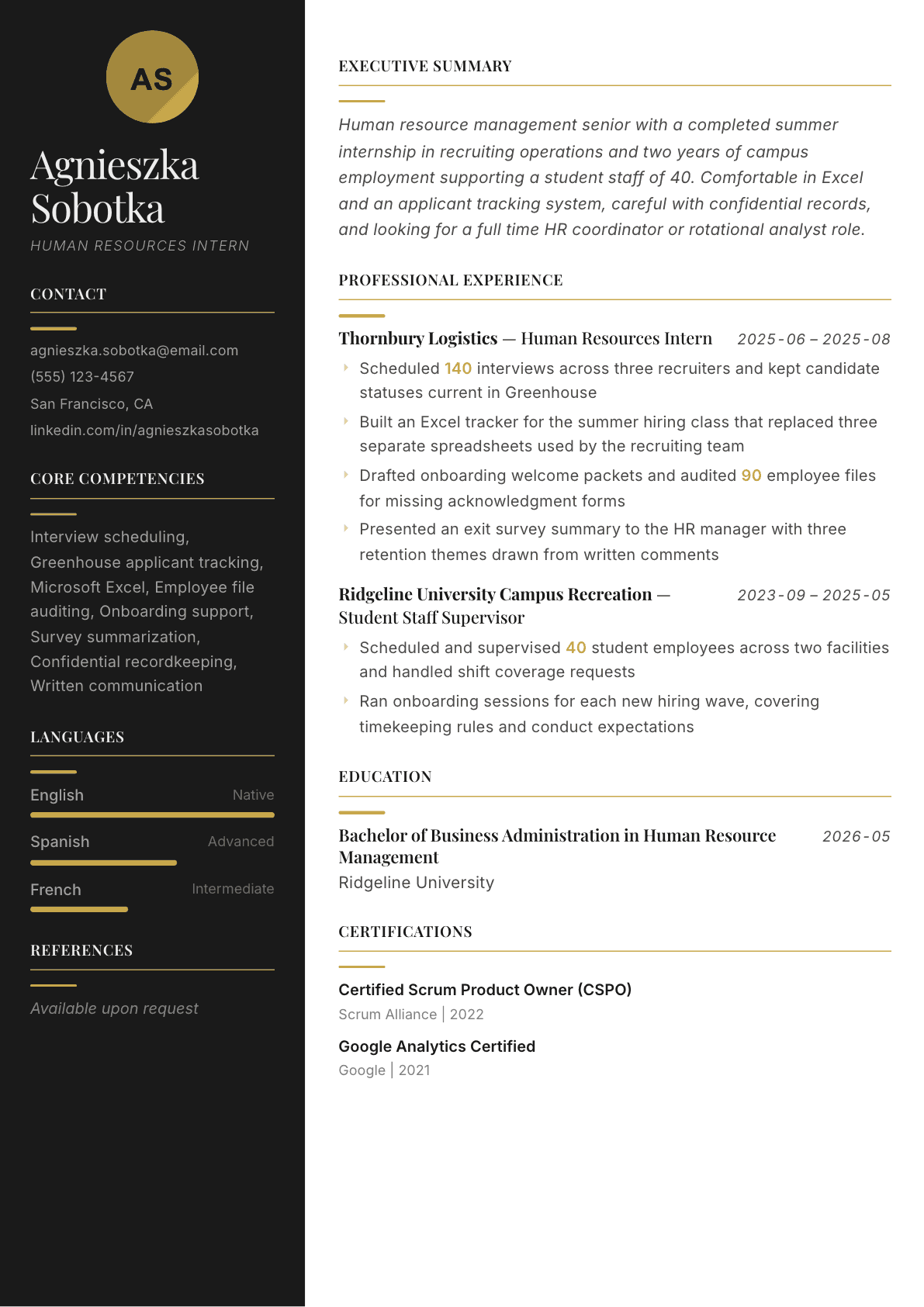
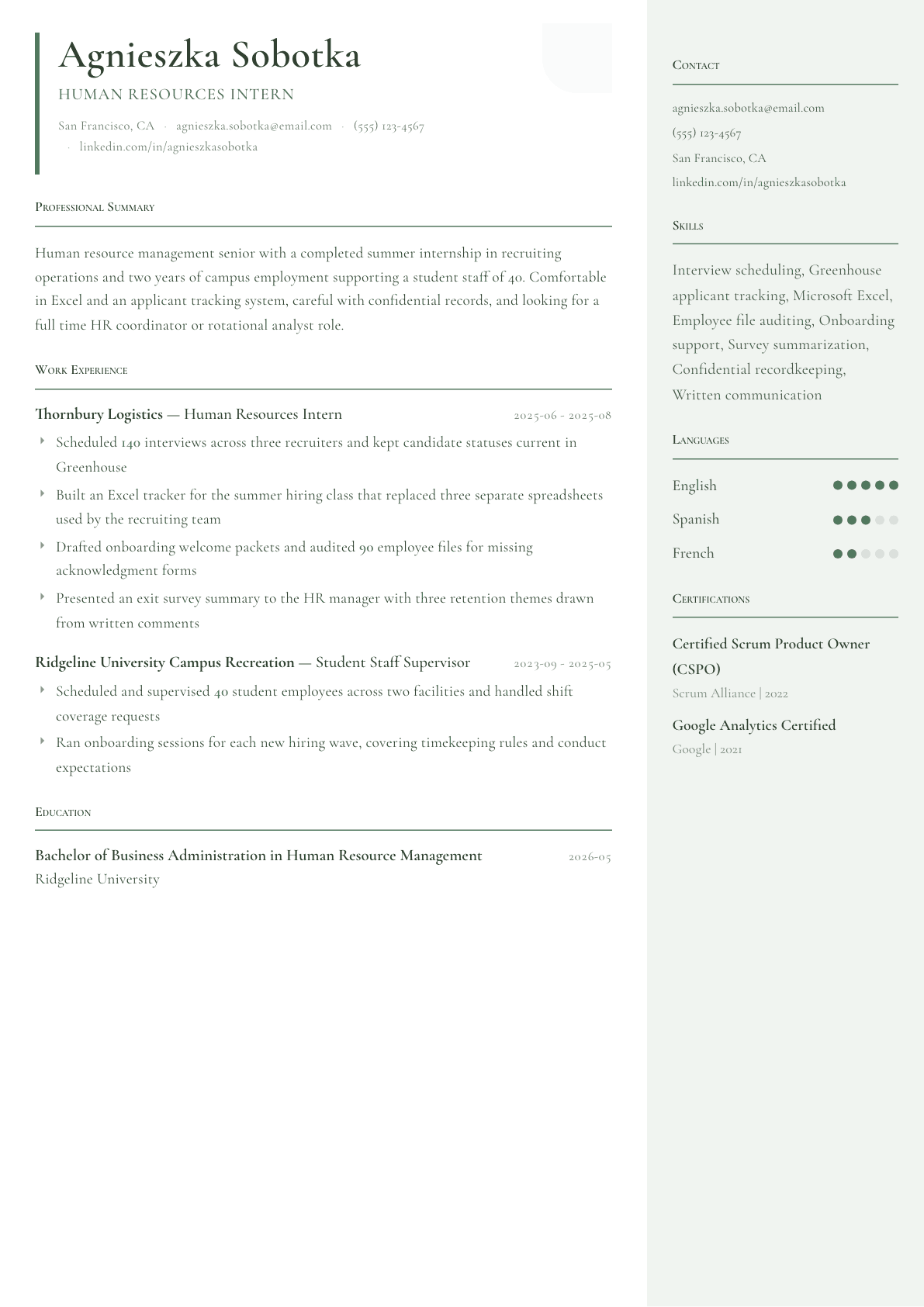
Example HR Intern summary
Human resource management senior with a completed recruiting operations internship and two years supervising a campus student staff of 40. Scheduled a full summer of interviews in Greenhouse, rebuilt the hiring class tracker in Excel and audited employee files for missing documentation. Coursework in compensation, staffing and employment law. Seeking a full time HR coordinator role or a rotational HR analyst program.
Skills to list on a HR Intern resume
- Interview scheduling
- Applicant tracking systems
- Greenhouse
- Microsoft Excel
- Onboarding support
- Employee file auditing
- Survey data summarization
- HR policy research
- Job description drafting
- New hire orientation support
- Confidential recordkeeping
- Meeting notes and follow up
- PowerPoint reporting
- Campus recruiting support
What actually gets this resume read
- Put education first with your major, expected graduation and relevant coursework such as compensation, employment law and staffing.
- Treat campus jobs as real experience by describing scheduling, onboarding and conflict handling in workplace language.
- Name any system you have touched, even briefly: Greenhouse, Workday student modules, Excel, or a survey tool.
- Turn class projects into evidence by describing the deliverable, the data you used and who reviewed the result.
- Show discretion explicitly, since an intern who understands confidential records is the one who gets file access.
- Ask for the specific next step in your summary, whether that is a coordinator role, a rotation, or a second internship.
How to write a hr intern resume
Writing an HR intern resume feels impossible because the thing you are applying for is the experience you do not yet have. The good news is that nobody reviewing intern applications expects HR experience. They expect evidence that you can be trusted around confidential information, that you will not need a reminder twice, and that you understand what human resources actually does beyond the version described in a textbook.
The reviewer is usually an HR manager who will supervise you directly, sometimes with a campus recruiter screening first. Both look at the same handful of things: your major and coursework, any job where you handled people, schedules or records, any system you have touched, and whether your writing on the page is careful. That last one carries more weight than students expect, because much of the work is written.
This guide covers the section order that works when experience is thin, how to make campus jobs and class projects count, the systems worth naming, and three sample summaries covering a first internship application, a student with one internship behind them, and a graduating senior aiming at a full time seat.
Format: one page, education first, no exceptions
One page, reverse chronological, education at the top with your major, expected graduation term, and a relevant coursework line naming courses such as compensation and benefits, staffing, employment law, organizational behavior and human resource analytics. Those course names are keywords in their own right and they tell a reviewer which parts of the function you already have vocabulary for.
Skip the photo, the skill bars and the two column design. A parser reads a clean single column reliably, and a plain layout makes your one page look like the work of someone who understands professional documents rather than design templates.
- Header: name, city and state, phone, email, and a professional profile link if it is complete.
- Sections: education, relevant experience, additional experience, skills and systems, activities.
- Include your grade point average only if it is strong, and drop it once you have graduated.
Summary: the ask, the background, the timing
Two or three lines is plenty. Say what you are studying, what relevant exposure you already have, and exactly what you are looking for, including the term you are available. An HR manager planning a summer program needs to know your availability window as much as your interests.
Do not write about passion for helping people. Every applicant writes it and it describes the wrong job anyway, since human resources is as much about policy, records and difficult decisions as it is about support. Naming a specific area of interest such as recruiting operations, benefits or people analytics reads far more credibly.
Experience: campus jobs are real jobs, so write them that way
Supervising student staff, running a shift schedule, training new hires at a restaurant, handling cash and closing procedures, working a front desk with student records. All of that is workplace evidence. Write it in the language a hiring manager uses: scheduling, onboarding, coverage, training, conflict resolution, confidential records.
Give each item a number where one exists. How many student employees you scheduled, how many shifts a week you covered, how many people you trained, how many guests or callers you handled during a peak. Numbers make small jobs concrete and they show you pay attention to your own work.
If you have held an HR internship already, that becomes the lead item and gets four bullets covering the actual cycle you supported, whether that was interview scheduling, file auditing, onboarding packets or survey summaries. Say what you produced, not what you observed.
Projects and coursework: turn assignments into evidence
A well described class project can carry a resume when work experience cannot. Describe the deliverable, the data or method, the constraint and who reviewed it: a job analysis and description you wrote for a real employer, a compensation benchmarking exercise using published survey structures, a mock investigation report, an engagement survey you analyzed for a student organization.
Case competitions, a student chapter of a professional HR association, and any volunteer role where you handled recruitment or scheduling all belong here too. The point is not to inflate them, it is to show you have already practiced the thinking the job requires.
- Name the artifact you produced: a job description, a policy draft, a benchmarking summary, a survey analysis.
- Say who reviewed it, whether a professor, a client organization or a chapter advisor.
- Keep each project to two lines so the section never overwhelms your actual work history.
Systems, discretion and the details that get you file access
List every tool you have genuinely used: Excel including lookups and pivot tables, an applicant tracking system if you have seen one, a survey platform, a scheduling system, a learning platform. Be honest about depth, because an intern who admits limited exposure and learns quickly is far more welcome than one who oversold a system in the interview.
Say something concrete about handling confidential information, such as student records, payroll data or customer information under a stated policy. Interns who show they understand discretion get real work. Interns who do not spend the summer on tasks nobody minds losing.
HR Intern resume summary examples
First internship application
Human resource management sophomore seeking a summer HR internship in recruiting or benefits. Two years supervising student staff at a campus recreation center, including scheduling and new hire training. Coursework in organizational behavior and staffing, comfortable in Excel, and available full time for the summer term.
One internship behind you
Junior in human resource management with a completed recruiting operations internship where I scheduled interviews for three recruiters and rebuilt the summer hiring tracker. Strong Excel skills and applicant tracking system exposure. Looking for a second internship with benefits or people analytics responsibility.
Graduating senior
Graduating human resource management senior with an internship in recruiting operations and two years supervising a campus staff of forty. Audited employee files, presented an exit survey summary to an HR manager, and completed coursework in compensation and employment law. Seeking a full time HR coordinator or rotational analyst role.
Work experience bullets: before and after
Before: Helped the HR team with daily tasks.
After: Scheduled one hundred forty interviews across three recruiters over a summer and kept candidate statuses current in the applicant tracking system.
A volume figure and a named system replace a phrase that could describe fetching coffee.
Before: Worked on a spreadsheet for the recruiting team.
After: Built an Excel tracker for the summer hiring class that replaced three separate spreadsheets and gave recruiters one shared view of candidate status.
Naming what it replaced and who used it turns a task into a small improvement you owned.
Before: Supervised student employees at the recreation center.
After: Scheduled and supervised forty student employees across two facilities, handling coverage requests and running onboarding for each new hiring wave.
Headcount, sites and the onboarding element show workplace responsibility rather than a title.
Before: Completed a project on employee engagement in class.
After: Analyzed an engagement survey for a student organization of ninety members and presented three themed recommendations to the executive board.
A real population, a deliverable and an audience make coursework function as genuine evidence.
Before: Handled confidential information responsibly.
After: Audited ninety employee files for missing acknowledgment forms, working under a restricted access policy and reporting gaps only to the HR manager.
Describing the control you worked under is proof of discretion, while asserting it is not.
Hard skills
- Microsoft Excel
- Applicant tracking systems
- Interview scheduling
- Onboarding support
- Employee file auditing
- Survey data summarization
- Job description drafting
- HR policy research
- PowerPoint reporting
- Meeting notes and follow up
Soft skills
- Discretion
- Asking a question once
- Reliability on deadlines
- Careful writing
- Comfort with routine detail
- Openness to feedback
Certifications worth listing
- Associate Professional in Human Resources (aPHR) (HR Certification Institute)
Mistakes that cost hr intern candidates the interview
- Opening with a passion for helping people, a line that appears on nearly every student application in the stack.
- Leaving campus jobs off the resume because they feel unrelated, when they carry the only workplace evidence you have.
- Listing courses by number instead of by name, so the reviewer cannot see which HR topics you have studied.
- Claiming system experience you do not have, which unravels in the first practical question of the interview.
- Writing a full page of activities and a short experience section, which inverts what the reviewer came to read.
- Sending a resume with a typo when the role you want is one where careless writing has real consequences.
HR Intern resume questions
What should I put on an HR intern resume with no experience?
Lead with education, coursework and any job where you scheduled, trained, supervised or handled records. Add one or two class projects described by their deliverable and audience. That combination gives a reviewer enough to judge without inventing anything.
Do I need to be an HR major to get an HR internship?
No. Business, psychology, communications and sociology students are all hired regularly. What matters is showing relevant coursework, some workplace evidence of handling people or records, and a clear reason you are interested in this function specifically.
Should I include my grade point average?
Include it while you are a student if it is strong, since some campus recruiting screens still filter on it. Leave it off if it is modest and use the space for a project or a campus job that shows more about how you work.
How do I write a cover letter for an HR internship?
Keep it to three short paragraphs: why this employer and this function, one concrete example of relevant responsibility from a job or project, and your availability. Reviewers reading many applications value specificity and brevity over enthusiasm.
What comes after an HR internship?
Most students move into an HR assistant or coordinator role, and some larger employers run rotational analyst programs that cycle through recruiting, benefits and analytics. Name the one you want in your summary so the reviewer can picture you in it.
Related resume examples
- HR Coordinator Resume example
- Human Resources Resume example
- Human Resources Assistant Resume example
- Recruiting Coordinator Resume example
- HR Administrator Resume example
- HR Generalist Resume example