Benefits Administrator Resume Examples: read this first
Build a Benefits Administrator Resume That Highlights Your Expertise
By Mustafa Tarabya, founder of CVBooster · Published · Updated
Create a detailed Benefits Administrator resume showcasing benefits plan management, vendor negotiations, compliance knowledge, and employee communication skills.
Sample resumes for a benefits administrator
The same benefits administrator content laid out in three CVBooster templates, so you can see what the finished document looks like before you write a word.
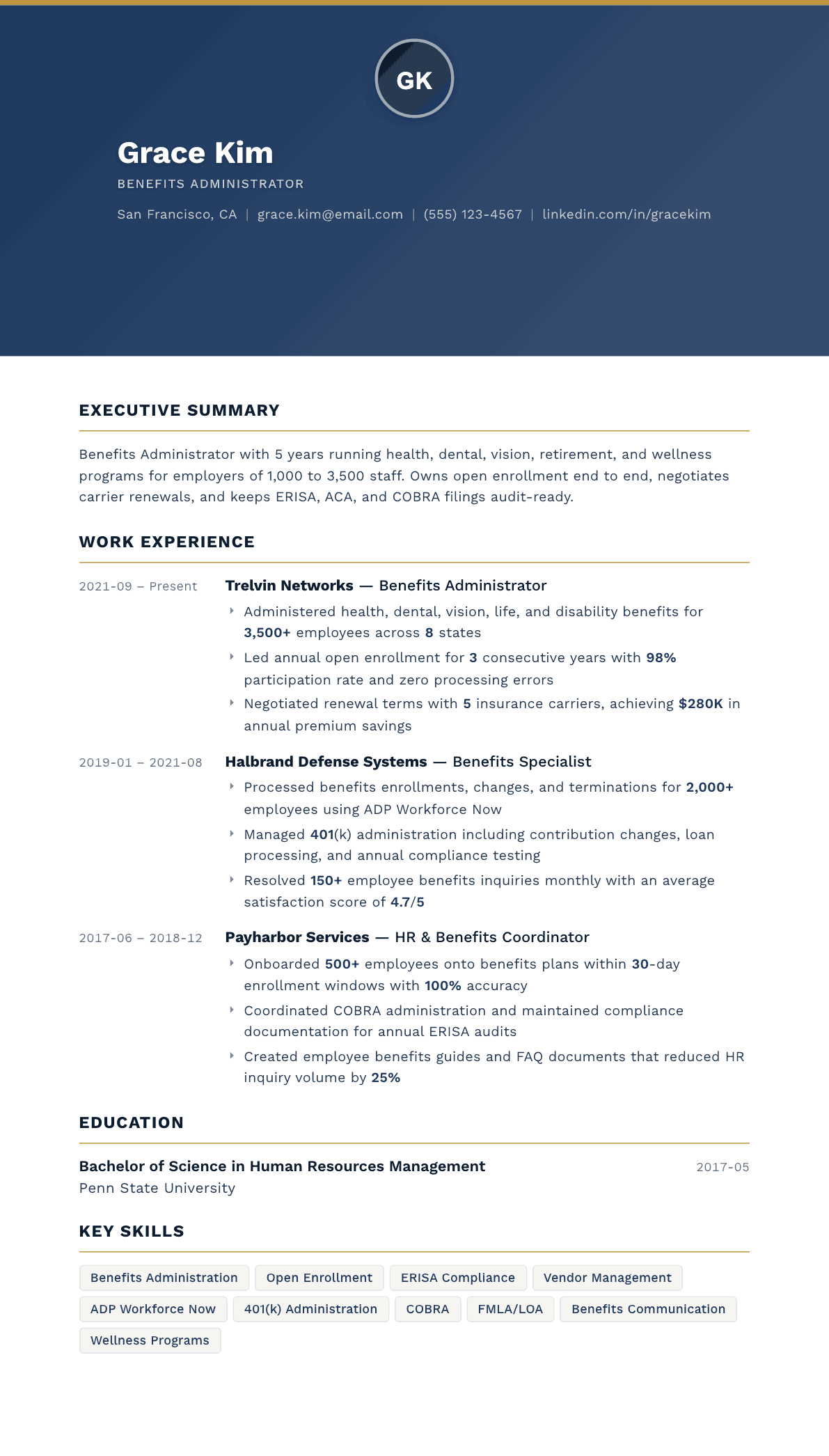
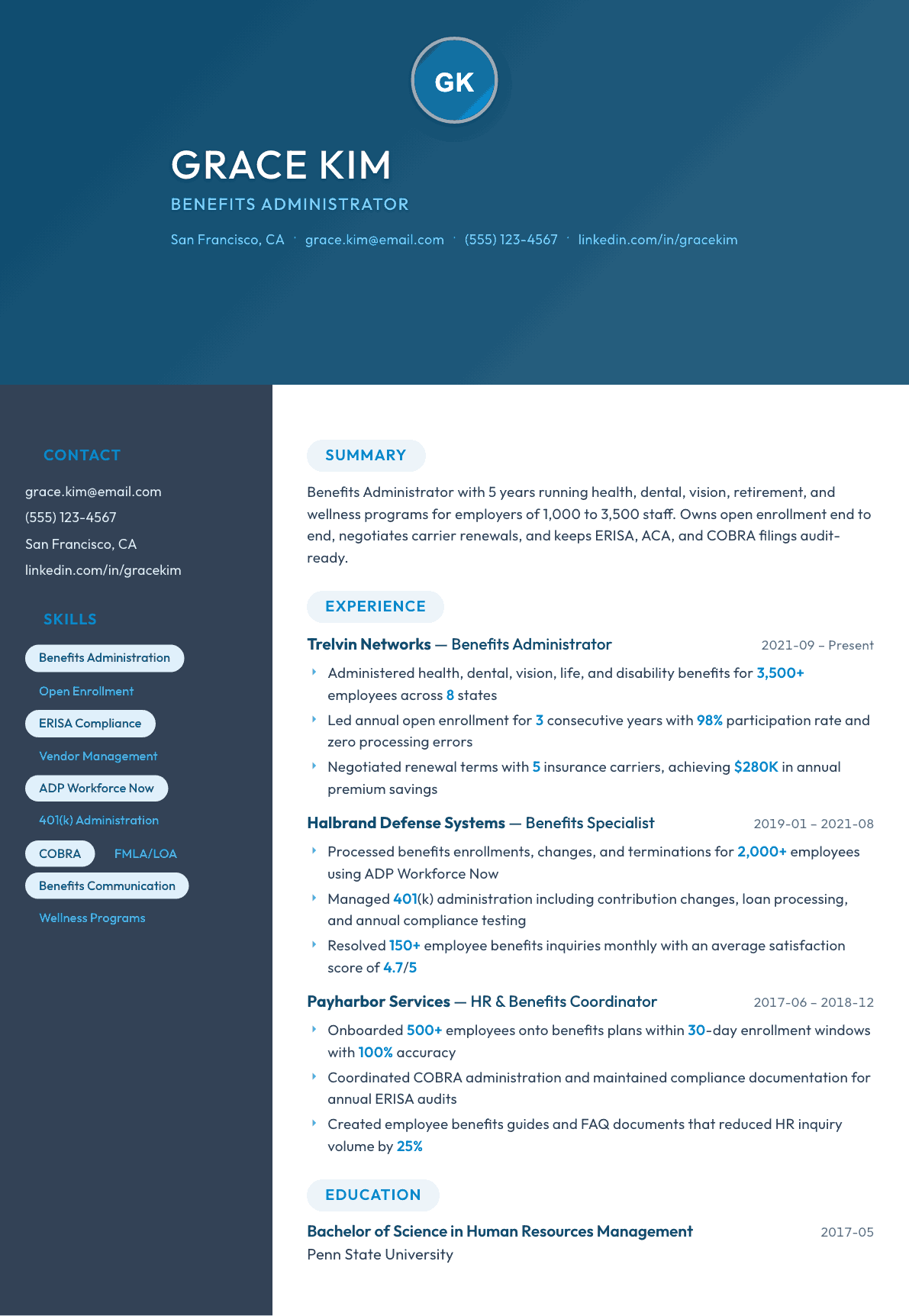
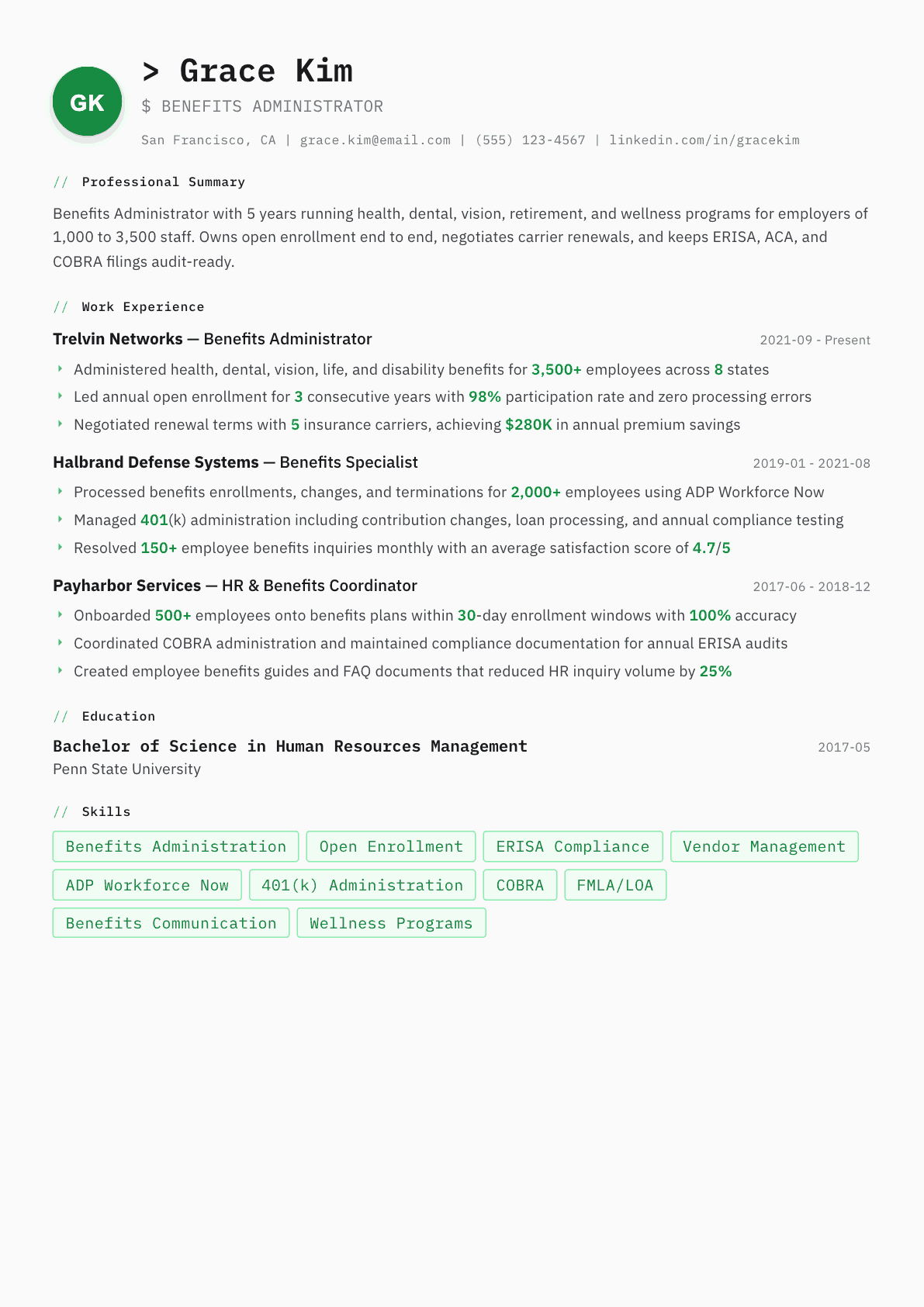
Example Benefits Administrator summary
Meticulous Benefits Administrator with 5 years managing comprehensive benefits programs for 3,500+ employees. Achieved $280K in annual carrier savings through strategic vendor negotiations and maintained 98% open enrollment participation. CEBS-certified professional skilled in ERISA compliance, 401(k) administration, and employee benefits communication.
Skills to list on a Benefits Administrator resume
- Benefits Administration
- Open Enrollment Management
- ERISA Compliance
- ACA Compliance
- COBRA Administration
- Vendor Negotiation
- 401(k) & Retirement Plans
- FMLA & Leave Management
- Wellness Programs
- ADP Workforce Now
- Benefits Communication
- HIPAA Compliance
- Claims Resolution
- Payroll Coordination
What actually gets this resume read
- Quantify the scope of your benefits administration: number of employees served, plan types managed, and budget overseen.
- Highlight vendor negotiation achievements with specific cost savings and improved plan terms.
- Showcase compliance expertise including ERISA, ACA, COBRA, HIPAA, and state-specific benefits laws.
- Include HRIS and benefits platform experience (ADP, Workday, BenefitFocus, PlanSource).
- Demonstrate communication skills through open enrollment campaigns, benefits guides, and employee education initiatives.
How to write a benefits administrator resume
A benefits administrator resume is screened by a total rewards manager or an HR director who is protecting the organization from two things: an enrollment cycle that goes wrong in front of every employee, and a compliance filing that goes wrong in front of a regulator. Everything on the page is read through those two risks.
That makes this a resume about scale and plan structure rather than about being organized and detail oriented. How many covered employees, how many plan options, self funded or fully insured, how many states and how many legal entities, which carriers and which broker, and which system the enrollment ran in. A benefits administrator supporting 300 employees on a single fully insured medical plan and one supporting several thousand across self funded plans in a dozen states are doing different jobs.
This guide covers the order a total rewards manager reads the sections in, how to write open enrollment and compliance bullets that prove control, the metrics worth quoting, three summaries at different career points, and the mistakes that make a strong administrator look like a data entry clerk.
Format: one page, population and plan profile under each role
One page for under eight years, two after that. Reverse chronological, single column, no graphics. Benefits roles sit inside HR functions that almost always use an applicant tracking system, and clean text is what parses.
Under each employer, give a population and plan profile before the bullets: employee count, number of states and entities, funding arrangement, plan lines covered, the carriers, the broker or consultant, and the human resource information system the enrollment ran through. That line tells a hiring manager whether your experience matches her benefits stack.
- Header: name, city and state, phone, email, and any benefits credential you hold.
- Order: summary, benefits experience with population profiles, systems, compliance and filings, education, certifications.
- Add a line naming the plan lines you have administered: medical, dental, vision, life, short and long term disability, retirement, health savings and flexible spending accounts, leave, wellness and voluntary products.
Summary: population, plan lines, and the cycle you own
Three lines. Say the covered population, the funding model, the plan lines, and the part of the annual cycle you personally lead. Open enrollment ownership is the headline claim for this role, so if you have run one end to end, put it in the first sentence.
If you are moving from a generalist role into a dedicated benefits seat, name the benefits work you already do: eligibility, life events, carrier files, invoice reconciliation, leave administration and the enrollment communications.
Experience: the annual cycle, not a list of duties
Structure your bullets around the calendar the job actually runs on. Renewal and plan design with the broker, building the plan year in the system, testing the enrollment, writing the employee communications, running the enrollment window, sending the carrier files, reconciling the first invoices of the new plan year, and closing out the compliance filings. A resume that follows that sequence reads as written by somebody who has lived it.
Then the ongoing work: eligibility and life event processing, dependent verification, retirement plan contributions and loans, health savings and flexible spending account funding, continuation coverage administration, leave coordination alongside disability, and the employee help desk.
Compliance deserves its own bullets and its own vocabulary. Nondiscrimination testing, annual reporting and disclosure notices, the health plan reporting filings, retirement plan testing and the annual return, continuation coverage notice timelines, and the audit support you have provided. Name the regulations by their common acronyms because those are the keywords.
- Renewal cycle: broker and carrier negotiation support, plan design modeling, contribution strategy, employee cost share changes.
- Enrollment: system build, testing, employee communications, meetings and webinars, confirmation statements, error correction.
- Ongoing: eligibility, qualifying life events, carrier file feeds, invoice reconciliation, terminations and continuation coverage.
- Compliance: nondiscrimination testing, required notices, annual filings, plan documents and summary descriptions, audit support.
Systems and data: the part that gets you shortlisted
Name the human resource information system and the benefits module by product, because that is the single strongest filter on these postings. Add the carrier connection experience, the file feed troubleshooting you have done, and any implementation or migration you took part in. A benefits administrator who has stood up an enrollment in a new system is unusually valuable and should say so.
Reconciliation is the quiet competence in this role. Monthly carrier invoices against enrolled headcount, retirement contribution funding against payroll, and account funding against elections. Show that you catch the differences rather than pay the bill.
- Platforms: Workday, ADP Workforce Now, UKG, Paycom, Paylocity, Oracle and the standalone enrollment portals layered on them.
- Data work: electronic data interchange carrier feeds, eligibility discrepancy reports, invoice to enrollment reconciliation, payroll deduction audits.
- Documentation: plan documents, summary plan descriptions, summaries of benefits and coverage, enrollment guides and decision support materials.
The numbers a total rewards manager checks
Benefits work is measurable even though most resumes for the role contain no figures at all. Quote the scale you have handled and the accuracy you held.
- Covered employees and dependents, plan options, states and legal entities.
- Enrollment participation and completion rate, and the share of employees who enrolled without help desk contact.
- Discrepancies found and corrected in carrier files and invoices, and the error rate after correction.
- Ticket or inquiry volume handled per month and average time to resolution.
- Filings and testing completed on time, and audits closed with no findings.
Benefits Administrator resume summary examples
Benefits coordinator
Benefits coordinator supporting 900 employees across three states, processing eligibility and qualifying life events in ADP Workforce Now, reconciling monthly carrier invoices and administering continuation coverage notices. Onboarded 500 new employees onto benefit plans inside the 30-day window with 100% documentation accuracy.
Benefits administrator
Benefits administrator for 3,500 employees across eight states and two legal entities, covering medical, dental, vision, life, disability and retirement plans on a self funded medical arrangement. Has led three consecutive open enrollments with 98% completion and closed each plan year with clean nondiscrimination testing.
Benefits manager
Benefits manager owning plan design, renewal strategy and vendor performance for a self funded population of 6,000. Led a migration from a legacy enrollment portal to a Workday benefits build, restructured the contribution strategy with the consultant, and closed two plan audits with no findings.
Work experience bullets: before and after
Before: Administered employee benefits programs.
After: Administered medical, dental, vision, life, disability and retirement plans for 3,500 employees across eight states on a self funded medical arrangement with four carrier relationships.
Population, plan lines, geography and funding model let a total rewards manager size your experience instantly.
Before: Managed open enrollment each year.
After: Ran open enrollment end to end for three plan years: built and tested the plan year in the system, wrote the employee guide, hosted eight information sessions and closed the window at 98% completion with no rework after the file feed.
Naming every stage of the cycle proves ownership rather than participation.
Before: Handled benefits questions from employees.
After: Resolved roughly 150 benefits inquiries a month on eligibility, claims escalation and life events, cutting average resolution time by adding a self service question and answer guide that removed a quarter of repeat tickets.
Volume, subject matter and a deflection result turn a support duty into a measurable service improvement.
Before: Worked with insurance carriers on renewals.
After: Supported annual renewal with the broker and four carriers, modeling three plan design and contribution scenarios for the leadership review and implementing the selected design across payroll and the enrollment system.
Modeling scenarios and implementing the decision shows analytical and execution work, not just attendance at meetings.
Before: Ensured compliance with benefits regulations.
After: Completed nondiscrimination testing, distributed required annual participant notices on schedule and prepared the retirement plan filing package, closing two plan audits with no findings.
Named compliance tasks and an audit outcome are verifiable, while ensured compliance is an assertion.
Hard skills
- Open enrollment administration
- Eligibility and life event processing
- Self funded and fully insured plan support
- Carrier file feeds and data reconciliation
- Invoice to enrollment reconciliation
- Retirement plan administration
- Health savings and flexible spending accounts
- Continuation coverage administration
- Leave and disability coordination
- Nondiscrimination testing support
- Plan documents and summary plan descriptions
- HRIS benefits configuration
- Broker and vendor management
Soft skills
- Explaining plan rules in plain language
- Discretion with medical and personal data
- Accuracy under deadline
- Vendor follow through
- Calm handling of upset employees
- Cross-team work with payroll and finance
Certifications worth listing
- Certified Employee Benefit Specialist (CEBS) (International Foundation of Employee Benefit Plans)
- Group Benefits Associate (GBA) (International Foundation of Employee Benefit Plans)
- Retirement Plans Associate (RPA) (International Foundation of Employee Benefit Plans)
- Certified Benefits Professional (CBP) (WorldatWork)
- Qualified 401(k) Administrator (QKA) (American Society of Pension Professionals & Actuaries)
- SHRM Certified Professional (SHRM-CP) (Society for Human Resource Management)
- Professional in Human Resources (PHR) (HR Certification Institute)
Mistakes that cost benefits administrator candidates the interview
- Leaving out the covered population and the funding model, which are the two facts that size a benefits job.
- Writing detail oriented and organized instead of showing an error rate, a reconciliation catch or a clean audit.
- Skipping the system name, when the enrollment platform is the strongest keyword filter on these postings.
- Describing open enrollment as a task you helped with rather than a cycle you built, tested, communicated and closed.
- Omitting compliance filings and testing, which is the risk the hiring manager is quietly worried about.
- Listing carriers with no context, so the reader cannot tell whether you managed the relationship or just processed the forms.
Benefits Administrator resume questions
What should a benefits administrator resume say about compliance?
Name the specific tasks you performed: nondiscrimination testing, participant notices, annual filings, plan document upkeep and audit support. Then add the outcome, such as filings completed on schedule or an audit closed with no findings, because that is what converts a duty into evidence.
How do I show benefits experience if I was a generalist?
Pull the benefits work out of your generalist bullets and give it its own block: eligibility, life events, carrier files, invoice reconciliation, leave coordination and enrollment support. Quantify the population you supported so the reader can size it against the opening.
Should I list every carrier and vendor I have worked with?
List the ones where you owned the relationship or the data feed, and say what you did with them. A long undifferentiated vendor list adds no information, while three carriers with a renewal, a file feed and a reconciliation attached to them does.
Is a benefits certification worth putting on the resume?
Yes. A benefits specialist or benefits professional credential is widely recognized by total rewards teams and signals that you understand plan design and regulation rather than only transaction processing. List the awarding body and any completed modules if you are partway through.
How do I quantify benefits work that has no obvious numbers?
Use scale and accuracy. Covered lives, plan options, states, enrollment completion, inquiry volume, reconciliation discrepancies caught, filings on time and audits closed without findings are all countable and all more persuasive than an adjective about attention to detail.
Related resume examples
- Compensation Analyst Resume example
- HR Coordinator Resume example
- HR Manager Resume example
- Benefits Specialist Resume example
- Wellness Coordinator Resume example
- HR Specialist Resume example