HR Operations Manager Resume Examples: read this first
Write an HR Operations Manager Resume That Proves You Run the Machine
By Mustafa Tarabya, founder of CVBooster · Published · Updated
Create an HR operations manager resume with a full example, the service levels and system detail HR leaders check, keywords and a writing guide.
Sample resumes for a hr operations manager
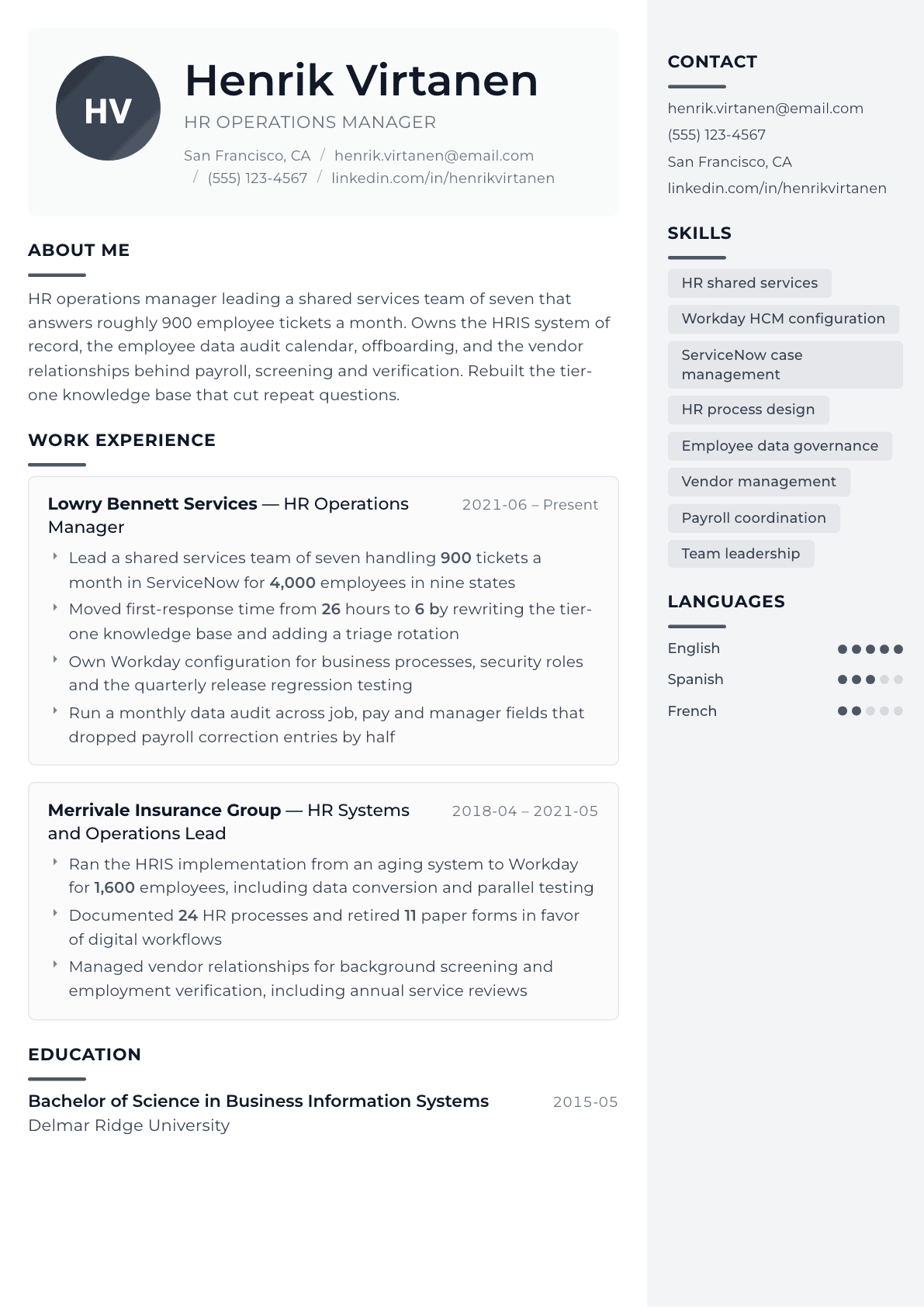
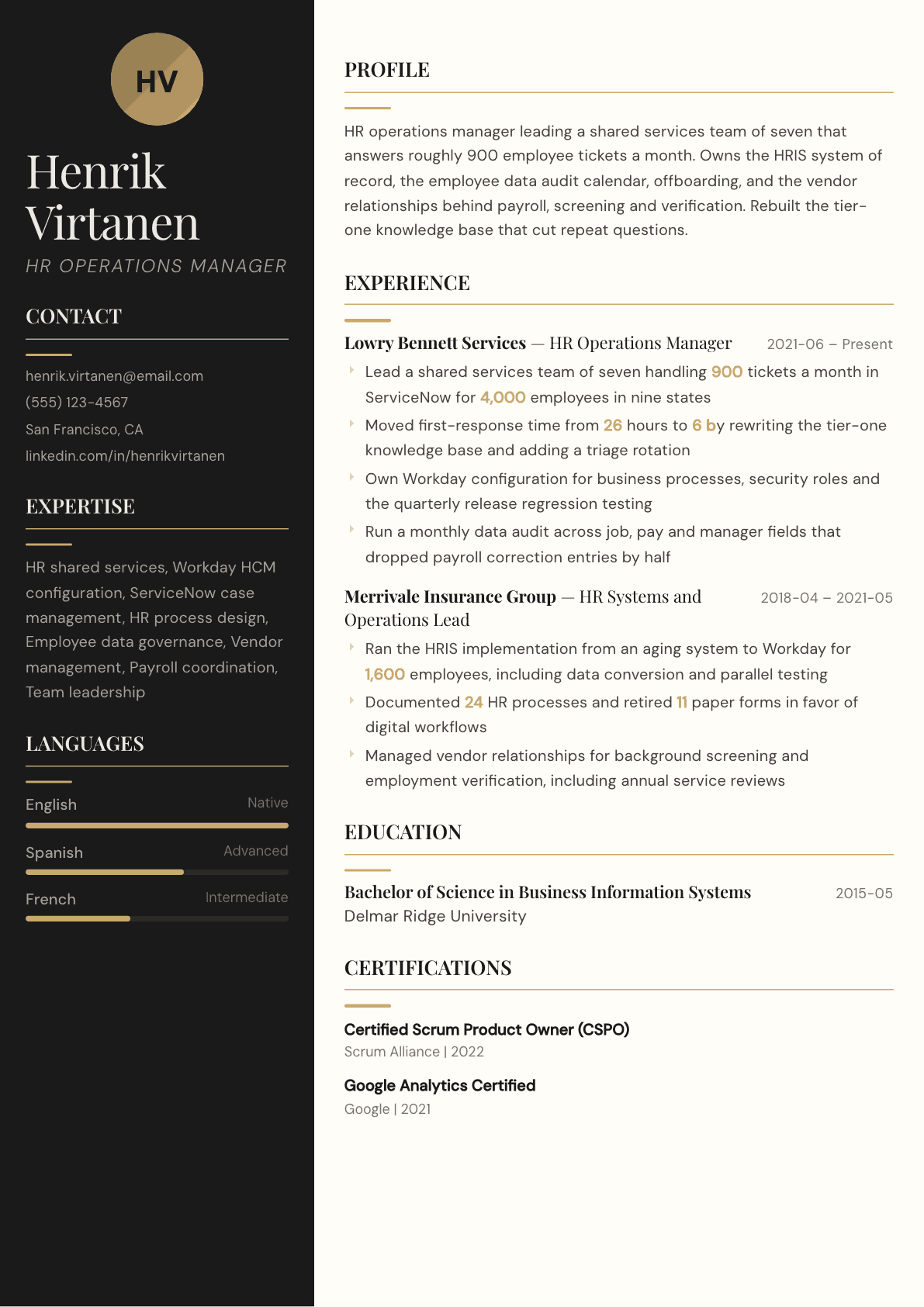
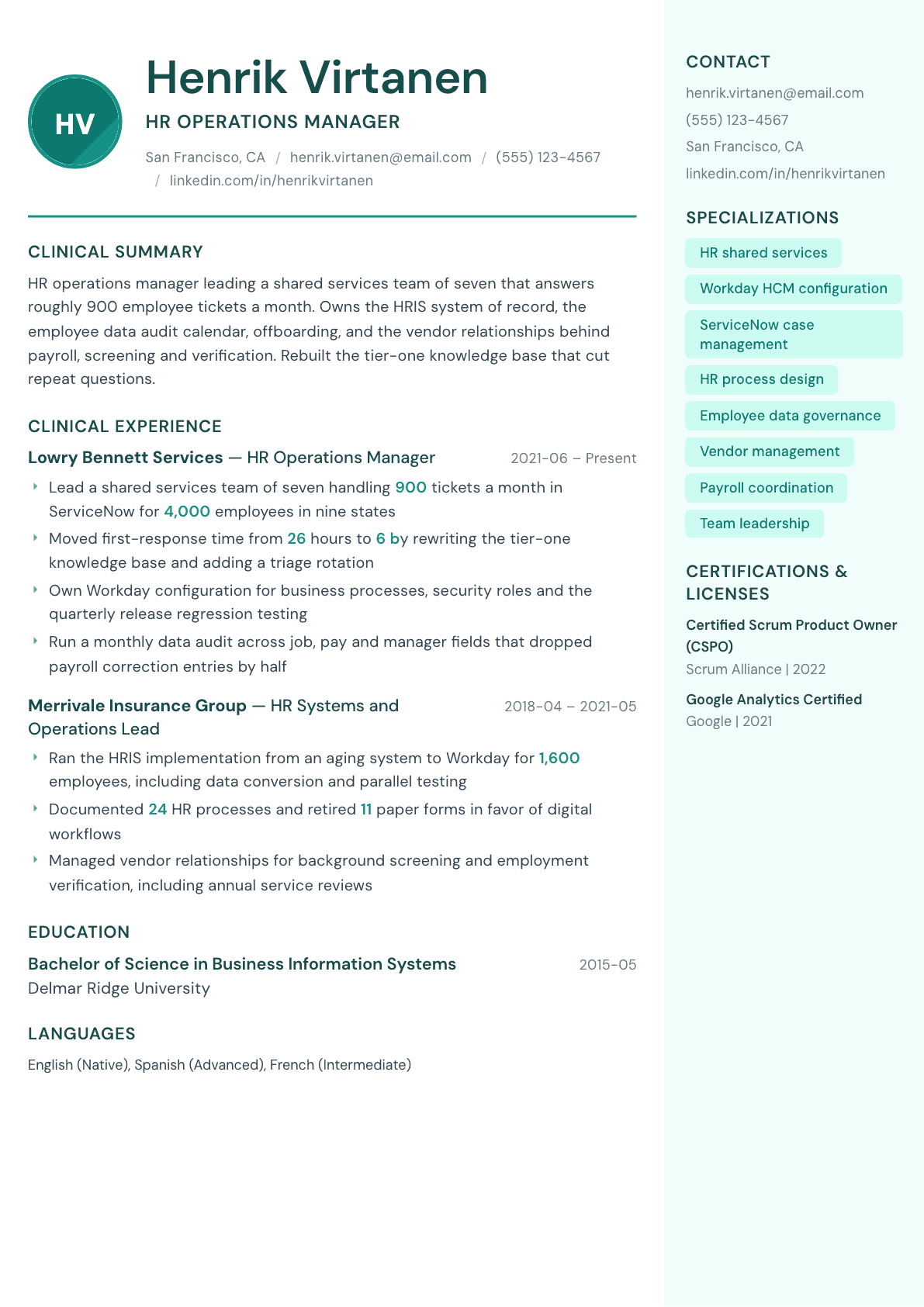
The same hr operations manager content laid out in three CVBooster templates, so you can see what the finished document looks like before you write a word.
Example HR Operations Manager summary
HR operations manager leading a shared services team of seven that supports four thousand employees across nine states. Owns Workday configuration, the quarterly release regression test, and a monthly employee data audit that cut payroll corrections in half. Rewrote the tier-one knowledge base and added a triage rotation that pulled first response time down from more than a day to a few hours.
Skills to list on a HR Operations Manager resume
- HR shared services
- Workday HCM
- UKG Pro
- ServiceNow case management
- HR process design
- Employee data governance
- HRIS implementation
- Payroll coordination
- Onboarding and offboarding operations
- Vendor management
- Standard operating procedures
- Service level reporting
- Team leadership
- Employment verification
- Records compliance
What actually gets this resume read
- Open each job with scope: employees supported, states or countries, team size and monthly case volume.
- Name the HRIS and the case management tool, and say whether you configured them or only used them.
- Show service levels the way an operations leader states them: first response time, resolution time and backlog.
- Put process work in numbers, such as forms retired, steps removed or manual entries eliminated per cycle.
- Include audit and data quality routines, since accurate employee data is the deliverable behind every HR report.
- Describe any system implementation with your role in it: data conversion, testing, training or cutover ownership.
How to write a hr operations manager resume
HR operations is the plumbing behind every other HR function: the system of record, the case queue, the payroll inputs, the audits, the vendors and the documented process that keeps all of it repeatable. A hiring manager reading this resume is asking whether you can take a messy people function and make it run on a schedule.
Which means the page has to look operational. Volumes, service levels, team size, systems configured, processes documented, errors removed. A candidate who writes about supporting HR initiatives and driving efficiency will lose to one who says the case queue was at a certain backlog and is now cleared within a day.
This guide covers the layout the role expects, three summaries by career stage, before-and-after bullets from shared services work, credentials worth listing, and the questions people ask when moving from HR generalist or HRIS work into operations leadership.
Format: two pages once you lead a team, with scope stated before bullets
Reverse chronological, two pages once you have managed people or run an implementation. Under each employer give a scope line that a reader can absorb in one pass: employees supported, locations or countries, team size, monthly case volume and the systems of record. Then bullets, ordered from the biggest thing you changed down to what you maintained.
Because this role touches payroll, keep any payroll ownership explicit rather than implied. Say whether you ran payroll, provided inputs to it, or owned the interface between the HRIS and the payroll system, since those are three different jobs and employers screen for the exact one.
- Header: name, city and state, phone, email, and a credential such as SHRM-SCP, SPHR or a Workday certification.
- Order: summary, experience, systems and tools, education, certifications.
- Add a one-line technical stack: HRIS, case management, payroll, e-signature, reporting.
Summary: population, team, systems, service level
Four facts in three lines. How many employees rely on your team, how big the team is, which HRIS you own, and what the service performance looks like. A service level is the fastest credibility signal in operations, because it means you measure the work rather than absorb it.
If you inherited a function with no measurement, say that and say what you established. Building the first case taxonomy, the first knowledge base, or the first monthly data audit is a stronger claim than maintaining a mature service desk someone else designed.
Experience: cases, data, process, vendors, people
Group your bullets around the five things this role owns. Case management: volume, tiering, first response and resolution times, deflection through self-service. Employee data: the audit calendar, the fields you check, the error rate you drove down and the downstream payroll or reporting impact. Process: what you documented, what you automated, what you retired.
Then vendors and team. Vendor bullets should show governance rather than contact: service reviews, service level enforcement, renewal decisions, implementation oversight for screening, verification, payroll or benefits administration partners. Team bullets should show how you built the group: hiring, tiering, cross-training and coverage models across time zones.
Every operations bullet wants a before and after. Twenty-six hours to six. Eleven paper forms to zero. Two hundred manual entries a cycle to none. If a bullet has no movement in it, it is describing a duty.
Systems work: say what you configured, not what you used
The line between an operations manager and a coordinator is configuration. Name the business processes you built or changed, the security roles you administered, the reports and dashboards you wrote, the integrations you monitored, and the release cycle regression testing you ran when the vendor pushed an update.
If you have carried an implementation, treat it as its own set of bullets: data extraction and cleansing from the legacy system, mapping decisions, parallel testing, cutover weekend, hypercare, and the training you delivered. Implementations are what employers pay a premium for, so do not bury them inside a general job description.
Compliance, reporting and the keywords
Operations owns the records that auditors ask for. Name the ones you handled: personnel file retention, employment verification responses, unemployment claim responses, EEO reporting preparation, and the internal control checks around terminations and access removal. The offboarding side matters here as much as onboarding.
Keyword phrases the posting will use include HR shared services, tier one support, service level agreement, case management, HRIS administration, employee data integrity, standard operating procedures, process improvement, vendor management and people operations. Place them where they describe real work.
HR Operations Manager resume summary examples
Stepping into management
HR operations lead supporting 1,600 employees, moving into a manager seat after running the HRIS conversion from a legacy system to Workday. Documented 24 HR processes, retired 11 paper forms, and manages screening and verification vendors. Ready to lead a shared services team.
Running shared services
HR operations manager leading seven people who handle 900 tickets a month in ServiceNow for 4,000 employees across nine states. Owns Workday configuration, security roles and release regression testing, plus a monthly data audit that cut payroll correction entries by half.
Multi-region leader
HR operations leader with two team leads and fourteen specialists covering 12K employees in the Americas and Europe. Built the follow-the-sun coverage model, moved tier-one deflection to a knowledge base, and governs payroll, verification and screening vendors under formal service reviews.
Work experience bullets: before and after
Before: Managed the HR service desk.
After: Lead a shared services team of seven handling 900 tickets a month in ServiceNow for 4,000 employees across nine states, with tiering and a daily triage rotation.
Team size, ticket volume, population and the operating mechanism give a reader the whole picture in one line.
Before: Improved response times for employee questions.
After: Moved first response from 26 hours to 6 by rewriting the tier-one knowledge base, adding canned resolutions for the ten most common cases, and staffing a morning triage shift.
The before and after plus the three actions behind it show a diagnosis, not an aspiration.
Before: Maintained employee data in the HRIS.
After: Run a monthly audit across job, pay, manager and cost center fields, which cut payroll correction entries by half and removed a recurring reporting mismatch with finance.
The audit is named, the downstream effect is quantified, and the beneficiary is a real stakeholder.
Before: Helped implement a new HR system.
After: Led the Workday conversion for 1,600 employees: legacy data extraction and cleansing, field mapping, two parallel test cycles, cutover and four weeks of hypercare support.
Listing the implementation phases you owned is what proves the work was yours rather than a vendor consultant's.
Before: Worked with HR vendors.
After: Manage background screening and employment verification vendors under quarterly service reviews, holding turnaround times to contract and rebidding one contract after repeated misses.
Governance language and a consequence show vendor management rather than vendor contact.
Hard skills
- HR shared services leadership
- Workday HCM configuration
- UKG Pro
- ServiceNow case management
- HRIS implementation and data conversion
- Employee data governance and audits
- Payroll input coordination
- Process documentation and automation
- Vendor and contract management
- Service level reporting
- Offboarding and access control
- Reporting and dashboards
Soft skills
- Team leadership
- Prioritization under queue pressure
- Written process clarity
- Stakeholder negotiation
- Coaching and development
- Change communication
Certifications worth listing
- SHRM Senior Certified Professional (SHRM-SCP) (Society for Human Resource Management)
- Senior Professional in Human Resources (SPHR) (HR Certification Institute)
- Workday HCM Core Certification (Workday)
- Human Resource Information Professional (HRIP) (International Association for Human Resource Information Management)
- Project Management Professional (PMP) (Project Management Institute)
- Certified Six Sigma Green Belt (CSSGB) (American Society for Quality)
Mistakes that cost hr operations manager candidates the interview
- Writing about supporting HR without a single volume, service level or team size on the page.
- Leaving the HRIS unnamed, which is the first filter most operations postings apply.
- Blurring the payroll relationship, so a reader cannot tell whether you ran it, fed it or interfaced with it.
- Describing an implementation in one line when the phases you owned are the most valuable content you have.
- Listing process improvements with no before state, which removes the only evidence that anything improved.
- Ignoring offboarding and access removal, the control failure auditors ask about most often.
HR Operations Manager resume questions
How is HR operations different from being an HR generalist?
A generalist supports a client group across every HR topic. Operations owns the systems, the case queue, the data and the process that all client groups depend on. Write the resume around throughput, accuracy and vendors rather than employee relations casework.
Do I need to be technical to run HR operations?
You need to configure rather than code. Business process design, security roles, report writing, integration monitoring and testing are the expected skills. SQL or a reporting tool helps, but the deciding factor is whether you can own a release cycle without a consultant.
What service level metrics should I include?
First response time, resolution time, backlog, deflection rate and quality or satisfaction scores. Give the current figure and where it started under you. Two well-chosen metrics beat a table of six that a reader cannot connect to any action you took.
How do I show process improvement without Six Sigma training?
Describe the problem, the measurement you took before, the change you made and the measurement after. Naming forms retired, handoffs removed or steps automated communicates the same discipline a belt certification signals, and it is specific to your workplace.
Should I include the team I manage on the resume?
Yes, with structure: how many direct reports, what tiers or specialties they cover, and how you handled coverage across locations or time zones. Add one bullet about development, such as cross-training or an internal promotion you prepared someone for.
Related resume examples
- HRIS Analyst Resume example
- Human Resources Resume example
- People Operations Manager Resume example
- HRIS Manager Resume example
- HR Director Resume example
- HR Administrator Resume example