HRIS Analyst Resume Examples: free ATS score and gap list
Create an HRIS Analyst Resume That Showcases Technical Depth
By Mustafa Tarabya, founder of CVBooster · Published · Updated
Build a technical HRIS Analyst resume highlighting system administration, data analytics, process automation, and HR technology integration expertise.
Sample resumes for a hris analyst
The same hris analyst content laid out in three CVBooster templates, so you can see what the finished document looks like before you write a word.
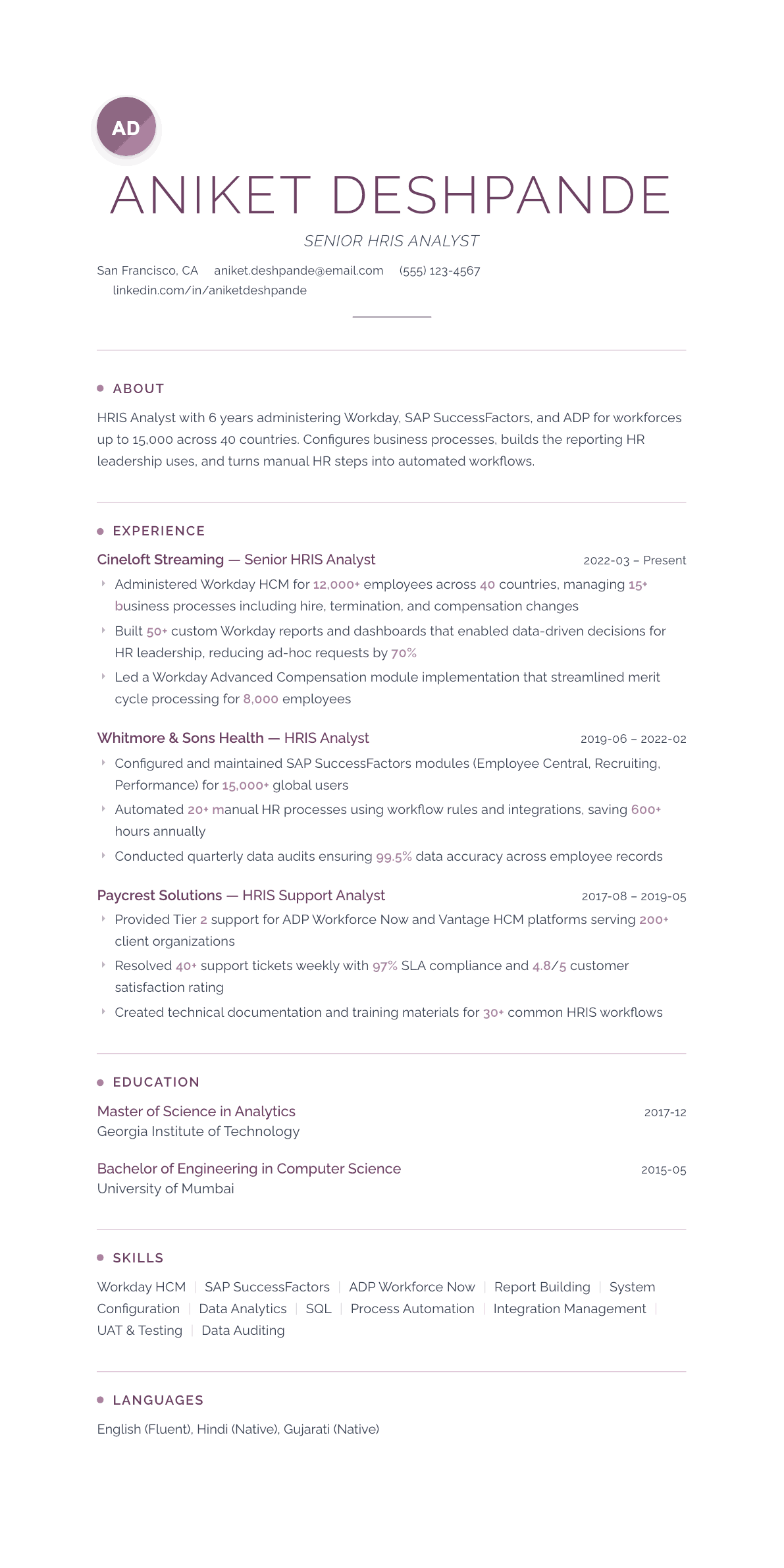
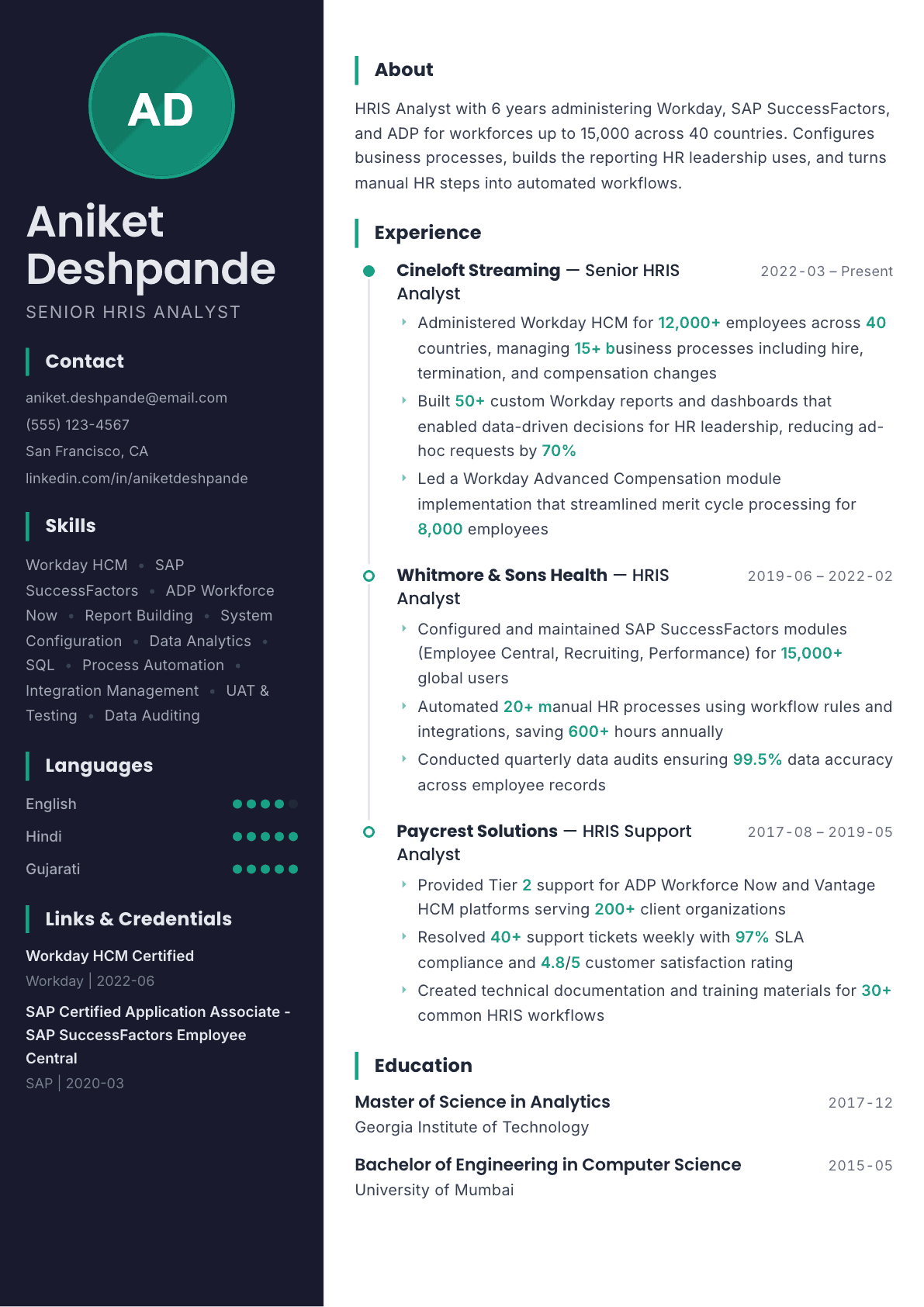
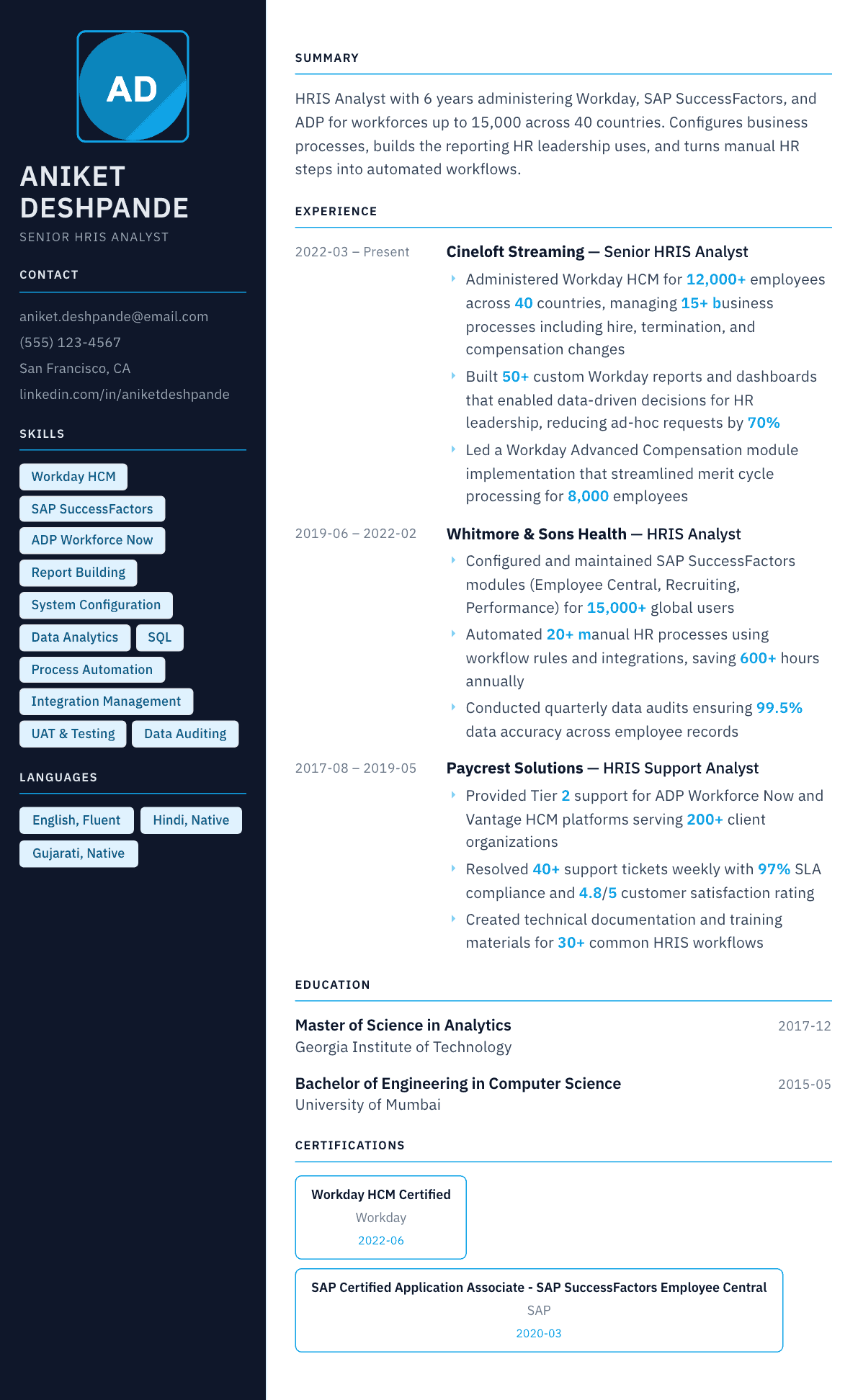
Example HRIS Analyst summary
HRIS Analyst, 6 years on Workday and SAP SuccessFactors at global scale. Built 50 custom reports, automated 20 HR processes for 600 hours a year saved, and holds employee data at 99.5% accuracy. Workday HCM certified, looking for a senior HRIS role.
Skills to list on a HRIS Analyst resume
- Workday HCM
- SAP SuccessFactors
- ADP Workforce Now
- System Configuration
- Report Building & Analytics
- SQL
- Process Automation
- Integration Management
- UAT & Testing
- Data Governance
- Business Process Design
- Payroll Integration
- Security Administration
- Change Management
What actually gets this resume read
- List specific HRIS platforms and modules you have administered (Workday HCM, SuccessFactors Employee Central, ADP Vantage).
- Quantify automation outcomes: hours saved, error reductions, and process efficiency improvements.
- Highlight report-building and analytics skills with specific tools (Workday Report Writer, BIRT, Crystal Reports, SQL).
- Include system implementation and migration experience with scope details (number of users, countries, modules).
- Showcase data governance accomplishments such as audit accuracy rates and data cleansing initiatives.
- Mention integration experience (API, middleware, flat-file) between HRIS and payroll, ATS, or LMS platforms.
How to write a hris analyst resume
The HRIS analyst sits between the people function and the systems that run it, and the resume has to satisfy both sides. An HR technology lead reads it for platform depth: which modules you configured, which business processes you own, whether you can build a calculated field or only run a delivered report. A hiring manager on the IT side reads it for engineering discipline: testing, environments, integrations, security roles and release cycles.
The strongest signal in this field is specificity of module. Saying you administer Workday tells a reader almost nothing, because Workday HCM, Advanced Compensation, Absence, Benefits, Recruiting and Payroll are close to different jobs. Saying you own Core HCM business processes, built the merit cycle in Advanced Compensation, and maintain a payroll integration through a middleware layer tells them exactly which chair you can fill.
This guide covers the layout that gets an HRIS analyst past both screens, three summaries from junior administrator to lead analyst, five rewritten bullets, and the questions analysts ask when their resume reads like a list of software rather than a record of systems ownership.
Format: technical block near the top, then projects inside each job
One or two pages depending on tenure, reverse chronological, single column so the parser does not scramble a systems block into prose. Directly under the summary, put a systems and tools block broken into three lines: HRIS platforms and modules, reporting and query tools, and integration or scripting tools. HR technology recruiters read that block first and often decide on it alone.
Inside each job, split the bullets into steady-state administration and named projects. Administration proves you can keep a system alive through a merit cycle and an open enrollment. Projects prove you can change it. A resume with only one of the two reads as either a ticket closer or an implementation contractor, and most teams want both.
- Systems line one: Workday HCM, SAP SuccessFactors Employee Central, ADP Workforce Now, with the modules.
- Systems line two: Workday Report Writer, calculated fields, BIRT, Crystal Reports, SQL, Excel modeling.
- Systems line three: EIB loads, Workday Studio, middleware, flat-file and API integrations.
Summary: population size, platform, and the depth of your access
Three sentences. The employee population and country count the system serves, the platform and modules you administer, and one project of consequence. Population and geography matter more here than in other HR roles because a system supporting employees in forty countries carries localization, data privacy and payroll complexity that a single-country instance never sees.
Say plainly what level of access you hold. Configuring business processes and security groups is a different job from raising tickets to a vendor partner, and an HRIS lead will ask in the first ten minutes anyway. Being clear on the resume prevents a wasted interview and reads as confidence.
Experience: configuration, reporting, integrations, data governance
Configuration bullets should name the business processes you own end to end: hire, job change, compensation change, termination, absence request. Say how many you maintain and whether you built the condition rules and approval routing, because approval chain design is where the real system knowledge lives.
Reporting is the second pillar and the one most analysts undersell. Do not write that you built reports. Write what class of report, who consumed it, and what it replaced. A dashboard that ended a weekly manual headcount reconciliation for the finance team is a business result; fifty unspecified custom reports is a number without a story.
Integrations are the third pillar and the strongest differentiator. Name the direction, the target system and the mechanism: an outbound payroll interface on a fixed schedule, an inbound benefits carrier file, an ATS to HRIS candidate handoff, a learning platform roster sync. Add the failure handling, since anyone who has run an interface knows the interesting part is what happens when a file does not land.
Data governance closes it. Audit reports you run on a schedule, data cleansing you led, field-level security you designed, and how you handle personal data access requests. This is what separates an analyst who can be trusted with the system of record.
Implementations and upgrades: state the phase you owned
Nearly every HRIS analyst has an implementation on their resume, and nearly all of them describe it the same way. Fix that by naming the phase and the artifacts. Requirements gathering with which stakeholder groups, design sessions, configuration workbooks, data conversion and reconciliation, unit and end-to-end testing, user acceptance testing coordination, cutover and hypercare.
Vendor-released updates deserve a bullet too. Twice-yearly platform releases mean regression testing on a schedule, and an analyst who has managed a release testing cycle across modules is immediately useful to a team that dreads it.
- Scope of the implementation: modules, countries, employee population, and the go-live window.
- Your phase and role: configuration lead, data conversion owner, test lead, or business analyst.
- Data conversion: records migrated, reconciliation method, and the error rate at cutover.
- Release management: regression test coverage and defects caught before production.
Keywords and the automation numbers that land
Postings for this role repeat a narrow vocabulary: system configuration, business process design, report building, data analytics, process automation, integration management, UAT and testing, data governance, security administration and payroll integration. Use those exact phrases where they are true, and pair each with the platform noun so both the automated search and the human read find them.
When you quantify automation, quantify it in hours returned to a named team rather than a vague efficiency claim. Hours saved on a merit cycle, ad hoc requests removed from the HR queue, or manual steps eliminated from an onboarding provisioning chain are all checkable numbers that a hiring manager can picture.
HRIS Analyst resume summary examples
Junior HRIS administrator
HRIS Analyst with 2 years administering ADP Workforce Now for a 1,200-employee employer. Maintains employee data, builds standard and custom reports, runs quarterly data audits, and supported the open enrollment configuration for two plan years. Strong SQL and Excel modeling.
Six years in
HRIS Analyst with 6 years administering Workday HCM and SAP SuccessFactors for global employers. Owns 15 business processes for twelve thousand employees across 40 countries, built 50 custom reports and dashboards, and automated 20 HR processes that returned roughly 600 hours a year to the HR operations team.
Lead analyst and implementation owner
Lead HRIS Analyst with 10 years across two Workday implementations and one SuccessFactors migration. Owns configuration, security design and integrations for a twenty-five-thousand-person instance, leads twice-yearly release regression testing, and manages two junior analysts and the vendor relationship.
Work experience bullets: before and after
Before: Administered Workday for the HR team.
After: Administered Workday HCM for twelve thousand employees across 40 countries, owning 15 business processes including hire, job change, compensation change and termination, with condition rules and approval routing maintained in house.
Naming the population, the module and the specific business processes shows configuration depth rather than user-level access.
Before: Built custom reports and dashboards.
After: Built 50 custom Workday reports and three leadership dashboards covering headcount, attrition and open requisitions, which retired a weekly manual reconciliation the finance team had run in a spreadsheet.
The consumer and the replaced process turn a report count into a business outcome.
Before: Worked on system integrations.
After: Maintained seven outbound integrations from Workday to payroll, benefits carriers and the learning platform, rebuilt the carrier file after a plan change, and added error alerting so failed runs were caught before the next payroll cycle.
Direction, targets and failure handling are what an integration owner is judged on, and the weak version proves none of them.
Before: Participated in a Workday implementation.
After: Owned data conversion for a Workday HCM implementation covering 8,000 employees: mapped six legacy sources, ran four mock loads through EIB, and reconciled record counts and key fields to a clean state before cutover.
Naming the phase, the mechanism and the reconciliation makes an implementation claim verifiable instead of generic.
Before: Improved data accuracy in the HRIS.
After: Designed a monthly audit report set covering missing manager assignments, invalid job codes and duplicate records, and drove a cleanup that brought core field completeness above 99% and held it across three quarters.
A named audit set and a sustained result show governance discipline rather than a one-off cleanup.
Hard skills
- Workday HCM configuration
- SAP SuccessFactors Employee Central
- ADP Workforce Now administration
- Business process and approval routing design
- Workday Report Writer and calculated fields
- SQL and data analysis
- EIB and mass data loads
- Integration management (API, middleware, flat file)
- Security group and role design
- UAT planning and regression testing
- Data governance and audit reporting
- Payroll interface support
Soft skills
- Requirements gathering
- Translating HR needs into configuration
- Stakeholder communication
- Change control discipline
- Documentation habit
- Vendor management
Certifications worth listing
- Workday HCM Pro (Workday)
- SAP Certified Application Associate, SuccessFactors Employee Central (SAP)
- SHRM Certified Professional (SHRM-CP) (Society for Human Resource Management)
- Professional in Human Resources (PHR) (HR Certification Institute)
- Prosci Change Management Certification (Prosci)
Mistakes that cost hris analyst candidates the interview
- Listing platforms without modules, which hides the difference between core administration and compensation or payroll depth.
- Claiming an implementation without naming the phase you owned, which every experienced reader treats as a red flag.
- Describing report volume with no consumer and no replaced process, so the count carries no meaning.
- Leaving integrations off the resume, even though they are the strongest differentiator in the HRIS market.
- Mixing steady-state administration and project work into one undifferentiated bullet list.
- Ignoring security and data governance, which is often the first area a lead probes in the interview.
HRIS Analyst resume questions
How technical does an HRIS analyst resume need to be?
Technical enough to prove configuration and reporting depth, but written so an HR director can follow it. Name modules, business processes, report types and integration mechanisms, then explain the outcome in plain HR terms so both reviewers can score the same bullet.
Should I list SQL if I only use it occasionally?
List it if you can write joins and aggregate queries against an HR data set without help. Say where you used it, such as reconciliation queries or data validation before a load. Overstating it is risky because a technical screen for this role frequently includes a live query question.
How do I show implementation experience if I was not the lead?
Name the workstream you personally owned, such as data conversion, test coordination, or configuration of a single module. A clearly bounded contribution described in detail reads far better than an implied leadership claim that collapses in the interview.
Is HRIS analyst an HR job or an IT job?
It reports either way depending on the employer, so write for both. Keep the compliance and lifecycle vocabulary that HR expects, and keep testing, environments, security roles and release cycles that IT expects. A file weighted entirely toward one side loses the other reader.
What certifications actually help an HRIS analyst?
Platform credentials carry the most weight, particularly vendor training tied to the system the employer runs. A general HR credential such as SHRM-CP helps when the role sits inside HR, and a change management certification helps when the job includes rollouts and adoption work.
Related resume examples
- Compensation Analyst Resume example
- HR Manager Resume example
- Benefits Administrator Resume example
- HRIS Manager Resume example
- HR Data Analyst Resume example
- Workforce Planning Analyst Resume example