HR Administrator Resume Examples: the lines they read
Write an HR Administrator Resume Built on Clean Records
By Mustafa Tarabya, founder of CVBooster · Published · Updated
An HR administrator resume sample with system and compliance bullets, the HRIS keywords screeners search, and a guide to each resume section.
Sample resumes for a hr administrator
The same hr administrator content laid out in three CVBooster templates, so you can see what the finished document looks like before you write a word.
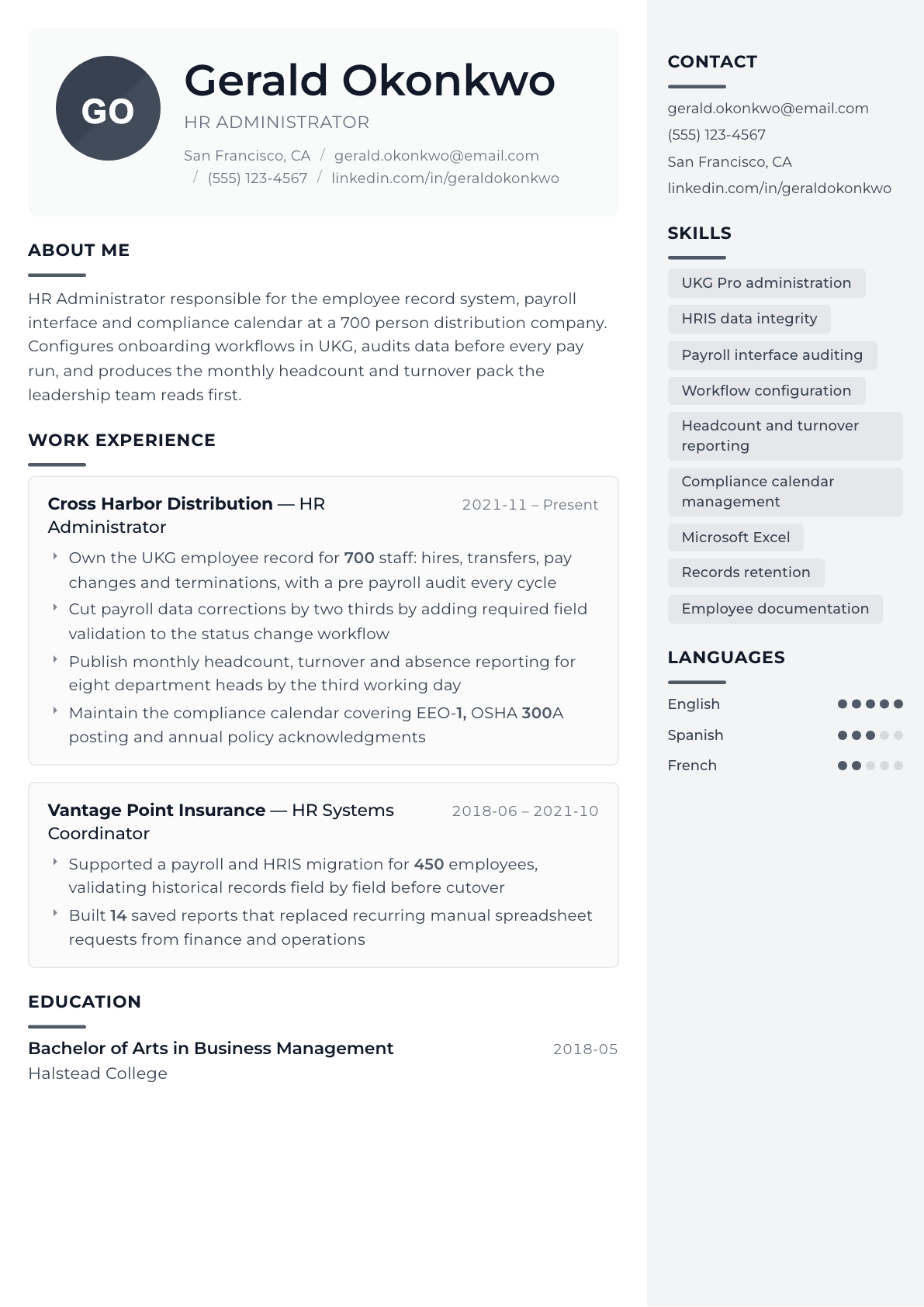
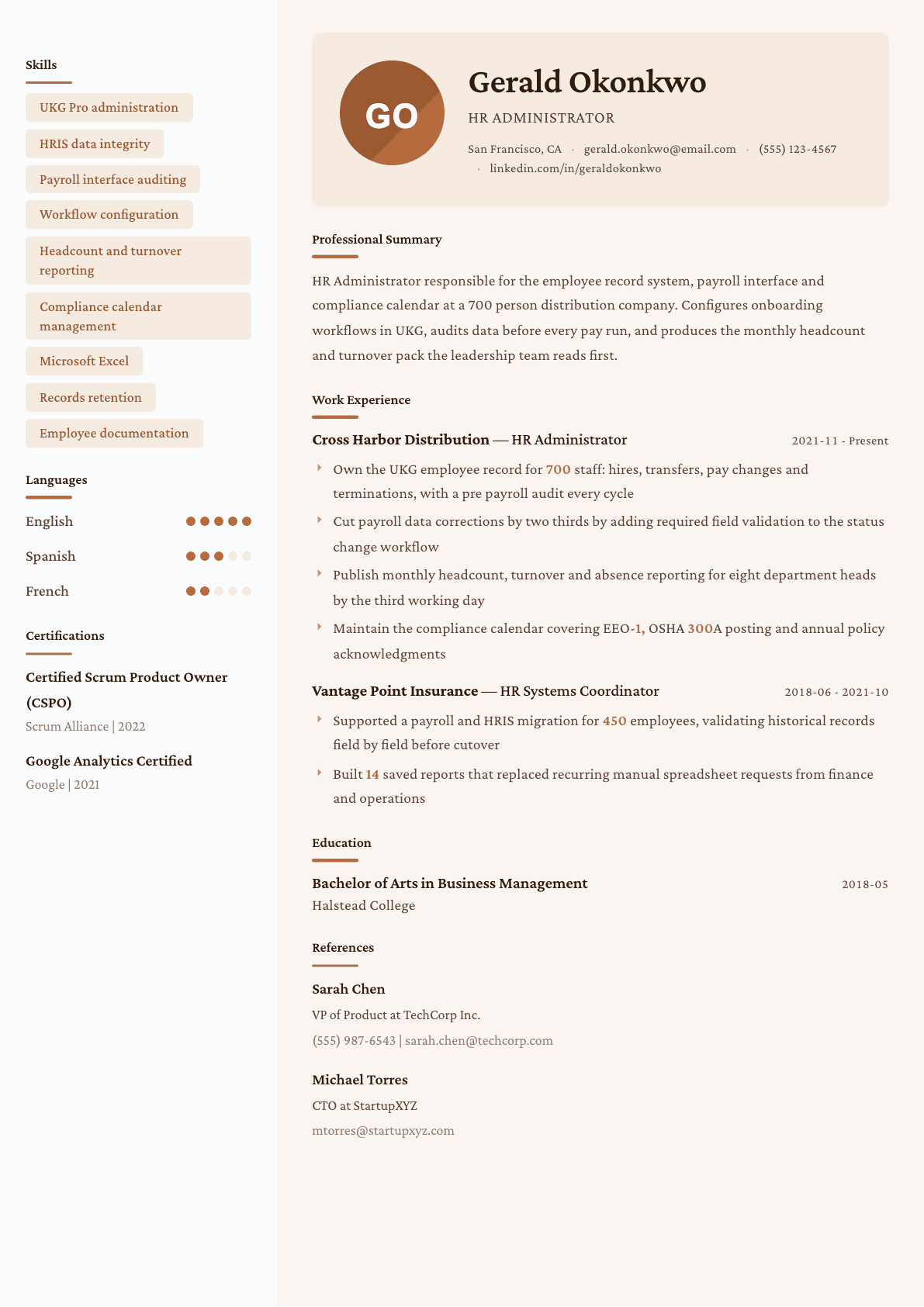
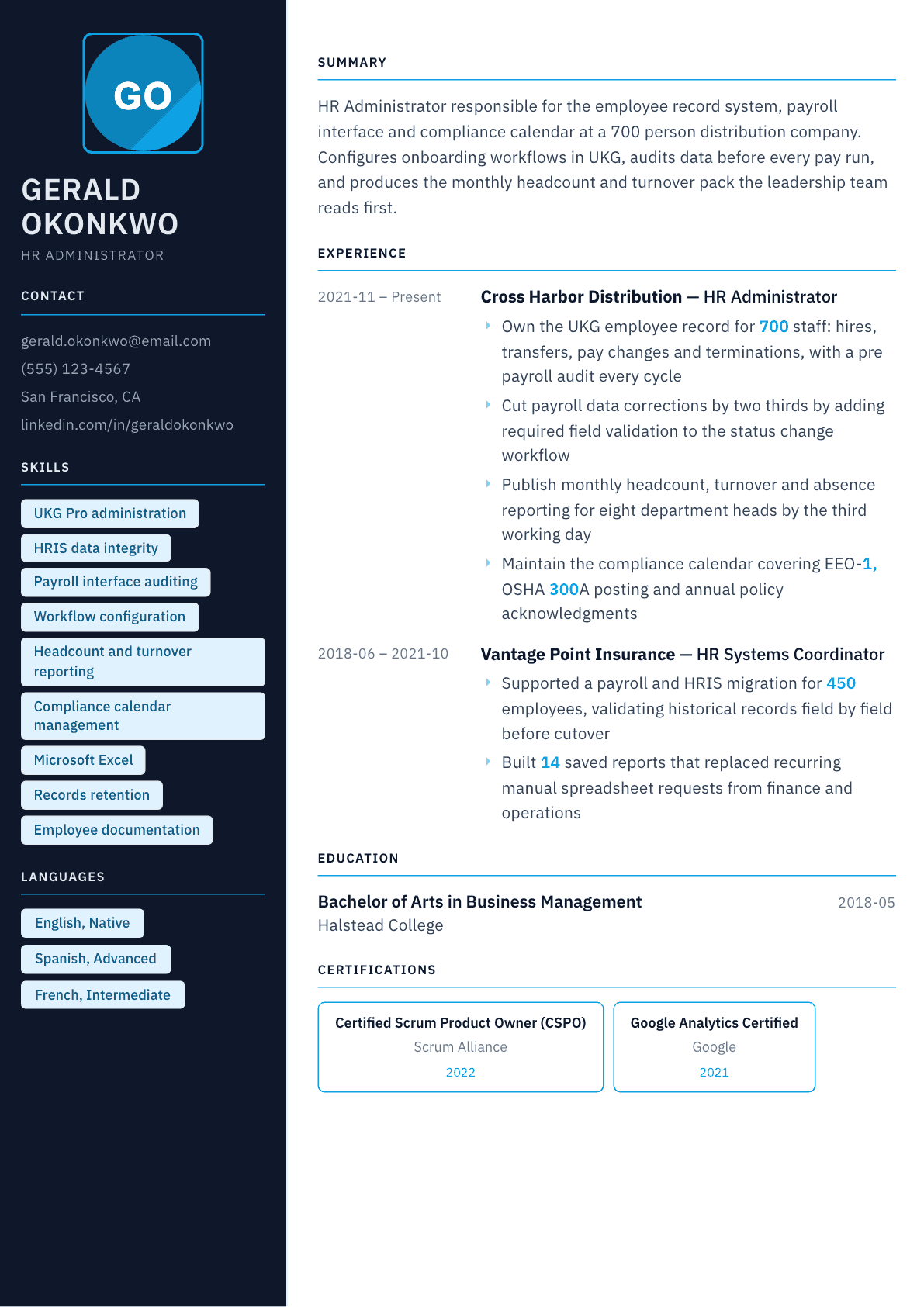
Example HR Administrator summary
HR Administrator with seven years owning employee records, payroll interfaces and the compliance calendar for employers of up to 700 people. Configures onboarding and status change workflows in UKG, audits every pay cycle before submission, and delivers monthly headcount and turnover reporting on a fixed deadline. Supported a full HRIS migration through record validation and cutover. Seeking an HR operations focused administrator role.
Skills to list on a HR Administrator resume
- HRIS administration
- UKG Pro
- Workday
- Payroll interface auditing
- Data integrity controls
- Workflow configuration
- HR reporting and dashboards
- Records retention and file management
- EEO-1 and OSHA recordkeeping
- Policy acknowledgment tracking
- Microsoft Excel
- System implementation support
- Employee documentation
- Process documentation
- Vendor and system support tickets
What actually gets this resume read
- Frame the role as system ownership: which HRIS, how many records, and which upstream and downstream systems you feed.
- Show a data quality result, such as a drop in payroll corrections or a clean audit, because accuracy is the whole job.
- List the recurring reports you produce and their deadline, since reliability on a calendar is what a manager buys.
- Name the compliance filings you maintain rather than claiming general knowledge of employment regulations.
- Describe any system migration or implementation you worked on, including your specific piece of the validation work.
- Keep the resume free of recruiting language unless you truly own requisitions, or you will be screened for the wrong seat.
How to write a hr administrator resume
The HR administrator is the person the payroll run depends on. When a status change is entered wrong, a new hire misses a first paycheck. When the compliance calendar slips, a filing is late. The manager hiring for this seat is not looking for someone inspirational, she is looking for someone whose records are correct on the first pass and whose deadlines never move.
That reality should shape the whole resume. The strongest HR administrator documents read like an operating record: this is the system I own, this is the population inside it, this is the audit I run before every cycle, this is the reporting that goes out on a fixed date. Achievements come in the form of errors removed and processes that stopped needing a reminder.
This guide lays out that structure, shows three summaries from a first systems role through senior operations work, converts common soft bullets into evidence a manager can check, and answers the questions administrators ask when they are competing with candidates who all claim attention to detail.
Format: system ownership visible before the first bullet
One page early, two once you have carried an implementation and several years of reporting ownership. Under each job title, name the HRIS, the employee population and the systems on either side of it, meaning the payroll platform it feeds and the applicant tracking or benefits tools it receives from. Administrators are hired against a specific stack, so putting that stack in plain view saves the reader the search.
Use simple structure and consistent date formatting. It sounds trivial, but a resume for a records role that has inconsistent dates or a misaligned column undercuts the exact claim you are making about yourself.
- Name the HRIS version or module set where it matters, since configuration depth varies widely between them.
- Sections: summary, systems and reporting, professional experience, education, certifications.
- Keep recruiting language minimal unless you truly own requisitions, or you will be routed to the wrong opening.
Summary: records owned, cycles run, deadlines met
Three lines. State the population whose records you maintain, the system you administer, the payroll cadence you support, and the recurring reporting you deliver. Reliability is the product here, so the summary should read like a service description rather than a personality sketch.
Add one line of evidence. A drop in payroll corrections, a clean audit, a migration you validated, a report suite that replaced manual requests. Administrators rarely get promoted for volume alone, they get promoted for removing recurring failure, and that is what the summary should promise.
Experience: the pre payroll audit and the rest of the control set
Write your controls down. The pre payroll audit, the monthly reconciliation between the HRIS and payroll, the termination checklist that confirms system access removal, the quarterly file review. Each one is a specific practice that a hiring manager will recognize instantly, and together they distinguish an administrator from a data entry clerk with a better title.
Then quantify what the controls prevent. Corrections avoided, off cycle payments eliminated, discrepancies caught before submission, an audit closed with no findings. Framing accuracy as prevention rather than as effort is the shift that makes these bullets land.
Configuration work belongs in its own bullet if you have done it. Building a status change workflow, adding required field validation, creating security roles or writing saved reports are all higher value than transaction processing, and they are the bridge to an HR systems analyst path later.
Reporting: the pack, the deadline, the audience
Recurring reporting is the visible half of the job. Name the pack you produce, the metrics inside it such as headcount, turnover, absence and open requisitions, the audience, and the working day it lands. A reader who sees a fixed delivery date understands that you run a calendar, not a queue of requests.
Mention the ad hoc side too, because it is where the time goes. Say how you reduced it, whether by building saved reports, giving managers self service access or standardizing definitions so two departments stop producing different turnover numbers from the same source.
Compliance calendar: name the filings you keep
List the recurring obligations you track rather than claiming general compliance knowledge. EEO-1 data preparation, the annual OSHA summary posting period, policy acknowledgment collection, I-9 file reviews and records retention schedules are concrete, checkable and specific to this role.
If you have supported an internal or external audit, describe your part: assembling the sample, reconciling the population, producing the evidence, closing the findings. Audit experience is one of the clearest separators between an administrator ready for an operations manager seat and one who is not.
HR Administrator resume summary examples
First systems seat
HR coordinator moving into a systems focused administrator role after two years of data entry, onboarding paperwork and status changes for three hundred employees. Runs a weekly accuracy check against payroll and has built six saved reports for department managers. Seeking an HR administrator role with configuration exposure.
Four years administering the HRIS
HR Administrator owning the employee record for seven hundred staff in UKG, including hires, transfers, pay changes and terminations with a pre payroll audit every cycle. Publishes monthly headcount, turnover and absence reporting for eight department heads by the third working day, and maintains the compliance calendar.
Senior HR operations
Senior HR Administrator with eight years across insurance and distribution, including a full payroll and HRIS migration for four hundred fifty employees. Owns data governance, workflow configuration and the recurring reporting suite, and has supported two external audits with no findings. Moving toward HR operations management.
Work experience bullets: before and after
Before: Maintained accurate employee records in the HR system.
After: Owned the UKG employee record for seven hundred staff across hires, transfers, pay changes and terminations, with a documented pre payroll audit every cycle.
The system, the population, the transaction types and the control turn maintenance into ownership.
Before: Reduced errors in payroll data.
After: Cut payroll data corrections by two thirds by adding required field validation to the status change workflow so incomplete records could not be submitted.
The mechanism explains how the improvement happened and proves it was designed rather than lucky.
Before: Provided reports to management.
After: Published a monthly headcount, turnover and absence pack for eight department heads by the third working day, replacing eleven recurring spreadsheet requests.
A named audience, a fixed deadline and the manual work removed give the reporting real shape.
Before: Helped with a system implementation.
After: Validated historical records field by field for four hundred fifty employees ahead of an HRIS cutover, resolving mapping conflicts in job codes and location hierarchy before go live.
Describing your specific validation work is far stronger than being present during a project.
Before: Kept the company compliant with regulations.
After: Maintained the compliance calendar covering EEO-1 data preparation, the annual injury summary posting period and companywide policy acknowledgments, with each item closed on schedule.
Named obligations on a tracked calendar are verifiable, while general compliance claims are not.
Hard skills
- HRIS administration
- UKG Pro
- Workday
- Payroll interface auditing
- Data integrity controls
- Workflow and form configuration
- HR reporting and dashboards
- Records retention
- EEO-1 data preparation
- Policy acknowledgment tracking
- System implementation and testing
- Advanced Excel
Soft skills
- Methodical checking
- Deadline discipline
- Clear escalation
- Documentation habit
- Confidentiality
- Patience with recurring requests
Certifications worth listing
- Associate Professional in Human Resources (aPHR) (HR Certification Institute)
- SHRM Certified Professional (SHRM-CP) (Society for Human Resource Management)
- Workday Pro Certification (Workday)
Mistakes that cost hr administrator candidates the interview
- Describing the job as data entry when the real value is the control set that protects the payroll run.
- Failing to name the HRIS and the systems it connects to, which is the first filter most of these postings apply.
- Reporting activity volume with no accuracy outcome, so the reader cannot tell good work from busy work.
- Claiming compliance responsibility without naming a single recurring filing or review you actually maintain.
- Hiding implementation or migration experience in a general project bullet when it is a promotion level differentiator.
- Submitting a resume with inconsistent dates or formatting while claiming meticulous record accuracy.
HR Administrator resume questions
What is the difference between an HR administrator and an HR coordinator?
A coordinator usually runs people facing processes such as onboarding and scheduling, while an administrator owns the record system, the payroll interface and recurring reporting. The titles overlap at small employers, so describe the work rather than relying on the label.
How technical does this role need to be?
You need configuration comfort rather than programming. Building workflows, saved reports, security roles and validation rules is normally enough, though strong spreadsheet skills and some familiarity with data structures make the reporting half of the job much easier.
How do I show data accuracy on a resume?
Point to a control and its result. A pre payroll audit that cut corrections, a reconciliation that catches discrepancies before submission, or an audit closed with no findings all show accuracy as an outcome instead of as a personal quality you assert.
Should I list every HR system I have used?
List the ones you administered and separate them from ones you only used lightly. Depth in one platform plus honest exposure to two others reads better than an undifferentiated list that collapses under a single practical interview question.
What is the natural next step from HR administrator?
Most people move toward HR systems analyst, HRIS manager or HR operations manager. Build toward it by taking configuration work, owning an implementation workstream and turning reporting into governance, since that combination is what those postings ask for.
Related resume examples
- HRIS Analyst Resume example
- Human Resources Resume example
- HR Operations Manager Resume example
- HRIS Manager Resume example
- HR Intern Resume example
- People Operations Manager Resume example