HRIS Manager Resume Examples: free ATS score and gap list
Write an HRIS Manager Resume That Shows System Ownership
By Mustafa Tarabya, founder of CVBooster · Published · Updated
An HRIS manager resume example covering module ownership, releases, integrations and security roles, plus ATS keywords and a full writing guide.
Sample resumes for a hris manager
The same hris manager content laid out in three CVBooster templates, so you can see what the finished document looks like before you write a word.
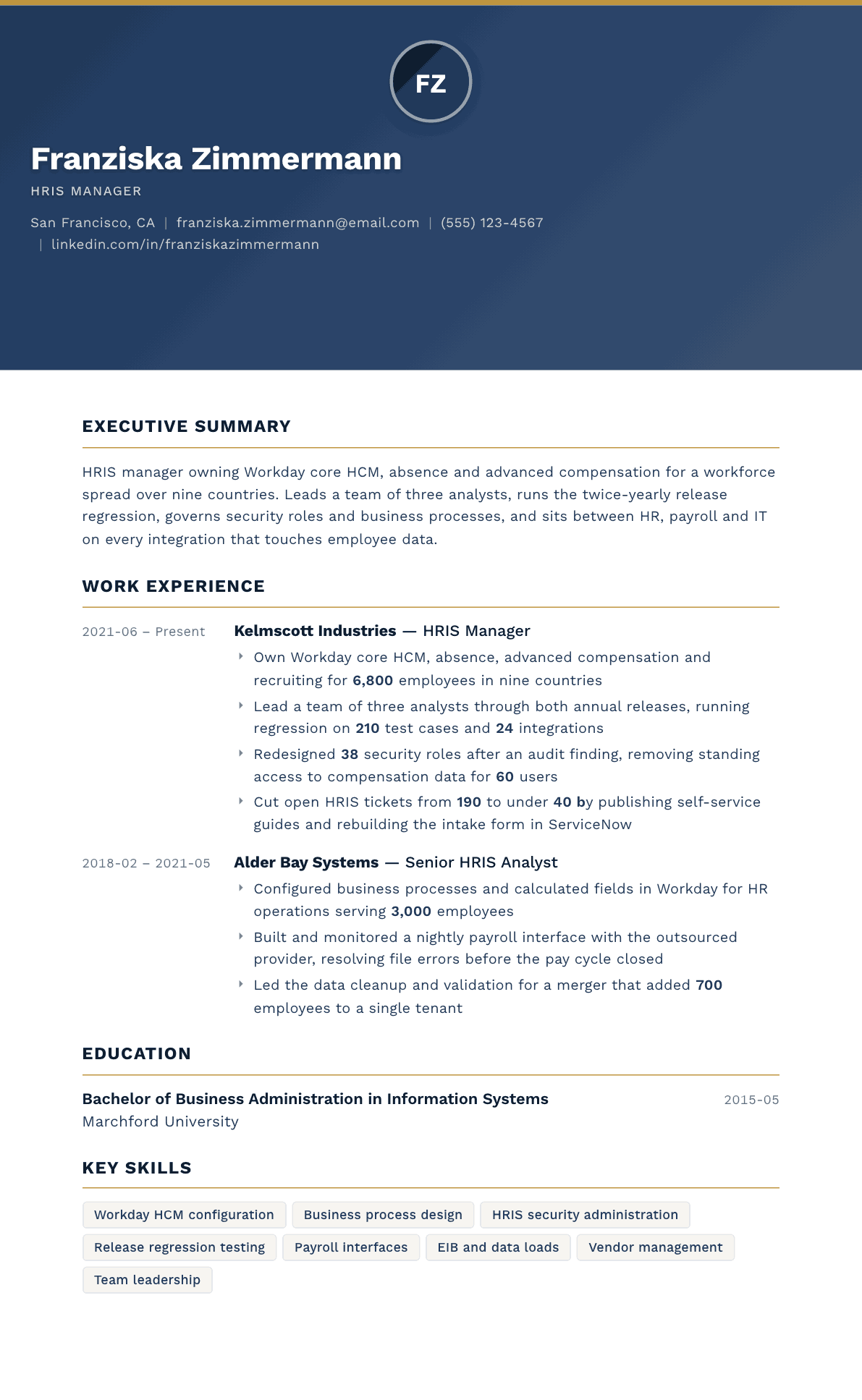
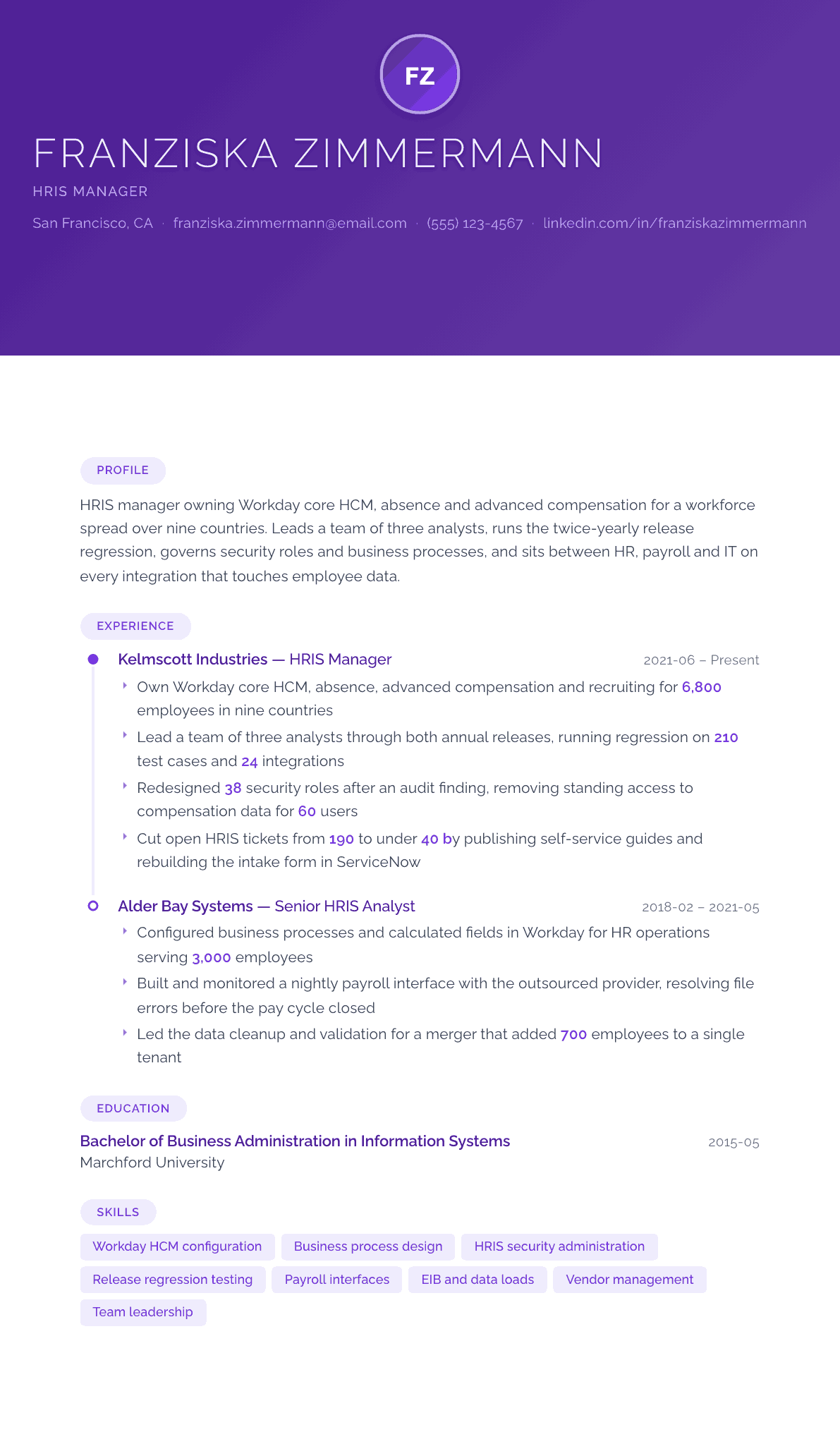
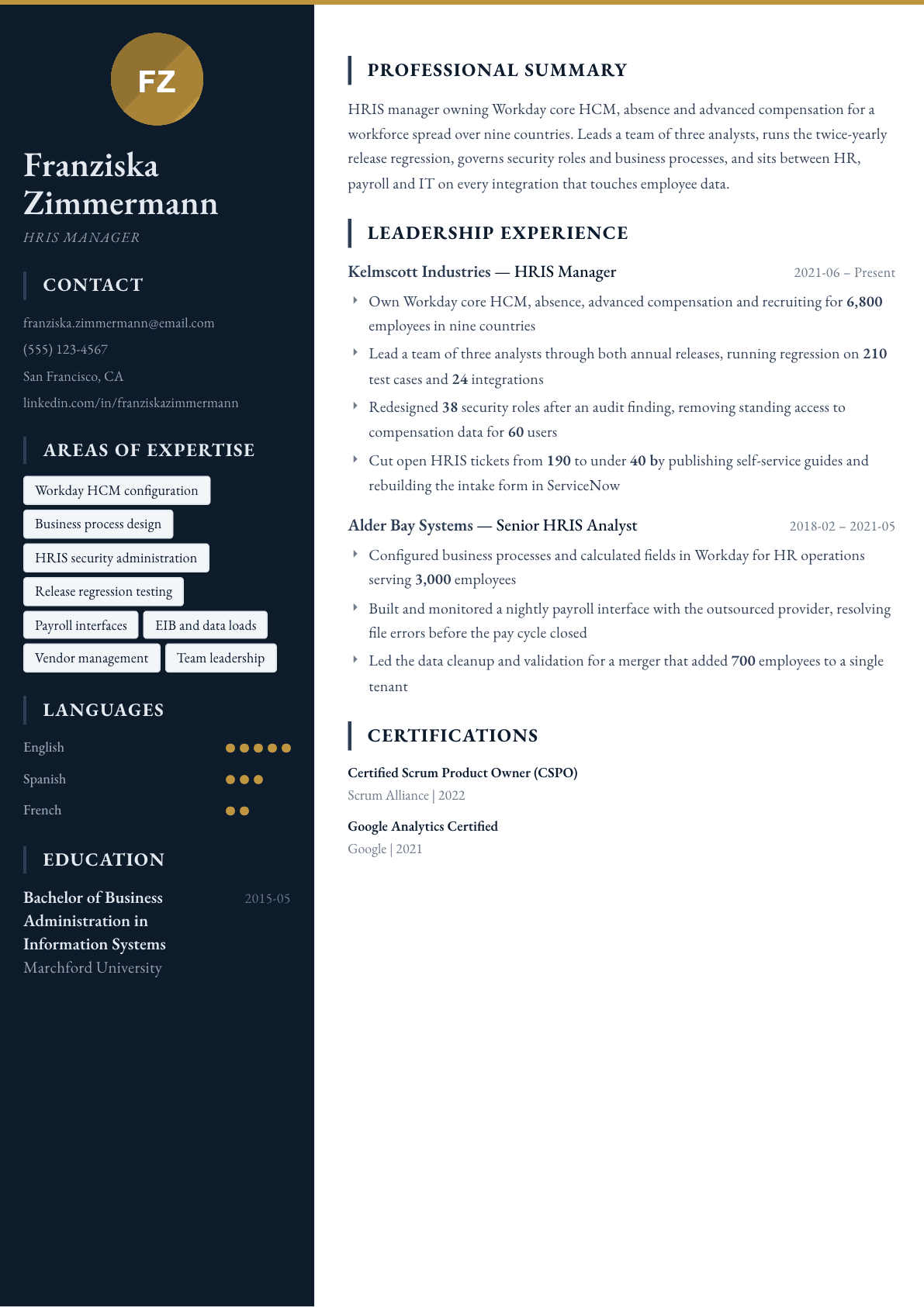
Example HRIS Manager summary
HRIS manager with eight years in Workday, the last four owning core HCM, absence and advanced compensation for 6,800 employees across nine countries. Leads three analysts through both annual releases, governs security roles after a clean audit cycle, and keeps the payroll and benefits integrations stable. Trusted by HR, payroll and IT to translate a policy change into working configuration.
Skills to list on a HRIS Manager resume
- Workday HCM
- SAP SuccessFactors
- Business process configuration
- HRIS security roles
- Release management
- Regression testing
- Integration monitoring
- EIB data loads
- Calculated fields
- Payroll interfaces
- Data governance
- Vendor management
- Requirements gathering
- Team leadership
- ServiceNow
What actually gets this resume read
- Name every module you actually own, because a Workday absence owner and a compensation owner are screened as different candidates.
- Give the tenant size in employees and the number of countries, since global configuration is what raises the difficulty.
- Show release work: how many test cases you regress, how many integrations you validate, and who signs off.
- Prove security governance with a real example, such as a role redesign or an audit finding you closed.
- Say how large your team is and how you split configuration, reporting and support across it.
- Include the ticketing platform and your support volume, because HRIS managers are measured on backlog as well as projects.
How to write a hris manager resume
The person hiring an HRIS manager has usually just lived through a bad release, a failed payroll interface or an audit finding about who could see compensation data. They are not reading your resume for enthusiasm about HR technology. They are reading it to work out whether you have owned a tenant through a full year of change without breaking payroll.
That makes module ownership the spine of the resume. Core HCM, absence, time tracking, benefits, advanced compensation, recruiting and talent each carry different configuration depth, and a candidate who has only ever supported core HCM is screened differently from one who has configured a compensation cycle. Say exactly which modules you own and which you support.
This guide covers how to present tenant scope, release and regression work, security governance, integrations and the support backlog, with summaries for three career stages and the questions HRIS professionals ask when their resume stops getting replies.
Format: two pages is normal, systems block near the top
Reverse-chronological with a short systems block under the summary listing the platform, the modules you own, and the integration and ticketing tools. HRIS managers accumulate a lot of configuration detail and two pages is expected once you have run releases.
Give each employer a scope line before the bullets: employees supported, countries in the tenant, number of legal entities or payroll groups, and team size if you manage people. Global tenants with multiple payroll providers are a different job from one country on a single provider, and the reader cannot infer it.
- Header: name, city and state, phone, email, and the certification abbreviation if you hold a platform credential.
- Section order: summary, systems and modules, experience, projects if you have led large ones, education, certifications.
- Analysts stepping up to manager should show team leadership or project leadership even without direct reports.
Summary: platform, modules, population, team
Four lines. Name the platform, the modules you personally own, the population and geography of the tenant, the size of your team, and one thing you are known for such as a clean audit, a stable payroll interface or a consolidation.
Resist listing every system you have ever touched. A summary claiming Workday, SuccessFactors, UKG, Oracle and ADP reads as shallow exposure. Lead with the one you are deep in and put the others in the systems block.
Experience: configuration, releases, security, integrations, support
Build each job from five bullet families. Configuration: business processes, condition rules, calculated fields, eligibility rules, and the policy changes you translated into working setup. Releases: how many test cases you regress, how many integrations you validate, who signs off, and how you handle features that arrive turned on. Security: roles designed, access removed, segregation of duties, and audit findings closed.
Integrations: name the direction and the counterparty type, such as an outbound payroll file to a provider, an inbound benefits eligibility feed from a carrier, or a bidirectional connection with an identity system. Say how failures are detected before they reach a pay run, because that is the question every interviewer asks.
Support: your ticket volume, the backlog you inherited, the backlog you left, and what you did to shift it. Configuration projects are visible; a stable support function is what keeps an HRIS manager in the job.
- Distinguish owning a module from supporting one, and never blur the two.
- Name the data load method you use, such as enterprise interface builder files or the equivalent on your platform.
- Say whether the tenant is single or multiple, and whether you manage sandbox refresh cycles yourself.
Projects: one block for the big ones
If you have led an implementation, a merger data migration, a payroll provider change or a module deployment, give it a short block with the scope, your role and the outcome. Recruiters searching for implementation experience look for the word next to a system name and a population size.
Be precise about your role. Leading a workstream is not leading a project, and a hiring manager who has run an implementation will ask which one you did. Claiming more than you owned is the fastest way to lose a final round.
Keywords and the words postings actually use
HRIS postings repeat a narrow set of phrases: business process configuration, security administration, release management, regression testing, integration monitoring, data integrity, reporting and dashboards, system upgrades, vendor management, and the platform name with the module name beside it. Mirror the exact combination the posting uses, such as absence configuration rather than time off setup.
Add the ticketing and project tools you work in. Many HR technology teams filter for candidates who have run intake through a service management platform, because it changes how the function operates.
HRIS Manager resume summary examples
Analyst moving up
HRIS analyst with three years configuring core HCM and absence in Workday for 2,000 employees in two countries. Owns business process changes, builds custom reports and calculated fields, and led regression on one release. Ready for a manager seat with module ownership and a small team.
Six years in
HRIS manager owning core HCM, absence and advanced compensation in Workday for 6,800 employees across nine countries, with three analysts reporting in. Runs both annual releases across 210 test cases and 24 integrations, and rebuilt 38 security roles after an audit finding without disrupting the pay cycle.
HR technology lead
HR technology leader responsible for the full HCM landscape at a manufacturer of 14K employees: core HCM, payroll interfaces, benefits, recruiting and a case management layer. Led the consolidation of four legacy systems into one tenant and manages a team of seven plus two implementation partners.
Work experience bullets: before and after
Before: Configured Workday business processes for HR.
After: Configured and maintained 60 business processes across hire, job change and termination for a nine-country tenant, including condition rules that route approvals by legal entity.
The count, the process names and the routing logic show configuration depth rather than familiarity with a menu.
Before: Supported the twice yearly system releases.
After: Led both annual releases with a team of three, regressing 210 test cases and validating 24 integrations in sandbox before sign-off from HR operations and payroll.
Leading with the scale of the regression and naming who signs off proves you have run the cycle, not attended it.
Before: Managed system security and access.
After: Redesigned 38 security roles after an internal audit finding, removing standing access to compensation data for 60 users and documenting segregation of duties for each domain.
A named trigger, a specific access change and documentation are what an auditor asks about in the interview.
Before: Worked on the payroll integration.
After: Owned the nightly outbound payroll interface to the external provider, adding a file validation step that caught mapping errors before the pay run rather than after it.
The control you added is the story; monitoring an interface without preventing failures is table stakes.
Before: Reduced the HRIS support backlog.
After: Cut open HRIS tickets from 190 to under 40 in two quarters by rebuilding the intake form, publishing seven self-service guides and routing password and access requests to the service desk.
Three concrete actions behind the number let the reader judge whether the improvement will hold.
Hard skills
- Workday HCM configuration
- SAP SuccessFactors
- Business process and condition rules
- Calculated fields and custom reports
- Security role design
- Release and regression management
- Integration monitoring and file validation
- Enterprise interface builder data loads
- Payroll and benefits interfaces
- Tenant and sandbox management
- Data integrity auditing
- Vendor and implementation partner management
- Service management intake
Soft skills
- Translating a policy change into configuration
- Managing a small technical team
- Staying calm during a broken pay cycle
- Requirements gathering with non-technical HR staff
- Written change documentation
Certifications worth listing
- Workday Pro Certification (Workday)
- SAP Certified Associate: SAP SuccessFactors Employee Central (SAP)
- Senior Professional in Human Resources (SPHR) (HR Certification Institute)
- Project Management Professional (PMP) (Project Management Institute)
Mistakes that cost hris manager candidates the interview
- Listing five platforms at equal depth, which signals shallow exposure to all of them.
- Saying you managed the HRIS without naming a single module you configured.
- Leaving out tenant scope, so a global multi-payroll environment reads like a single-country setup.
- Describing releases as supported rather than led, when you actually ran the regression.
- Omitting security work entirely, which is often the first question an audit-scarred employer asks.
- Claiming implementation leadership for a workstream you contributed to.
- Filling the page with project names and never mentioning the ongoing support load you carry.
HRIS Manager resume questions
How much configuration experience does an HRIS manager need?
Enough to make changes yourself and to review an analyst's work before it reaches production. Most employers want a manager who still configures, because small HR technology teams cannot afford a leader who only coordinates. Show recent hands-on work in the current job.
Should I list every module I have touched?
List them, but mark ownership clearly. Put the modules you configure and maintain in the summary and the rest in a systems block. A reader who discovers in the interview that your compensation experience was one training session will end the process there.
Is a platform certification necessary?
Not always, but a vendor credential removes doubt about depth and some postings screen on it. Access to certain vendor certification programs depends on your employer being a customer or partner, so note the training you have completed if the credential itself is out of reach.
How do I show release management if my team was tiny?
Scale is not the point; process is. Say how you reviewed the release notes, which features you tested, how you built the regression list, what you turned off before it went live, and who approved the change. A small tenant run carefully reads well.
What if my experience is on a legacy system nobody advertises for?
Lead with the transferable work: business process design, security models, integrations, data integrity and release testing. Then say plainly which modern platform you are learning and how far you have got. Employers hire for judgment when the configuration skill is clearly there.
Related resume examples
- HRIS Analyst Resume example
- Human Resources Resume example
- HR Operations Manager Resume example
- HR Data Analyst Resume example
- HR Administrator Resume example
- People Operations Manager Resume example