Logistics Coordinator Resume Examples: read this first
Coordinate a Winning Logistics Resume
By Mustafa Tarabya, founder of CVBooster · Published · Updated
Logistics Coordinator resume examples with expert tips, ATS keywords, and professional templates. See exactly what a winning senior logistics coordinator resume looks like.
Sample resumes for a logistics coordinator
The same logistics coordinator content laid out in three CVBooster templates, so you can see what the finished document looks like before you write a word.
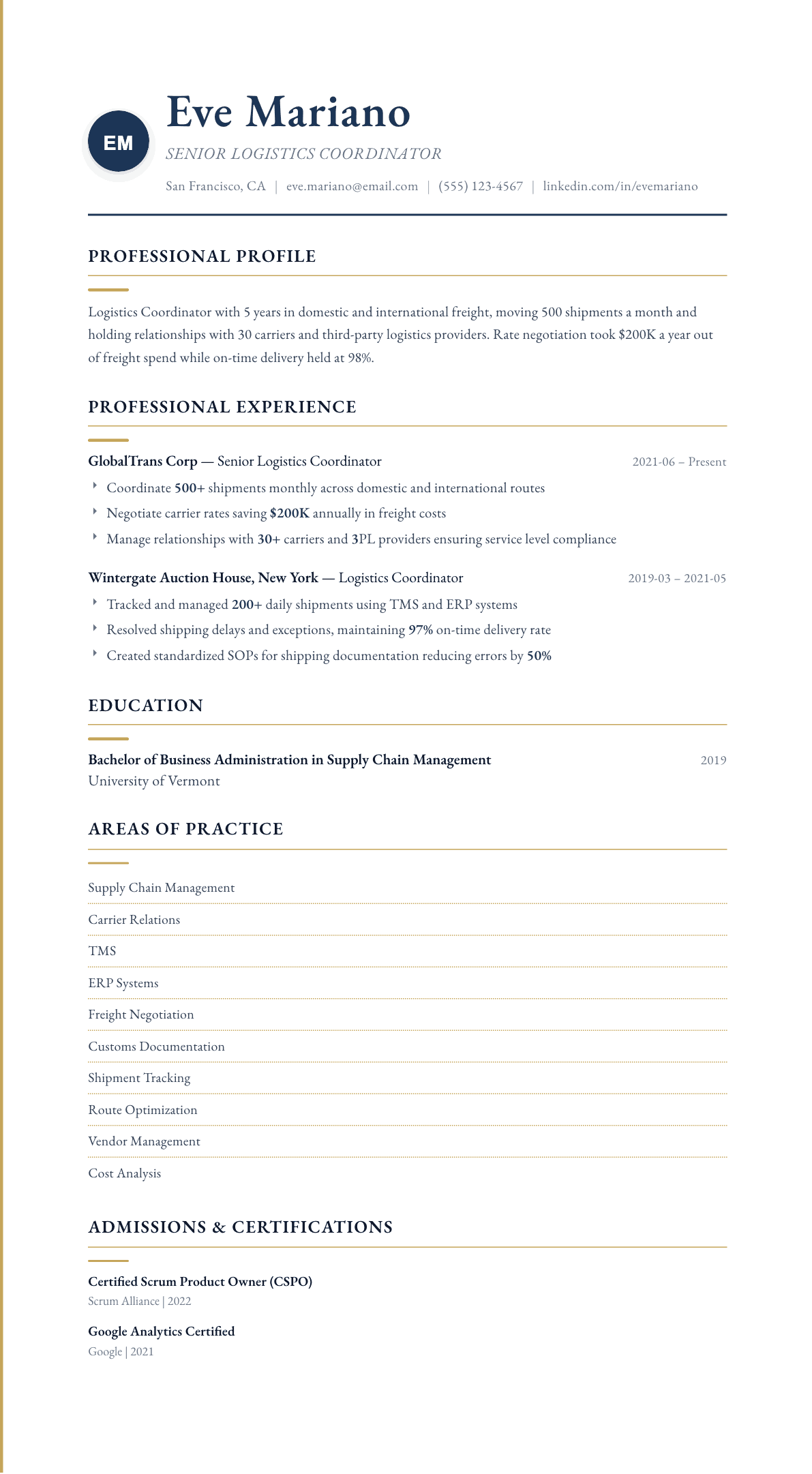
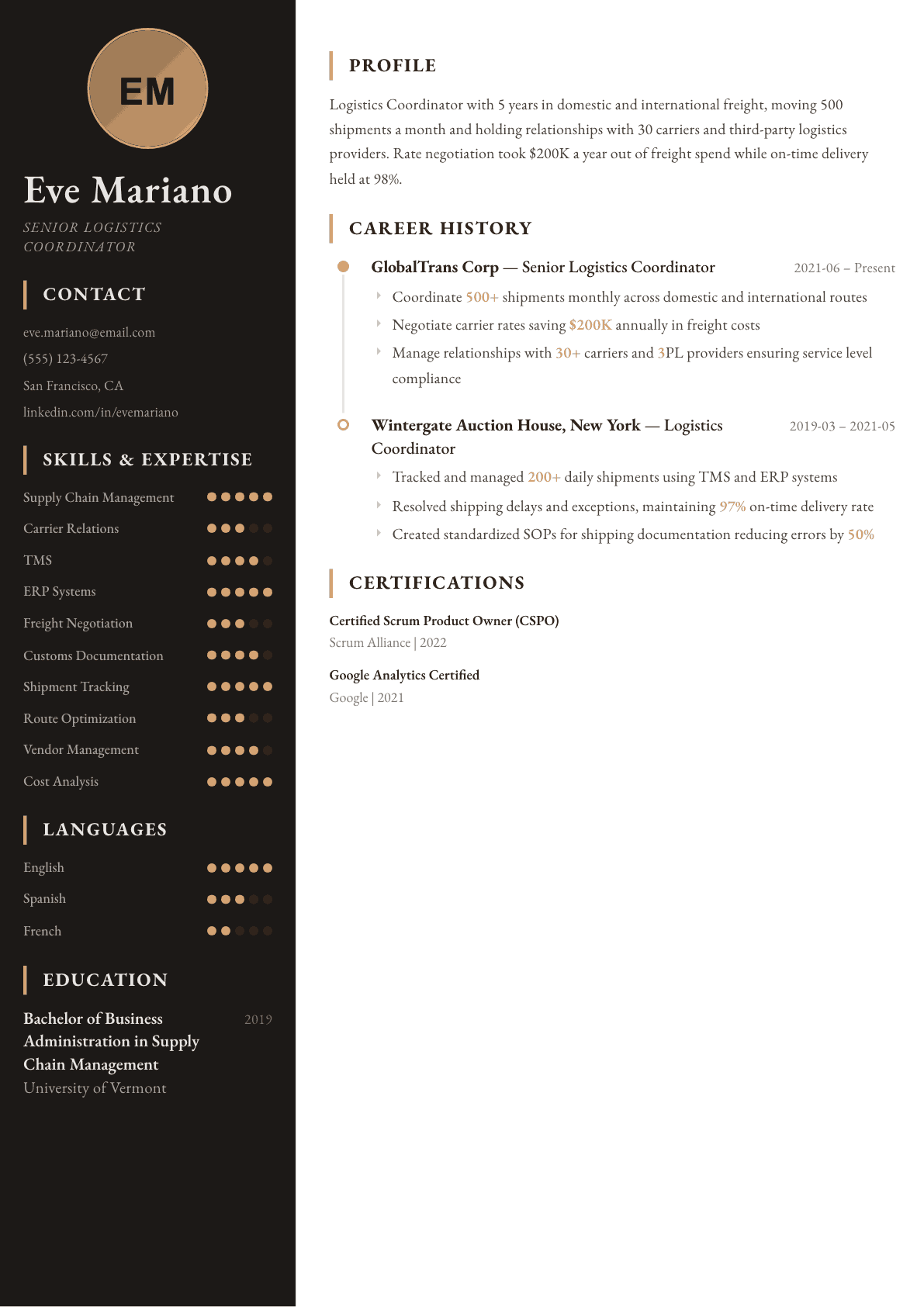
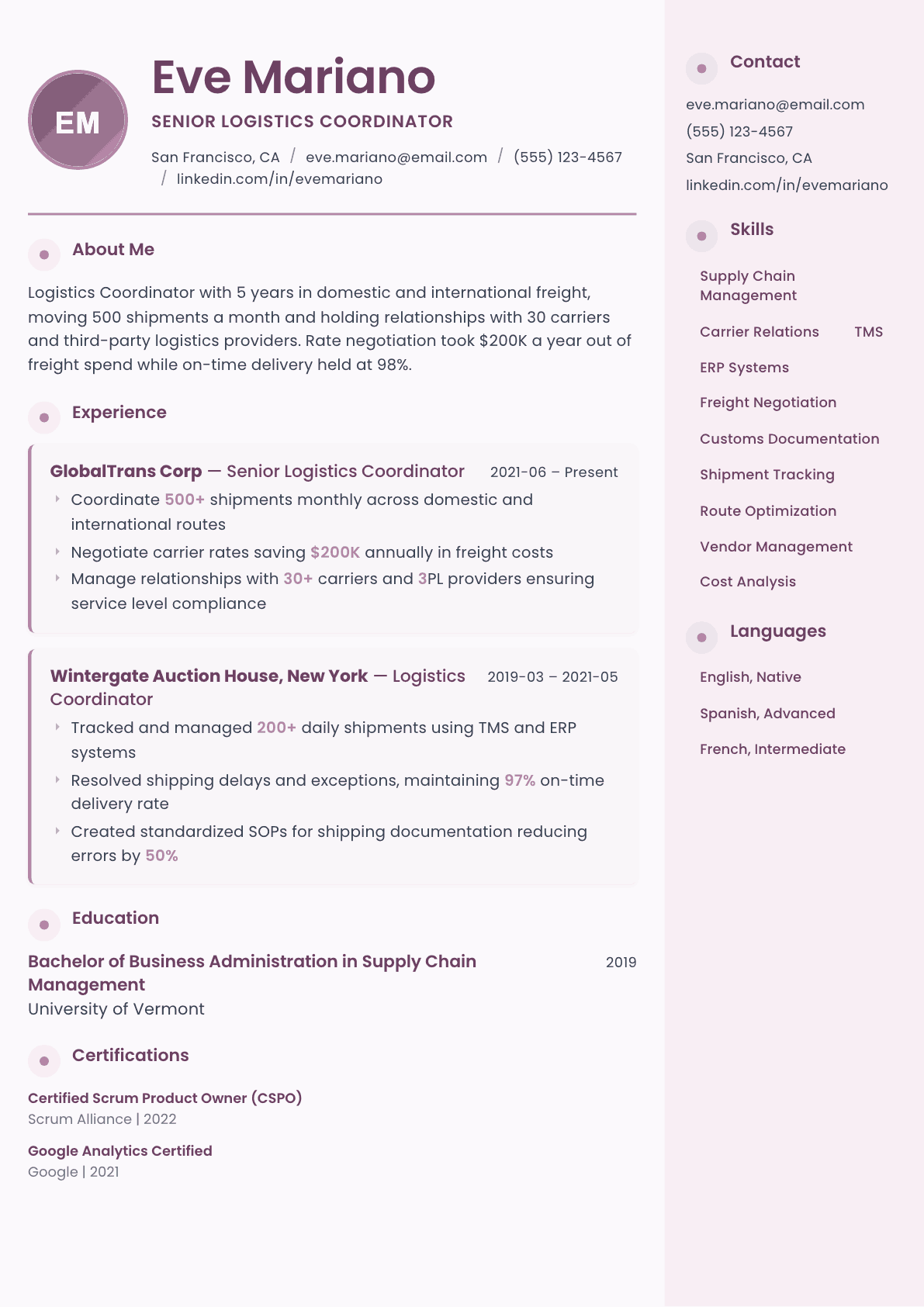
Example Logistics Coordinator summary
Logistics coordinator, 5 years, 500 shipments a month tracked in TMS and ERP across domestic and international lanes. Cut freight spend $200K a year through carrier negotiation, holds 98% on-time delivery, and wrote the shipping documentation SOPs that halved paperwork errors.
Skills to list on a Logistics Coordinator resume
- Supply Chain Management
- Carrier Relations
- TMS
- ERP Systems
- Freight Negotiation
- Customs Documentation
- Shipment Tracking
- Route Optimization
- Vendor Management
- Cost Analysis
What actually gets this resume read
- Quantify shipment volumes, cost savings, and on-time delivery rates.
- List TMS and ERP systems you're proficient with (SAP, Oracle).
- Show carrier relationship management and negotiation skills.
- Include customs and international shipping experience if applicable.
- Highlight process improvements and SOP development.
How to write a logistics coordinator resume
A logistics coordinator resume is judged on whether the reader believes you can hold a lane plan together on a bad day. Carriers no-show, a dock closes, a customs hold lands on a container that was already late, and the coordinator is the person who reroutes it and tells the customer before the customer calls. Hiring managers read for evidence of exactly that.
What they cannot tell from a generic resume is scale and system. A coordinator moving 30 domestic truckloads a week out of one dock is doing a different job from one managing ocean and air freight into four distribution centers with a customs broker in between. Naming the volume, the modes and the platform you worked in resolves that in a single line.
This guide walks through the sections a logistics manager reads first, how to write bullets about cost and service without inventing numbers, sample summaries from a first coordinator seat through to a lead, and the questions coordinators ask when they are trying to move up into planning or management.
Format: one page, operations detail above the fold
Reverse-chronological and one page for the first eight years. Logistics teams hire on urgency, and the resume that wins the screen puts modes, volume and systems in the top third rather than burying them in the third bullet of the second job.
Skip the two-column template. Freight employers run applicant tracking systems that read a single text stream, and the carrier names, platform names and mode abbreviations that make your file findable are the first things a column layout scrambles.
- Header: name, city and state, phone, email, plus the modes you coordinate (truckload, LTL, parcel, ocean, air).
- Order: summary, experience, systems and platforms, education, certifications.
- Add a one-line "Network" note when you support multiple sites: number of facilities, regions and whether the freight is inbound, outbound or both.
Summary: modes, volume, network shape, systems
Three or four lines. Give the modes, the weekly or monthly freight volume, the number of facilities or lanes you support, and the transportation management system you live in. That combination lets a manager place you against their own operation in seconds.
If you have international exposure, say so explicitly and name the part you owned: booking with the forwarder, preparing commercial documents, tracking container availability, or working demurrage and detention. International experience is a hiring differentiator and is regularly buried in the middle of a bullet where nobody finds it.
Experience: service, cost and exception handling
Managers measure a coordinator on three things: on-time performance, freight cost per unit or per load, and how exceptions were handled. Write bullets against those three. Tendering and carrier selection, appointment scheduling with receiving docks, load consolidation, and the daily exception list you cleared.
Name the carriers and forwarders you worked with by type at least, since relationships and rate structures differ between an asset carrier, a brokerage and a forwarder. Where you ran a bid or negotiated rates, say what the scope was: how many lanes, how many carriers invited, and whether you moved freight to a new provider afterward.
Give the exception work its own bullet. Detention and demurrage disputes, reconsignment, damage claims and the recovery process, and the escalation path you used when a customer commitment was at risk. Coordinators who never mention exceptions read as coordinators who have only worked easy weeks.
Systems: name the platform, not the category
A hiring manager scans for the transportation management system first: Oracle Transportation Management, Blue Yonder, MercuryGate, Manhattan, e2open or an in-house tool. Then the enterprise system the orders live in, usually SAP or Oracle, and the warehouse system if you touched it. Then the everyday tools: carrier portals, load boards, and the spreadsheet work you actually do, including lookups and pivot tables.
If you built reporting, say what it reported on and who read it. A weekly on-time and cost dashboard that a distribution manager used to pick carriers is a stronger line than "created reports in Excel", because it shows the output changed a decision.
Words a logistics posting keeps using
Postings for this role repeat a short list: freight tendering, carrier management, route optimization, on-time delivery, inbound and outbound coordination, dock scheduling, order fulfillment, third party logistics, customs documentation, freight audit and payment, and standard operating procedures. Use each once where it is true, and prove one of them with a number in the experience section rather than repeating it in a skills block.
Logistics Coordinator resume summary examples
First coordinator role
Logistics coordinator with 18 months scheduling outbound truckload and LTL freight from a single distribution center, tendering 60 loads a week and booking dock appointments. Works daily in Oracle Transportation Management and holds a Certified Logistics Technician credential.
Five years in
Logistics coordinator with five years supporting four distribution centers across inbound and outbound freight, roughly 400 loads a month plus 30 ocean containers. Ran a regional carrier bid that cut cost per load by 12%, and holds 98% on-time delivery across the network.
Lead coordinator
Lead logistics coordinator with nine years and a team of four, owning carrier selection, dock scheduling and freight audit for a national network. Rebuilt the exception escalation process, cut detention charges by a third, and trains new coordinators on the transportation management system.
Work experience bullets: before and after
Before: Coordinated shipments with carriers and customers.
After: Tendered 400 loads a month across truckload, LTL and parcel to a 25 carrier base, confirming pickup windows with plants and delivery appointments with receiving docks.
Volume, mode mix, carrier count and both ends of the appointment process show the actual span of the desk.
Before: Reduced freight costs for the company.
After: Consolidated 90 weekly LTL moves into scheduled multi-stop truckloads on six lanes, lowering cost per unit by 14% without missing a delivery window.
The mechanism behind the saving makes the number believable and shows a coordinator who thinks about the network.
Before: Tracked orders and updated customers on status.
After: Ran a daily exception list of 20 to 30 at-risk loads, reworking routes and notifying customers before the missed window, holding on-time delivery at 98%.
Proactive exception work is the part of the job managers care about, and the weak version hides it inside status updates.
Before: Worked with a freight forwarder on international orders.
After: Booked 30 ocean containers a month with the forwarder, prepared commercial invoices and packing lists, and cleared two customs holds by supplying origin documentation within 48 hours.
Naming the documents and the hold resolution proves real international handling rather than passive involvement.
Before: Created reports for management.
After: Built a weekly carrier scorecard covering on-time pickup, on-time delivery, tender acceptance and claims, which the distribution manager used to reallocate freight each quarter.
Naming the metrics and the decision the report drove turns reporting into influence.
Hard skills
- Freight tendering and carrier selection
- Truckload, LTL and parcel modes
- Ocean and air freight booking
- Transportation management systems
- SAP and Oracle order management
- Dock and appointment scheduling
- Route and load consolidation
- Freight audit and payment
- Customs and export documentation
- Detention, demurrage and claims
- Carrier scorecards and reporting
- Standard operating procedures
Soft skills
- Calm under disruption
- Carrier negotiation
- Customer communication
- Prioritizing a crowded exception list
- Cross site coordination
- Follow through on open items
Certifications worth listing
- Certified in Logistics, Transportation and Distribution (CLTD) (Association for Supply Chain Management)
- Certified Logistics Technician (CLT) (Manufacturing Skill Standards Council)
- Dangerous Goods Regulations Training (International Air Transport Association)
- Certified Six Sigma Green Belt (CSSGB) (American Society for Quality)
Mistakes that cost logistics coordinator candidates the interview
- Describing the role in verbs with no volume attached, so a manager cannot tell one dock from a national network.
- Leaving the transportation management system unnamed, which is the single fastest fit check a hiring manager makes.
- Never mentioning exceptions, disputes or recovery work, which reads as someone who has only worked quiet lanes.
- Claiming cost savings with no mechanism, when the mechanism is what proves the saving was yours.
- Burying international freight experience inside a bullet instead of putting it in the summary where it differentiates you.
- Listing carrier names as a substitute for describing what you negotiated or measured with them.
Logistics Coordinator resume questions
What metrics belong on a logistics coordinator resume?
On-time pickup and delivery, load or container volume per week, cost per load or per unit, tender acceptance rate, and claims or detention charges. Pick the ones you can defend from a real report rather than estimating, because interviewers ask how the number was measured.
How do I write this resume with no formal logistics title?
Warehouse, customer service and dispatch roles all contain coordination work. Pull out the scheduling, carrier calls, tracking and paperwork you already did, give them volume, and title the section by what you performed rather than by the job title you held.
Should I list every carrier I have worked with?
No. Name a handful that show the range of your base, such as one national asset carrier, one regional, one brokerage and one forwarder, then spend the space on what you negotiated, measured or fixed with them.
How do I move from coordinator to logistics analyst or planner?
Lead with the analytical work already inside your job: bid analysis, carrier scorecards, cost per load trending, network consolidation studies. Then add the tool proof, usually advanced spreadsheet work plus any query or dashboard experience, near the top of the systems section.
Is a CLTD certification worth listing?
Yes, particularly when your job history is short or comes from adjacent work. It signals formal grounding in transportation, warehousing and network design, and it gives a screener a reason to read a resume that is otherwise light on years.
Related resume examples
- Warehouse Worker Resume example
- Truck Driver Resume example
- Operations Manager Resume example
- Logistics Manager Resume example
- Logistics Specialist Resume example
- Logistics Analyst Resume example