Freight Forwarder Resume Examples: the lines they read
A Freight Forwarder Resume Built on Ocean and Air Detail
By Mustafa Tarabya, founder of CVBooster · Published · Updated
A freight forwarder resume covering ocean and air files, Incoterms, customs documents and forwarding software, with a sample resume and a writing guide.
Sample resumes for a freight forwarder
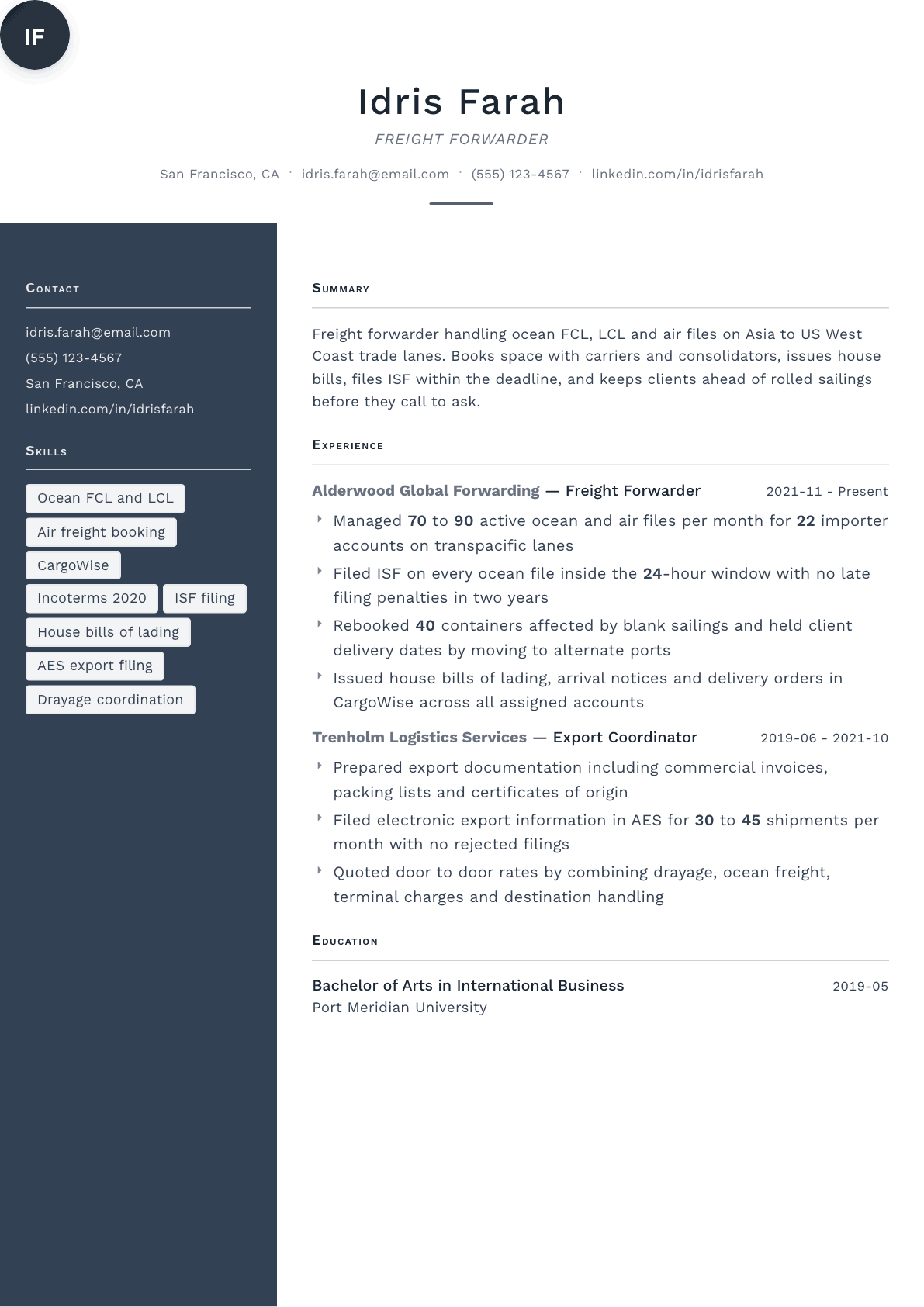
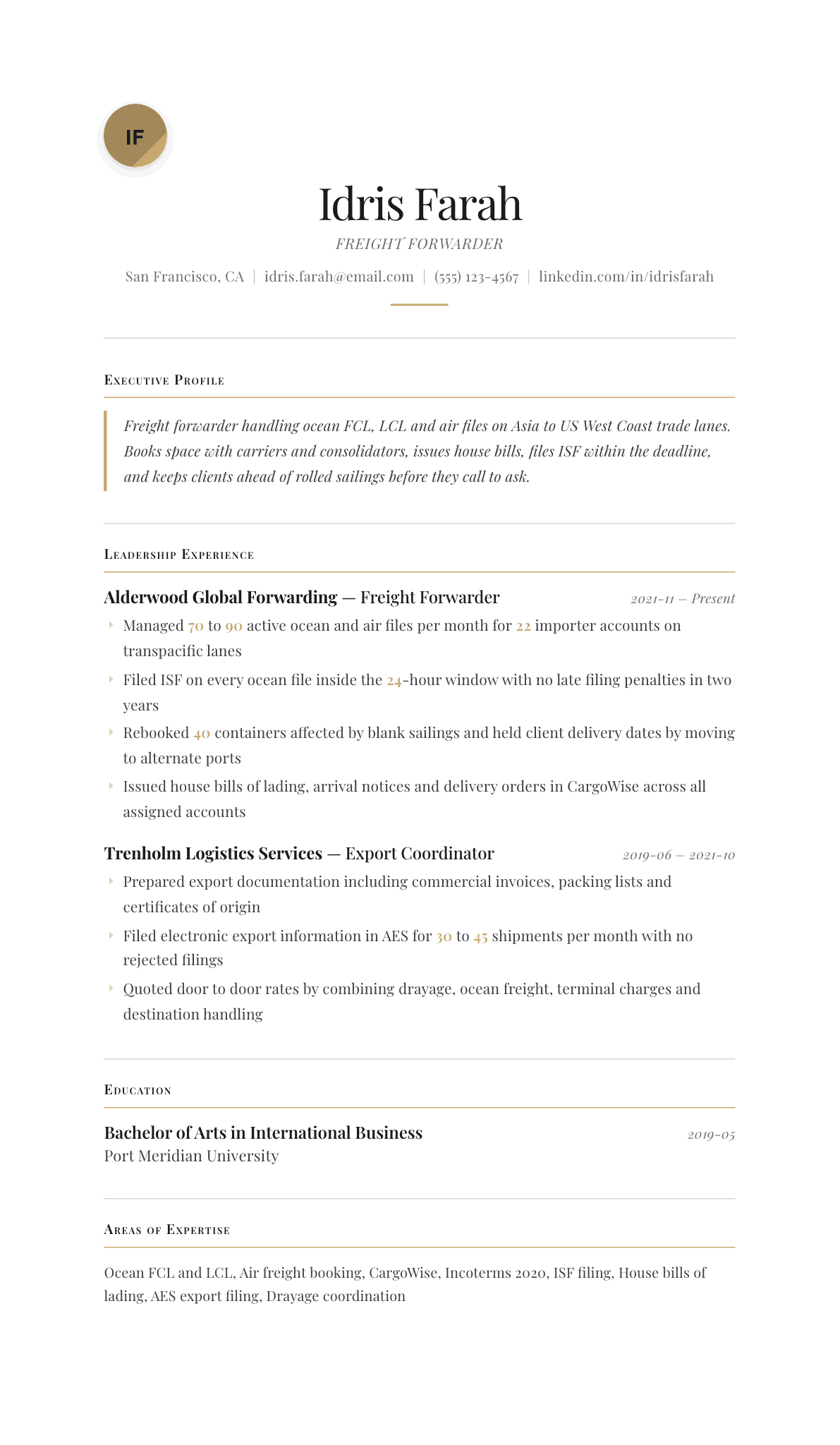
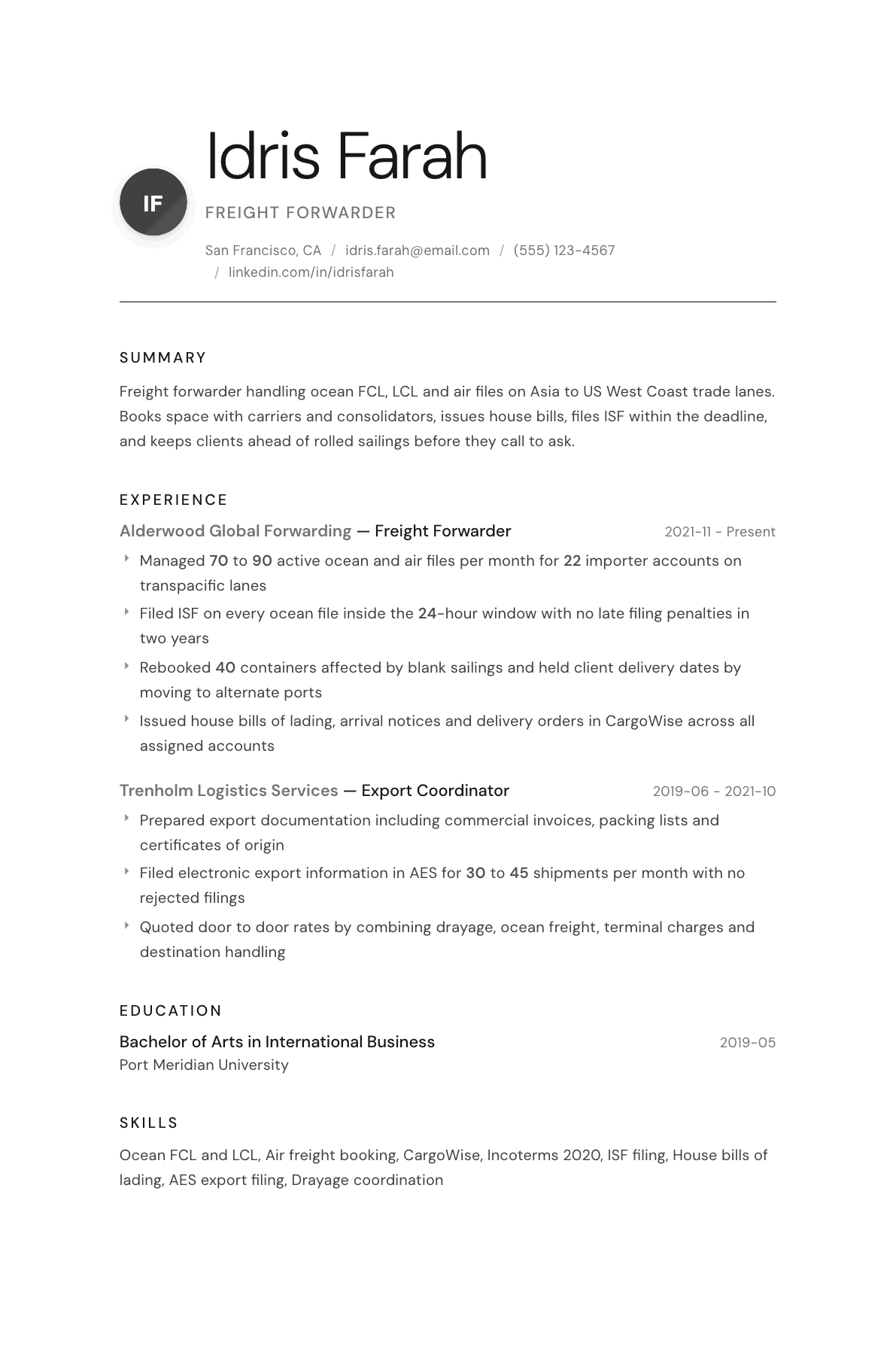
The same freight forwarder content laid out in three CVBooster templates, so you can see what the finished document looks like before you write a word.
Example Freight Forwarder summary
Freight forwarder with five years managing ocean FCL, LCL and air files on transpacific lanes for importer and exporter accounts. Books carrier space, issues house bills, files ISF and AES on deadline, and quotes door to door against Incoterms. Rerouted 40 containers through alternate ports during blank sailings without missing client delivery dates. Seeking a forwarding role with account ownership.
Skills to list on a Freight Forwarder resume
- Ocean freight forwarding
- Air freight forwarding
- Incoterms 2020
- CargoWise
- ISF filing
- AES filing
- House and master bills of lading
- Certificates of origin
- Letters of credit documentation
- Drayage and cartage
- Rate quoting
- Consolidation and deconsolidation
- Dangerous goods documentation
- Carrier space booking
What actually gets this resume read
- Name your trade lanes and modes, because a transpacific ocean desk and an intra-European air desk hire differently.
- Give file counts per month and the number of accounts you owned rather than describing the workflow in general terms.
- Show that you know Incoterms by naming the terms you quote against, such as FOB, CIF, DAP and EXW.
- List the forwarding software you have worked in, whether CargoWise, Descartes, Magaya or a carrier booking portal.
- Prove regulatory reliability with ISF, AES and dangerous goods filings, including your record on deadlines.
- Describe how you handled disruption: rolled cargo, blank sailings, port congestion, or a rate spike on a key lane.
How to write a freight forwarder resume
A freight forwarder resume is assessed on file ownership. The branch manager reading it wants to know which trade lanes you have worked, whether you handled ocean, air or both, how many files you carried at once, which forwarding system you operated in, and whether your regulatory filings were ever late. Those five facts decide whether the page moves forward.
Forwarding resumes tend to describe the process instead of the desk. Booking space, preparing documents and tracking cargo is what the industry does. The differentiators are trade lane knowledge, the accounts you owned, your record on filing deadlines, and how you behaved when cargo rolled, a port congested or a rate moved against a quote you had already given.
This guide sets out the sections in the order a forwarding branch reads them, offers summaries for a documentation clerk, a working forwarder and a senior one, rewrites five bullets that recur across applications, and answers what candidates ask when moving between ocean, air and customs sides of the business.
Format: one page, trade lanes and modes in the opening lines
Reverse chronological and tight. Open each role with the desk: modes handled, trade lanes, monthly file count, number of accounts owned, and whether the work was import, export or both. Forwarding is regional in practice, so a reader wants the lanes before anything else.
Put your systems and filings near the top. Forwarding software fluency and a clean filing record are the two practical screens, and burying them under a paragraph of duties costs you the read.
- Summary of three lines: modes, lanes, monthly files, accounts, system.
- Experience with the desk profile first and results underneath.
- A systems and filings line: forwarding software, filing types, carrier portals.
- Language ability, which is a genuine operational asset on international desks.
Summary: modes, lanes, files, filings
Say whether you run ocean full container, less than container load, air, or a mixed desk, then name the lanes: transpacific eastbound, transatlantic, intra-Asia, Latin America. A branch hiring for a transpacific import desk is looking for exactly that experience, and a general international logistics line will not read as a match.
Add your filing record. Import security filings and export electronic filings both carry deadlines, and a forwarder who has never had a late filing or a penalty is telling the reader something valuable about their file discipline in a single clause.
Experience: files owned, exceptions handled, money quoted
Start with volume and ownership. Files per month, accounts assigned to you, and whether you owned the file from booking to final delivery or worked one segment of it. Owning a file end to end, including the arrival notice, delivery order and final invoice, is a meaningfully different job from booking only.
Then the exceptions, because that is where forwarders earn their keep. Rolled cargo, blank sailings, port congestion, customs holds, flight offloads, damaged or short-landed cargo, and demurrage exposure. Write what you did about them: alternate ports, split loads, mode conversion to air, or an early release that avoided storage charges.
Include the commercial side if you touched it. Building door to door quotes across drayage, ocean or air freight, terminal handling, destination charges and delivery, and defending a quote when a rate moved. Forwarders who understand the full charge structure are the ones promoted into account management.
Documents, filings and the regulatory frame
List the documents you produce and check: house and master bills of lading, air waybills, commercial invoices, packing lists, certificates of origin, arrival notices, delivery orders and letter of credit documentation. Documentation errors turn into customs holds and claims, so this list is read as evidence of care.
Name the filings and the trade rules you work under. Import security filing before vessel loading, electronic export information for outbound cargo, dangerous goods declarations, and the Incoterms rules you quote against such as FOB, CIF, DAP and EXW. State that you understand where risk and cost transfer, because that is the question that separates a forwarder from a coordinator.
- Forwarding software by product, such as CargoWise, Magaya or Descartes.
- Regulatory filings you made yourself, with your record on deadlines.
- Document types you issued or audited.
- Incoterms rules you quote against and how you explain them to clients.
Keywords international logistics recruiters search
The vocabulary is specific and worth using exactly: freight forwarding, ocean export, ocean import, full container load, less than container load, air freight, consolidation, house bill of lading, arrival notice, delivery order, drayage, demurrage, detention, customs clearance coordination, and the software name. Place them where they carry a fact.
Add the languages you work in and the regions you know, since forwarding branches often hire specifically to cover a desk that talks to origin offices in another time zone.
Freight Forwarder resume summary examples
Documentation clerk
Export documentation clerk preparing commercial invoices, packing lists and certificates of origin for 30 to 45 outbound consignments a month. Files electronic export information without rejections, tracks bookings with carrier offices, and is training on ocean file handling in CargoWise.
Four years forwarding
Freight forwarder managing 70 to 90 active ocean and air files a month for 22 importer accounts on transpacific lanes. Files import security data inside the required window with no penalties in two years, issues house bills in CargoWise, and quotes door to door against Incoterms rules.
Senior forwarder
Senior freight forwarder holding the branch key accounts across ocean, air and cross-trade files. Owns rate agreements with carriers and consolidators, mentors two coordinators, and rerouted 40 containers during blank sailings while protecting client delivery dates and avoiding demurrage exposure.
Work experience bullets: before and after
Before: Handled ocean and air freight files for clients.
After: Managed 70 to 90 active ocean and air files a month for 22 importer accounts on transpacific lanes, owning each file from booking through delivery order.
File volume, account count and the span of ownership define a desk that the generic line leaves invisible.
Before: Completed customs and security filings on time.
After: Filed import security data on every ocean file inside the 24-hour window before vessel loading, with no late filing penalties across two years.
Naming the deadline and the penalty record turns a routine claim into a compliance credential.
Before: Dealt with delays and rerouted cargo.
After: Rebooked 40 containers affected by blank sailings through alternate discharge ports and held client delivery dates without moving cargo to air.
The disruption type, container count and cost-aware solution show judgment under pressure.
Before: Prepared quotes for customers.
After: Built door to door quotes combining drayage, ocean freight, terminal handling and destination charges, and explained where cost and risk transferred under each Incoterm.
Listing the charge components and the terms proves commercial fluency rather than rate copying.
Before: Kept customers updated on their cargo.
After: Issued proactive milestone updates at booking, loading, sailing and arrival so accounts learned about a delay from me rather than from a tracking page.
The milestone cadence makes a service claim into a repeatable practice a branch can rely on.
Hard skills
- Ocean freight forwarding
- Air freight forwarding
- Full and less than container load handling
- CargoWise operations
- House and master bill of lading issuance
- Import security filing
- Electronic export filing
- Certificates of origin and consular documents
- Letter of credit documentation
- Drayage and cartage coordination
- Consolidation and deconsolidation
- Dangerous goods documentation
Soft skills
- Client communication across time zones
- Problem solving under disruption
- Accuracy in document review
- Negotiation with carriers and agents
- Prioritizing competing file deadlines
- Working with overseas origin offices
Certifications worth listing
- Certified Export Specialist (CES) (National Customs Brokers and Forwarders Association of America)
- IATA Dangerous Goods Regulations Training (International Air Transport Association)
- Certified in Logistics, Transportation and Distribution (CLTD) (Association for Supply Chain Management)
Mistakes that cost freight forwarder candidates the interview
- Describing forwarding duties in general terms with no trade lanes, modes or file volume.
- Leaving out the regulatory filings you personally made, which is the first competence a branch checks.
- Writing that you know Incoterms without naming the terms you actually quote and explain.
- Skipping disruption stories, when handling rolled cargo and congestion is the real test of the desk.
- Naming forwarding software vaguely instead of the product a recruiter will search for.
- Omitting language ability that would qualify you for a specific origin desk.
- Presenting a customs brokerage background as forwarding experience without separating the two clearly.
Freight Forwarder resume questions
Should a freight forwarder resume separate ocean and air experience?
Yes, because branches hire by mode. Give file volumes for each and note which one you owned end to end. A candidate strong in ocean import and light in air should say so rather than blur both into one international freight line.
How important is CargoWise experience?
It is one of the most searched terms in forwarding recruitment because it shortens onboarding considerably. If you have used it, name the modules. If you have not, name whatever system you did use and any formal training you have completed.
Do I need a customs broker license to be a forwarder?
No. Forwarding and customs brokerage are separate functions and many forwarders work alongside licensed brokers. If you are studying for the broker examination, put that on the page because it signals depth on the compliance side.
What should I write if my company handled clearance in house?
Say exactly what you did and what the licensed broker did. Coordinating entries, gathering documents and resolving holds is valuable experience, but claiming to have filed entries yourself invites a question you may not want in an interview.
How do I show client value beyond moving cargo?
Point to retention, growth on assigned accounts, quotes converted, or a service problem you fixed permanently. Branch managers hire forwarders who keep accounts calm, because the operational skill is common and account stability is not.
Related resume examples
- Customs Broker Resume example
- Import-Export Specialist Resume example
- Freight Coordinator Resume example
- Logistics Specialist Resume example
- Import Coordinator Resume example
- Shipping Coordinator Resume example