Innovation Director Resume Examples: what gets the call
Build an Innovation Director Resume That Breaks the Mold
By Mustafa Tarabya, founder of CVBooster · Published · Updated
Create an innovation director resume that showcases new product development, corporate venturing, and a pipeline of breakthrough initiatives with measurable business impact.
Sample resumes for a innovation director
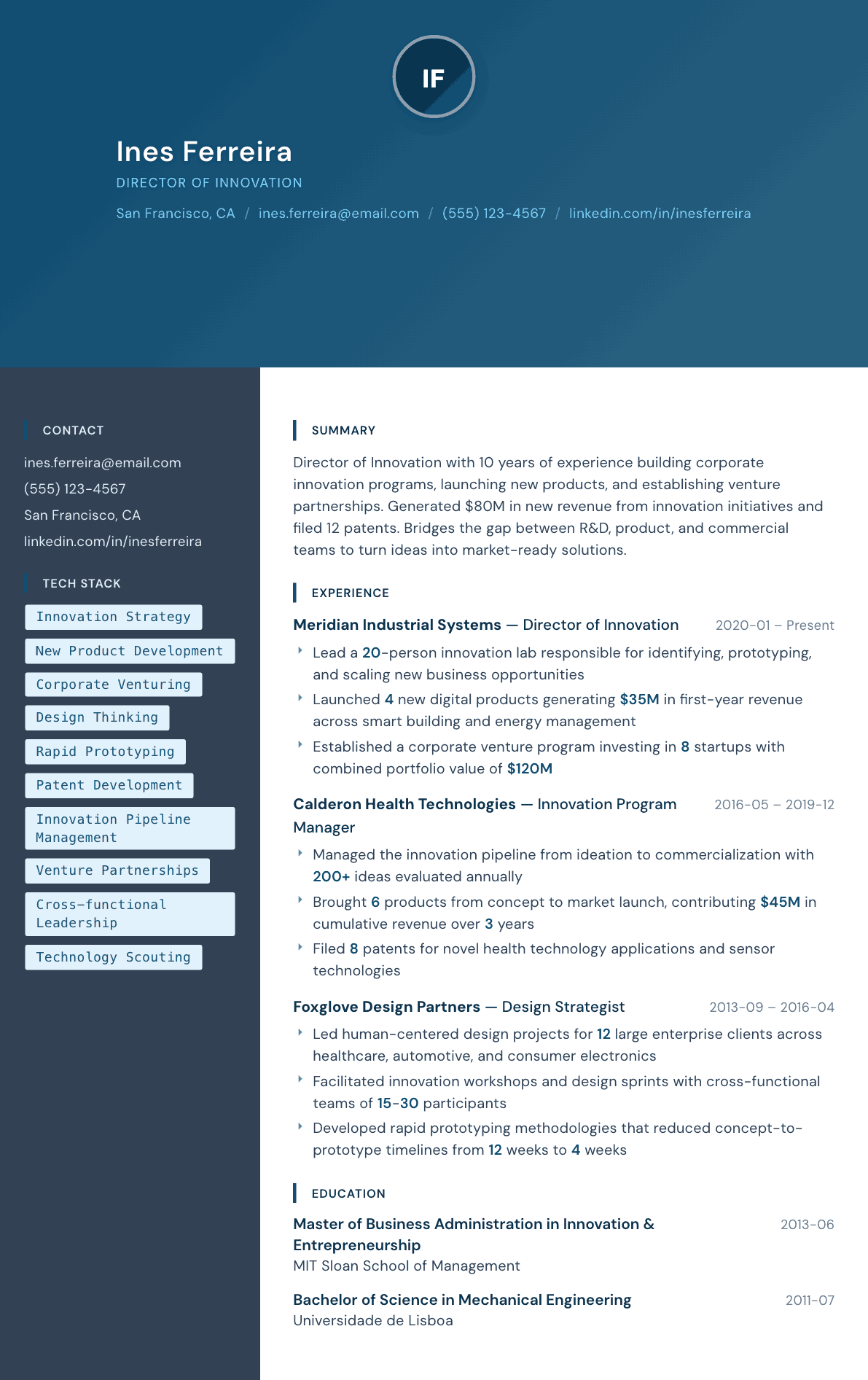
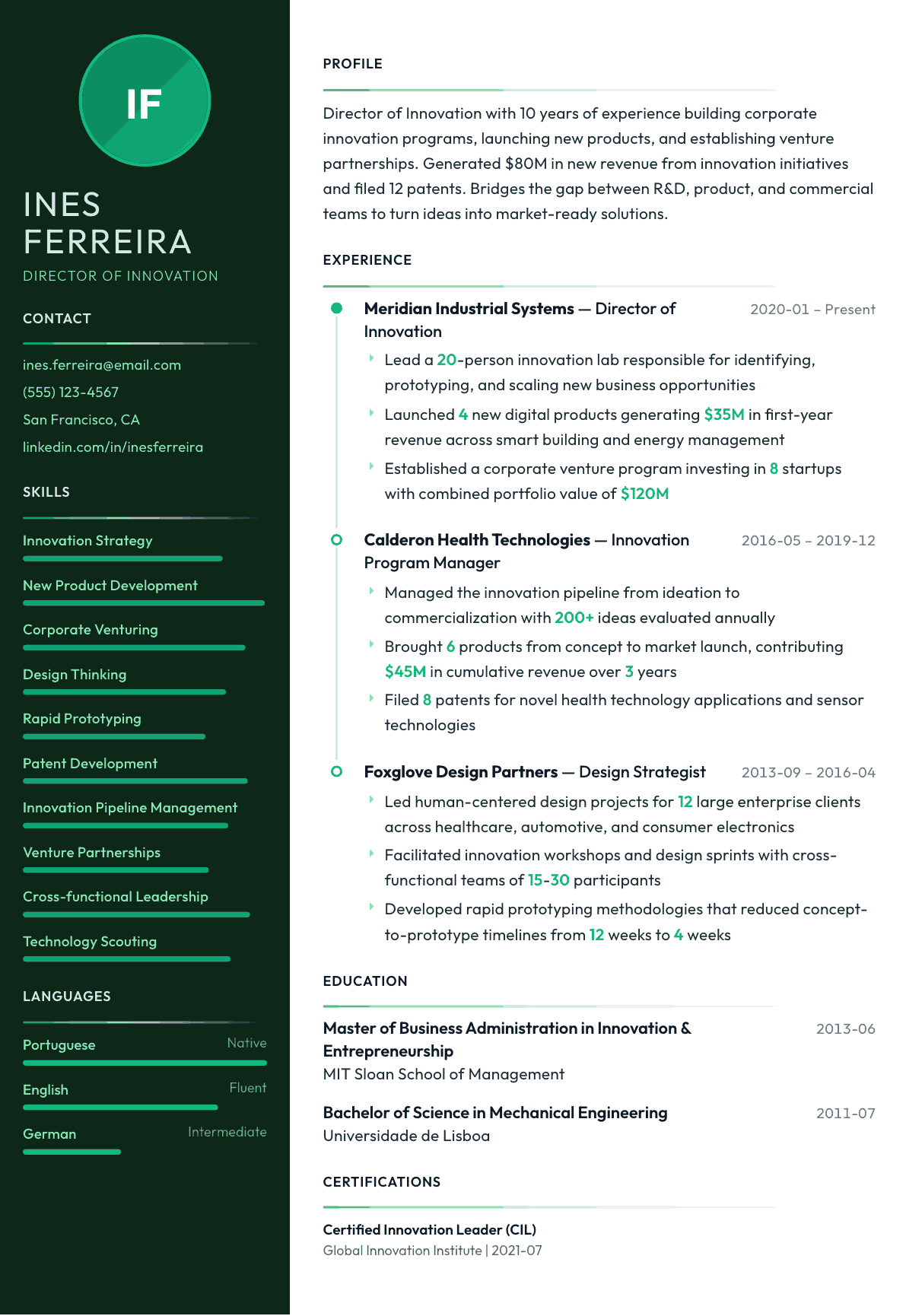
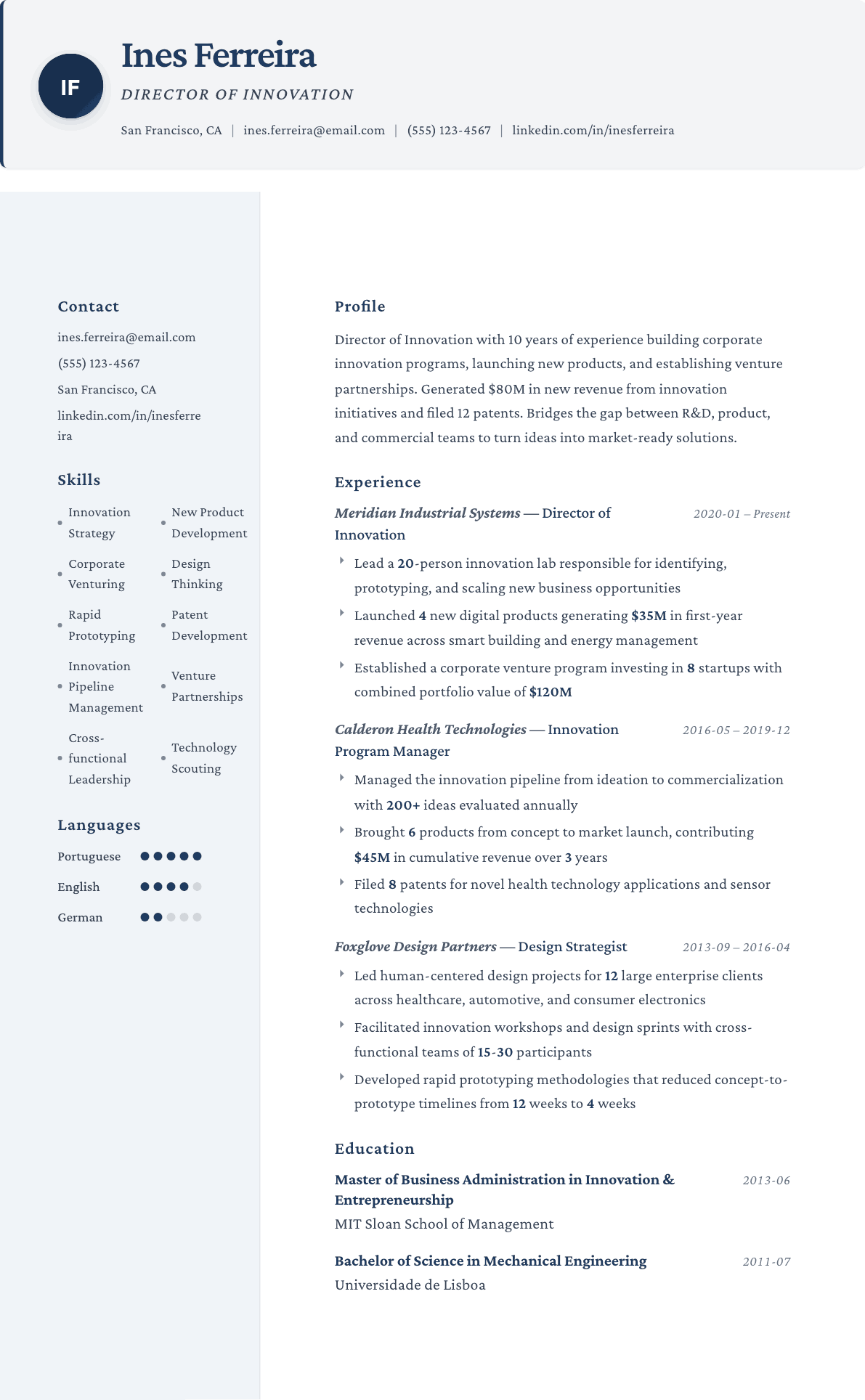
The same innovation director content laid out in three CVBooster templates, so you can see what the finished document looks like before you write a word.
Example Innovation Director summary
Director of Innovation with 10 years of experience building corporate innovation programs and launching products that generated $80M in new revenue. Filed 12 patents and established a corporate venture portfolio valued at $120M. Expert in design thinking, rapid prototyping, and technology scouting. Seeking a VP Innovation role to drive next-generation product strategy at a global enterprise.
Skills to list on a Innovation Director resume
- Innovation Strategy
- New Product Development
- Corporate Venturing
- Design Thinking
- Lean Startup
- Rapid Prototyping
- Patent Development
- Innovation Pipeline
- Technology Scouting
- Cross-Functional Leadership
- Stage-Gate Process
- Workshop Facilitation
- Market Analysis
- R&D Collaboration
What actually gets this resume read
- Quantify revenue from products you launched, patents filed, and ideas commercialized.
- Highlight the innovation methodologies you use: design thinking, lean startup, stage-gate.
- Show experience bridging R&D and commercial teams to bring products to market.
- Include corporate venture investments, startup partnerships, and ecosystem building.
- Demonstrate both creative ideation and disciplined execution of innovation programs.
- Name the industries and technology domains where you have driven innovation.
How to write a innovation director resume
Innovation director is a role with a credibility problem built into the title, and the resume has to solve it on the first page. Executives have watched innovation labs open with ceremony and close two years later having produced posters and prototypes. So the chief executive or chief technology officer reading your file is asking one blunt question: what did this person put into the market, and what did it earn or save.
The strongest resumes in this field are unusually concrete. They name products that launched with dates, revenue lines that did not exist before, patents filed and granted, partnerships signed, and ventures funded or killed on evidence. They also name the things that were stopped, because disciplined termination is a skill executives value and almost nobody claims.
This guide covers how to structure the file, how to describe a portfolio rather than a list of projects, three summary examples from program manager to enterprise innovation leader, before and after bullets, and the questions innovation leaders ask when they write this document.
Format: portfolio framing, two pages at director level
Reverse chronological. Under each employer, give a portfolio line before the bullets: budget in a band, team size including any dedicated engineers or designers, the number of concepts entering the pipeline in a typical year, how many reached market, and the governance body you reported into. That single line answers whether you ran a real function or a small advisory team.
Then organize achievements by outcome type rather than by project. Ventures launched, revenue generated from new offers, intellectual property created, partnerships and investments, and capability built inside the organization. Executives read for those categories, and a chronological list of project names forces them to do the sorting themselves.
- Header: name, city and state, phone, email, and patent portfolio reference if you hold granted patents.
- Order: summary, portfolio and scope, professional experience, launched products or ventures, patents and publications, education, certifications.
- Name the technology domains and the industries where your judgment is credible.
- Say whether you ran corporate innovation, a product organization, an internal venture studio, or a research to commercialization function.
Summary: what you commercialized, in what domain
Lead with commercialization, not methodology. Years, the industries, the technology domains, and the count of products or ventures you have taken from concept into market. A director who has launched four products that are still generating revenue outranks one who has facilitated two hundred ideation workshops, and the summary is where that distinction is made.
Name the model you operate. A stage gate portfolio inside a large corporation, an internal venture studio with dedicated funding, an open innovation function partnering with startups and universities, a corporate venture capital arm, or a new product development organization inside a business unit. Each attracts different employers and the vocabulary is not interchangeable.
Experience: the funnel, the launches, and the kills
Show the funnel with numbers. Concepts screened, how many were funded to a validation stage, how many reached a pilot with real customers, how many launched, and what the survivors produced. A funnel with honest conversion is far more persuasive than a claim about a culture of innovation, because it shows you ran a portfolio with discipline rather than a suggestion box.
Then detail the launches. Product name or category, the customer problem, the launch date, adoption, and revenue contribution in relative terms. Where a venture was spun into a business unit or a separate company, say what happened to it afterward. Longevity after handover is the fact that separates real commercialization from a demonstration.
Write the terminations too. Concepts stopped after validation failed, a pilot ended before scaling because the unit economics did not work, a partnership exited. Frame each with the evidence that triggered the decision and the cost avoided. Executives who have funded innovation before know that stopping well is the harder half of the job.
Intellectual property, partnerships and investment
Patents belong on this page if you have them. State filings and grants separately, name your position on the inventor list, and give the domain rather than reproducing titles. If you have managed a portfolio rather than invented, say what you managed: filing strategy, freedom to operate reviews, licensing, or defensive publication.
Partnerships and investments are the other half of a modern innovation function. Startup pilots run and converted into commercial contracts, university research agreements, joint development deals, accelerator programs, and any minority investment where you led or supported diligence. Give the count and at least one outcome, because ecosystem activity without conversion is the classic criticism of this role.
Methods and keywords
Name the methods you actually run, and match them to context. Design thinking discovery, jobs to be done research, lean validation with real buying signals, stage gate governance, portfolio management with funding tranches, technology roadmapping, and scouting processes. Method names are searched by recruiters, but they only carry weight when attached to a decision they produced.
Recurring posting terms include new product development, commercialization, innovation portfolio, venture building, open innovation, corporate venturing, technology scouting, prototyping, minimum viable product, intellectual property strategy, go to market and business model design. Use the ones your record supports and skip the rest.
Innovation Director resume summary examples
Innovation program manager
Innovation program manager with 4 years in consumer goods, running a stage gate pipeline that screened 90 concepts a year. Took 3 concepts through customer validation to pilot, including a refill format now sold in 400 stores, and built the scouting process for external partners.
Innovation manager to director
Innovation leader with 8 years in industrial technology, managing a portfolio of 12 active concepts and a team of 9 across product, design and engineering. Launched 4 offers generating a new recurring revenue line, filed 6 patents, and stopped 2 ventures after validation showed weak unit economics.
Enterprise innovation director
Innovation director with 15 years across healthcare and mobility, running a venture studio with a budget in the tens of millions and 30 staff. Commercialized 7 products, spun 2 ventures into standalone business units, holds 14 granted patents, and chairs the corporate investment committee.
Work experience bullets: before and after
Before: Led innovation initiatives across the organization.
After: Ran a stage gate portfolio of 12 concepts a year with a budget in the low tens of millions and a team of 9, reporting funding decisions to an executive investment committee each quarter.
Portfolio size, budget band, team and governance forum describe a function rather than an aspiration.
Before: Launched several new products to market.
After: Launched 4 products in three years, including a condition monitoring service that reached 300 installed sites and became the first recurring revenue line in a division that had only sold hardware.
A named offer, an adoption figure and a structural change to the business model prove commercialization.
Before: Ran ideation workshops and innovation training.
After: Trained 140 employees across 6 business units in validation methods, then required every funding request to present customer evidence, which cut concepts entering the pipeline by half and doubled the pilot conversion rate.
Training becomes meaningful when it changes a decision process and the funnel numbers show the effect.
Before: Worked with startups and external partners.
After: Built a scouting pipeline of 200 startups, ran 14 paid pilots, converted 5 into commercial contracts, and led diligence on 2 minority investments alongside the corporate development team.
Conversion from pilots to contracts answers the standard criticism that ecosystem activity produces nothing.
Before: Managed the innovation budget responsibly.
After: Stopped 2 funded ventures after validation showed acquisition cost exceeding customer value, redeployed 7 people onto the two strongest concepts, and reported both decisions openly to the executive committee.
Terminating well and saying so is rare on these resumes and reads as portfolio discipline rather than enthusiasm.
Hard skills
- Innovation portfolio management
- Stage gate governance
- New product development
- Customer discovery and validation
- Business model design
- Prototyping and pilot design
- Technology scouting and open innovation
- Corporate venturing and investment diligence
- Intellectual property strategy
- Go to market planning
- Technology roadmapping
- Unit economics and business case modeling
Soft skills
- Killing your own idea on evidence
- Selling an unproven concept to a skeptical board
- Working across research and commercial teams
- Recruiting entrepreneurial people into a corporation
- Holding ambiguity without paralysis
- Protecting a small team from corporate process
Certifications worth listing
- New Product Development Professional (NPDP) (Product Development and Management Association)
- Project Management Professional (PMP) (Project Management Institute)
- Certified Scrum Product Owner (Scrum Alliance)
- Certified Six Sigma Black Belt (CSSBB) (American Society for Quality)
Mistakes that cost innovation director candidates the interview
- Filling the page with workshops facilitated and ideas generated, with nothing that reached a customer.
- Leaving out the funnel numbers, so a reader cannot tell whether you ran a portfolio or a few side projects.
- Omitting what happened to launched products after handover, which is where commercialization is proven.
- Never mentioning a concept you stopped, which makes the record look uncritical rather than disciplined.
- Listing patent titles at length instead of filings, grants, your inventor position and the domain.
- Naming methods without the decision each one produced, which reads as vocabulary rather than practice.
- Describing an advisory role in language that implies you controlled a budget and a team.
Innovation Director resume questions
How do I show innovation results when most projects fail?
Report the portfolio rather than only the winners. Concepts screened, funded, piloted and launched, plus the ones stopped and why, shows an executive that you manage risk deliberately. A record with no failures reads as either a very small portfolio or an incomplete account.
Should I list patents on an innovation director resume?
Yes, in a short section giving filings and grants separately, your position on the inventor list and the technology domain. Do not reproduce full titles or numbers for more than a few, and note any that are licensed or commercially deployed.
How do I present revenue from products that are still young?
Use relative and directional measures with the stage attached: pilot customers converted, installed sites, first year run rate as a share of the division, or contribution to a new recurring revenue line. Label forecasts as forecasts rather than results.
Do I need a technical degree for this role?
Not always, but you need domain fluency deep enough to challenge a technical team and judge feasibility. Employers in deep technology fields usually expect an engineering or science background, while consumer and services organizations weight commercialization record more heavily.
How do I move from product management into an innovation director role?
Emphasize the work furthest from the existing roadmap: new categories, businesses without an existing customer base, ventures funded in stages rather than through an annual plan, and any offer you took from a blank page to first revenue.
Related resume examples
- Startup Founder Resume example
- Strategy Director Resume example
- Product Manager Resume example
- MBA Graduate Resume example
- Business Consultant Resume example
- General Manager Resume example