Startup Founder Resume Examples: the lines they read
Create a Startup Founder Resume That Tells Your Story
By Mustafa Tarabya, founder of CVBooster · Published · Updated
Build a startup founder resume that translates entrepreneurial experience into corporate-ready language with fundraising metrics, team building, and product-market fit achievements.
Sample resumes for a startup founder
The same startup founder content laid out in three CVBooster templates, so you can see what the finished document looks like before you write a word.
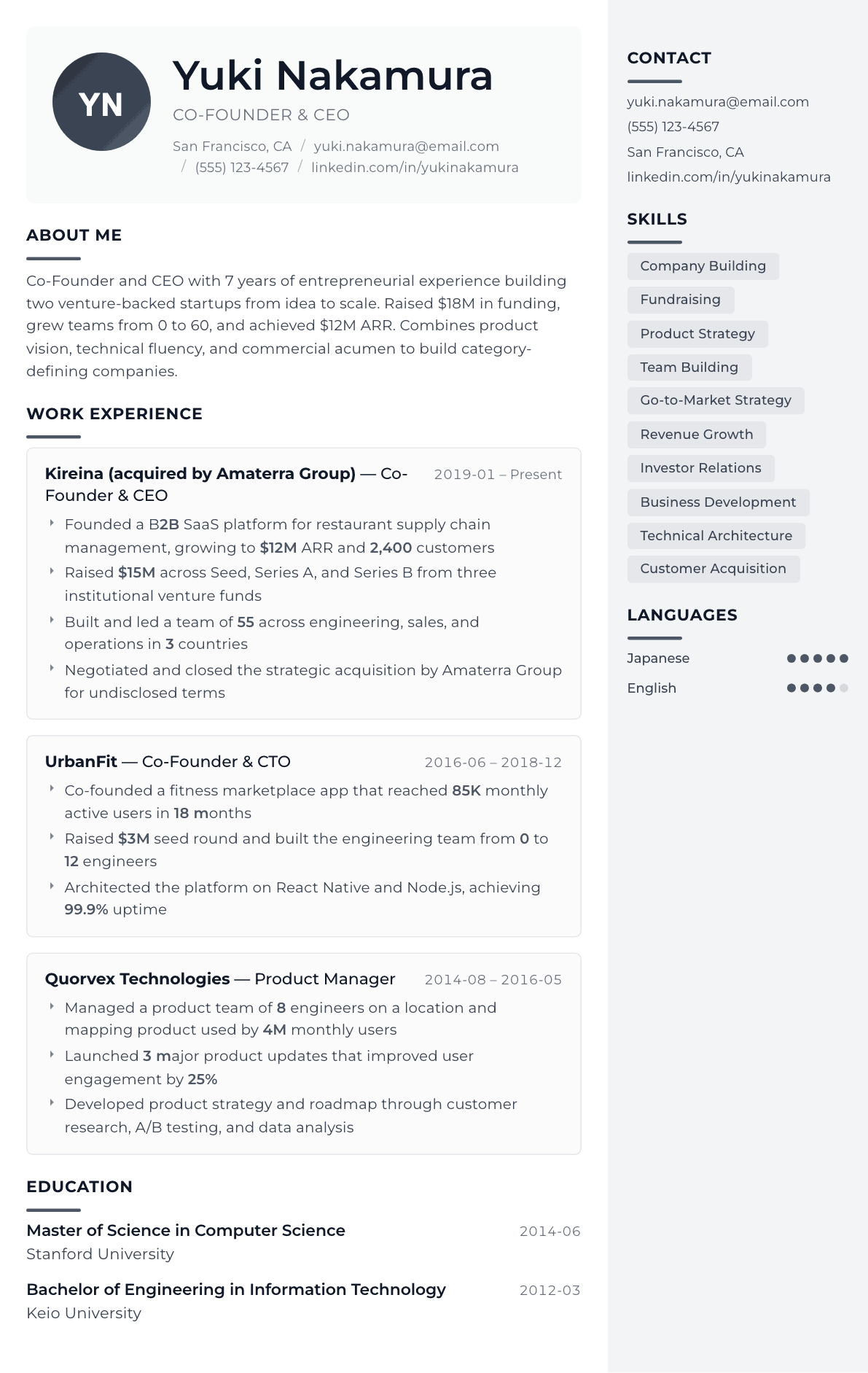
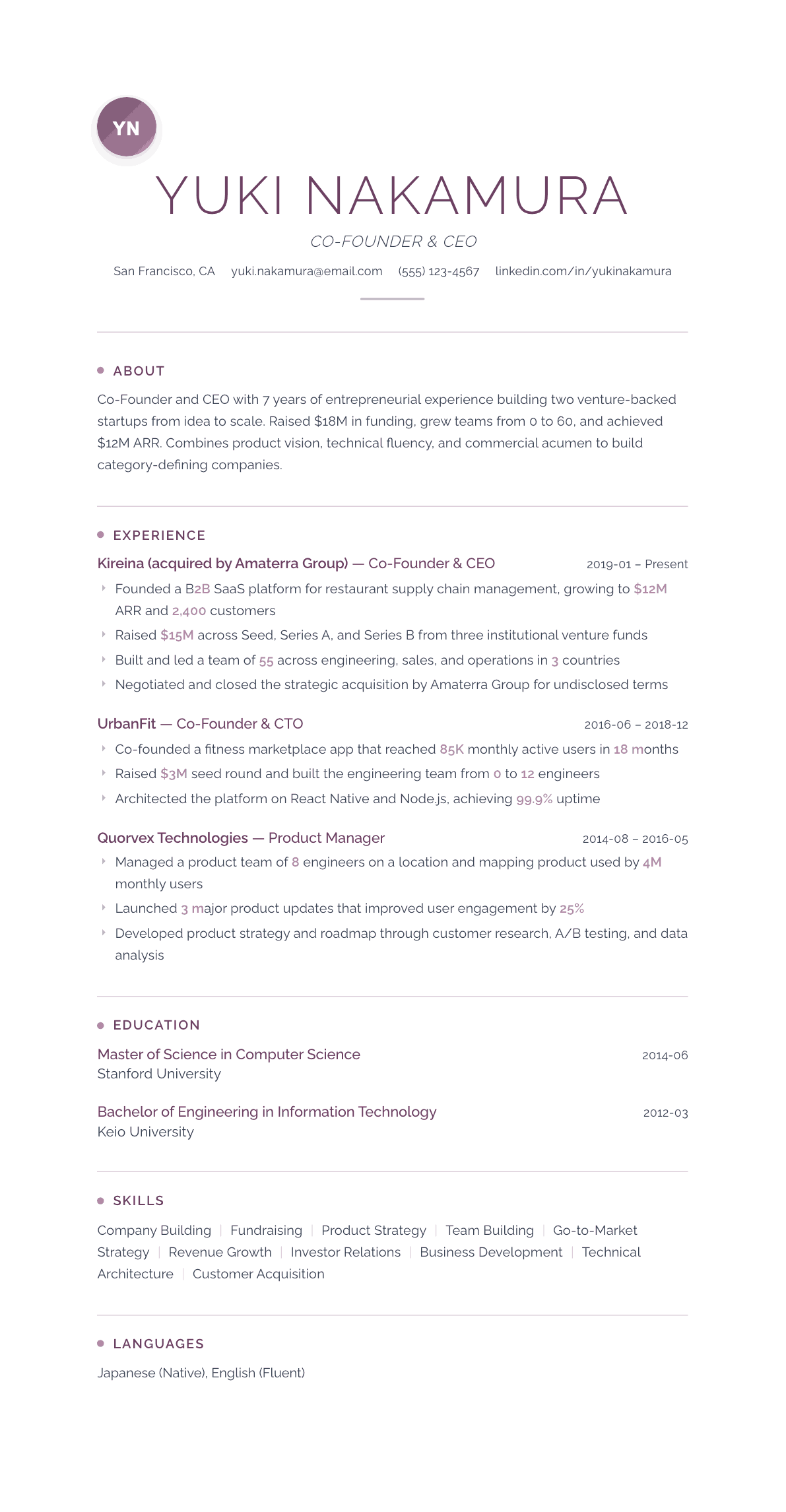
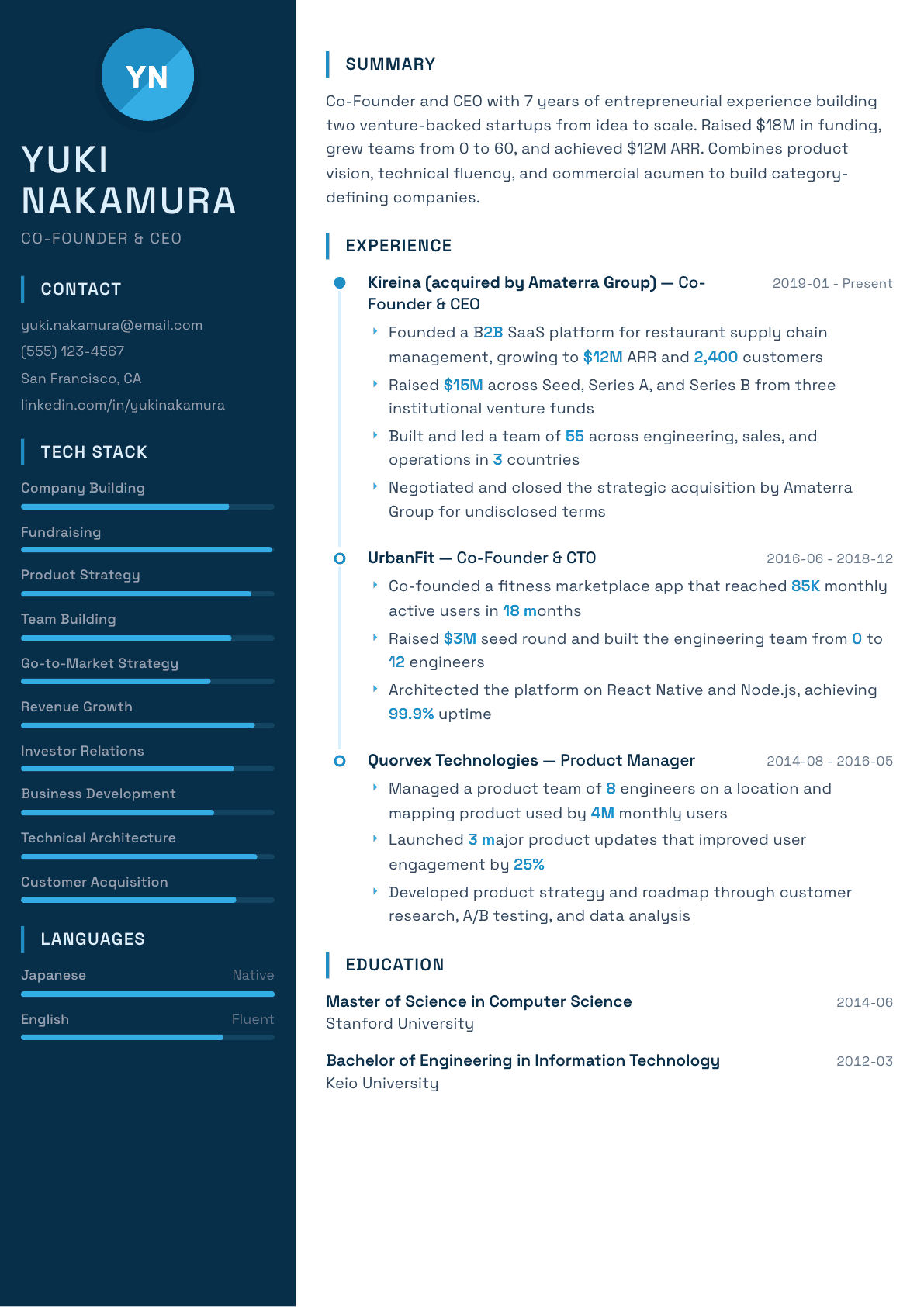
Example Startup Founder summary
Entrepreneurial CEO with 7 years of experience building venture-backed startups from 0 to $12M ARR. Raised $18M across four rounds, grew teams to 60, and sold the company in a strategic acquisition. Combines product vision, technical depth, and commercial acumen. Seeking a senior leadership role (VP/GM/COO) to bring founder energy and scaling expertise to a high-growth company.
Skills to list on a Startup Founder resume
- Company Building
- Fundraising (Seed to Series B)
- Product Strategy
- Team Building
- Go-to-Market Strategy
- Revenue Growth
- Investor Relations
- Business Development
- Customer Acquisition
- Financial Planning
- Board Management
- Product-Market Fit
- Strategic Partnerships
What actually gets this resume read
- Translate founder experience into business metrics: revenue, users, funding raised, team size.
- Show the full arc: ideation, product-market fit, fundraising, scaling, and exit (if applicable).
- Highlight leadership across functions: product, engineering, sales, operations, finance.
- Include pre-startup corporate experience to show you can operate in structured environments.
- Frame failures as learning experiences with specific takeaways.
- Tailor your resume to the target role: emphasize the functional skills most relevant to the position.
How to write a startup founder resume
A startup founder writing a resume is doing something unusual: translating an experience where you set your own title, your own scope and your own measures of success into a document read by people who assume none of that. The hiring manager is not hostile, but they are cautious. They want to know what you actually did day to day, whether the company was real, and whether you can work inside a structure you did not design.
Two failures are common. The first is a founder resume that reads like a pitch deck: vision, market, traction, no evidence of personal craft. The second is one that hides the founding entirely behind a safe corporate title, which loses the strongest thing you have. The right version is specific about the operating work you personally did, honest about the size of the company, and clear about which functional role you now want.
This guide covers how to size the company so a reader trusts the file, how to write the founding years as functional experience, how to handle a company that closed, summaries for an early founder, a scaled operator and a founder moving into a senior role, and the questions founders ask when they go back to employment.
Format: pick the target role first, then build backwards
A founder resume cannot be generic, because founders did everything and a document that reflects that reads as unfocused. Decide the functional destination first: product leadership, commercial leadership, operations, general management, or a specialist role. Then write the founding years with the bullets that belong to that function occupying the top of the block, and compress the rest into a single line about the other areas you covered.
Use a title a reader can place. Founder and chief executive of a company of five people invites a raised eyebrow at a large employer, so pair the title with the real scope: founder and head of product at a seven person company. The honesty buys you credibility for everything that follows, and nobody is fooled by a grander version.
- Company line: what it sold, to whom, the business model, the years, the team size at peak.
- Funding line: the stage reached and the investor type, stated plainly, or bootstrapped if it was.
- Outcome line: acquired, wound down, still operating, or handed to a successor.
- Function block: the work in the area you are now targeting, in detail.
Size the company honestly and early
The single most useful thing you can do is remove ambiguity about scale. Give the peak headcount, the customer count, the users, the revenue as a magnitude or an order of size, the funding stage, and how long the company operated. A reader who cannot size the company will assume the smallest interpretation of every claim on the page.
Scale honesty also protects your strongest bullets. Building a category leading product with four engineers is impressive precisely because the team was four. Hiding the team size turns a genuinely difficult achievement into a claim that looks inflated once the interviewer asks the obvious question.
Write the operating work, not the narrative
Employers hire for demonstrated craft. Write what you personally built: the sales motion you ran and the deals you closed yourself, the hiring you did and the people you kept, the pricing model you set and revised, the customer support you handled before there was a team, the financial model you maintained, the systems you chose and implemented.
Then show the decisions where you changed course. Retiring a product line, moving from a self serve model to a direct sales motion, firing a customer segment that never renewed, or cutting the team to extend the runway are all evidence of commercial judgment. Employers reading a founder file are specifically looking for whether you can face facts you do not like, since that is the founder failure mode they worry about.
Wind downs, gaps and the questions in the reader mind
If the company closed, write one clear line about why, in the language a business person uses: the market did not develop, funding did not follow the seed round, the unit economics never worked at the price customers would accept, or a cofounder split. A plain explanation ends the question. Silence invites a worse assumption.
Gaps work the same way. A year spent building something that never launched is a normal founder experience, and it is better stated with what you learned and what you did next than left as an unexplained blank. Where you were consulting or contracting between ventures, list it as a role with the clients described by type.
Expect the loyalty question too. Employers wonder whether a founder will leave to start something else, so answer it implicitly by being concrete about why this function and this kind of company are what you want now, in the summary rather than in a cover letter alone.
Keywords and framing for the destination employer
Founder vocabulary and employer vocabulary differ, and the applicant tracking system understands the second one. Translate: company building becomes team leadership and hiring, traction becomes customer acquisition and retention, runway management becomes budget and cash flow ownership, product market fit becomes customer discovery and validation, and investor updates become executive reporting.
Match the destination as well. A large company wants to see process, documentation, cross functional working and handovers, so surface the parts of your founding experience that involved structure. A growth stage company wants zero to one instincts and speed, so surface the launches, the direction changes and the small team wins. Same career, different emphasis.
Startup Founder resume summary examples
First venture, early stage
Founder of a bootstrapped scheduling tool for independent clinics, built to 240 paying customers over two years with a team of three. Handled product decisions, onboarding and every renewal conversation personally, and reached breakeven before deciding to join a larger product organization.
Founder and operator, scaled team
Cofounder and chief operating officer of a venture backed logistics platform, grown from four people to 38 across two countries. Owned hiring, finance and customer operations, set the pricing model that lifted gross margin by 14 points, and led the company through a Series A process.
Founder moving into a senior role
Founder with nine years building and running a business to business software company through acquisition by a strategic buyer. Led product and commercial functions, hired and retained a leadership team of six, and now targeting a general management role where that operating range applies inside a larger organization.
Work experience bullets: before and after
Before: Founded and grew a successful startup from the ground up.
After: Founded a scheduling product for independent clinics and grew it to 240 paying customers over two years with a team of three, handling product, onboarding and every renewal conversation personally.
Customer count, team size and the specific work you did replace a claim that a reader has no way to size.
Before: Raised venture funding for the company.
After: Ran a Series A process from first meeting to close over five months, built the data room and the operating model, met 34 funds, and negotiated terms alongside our existing seed investors.
The process detail shows the actual work of fundraising rather than the outcome alone.
Before: Built and led a high performing team.
After: Hired 22 people across engineering, sales and operations in eighteen months, wrote the first performance and compensation structure, and kept voluntary attrition in single figures through a difficult second year.
Hiring volume, the structure you created and retention through a hard period make the leadership claim testable.
Before: Responsible for company strategy and vision.
After: Retired a hardware line that carried a negative margin after twelve months of evidence, moved the company to a software only model, and reached breakeven two quarters later on a smaller cost base.
A hard decision with a described trigger and result is far stronger evidence of strategy than the word vision.
Before: The company was unfortunately not able to continue operating.
After: Wound the company down in an orderly way when the second funding round did not follow: paid out staff, transitioned 140 customers to two alternative providers, and closed the entity without leaving supplier debt.
An orderly wind down described in detail reads as integrity and operating discipline instead of a failure to explain.
Hard skills
- Business model and pricing design
- Customer discovery and validation
- Fundraising and investor reporting
- Financial modeling and cash flow management
- Hiring and compensation structure
- Go to market and sales motion design
- Product roadmap ownership
- Contract and supplier negotiation
- Board and stakeholder management
- Unit economics analysis
- Operations and systems implementation
- Partnership development
Soft skills
- Decision making with incomplete information
- Resilience through funding pressure
- Direct customer conversation
- Recruiting people who could earn more elsewhere
- Changing course on evidence
Mistakes that cost startup founder candidates the interview
- Writing the resume as a pitch deck, full of market narrative and empty of personal operating work.
- Hiding the founding years behind a corporate sounding title, which throws away the most distinctive part of the file.
- Leaving the company unsized, so a reader assumes the smallest possible interpretation of every achievement.
- Giving no explanation for a wind down, which invites a worse assumption than the truth usually is.
- Applying to every kind of role with one document instead of choosing a functional destination and building toward it.
- Using founder vocabulary such as traction and runway that an employer keyword screen does not recognize.
- Claiming a chief executive scope at a five person company without stating the team size alongside it.
Startup Founder resume questions
Should I put founder as my job title on a resume?
Yes, and pair it with the functional scope you actually held, such as founder and head of product. The founder title alone tells an employer nothing about your daily work, and pairing it with a function immediately answers the question the reader is forming.
How do I explain a startup that failed?
One plain sentence about why, then what you did about it. Funding that did not follow, unit economics that never worked at the achievable price, or a market that stayed too small are all normal outcomes. Describing an orderly close, with customers and staff handled well, reads as operating maturity.
Will employers think I am overqualified or unmanageable?
Some will, so answer it in the summary by naming the function you want and why a structured organization suits you now. Then show evidence of working inside constraints: a board you reported to, investors you answered to, auditors, regulators, or a large partner whose process you had to follow.
How do I write about revenue when the numbers were small?
Give them anyway, with the context that makes them meaningful: the team size that produced them, the growth over a stated period, retention or renewal rates, and gross margin. A modest figure earned with four people and strong retention reads better than a vague claim of rapid growth.
Should my resume mention the same startup twice if I held different roles?
Only when the roles were genuinely distinct and separated in time, such as leading product for two years and then taking over commercial operations. Show it as two dated sub blocks under one company heading, which keeps the progression clear without implying two employers.
Related resume examples
- COO Resume example
- Innovation Director Resume example
- Product Manager Resume example
- Entrepreneur Resume example
- Executive Resume example
- General Manager Resume example