High School Teacher Resume Examples: what gets the call
Build a High School Teacher Resume Around Subject and Outcomes
By Mustafa Tarabya, founder of CVBooster · Published · Updated
High school teacher resume examples with course load and certification keywords, sample bullets on exam results, and a complete writing guide.
Sample resumes for a high school teacher
The same high school teacher content laid out in three CVBooster templates, so you can see what the finished document looks like before you write a word.
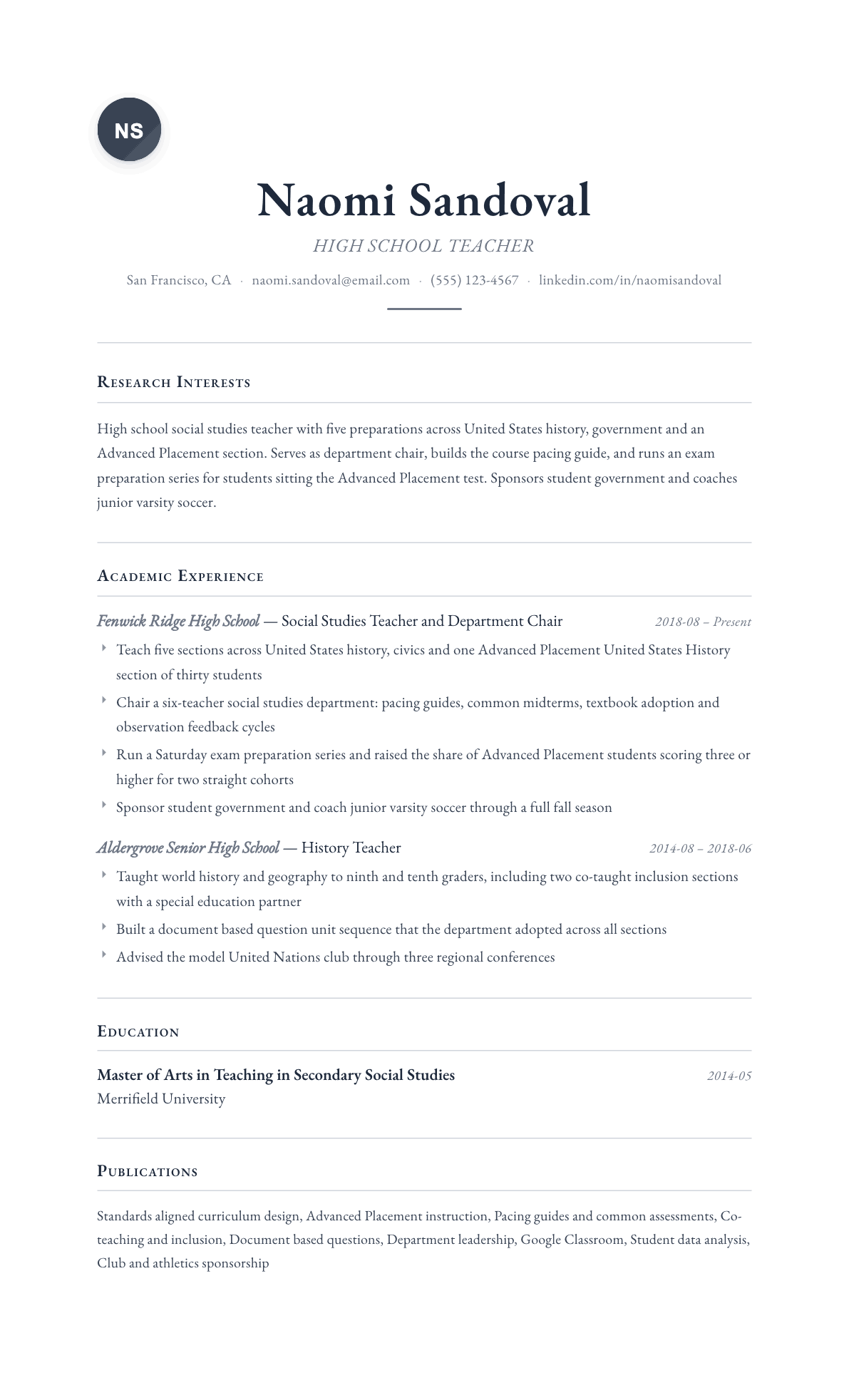
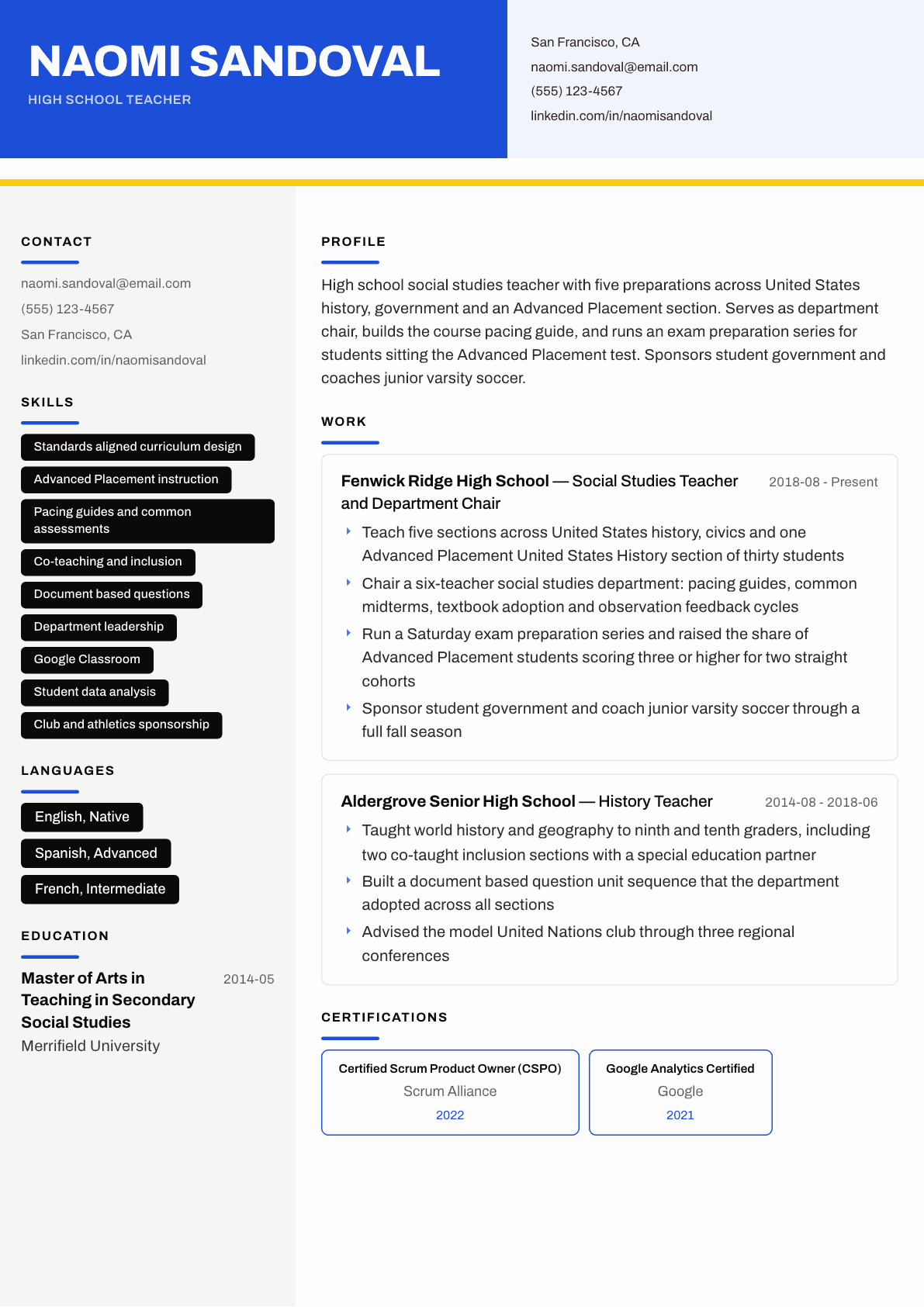
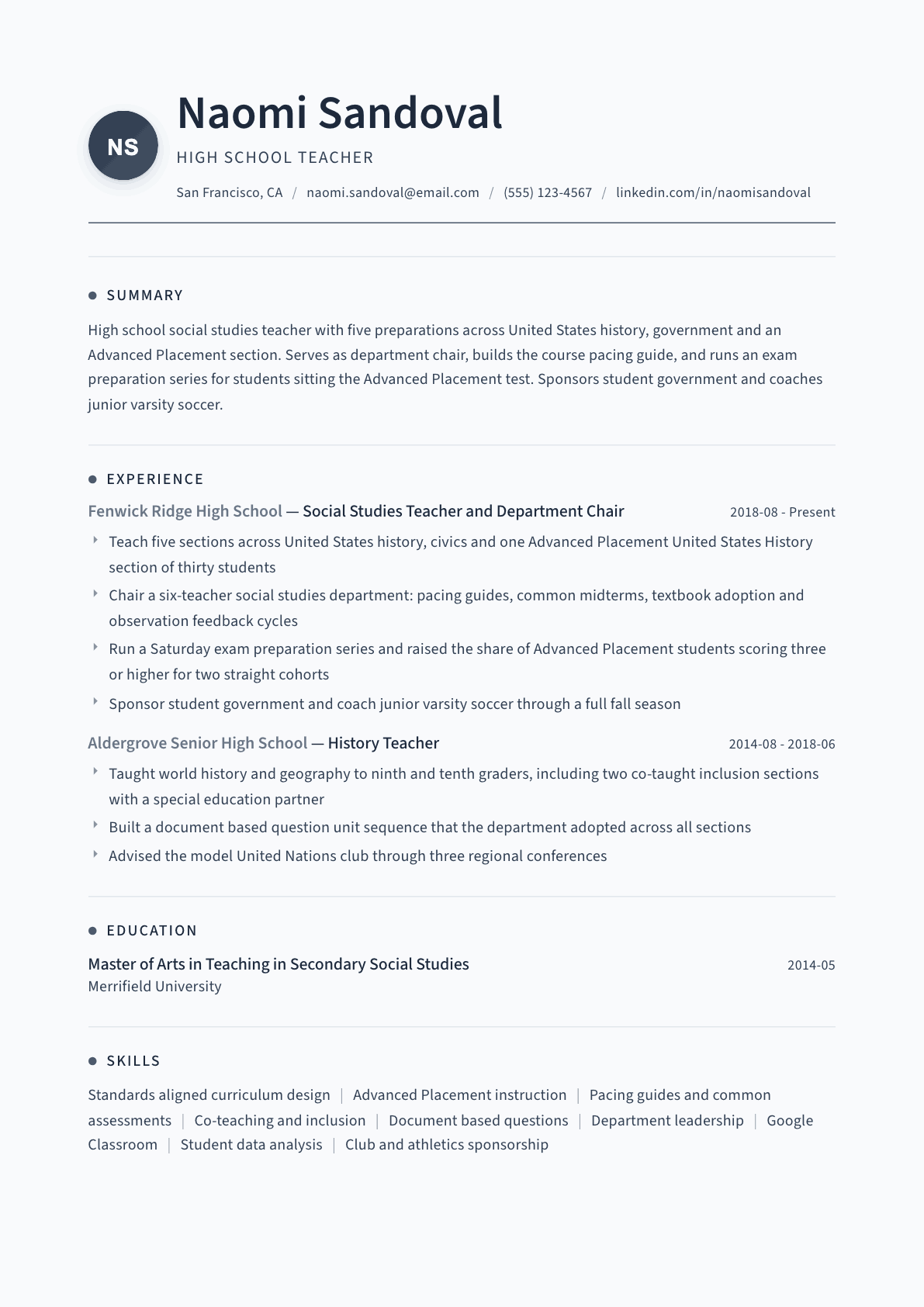
Example High School Teacher summary
High school social studies teacher with eleven years and department chair for the last four, teaching five sections including Advanced Placement United States History. Builds pacing guides and common midterms for a six-teacher department, runs an exam preparation series, and gives observation feedback to colleagues. Sponsors student government and coaches soccer. Seeking a curriculum coordinator or assistant principal track position.
Skills to list on a High School Teacher resume
- Standards aligned curriculum design
- Advanced Placement instruction
- Pacing guides
- Common assessment design
- Co-teaching and inclusion
- Differentiated instruction
- Document based question instruction
- Student data analysis
- Department leadership
- Teacher mentoring
- Classroom management for adolescents
- Google Classroom
- Learning management systems
- Family and guardian communication
- Club sponsorship and coaching
What actually gets this resume read
- Lead with your subject and the exact courses you have taught, including any Advanced Placement, honors, dual credit or inclusion sections.
- State the number of preparations and sections you carry, because a principal is solving a schedule problem when reading your resume.
- Report student outcomes honestly using exam participation, pass rates or growth on a named assessment you actually track.
- Put your teaching certificate, subject endorsements and grade band in a section directly under the summary.
- Include department, curriculum or mentoring leadership, since these separate a veteran teacher from a fifth year teacher.
- List clubs, coaching and duty assignments; many high school openings are written around a specific extracurricular need.
How to write a high school teacher resume
High school hiring is subject hiring. A principal is not looking for a good teacher in the abstract, she is looking for someone who can take four sections of chemistry, one honors section, a duty period and the robotics club, all in one schedule that currently has a hole in it. Your resume gets read against that hole.
So the two facts that decide everything are your certification areas and your course history. A teacher licensed in two subjects with an Advanced Placement course under their belt solves more scheduling problems than a stronger teacher licensed in one, and principals know it. After that comes evidence with older students: how you keep a room of thirty-two juniors working, how you grade at that volume without falling behind, and what you have led beyond your own classroom.
This guide covers the resume structure secondary principals expect, three summaries from a new certificate through department chair, before and after bullets that turn a course list into evidence, and the questions high school teachers ask when they change schools or districts.
Format: certification areas, then the course list
Two pages is normal past your first few years, and one page is fine before that. Put certification directly under the summary with the state, the subject areas and the grade band, then a course history line naming every course you have taught, including honors, Advanced Placement, dual credit, inclusion and intervention sections.
Keep the file simple and single column. District applicant systems parse resumes automatically, and a scheduling administrator often works from the parsed fields before a principal ever opens the original document.
- Header: name, city and state, phone, email, certification areas in one line.
- Order: summary, certification and course history, teaching experience, leadership, extracurricular, education, professional learning.
- Second certification areas belong in the header line, not buried in the education section.
Summary: subject, preparations, level, leadership
Name the subject, the number of preparations and sections, the levels you teach from standard through Advanced Placement, and any leadership role. Preparations matter because a teacher carrying five distinct courses is doing a different job from one teaching five sections of the same course.
Then add the outcome you can defend in an interview. Exam participation you grew, a course you built and got approved, a pass rate you tracked, or a department process you own. Keep it to something you personally influenced and can explain in detail.
Experience: courses, outcomes, and the adult work
Open each position with the school, the subject, the course titles and the section counts. Then write bullets that answer what a department chair would ask: what you built, what students produced, and how you know it worked.
Curriculum building is the most persuasive bullet at this level. A unit sequence the department adopted, a pacing guide you wrote, a course you got through approval or a common midterm you designed all show that your work outlives your own sections.
Report outcomes carefully. Exam participation, course pass rates, the number of students who moved from standard to honors, or growth on a named assessment are all defensible when you collected them. Vague claims about raising achievement invite an interview question you cannot answer.
Then include the adult work: department chair duties, observation feedback cycles, mentoring, textbook adoption, master schedule input and committee leadership. This is what separates an experienced teacher from a fifth year teacher with a longer list of courses.
Inclusion, differentiation and grading at volume
Co-teaching and inclusion sections are common in high school and worth naming with the partner role and the subject. Say how you differentiated within a section of thirty-plus students rather than claiming differentiation as a value, because at this scale the mechanism is the interesting part.
Grading practice is a real interview topic in secondary schools. Feedback cycles, rubrics you built, revision policies, retake structures and how you handled late work all describe a system, and a principal who has managed grading complaints will read it closely.
Extracurricular assignment and posting language
Coaching, club sponsorship and duty assignments frequently decide a secondary hire, because many openings pair a teaching vacancy with a supervision vacancy. List what you have sponsored or coached, the level and the season, and be honest about what you will take on.
Mirror the posting language once in the summary and once inside a bullet: standards aligned curriculum, pacing guide, common assessment, co-teaching, differentiated instruction, data analysis, department leadership, the learning management system and the exact course titles. Districts search on course titles more than candidates expect.
High School Teacher resume summary examples
Newly certified
Newly certified secondary social studies teacher with a full semester student teaching two sections of world history and one of civics under a mentor, including a document based question unit built independently. Seeking a high school position with induction support and an opportunity to sponsor a club.
Six years in
High school social studies teacher with six years and five preparations across United States history, civics and one Advanced Placement section of thirty students. Built the department document based question sequence, runs a Saturday exam preparation series, and advises model United Nations.
Department chair
Social studies department chair with twelve years teaching and four leading a six-teacher department. Owns pacing guides, common midterms, textbook adoption and observation feedback cycles, teaches five sections including Advanced Placement, and sponsors student government alongside junior varsity soccer.
Work experience bullets: before and after
Before: Taught history classes to high school students.
After: Taught five sections across United States history, civics and one Advanced Placement United States History section of thirty students, carrying three distinct preparations each semester.
Course titles, section count and preparations describe the schedule problem you can solve.
Before: Led the social studies department.
After: Chaired a six-teacher social studies department, owning pacing guides, common midterms, textbook adoption and the observation feedback cycle for every member.
Naming the department size and the specific responsibilities turns a title into evidence of leadership.
Before: Improved Advanced Placement scores.
After: Ran a Saturday exam preparation series for Advanced Placement students and grew the number scoring three or higher for two consecutive cohorts while participation also rose.
A named intervention and a defined result are things you can walk an interviewer through.
Before: Created new curriculum materials.
After: Built a document based question unit sequence for ninth grade world history that the department adopted across all sections and revised after two cycles of common assessment results.
Adoption by colleagues and revision from data prove the work outlived your own classroom.
Before: Worked with special education students.
After: Co-taught two inclusion sections of world history with a special education partner, sharing planning, splitting small group instruction and writing shared accommodations into every unit assessment.
Describing the co-teaching model shows how the partnership actually functioned day to day.
Hard skills
- Standards aligned curriculum design
- Advanced Placement course instruction
- Pacing guide development
- Common assessment design
- Document based question instruction
- Co-teaching and inclusion practice
- Differentiated instruction at scale
- Student data analysis
- Department leadership and observation feedback
- Learning management systems
- Rubric and revision policy design
- Dual credit and honors course delivery
Soft skills
- Classroom presence with older students
- Direct feedback to colleagues
- Guardian communication about grades
- Time management across preparations
- Mentoring newer teachers
- Composure in a large section
Certifications worth listing
- State Teaching Certificate, Secondary (State Department of Education)
- National Board Certification, Adolescence and Young Adulthood (National Board for Professional Teaching Standards)
- Advanced Placement Summer Institute Completion (College Board)
- Gifted Education Endorsement (State Department of Education)
Mistakes that cost high school teacher candidates the interview
- Listing a subject without the actual course titles, which are the terms district systems and principals search on.
- Leaving a second certification area out of the header when dual certification is the strongest scheduling advantage you have.
- Claiming improved achievement with no named assessment, cohort or intervention behind it.
- Writing nothing about work beyond your own sections, which makes a veteran look like a beginner on paper.
- Omitting coaching and club sponsorship when the opening pairs a classroom vacancy with a supervision need.
- Describing differentiation as a belief instead of the mechanism you used in a section of over thirty students.
High School Teacher resume questions
How many pages should a high school teacher resume be?
One page while you are new, two once you carry department leadership, curriculum work, multiple certification areas or a long coaching history. Use the second page for leadership and course development rather than for longer descriptions of ordinary classroom duties.
Should I list every course I have ever taught?
List every distinct course title, because principals and district systems match on those terms, but do not repeat the same course under each school. Group the course history in one block near the top and keep the job bullets focused on what you built and what students produced.
How do I present Advanced Placement experience honestly?
Name the course, whether you completed the required course audit, whether you attended a summer institute, and what you actually influenced such as participation, preparation sessions or a syllabus you wrote. Avoid quoting cohort results you did not collect yourself.
Does coaching help me get a teaching job?
Often decisively, because many secondary openings exist to fill both a classroom and a team or club. Put coaching and sponsorship in its own short section with the level and the season, and say clearly what you are willing to take on at the new school.
What if I am moving between states with a different license?
Write your current certification exactly, then add a line stating your reciprocity application status or the requirements you have already met in the new state. Principals will consider an applicant whose paperwork is visibly underway and skip one whose status is unclear.