Curriculum Coordinator Resume Examples: read this first
Write a Curriculum Coordinator Resume Districts Move Forward
By Mustafa Tarabya, founder of CVBooster · Published · Updated
Curriculum coordinator resume examples with adoption and alignment bullets, standards keywords and a writing guide for district level hiring.
Sample resumes for a curriculum coordinator
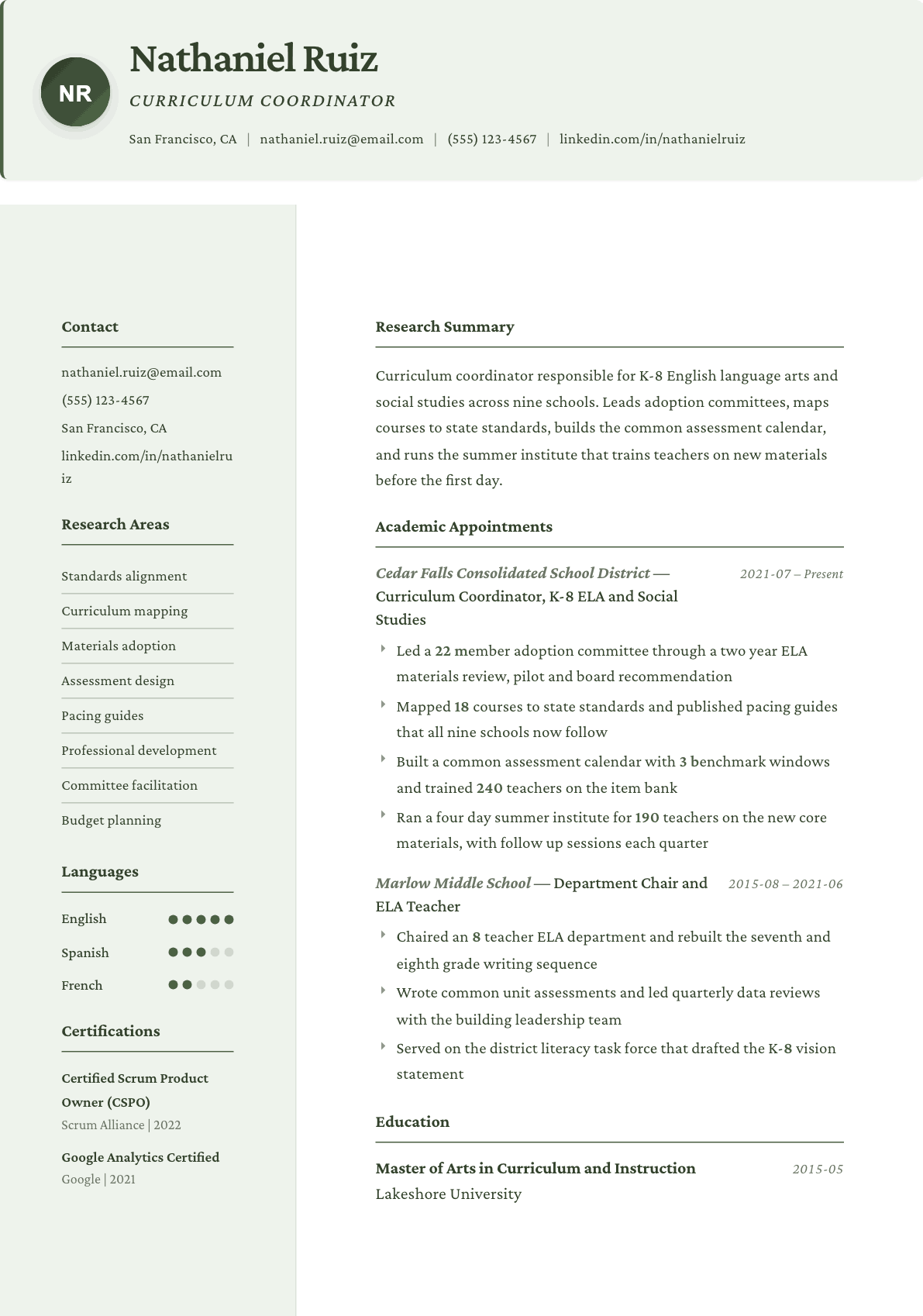
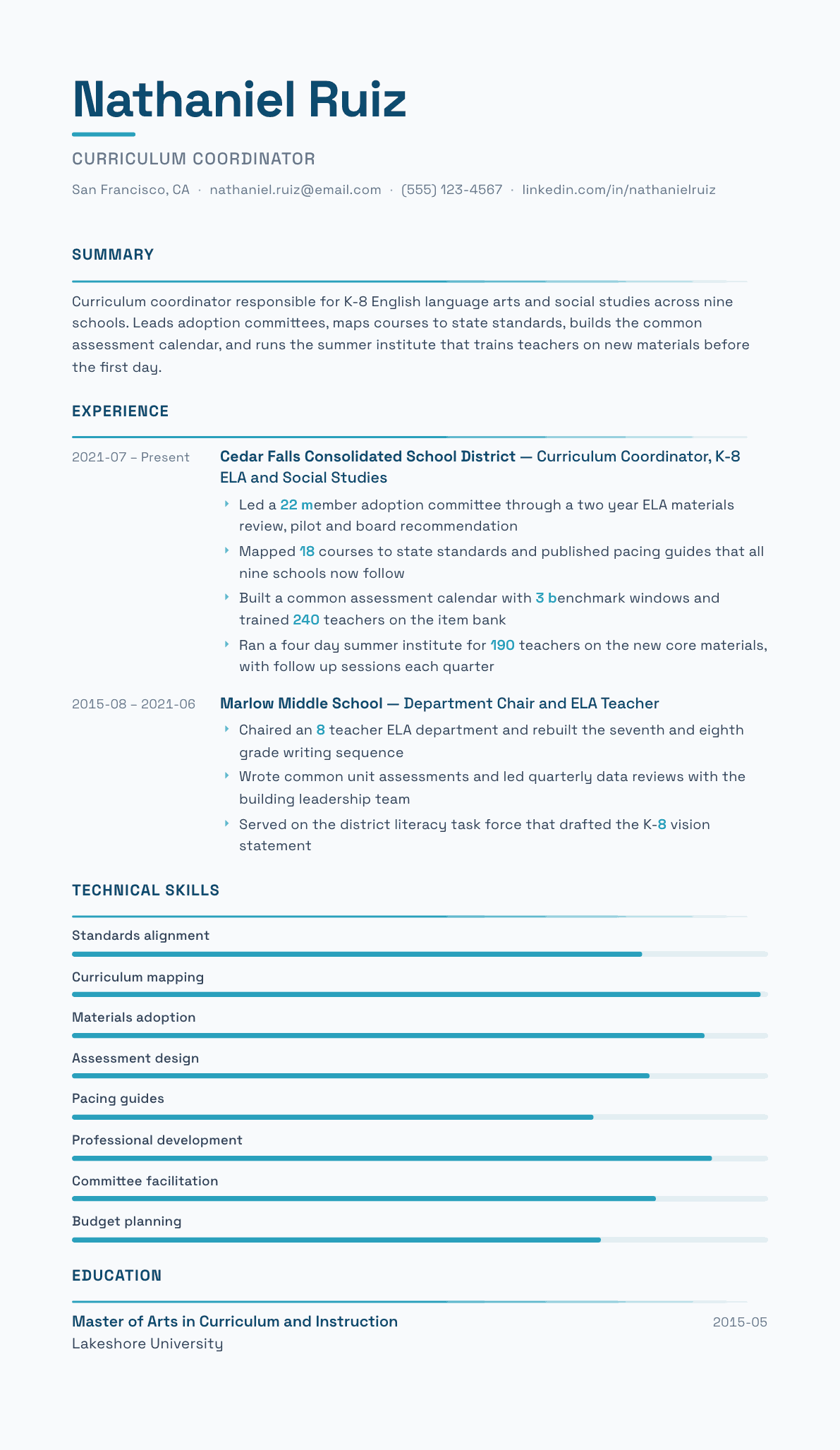
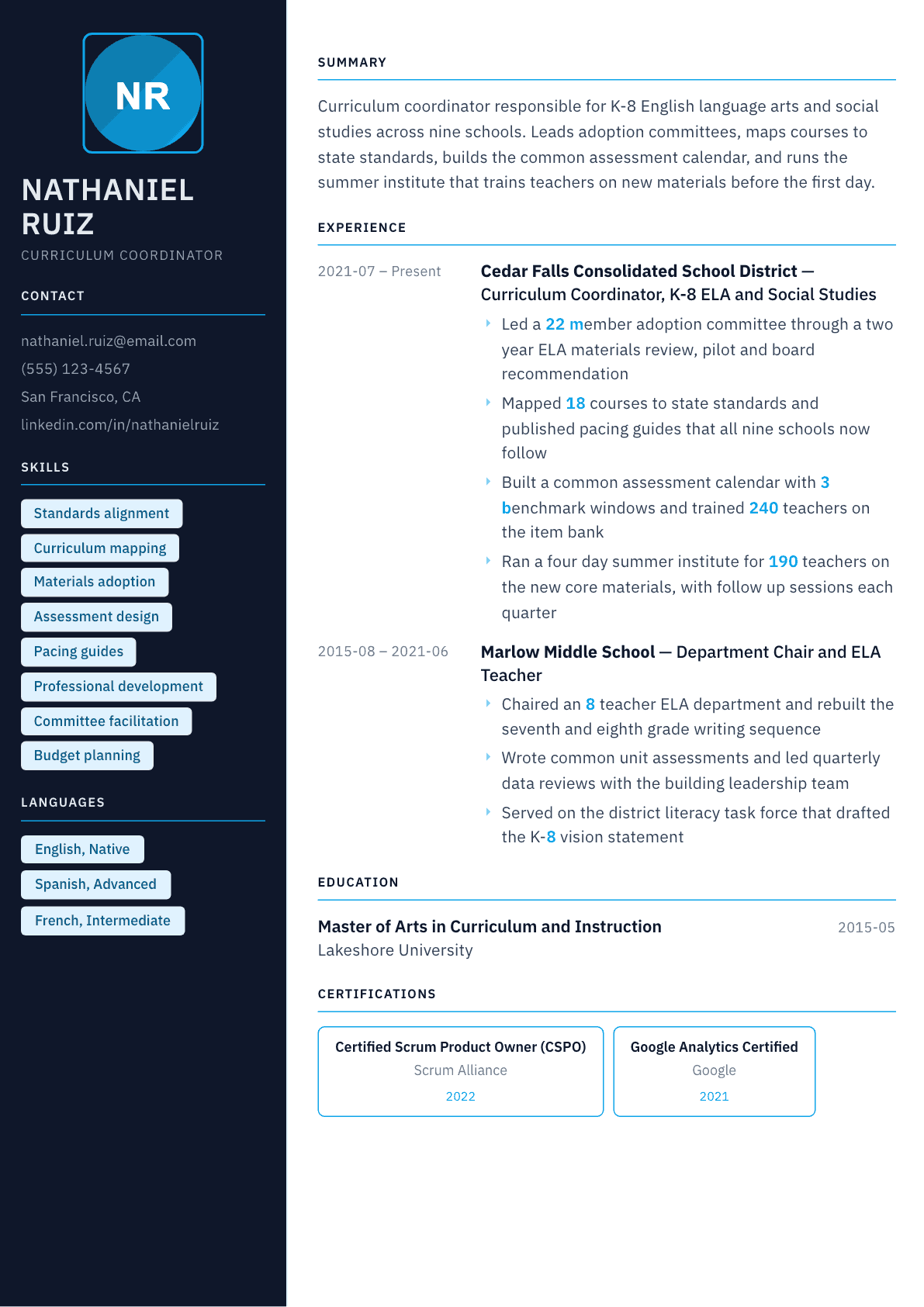
The same curriculum coordinator content laid out in three CVBooster templates, so you can see what the finished document looks like before you write a word.
Example Curriculum Coordinator summary
Curriculum coordinator overseeing K-8 English language arts and social studies for a nine school district. Led a full materials adoption from review criteria through board recommendation, published pacing guides for eighteen courses, and built the benchmark calendar the buildings run on. Former department chair who still models lessons during the summer institute each year.
Skills to list on a Curriculum Coordinator resume
- Curriculum mapping
- Standards alignment
- Materials adoption
- Pacing guides
- Common assessments
- Item bank management
- Data analysis
- Professional development design
- Committee facilitation
- Vendor management
- Grant reporting
- Program evaluation
- Instructional materials review
- Stakeholder communication
What actually gets this resume read
- State your scope in the first line: grade bands, subjects, number of schools and how many teachers you serve.
- Walk through an adoption you led from review criteria to pilot to board recommendation, because that is the signature task.
- Name the standards framework and any state review process you have worked inside, so the district sees a match.
- Show the assessment side of the job: benchmark calendars, item banks, and how results reach teachers in time to matter.
- Include budget, grant or vendor management figures when you owned them, since coordinators sign for materials.
- Keep your classroom and department chair history visible, because teachers judge a coordinator on credibility.
How to write a curriculum coordinator resume
A curriculum coordinator resume is read at the district office, usually by an assistant superintendent for teaching and learning, and often by a committee that includes principals and a teacher union representative. They are hiring someone who will decide what materials arrive in classrooms, when units are taught, and how the district proves alignment to state standards when the state asks.
That means the file has to show scope and process together. Scope is grade bands, subjects, schools and teachers served. Process is how you run an adoption, how you map courses to standards, how you build an assessment calendar, and how you get teachers to use what was bought instead of leaving it in the closet.
This guide walks through the sections a district committee expects, how to write about an adoption you led, three summaries across career stages, five rewritten bullets, and the questions teachers ask when they move from a department chair role into district curriculum work.
Lead with scope, because that is how the job is sized
The first line under your job title should say what you are responsible for: grade bands, subject areas, number of schools, number of teachers, and whether you supervise anyone. A coordinator for K-8 English language arts across nine schools and a coordinator for secondary science in a single high school hold the same title and do different work.
Then say who you report to and who you work through. Coordinators rarely supervise teachers directly, so the influence runs through principals, department chairs and coaches. Naming that structure shows you understand how a district office actually gets anything into a classroom.
- Header line: grade bands, subjects, schools, teachers served, direct reports if any.
- Sections: summary, experience, adoptions and program work, education, licenses, skills, presentations.
- Keep your teaching and department chair history on the page, since credibility with teachers is part of the job.
Write an adoption the way a committee experiences it
Leading a materials adoption is the signature accomplishment for this role, so give it real space. Walk the reader through the stages: forming the committee, writing review criteria, screening publishers, running a classroom pilot, gathering teacher and family input, and bringing a recommendation to the board.
Include the size of the committee, the length of the process and the outcome. An adoption is a political act as much as an academic one, and a coordinator who has taken one through a public board meeting without it unraveling has proved something no course can teach.
Then say what happened after the vote. Purchase timelines, teacher training, pacing guides, and the first year support plan are where adoptions succeed or quietly fail, and the committee reading your resume has watched both happen.
Mapping, pacing and assessment
Standards alignment work is dull to write and important to prove. Say how many courses you mapped, which framework you aligned to, where the maps live so teachers can reach them, and how often they are revised. A map that no one opens is a document, not an accomplishment.
Assessment is usually attached to the same job. Write the benchmark calendar you built, the number of windows, who writes items, how the item bank is maintained, and how quickly results reach teachers. The turnaround matters, because data returned after the unit is over changes nothing.
- Name the assessment platform and item bank you administered, since districts hire against their own stack.
- Say how teachers use the results: data meetings, small group rosters, reteach windows in the pacing guide.
- Note any state review, audit or accreditation cycle you prepared documentation for.
Money, vendors and grants
Coordinators sign for materials, negotiate with publishers, manage consumable reorders, and often administer a federal or state grant tied to a program. If you held budget authority, say what you managed and how you controlled it, in plain language rather than exact dollar amounts.
Grant work is worth its own line. Writing the application, tracking allowable expenses, and preparing the annual report are duties assistant superintendents are relieved to hand over, and candidates who have done them are rare enough to stand out.
Professional learning, because materials do not teach themselves
Every adoption comes with training. Write the summer institute or the launch series you designed: days, audience size, structure, and the follow up sessions across the year. Then name what you did about the teachers who missed it, because that gap is the reason implementation stalls in year two.
Show that you still model in classrooms if you do. A coordinator who has taught a lesson with the new materials in front of skeptical teachers earns a hearing that a memo never will.
Curriculum Coordinator resume summary examples
Moving from department chair
English department chair of six years stepping into district curriculum work. Rebuilt a middle school writing sequence, wrote common unit assessments for eight teachers, and served on the district literacy task force that drafted the K-8 vision. Holds a masters degree in curriculum and instruction and a secondary teaching license.
Coordinator of one subject area
Curriculum coordinator for K-8 English language arts and social studies across nine schools. Led a two year materials review from criteria through board recommendation, published pacing guides for eighteen courses, and built the benchmark calendar the buildings now run on. Trains teachers at the summer institute each year.
Director level
Director of curriculum and instruction overseeing all content areas, assessment and federal programs for a mid sized district. Supervises four subject coordinators and the assessment office, presents adoption recommendations to the board, and administers the district consolidated federal application and its annual report.
Work experience bullets: before and after
Before: Helped select new curriculum materials.
After: Led a 22 member adoption committee through a two year materials review, classroom pilot and public board recommendation for K-8 English language arts.
Committee size, duration and the board step show you carried a political process, not just a preference for one publisher.
Before: Aligned curriculum to standards.
After: Mapped 18 courses to the state standards and published pacing guides in a shared location that all nine schools now follow.
The course count and the fact that buildings actually use the guides separate real alignment work from a filed document.
Before: Worked on district assessments.
After: Built a common assessment calendar with 3 benchmark windows and trained 240 teachers on the item bank and the results dashboard.
The calendar, the windows and the training volume show the full loop from writing items to teachers reading results.
Before: Provided professional development.
After: Ran a four day summer institute for 190 teachers on the new core materials and added quarterly follow up sessions through the first implementation year.
The follow up plan proves you know that a single summer training does not carry an adoption through winter.
Before: Managed the curriculum budget.
After: Administered the instructional materials budget and the consumable reorder cycle for nine schools, and prepared the annual federal grant report for the subject areas.
It names the specific financial duties a district office needs covered rather than a vague claim of budget experience.
Hard skills
- Curriculum mapping
- Standards alignment
- Instructional materials adoption
- Pacing guide development
- Common assessment design
- Item bank administration
- Benchmark data analysis
- Professional development design
- Committee facilitation
- Vendor and publisher negotiation
- Federal program reporting
- Program evaluation
Soft skills
- Consensus building
- Presenting to a board
- Managing dissent in a committee
- Clear written guidance
- Working through principals
- Follow through across a school year
Certifications worth listing
- National Board Certification (National Board for Professional Teaching Standards)
- Curriculum and Instruction Supervisor Endorsement (State department of education)
- Reading Specialist Endorsement (State department of education)
Mistakes that cost curriculum coordinator candidates the interview
- Opening with duties instead of scope, so the reader never learns how many schools and teachers you served.
- Describing an adoption as a purchase decision and skipping the pilot, the input process and the board step.
- Publishing pacing guides as an accomplishment without any sign that buildings actually follow them.
- Dropping the classroom years, which leaves teachers on the committee wondering whether you ever taught the standards.
- Listing assessment work without the turnaround time, when late results are the complaint teachers raise most.
- Using district acronyms a neighboring district does not share, which makes half the resume unreadable to the reviewer.
Curriculum Coordinator resume questions
What is the difference between a curriculum coordinator and an instructional coach?
A coordinator owns what gets taught and with which materials across a district, including adoption, mapping and assessment. A coach works inside buildings on how teaching happens, cycle by cycle. Some small districts combine them, so split your bullets by function if yours did.
Do I need an administrator license to be a curriculum coordinator?
It depends on the state and on whether the position supervises staff. Many districts require a supervisor or administrator endorsement, and others accept a teaching license with a curriculum masters degree. Read the posting and put the exact credential you hold near the top.
How do I write about an adoption that the board rejected?
Write the process honestly and focus on what you produced: the review criteria, the pilot data, the input sessions and the recommendation. Committees respect a candidate who ran a clean process, and how you describe the outcome tells them how you handle a public setback.
How much of my teaching history should stay on the resume?
Keep every teaching position with grades, subjects and dates, but tighten the bullets to leadership and curriculum work: unit writing, common assessments, department chair duties and pilot classrooms. That is the part a district committee reads as preparation for the coordinator role.
Should I include presentations and published curriculum work?
Yes, in a short section near the end. State conference sessions, regional institutes and curriculum published through a professional organization all verify expertise, and they give the hiring committee something concrete to ask you about in the interview.