Laser Technician Resume Examples: the lines they read
Build a Laser Technician Resume That Clears Safety Review
By Mustafa Tarabya, founder of CVBooster · Published · Updated
Laser technician resume example, device keywords and a guide to writing platforms, settings, safety records and treatment outcomes.
Sample resumes for a laser technician
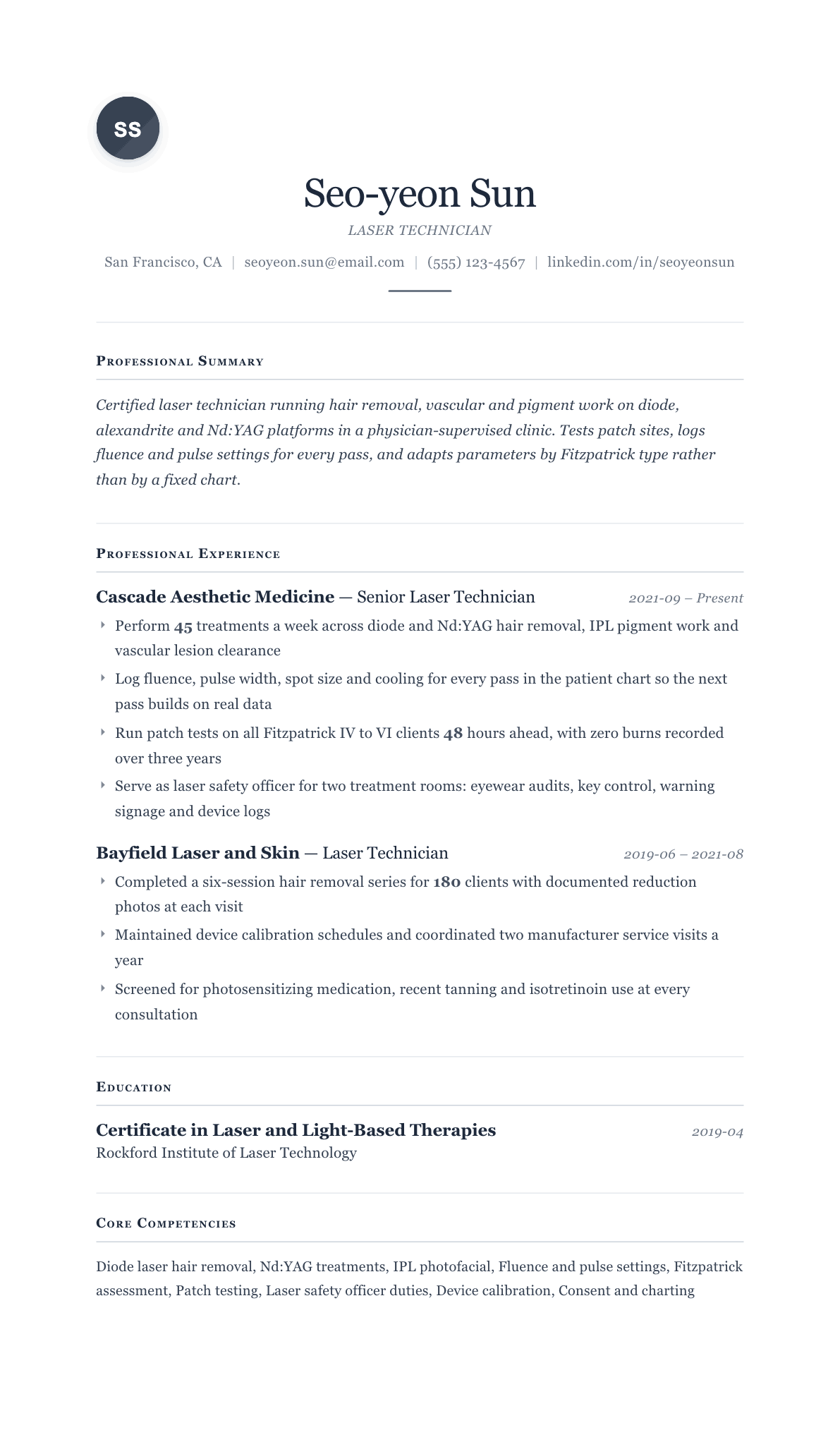
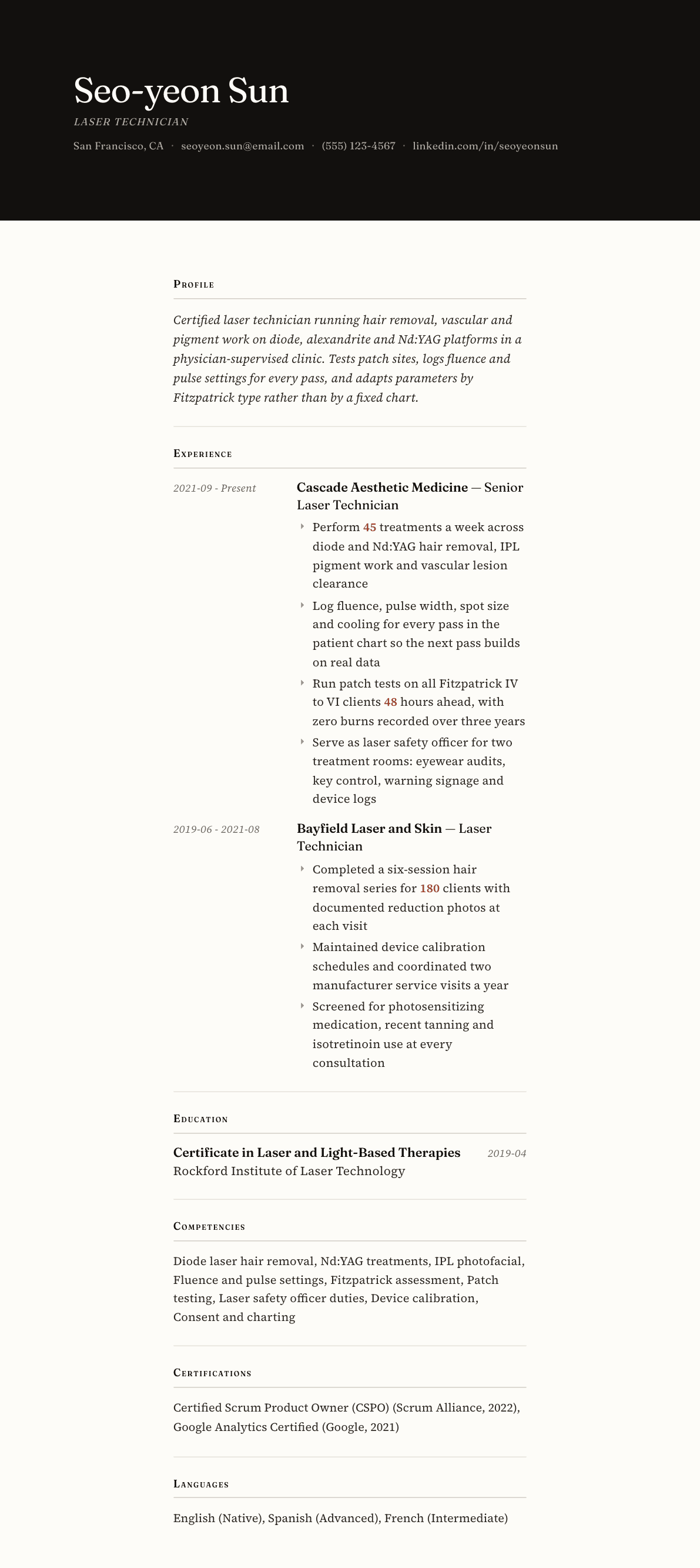
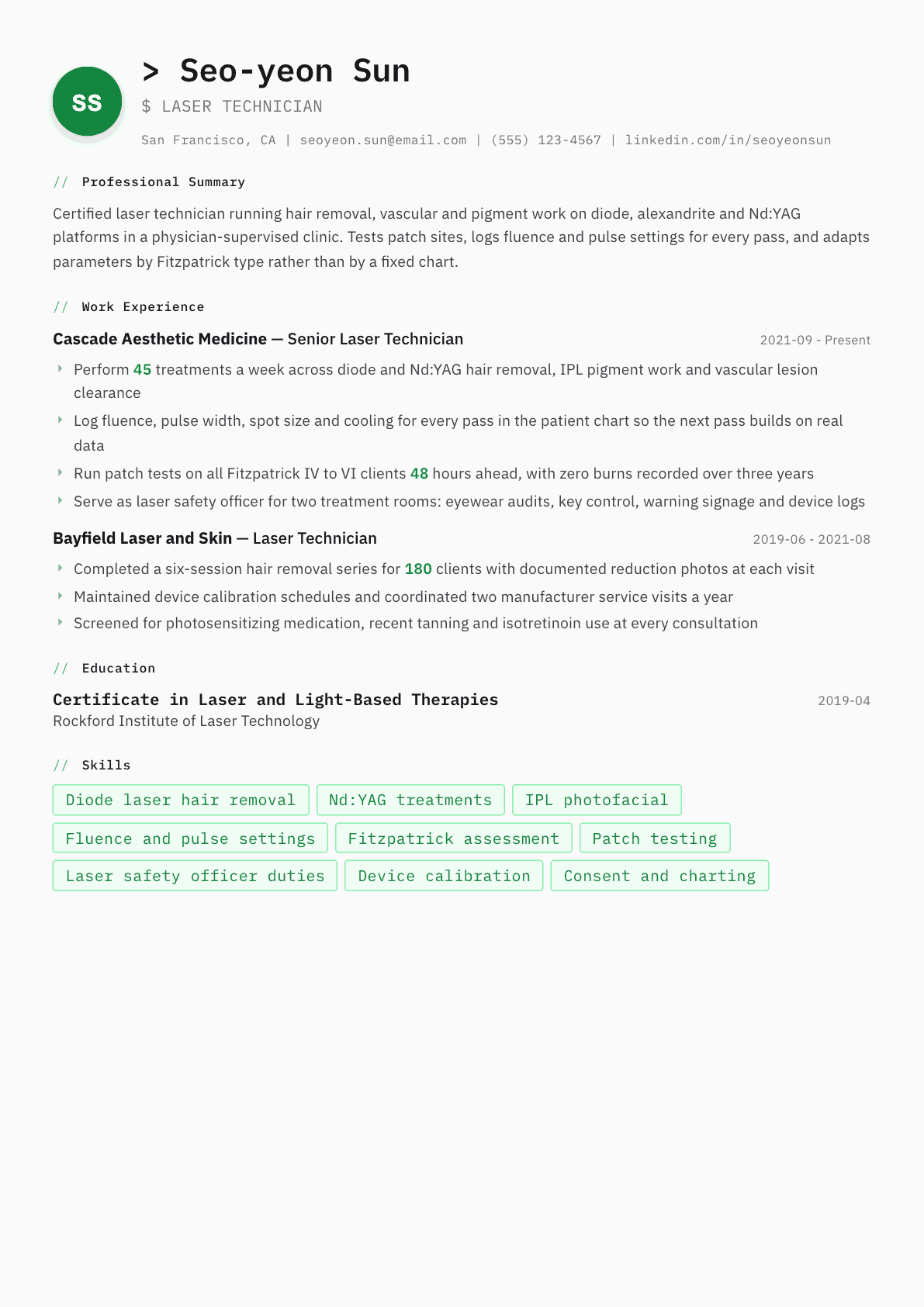
The same laser technician content laid out in three CVBooster templates, so you can see what the finished document looks like before you write a word.
Example Laser Technician summary
Certified laser technician running hair removal, pigment and vascular treatments on diode, alexandrite and Nd:YAG platforms inside a physician-supervised clinic. Selects fluence, pulse width and cooling by skin type rather than by a fixed chart, logs every parameter in the chart, and patch tests darker skin types ahead of a first pass. Also serves as laser safety officer covering eyewear audits, key control and device logs. Seeking a senior clinic role.
Skills to list on a Laser Technician resume
- Diode laser hair removal
- Alexandrite laser treatment
- Nd:YAG vascular treatment
- Intense pulsed light
- Fractional resurfacing support
- Fluence and pulse width selection
- Cooling and comfort management
- Fitzpatrick typing
- Patch testing protocol
- Laser safety officer duties
- Eyewear and key control
- Device calibration and service logs
- Informed consent documentation
- Post-treatment care instruction
- Adverse event reporting
What actually gets this resume read
- List every laser and light platform by wavelength and device family, because clinics buy specific hardware.
- Show that you record settings: fluence, pulse width, spot size and cooling, treatment by treatment.
- State your laser certification and your safety officer training with the board that issued each one.
- Give your patch test protocol and lead time, especially for darker Fitzpatrick types where risk is real.
- Say whether you worked under physician supervision, and what the delegation rules were in that state.
- Include device calibration, service scheduling and eyewear control, which is the compliance half of the job.
How to write a laser technician resume
Laser hiring is risk hiring. The clinic owner or medical director reading your resume is thinking about the one client who leaves with a burn, a blister or a patch of post-inflammatory pigment, and about who will be answering for it. So the page is read as a safety document first and a service list second.
That changes what belongs on it. Platforms by name and wavelength, because clinics own specific hardware and want someone who can treat on it in week one. Parameter discipline, because a technician who records fluence, pulse width, spot size and cooling gives the next pass something to build on. Patch testing, consent, calibration and eyewear control, because that is the machinery that keeps a clinic insured.
This guide walks through the sections a laser clinic reads and in what order, with summaries for a newly certified technician, a technician with a full treatment week and a senior technician doubling as safety officer, five rewritten bullets, and the questions estheticians ask when they cross over into device work.
Format: platforms and certification in the top third
One page, reverse chronological. Two blocks go high: the laser and light platforms you have treated on, and the certification plus safety training that lets you stand behind them. A clinic screening ten applicants for a specific device will start there and stop reading if it is absent.
List platforms by device family and wavelength rather than by brand name alone. A clinic that runs a different manufacturer still recognizes an alexandrite or a long-pulsed Nd:YAG, and a technician who talks in wavelengths reads as someone who understands the physics rather than the button layout.
- Platform block: diode, alexandrite, long-pulsed Nd:YAG, intense pulsed light and any fractional systems you have assisted on.
- Indication block: hair reduction, vascular lesions, pigmented lesions, photofacial and resurfacing support, kept separate from the platforms.
- Safety block: laser safety officer training, eyewear and key control, warning signage, controlled area practice and device logs.
- Supervision line: whether you treated under physician supervision, and what the delegation arrangement was.
Summary: platforms, indications, volume, safety record
Three lines. Name the platforms, the indications you treat, the treatments you carry in a week, and your safety record with the period it covers. A clinical reader will use those four facts to decide whether you can be put on a schedule without a supervising retrain.
If you are crossing over from esthetics, be explicit. Say the device hours you have, who supervised them, and what your certification covers. A clinic will train a strong esthetician onto a platform, but it will not discover mid-consultation that your laser experience was a weekend course.
Experience: settings, skin type and what you recorded
Write bullets that show parameter thinking. Selecting fluence and pulse width for skin type and hair caliber, dropping fluence on a client who came back with a reaction, extending cooling on a bony area, changing spot size to reach depth. Then say that you recorded it, because a chart with settings in it is what makes a series work rather than a sequence of unrelated appointments.
Give skin type honestly. Treating Fitzpatrick IV to VI safely on the right wavelength is a distinct competency and clinics in diverse cities hire specifically for it. Say what you have treated, on which platform, with what patch test lead time, and what your outcome record was.
Add the volume: treatments per week, series completed, and the mix across indications. A technician who has completed hundreds of six-session hair reduction series knows what session four looks like when the hair comes back finer, and that experience is exactly what a clinic is buying.
Compliance: consent, calibration, eyewear and adverse events
Give compliance its own section if you have carried it. Consent forms and what they disclose, patch test policy and lead time, medication and tanning screening, device calibration schedules, manufacturer service visits, eyewear inventory and optical density checks, key control and controlled area signage. This section is why a medical director shortlists a technician who is otherwise equal to another.
Include adverse event handling. Nobody with real volume has a spotless story forever, and a technician who describes how a blister was managed, documented and followed up reads as safer than one who implies nothing has ever gone wrong.
Keywords a laser clinic filters on
Clinic postings recycle a narrow vocabulary: laser hair reduction, diode, alexandrite, Nd:YAG, intense pulsed light, fluence, pulse duration, spot size, epidermal cooling, Fitzpatrick, patch test, informed consent, contraindications, post-treatment care, laser safety officer, calibration. Mirror the true ones once in a block and once inside a bullet where the work is shown.
Name the charting system and the booking platform. Device clinics run on records, and a technician who already writes in the same system is quicker to make productive than one who does not.
Laser Technician resume summary examples
Newly certified
Licensed esthetician with laser certification and 200 supervised device hours on diode hair reduction and intense pulsed light. Trained in Fitzpatrick assessment, patch testing and parameter recording, with bloodborne pathogens and eyewear safety training current. Seeking a supervised treatment room in a clinic setting.
Full treatment week
Laser technician performing 45 treatments a week across diode and Nd:YAG hair reduction, intense pulsed light pigment work and vascular clearance. Logs fluence, pulse width, spot size and cooling for every pass, patch tests darker skin types ahead, and has recorded no burns across three years.
Senior technician and safety officer
Senior laser technician and safety officer for two treatment rooms, owning eyewear audits, key control, signage and device service scheduling alongside a full clinical week. Trains new technicians on parameter selection by skin type and handles the clinic escalation path for adverse events.
Work experience bullets: before and after
Before: Performed laser hair removal treatments on clients.
After: Performed 45 treatments a week across diode and long-pulsed Nd:YAG hair reduction, intense pulsed light pigment work and vascular lesion clearance in a physician-supervised clinic.
Volume, platforms, indications and the supervision context tell a clinic exactly what you can take on.
Before: Adjusted settings for each client.
After: Selected fluence, pulse width, spot size and cooling by skin type and hair caliber, and recorded every parameter in the chart so the following session could step up from real data.
Naming the four parameters and the reason for recording them shows how a series is actually built.
Before: Was careful with darker skin tones.
After: Patch tested every Fitzpatrick IV to VI client 48 hours ahead on the intended settings, then treated on longer wavelengths with extended cooling, with no burns recorded across three years.
A lead time, a wavelength rationale and an outcome period make the safety claim checkable.
Before: Responsible for laser safety in the clinic.
After: Acted as laser safety officer for two treatment rooms: eyewear inventory and optical density checks, key control, controlled area signage and a device log reviewed monthly.
Listing the actual duties proves the role rather than borrowing the title.
Before: Made sure the machines were maintained.
After: Maintained calibration schedules across four devices and coordinated two manufacturer service visits a year, keeping every unit inside its service window through the clinic busiest quarters.
Device count, service cadence and the outcome show ownership of uptime and compliance together.
Hard skills
- Diode laser hair reduction
- Alexandrite laser treatment
- Long-pulsed Nd:YAG treatment
- Intense pulsed light
- Vascular and pigmented lesion work
- Fluence and pulse width selection
- Epidermal cooling management
- Fitzpatrick typing
- Patch testing protocol
- Laser safety officer duties
- Device calibration and service logs
- Informed consent documentation
- Adverse event management
Soft skills
- Explaining realistic session counts
- Staying calm during a reaction
- Refusing an unsafe treatment request
- Precision under repetitive work
- Clear post-treatment instruction
Certifications worth listing
- Certified Medical Laser Safety Officer (CMLSO) (Board of Laser Safety)
- Certified Laser Safety Officer (CLSO) (Board of Laser Safety)
- Certified Laser Hair Removal Professional (CLHRP) (Society for Clinical and Medical Hair Removal)
- Bloodborne Pathogens Training (American Red Cross)
Mistakes that cost laser technician candidates the interview
- Naming only the brand of machine you used, so a clinic on different hardware cannot tell what you can actually treat.
- Leaving out parameter recording, which suggests each session started from scratch instead of building on the last.
- Claiming comfort with all skin types without naming the wavelength, the cooling and the patch test lead time behind it.
- Omitting supervision arrangements, when delegation rules are the first compliance question a medical director asks.
- Presenting a weekend course as equivalent to supervised device hours on a clinical floor.
- Saying nothing about adverse events, which reads as inexperience rather than as a spotless record.
Laser Technician resume questions
What certification does a laser technician actually need?
It depends on the state, and requirements range from an esthetician license with device training to a dedicated laser certification under physician supervision. List your certification, the issuing body, your supervised device hours and the jurisdiction you worked in.
How do I get device experience onto a resume without clinic hours?
Count supervised training hours explicitly, naming the platform, the supervisor and the number of treatments observed and performed. Then say what you have not yet run alone. Clinics hire trainees for device rooms regularly, but only when the gap is stated.
Should I list treatment volumes on a laser resume?
Yes. Treatments per week, series completed and the mix across hair reduction, pigment and vascular work show that you have seen the whole arc of a course, including the sessions where results slow and settings need rethinking.
How do I write about a burn or an adverse reaction?
Describe it as management rather than as failure: how it was identified, what was done immediately, how it was documented, who was notified and what changed in the protocol afterward. Clinical readers trust that far more than a claim of a perfect record.
Do medspas and dermatology practices read this resume differently?
They do. A dermatology practice weighs charting, supervision and adverse event handling most heavily, while an aesthetic medspa also wants consultation and rebooking ability. Keep the safety section for both and swap the emphasis in your summary.
Related resume examples
- Medical Esthetician Resume example
- Esthetician Resume example
- Skincare Specialist Resume example
- Permanent Makeup Artist Resume example
- Lash Technician Resume example
- Naturopath Resume example