Legal Assistant Resume Examples: the lines they read
Legal Assistant Resume: Lawyer Assistant Resume Samples
By Mustafa Tarabya, founder of CVBooster · Published · Updated
Lawyer assistant resume samples for small firm, litigation, corporate and senior seats, with the section order, software and deadline wording firms expect.
Sample resumes for a legal assistant
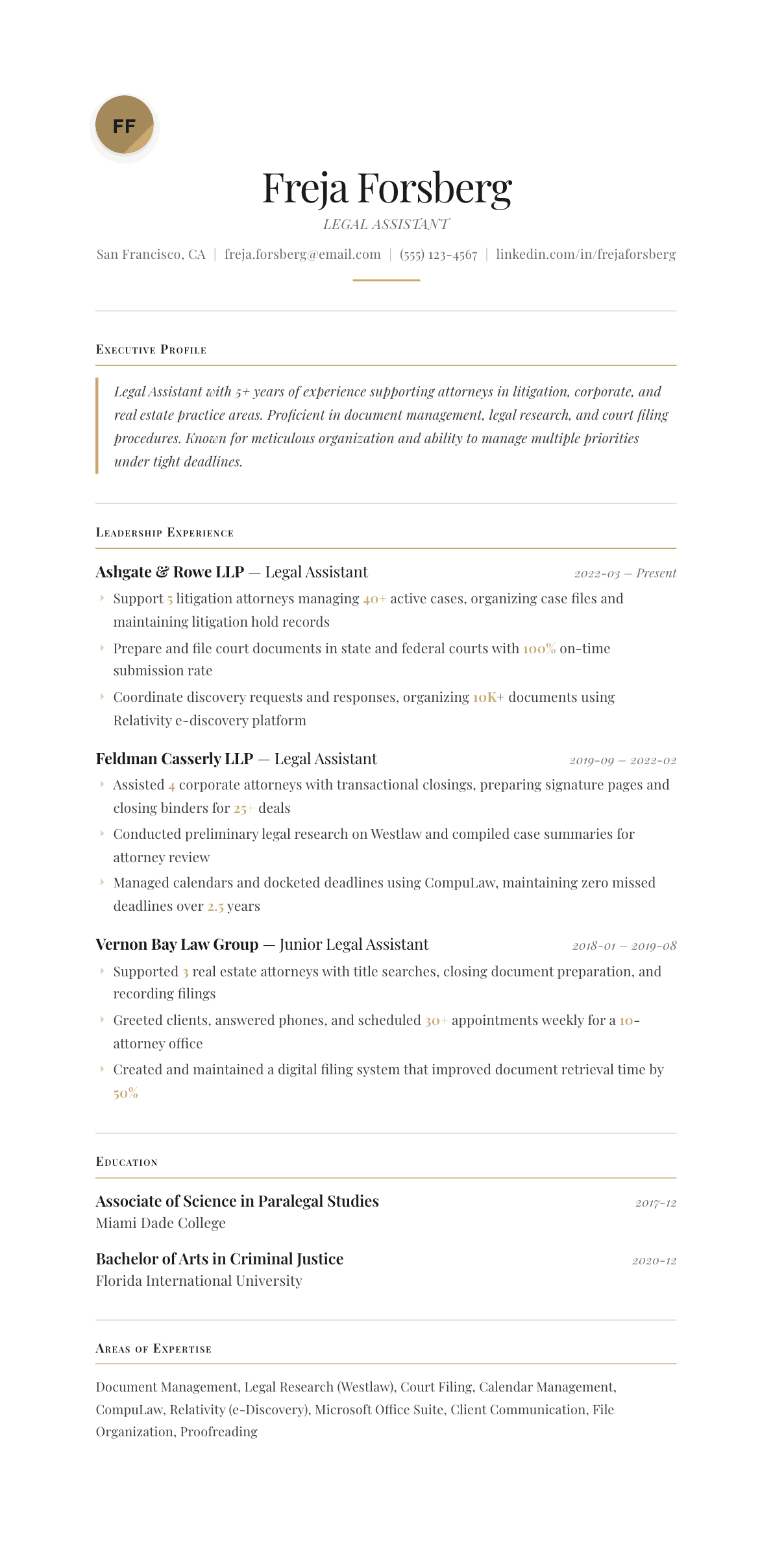
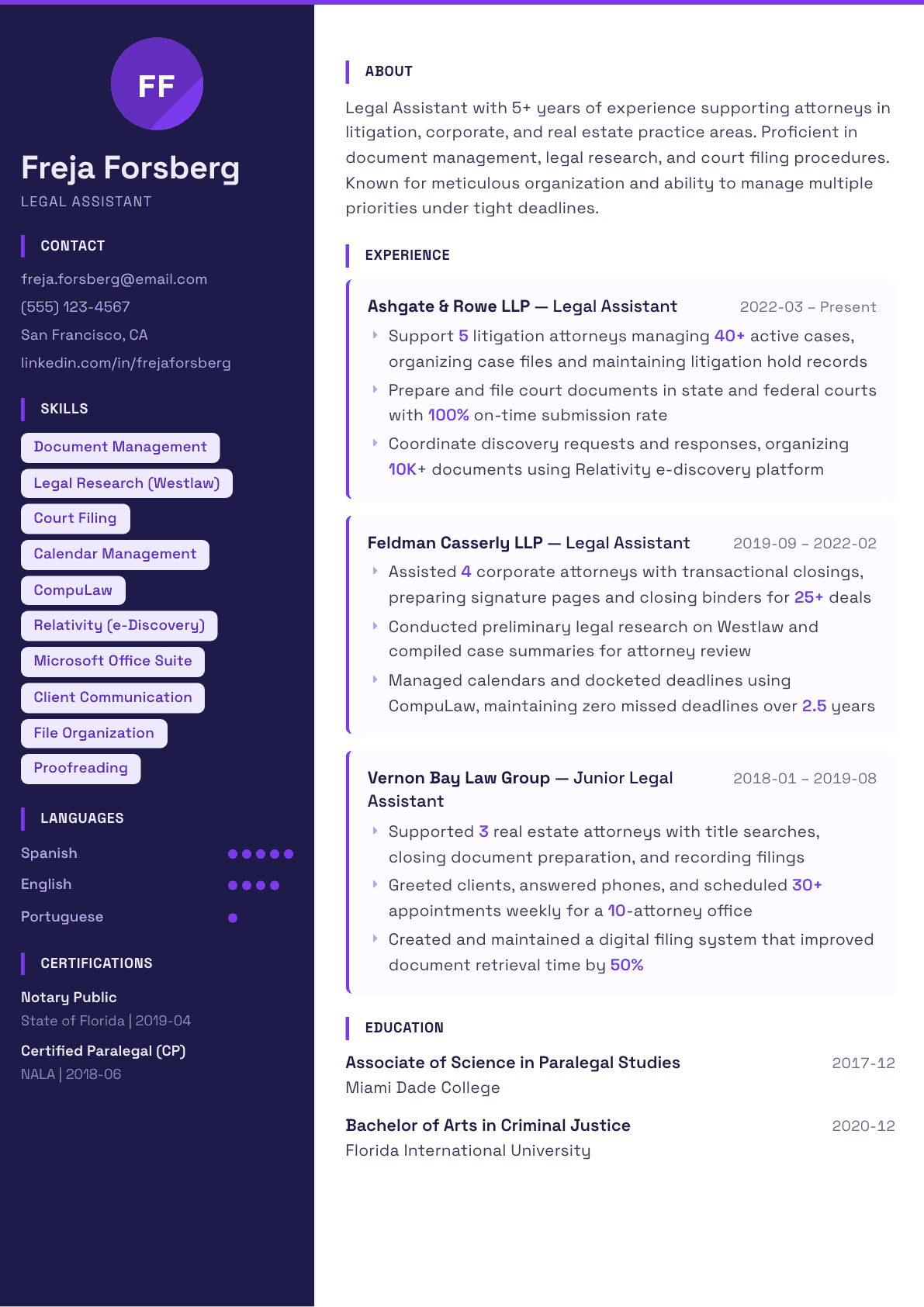
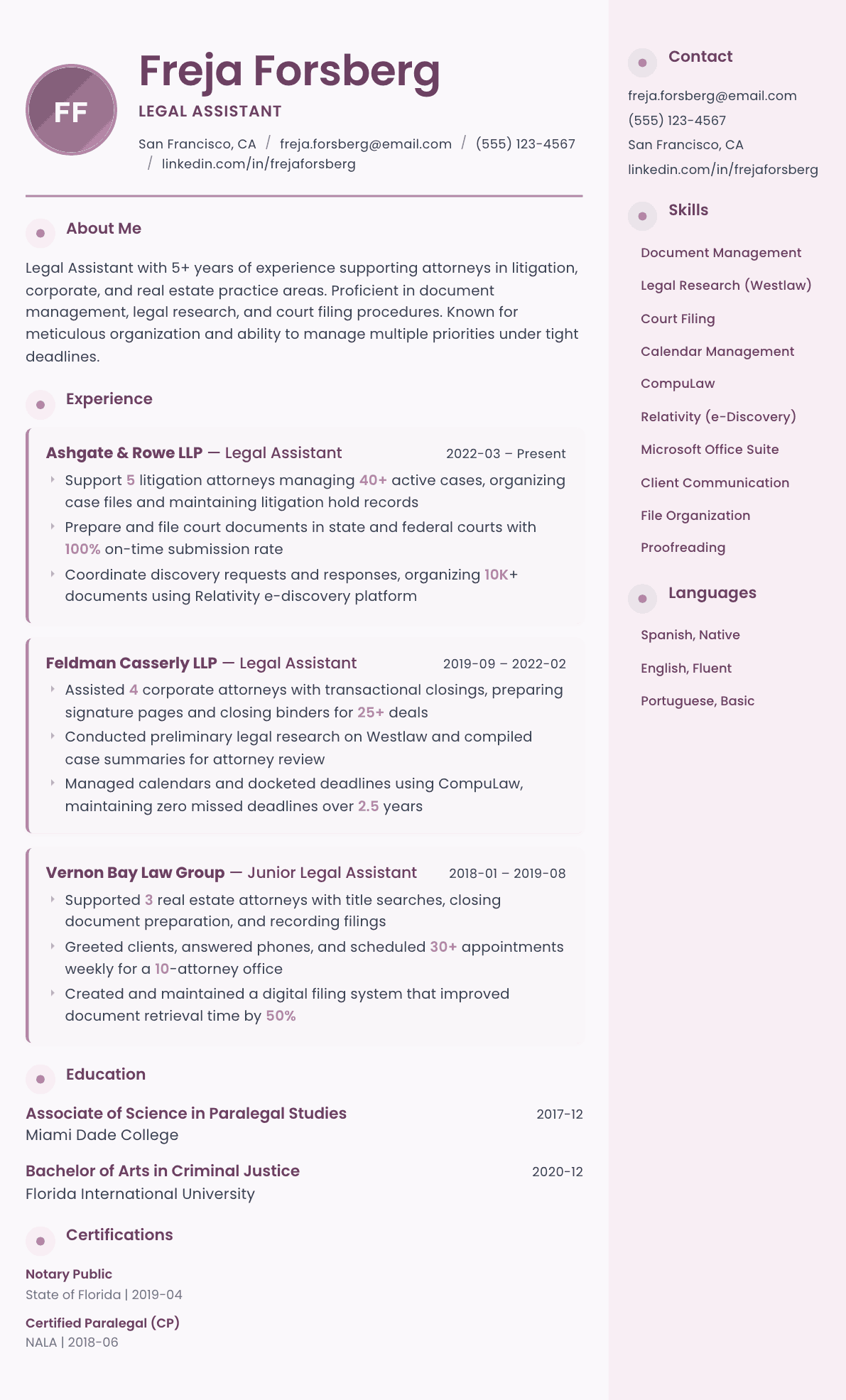
The same legal assistant content laid out in three CVBooster templates, so you can see what the finished document looks like before you write a word.
Example Legal Assistant summary
Legal Assistant with 5 years supporting litigation, corporate, and real estate attorneys across 40+ active cases. Proficient in Westlaw, Relativity, and CompuLaw, with a 100% on-time filing record and no missed docket deadlines in 2.5 years. Bilingual in English and Spanish.
Skills to list on a Legal Assistant resume
- Document Management
- Legal Research
- Court Filing
- Calendar Management
- CompuLaw
- Relativity
- Westlaw
- Microsoft Office Suite
- Client Communication
- File Organization
- Proofreading
- Notarization
- Travel Coordination
- Multi-Attorney Support
What actually gets this resume read
- Mention the practice areas you have supported: litigation, corporate, real estate, IP, family law.
- List legal software and platforms: Westlaw, LexisNexis, Relativity, CompuLaw, iManage, NetDocuments.
- Quantify your work: cases managed, documents filed, appointments scheduled, deadlines tracked.
- Highlight your organizational skills -- law firms value assistants who keep things running smoothly.
- Include any certifications or notary commissions as they add credential weight.
How to write a legal assistant resume
A legal assistant resume is screened by an office administrator or a practice group manager who has one worry: how long before this person can be left alone with a court deadline. Everything on the page is read as evidence for or against that. The practice areas you have supported, the software you can already operate, the filing systems you know, and whether your dates suggest you stay long enough to become useful.
The title itself is used loosely across the market. In some firms a legal assistant does substantive support work close to a paralegal role, and in others it is an administrative role centered on documents, calendars and client contact. Your resume has to declare which version you are, because the reader is matching you to one specific job description.
This guide covers lawyer assistant resume samples for four common seats, the section order law firm hiring managers expect, how to show deadline reliability without inventing metrics, summaries for three stages of the career, and the rewrites that make routine support work sound like the operational backbone it actually is.
Format: single column, practice areas visible in the first third
One page unless you have more than ten years of firm experience. Reverse-chronological, single column, plain font. Firms often run legal support resumes through applicant tracking software configured for exact software names, so a two-column design that scrambles the parse can drop you before anyone reads a word.
Put a short technical proficiencies line high on the page rather than at the bottom. The systems are the fastest way for a manager to see whether you can start without a month of training, and that line is often what gets your file pulled from the pile.
- Header: name, city and state, phone, email, and any legal support certification after your name.
- Section order: summary, technical proficiencies, experience, education and certifications, additional skills.
- Career changers put a short relevant-skills block above experience and keep prior roles brief.
Summary: practice area, firm size, what you own
Name the practice areas you have supported, because the vocabulary and the deadlines differ completely: litigation, corporate, real estate, estate planning and probate, family, immigration, personal injury, or insurance defense. Then the environment, since supporting three attorneys in a boutique is a different job from working in a document center at a large firm.
Close with the piece of the work you own. Calendaring court deadlines, preparing filings, managing client intake, or running the document management library are all specific claims. Avoid describing yourself as a hardworking team player, which tells a hiring manager nothing she can test.
Experience: attorneys supported, matters carried, deadlines held
Open each position with the frame a manager needs: the firm type, the practice area, how many attorneys you supported and roughly how many active matters were on your desk. Supporting four litigation attorneys across ninety open matters is a sentence that immediately sets your capacity.
Then bullets on the work itself. Preparing and e-filing pleadings, calendaring deadlines from court rules, assembling exhibits and deposition binders, drafting routine correspondence and engagement letters, opening and closing matters, running conflicts checks, processing client intake, tracking billable time entries and preparing prebills for attorney review.
Reliability is the product here, so show it in the way the work was structured rather than through an invented statistic. Describe the calendaring system you maintained, the reminder intervals you set before a filing date, the checklist you built for closing binders, or the intake process you standardized. That reads as competence; a claimed accuracy figure reads as decoration.
Lawyer assistant resume: four samples by practice seat
A lawyer assistant resume is a legal assistant resume under the name most people outside firms use. Keep the posting title, legal assistant, attorney assistant or legal secretary, in your headline so the applicant tracking search finds you, and let the summary say which attorneys and matters you support. The four samples below are invented; each shows the headline, the summary line and the strongest bullet.
- Entry level, small firm: Headline: Legal Assistant, three attorney family law firm. Summary: Answers intake calls, opens client files, prepares engagement letters and keeps the shared court calendar for three attorneys. Best bullet: Built an intake checklist that stopped files opening without a signed engagement letter and conflict check.
- Litigation support, mid size firm: Headline: Litigation Legal Assistant, state and federal courts. Summary: Supports two partners and an associate through discovery, motion practice and trial preparation. Best bullet: Prepared and electronically filed motions and exhibits on two dozen matters with no rejected filings in the year.
- Corporate and transactional: Headline: Corporate Legal Assistant, entity formation and closings. Summary: Maintains minute books, prepares formation documents and assembles closing binders for a four attorney business practice. Best bullet: Moved the closing binder process to a shared checklist, cutting post closing cleanup from weeks to days.
- Senior attorney assistant, large firm: Headline: Senior Legal Assistant, real estate practice group. Summary: Manages calendars, billing entries and document production for a practice group head and two senior associates. Best bullet: Trained four new assistants on the firm document management system and billing codes during an office merger.
Systems: name the exact software, spelled the way the firm spells it
This is the section that gets you interviewed. Name the legal research platforms, the document management systems, the case and matter management tools, the docketing and calendaring software, the billing systems, and the electronic discovery review platforms you have used. Then the filing portals: the federal electronic filing and case access systems, and the state or county portals you have filed in.
Say what you did in each, at least briefly. Having filed in a court portal is different from having only viewed dockets in it, and a hiring manager will ask.
Education, certification and the keywords in the posting
A paralegal certificate or an associate degree in paralegal studies is common and worth listing with the granting institution and whether the program is approved by the American Bar Association. A national certification carries weight in larger firms and is worth the exam if you plan to stay in the field.
Mirror the posting vocabulary once in the summary and once in the experience: legal document preparation, e-filing, calendaring, docketing, trial preparation, client communication, conflicts, matter intake, records management, and the named practice area. Screening software matches strings, so use the exact words the firm used.
Legal Assistant resume summary examples
New to legal support
Paralegal studies graduate from an American Bar Association approved program with an internship at a personal injury firm, where I prepared demand packages, requested medical records and maintained a calendar of 60 active matters. Proficient in document management and court e-filing portals.
Five years in
Legal assistant supporting four litigation attorneys across roughly 90 open matters, responsible for state and federal e-filing, deadline calendaring from court rules, exhibit and deposition binder preparation, and monthly prebill review. Experienced with document management, docketing and time entry systems.
Senior legal assistant
Senior legal assistant with eleven years across corporate and real estate practice, managing closing checklists, entity records and signature packages for a six-attorney group. Trains new support staff, owns the matter intake and conflicts process, and standardized the closing binder workflow adopted across the practice.
Work experience bullets: before and after
Before: Filed documents with the court.
After: Prepared and electronically filed pleadings, motions and exhibits in federal and two state court systems, confirming conformed copies and calendaring response deadlines the same day.
Naming the courts and the follow-through shows you understand filing as a deadline chain, not a single upload.
Before: Maintained attorney calendars and schedules.
After: Calendared litigation deadlines for 90 active matters by computing dates from court rules, setting reminders at 30, 14 and 3 days, and reconciling the docket with attorney calendars each Monday.
The method and the cadence are what a manager is actually buying, and they cannot be faked in an interview.
Before: Helped attorneys prepare for trials and depositions.
After: Assembled deposition and trial binders for 12 matters, indexing exhibits, coordinating court reporters and videographers and preparing witness files ahead of each hearing date.
Concrete deliverables and vendor coordination show trial support experience that helped prepare only implies.
Before: Answered client calls and emails.
After: Served as first contact for 40 active clients, conducting intake interviews, collecting required documents and updating clients on filing status while routing legal questions to the responsible attorney.
The intake role and the boundary on legal advice show professional judgment as well as service.
Before: Worked with billing and time entries.
After: Entered and reviewed time for four attorneys, prepared monthly prebills, applied client billing guidelines on task codes and reduced write-offs by catching guideline conflicts before invoices went out.
Billing guideline knowledge is a revenue skill, and naming it separates you from candidates who only typed entries.
Hard skills
- Court e-filing in federal and state systems
- Deadline calendaring from court rules
- Legal document preparation
- Document management systems
- Case and matter management software
- Trial and deposition binder preparation
- Records requests and subpoena tracking
- Client intake and conflicts checks
- Time entry and prebill preparation
- Legal research platforms
- Electronic discovery review platforms
- Transcription and correspondence drafting
Soft skills
- Deadline discipline
- Discretion with client information
- Prioritizing across attorneys
- Clear status reporting
- Attention to detail under volume
- Calm handling of upset clients
Certifications worth listing
- Certified Paralegal (CP) (NALA, the Paralegal Association)
- Professional Paralegal (PP) (NALS, the Association for Legal Professionals)
- Registered Paralegal (RP) (National Federation of Paralegal Associations)
- Notary Public commission (State commissioning authorities)
Mistakes that cost legal assistant candidates the interview
- Leaving the software list to the last line, when it is the single fastest signal that you can start without weeks of training.
- Writing that you provided administrative support to attorneys without naming the practice area, which makes your deadline knowledge unverifiable.
- Claiming an accuracy or on-time filing percentage nobody measured, when describing your calendaring method would have been more convincing.
- Omitting how many attorneys you supported and how many matters were open, which is how a manager estimates your capacity.
- Using a decorative two-column template that scrambles in the parser, so the software names never reach the screening report.
- Listing court portals you have only viewed dockets in as though you have filed in them, which the first interview question exposes.
Legal Assistant resume questions
What is the difference between a legal assistant and a paralegal on a resume?
Firms use the titles differently, so let the bullets settle it. If your work was substantive, such as drafting pleadings and digesting depositions, show that. If it was document, calendar and client-facing support, show that instead and apply to the matching posting.
Do I need a paralegal certificate to work as a legal assistant?
Many firms hire without one, especially for administrative support roles, but a certificate from an American Bar Association approved program shortens the screening argument considerably and is usually required for the substantive positions.
How do I show I can be trusted with deadlines?
Describe the system rather than claiming a statistic. Name how you computed dates from court rules, the reminder intervals you set, how you reconciled the docket with attorney calendars, and who reviewed the calendar with you each week.
Is a lawyer assistant the same as a legal assistant?
Yes. Lawyer assistant, attorney assistant and legal assistant usually describe the same job, and many firms post it as legal assistant. Use the exact title from the posting in your headline, then name the practice area, the number of attorneys you support and the software you already use, such as the firm document and billing systems.
How do I move from general office administration into a law firm?
Lead with the transferable pieces: calendar ownership, document production, records handling and client contact. Then add legal-specific proof through a paralegal certificate, notary commission, or volunteer work with a legal aid clinic that put you near real filings.