Learning & Development Manager Resume Examples: free
Craft a Learning & Development Manager Resume That Inspires
By Mustafa Tarabya, founder of CVBooster · Published · Updated
Build a compelling L&D Manager resume with training program achievements, measurable learning outcomes, and instructional design expertise.
Sample resumes for a learning & development manager
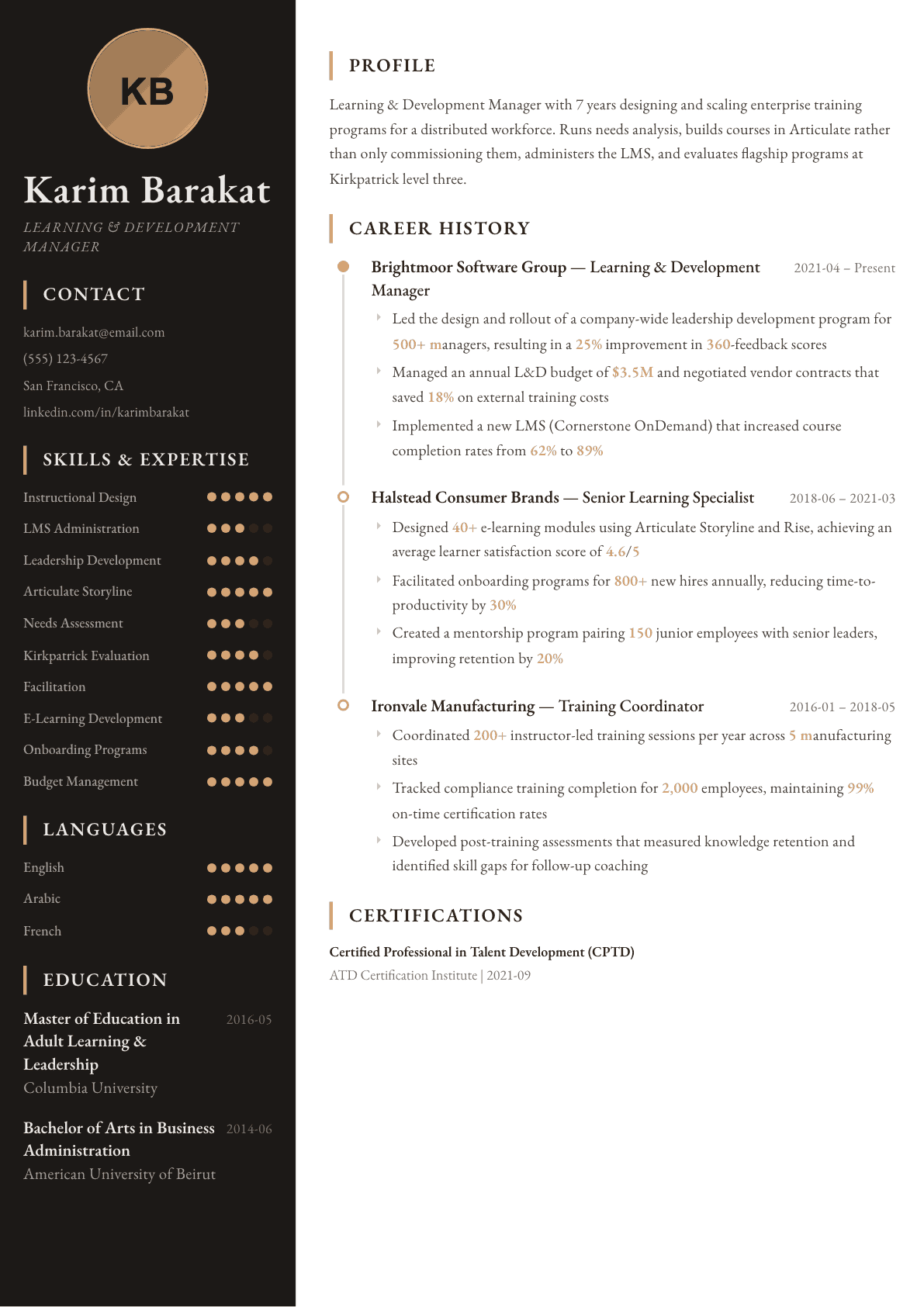
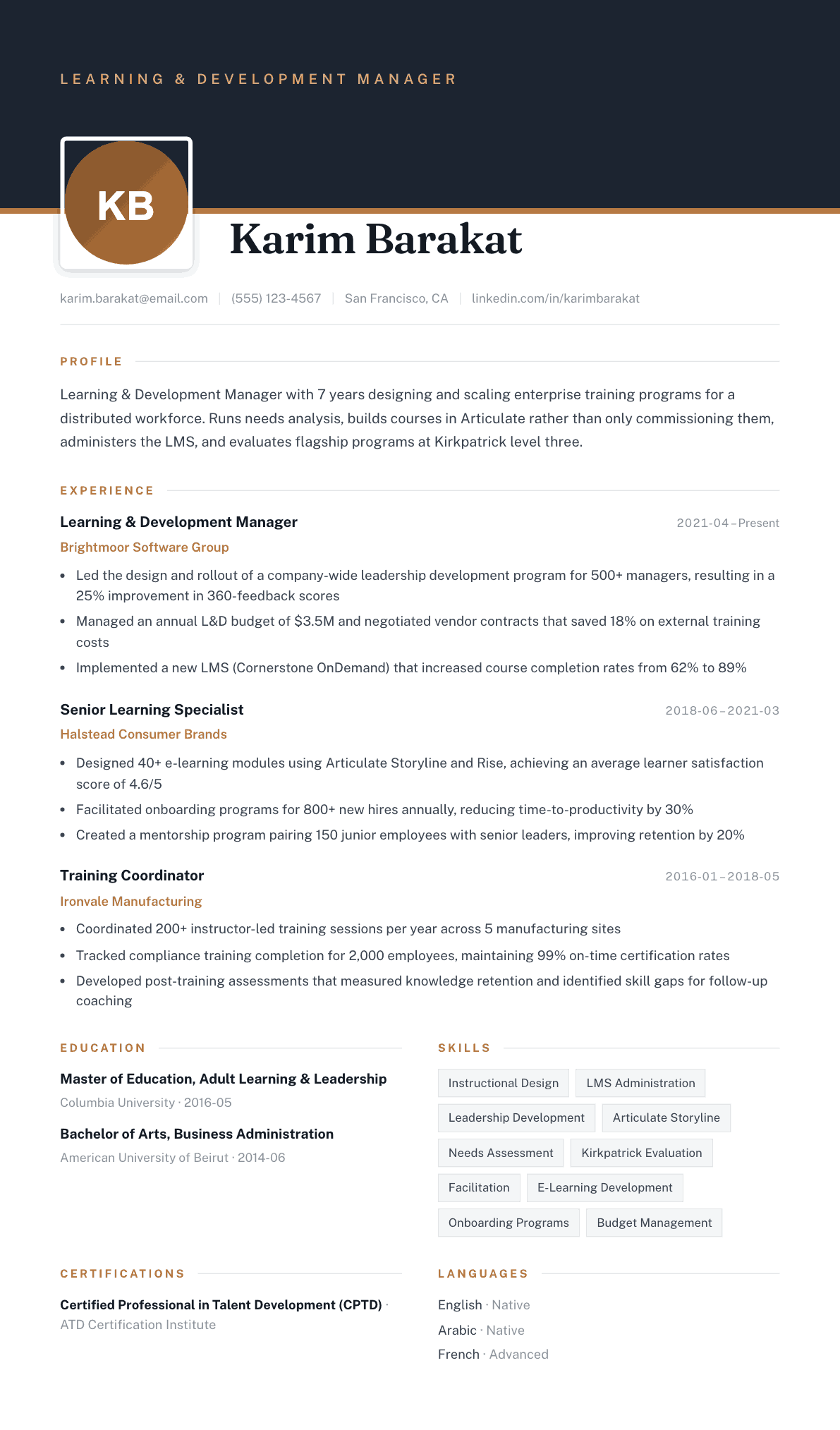
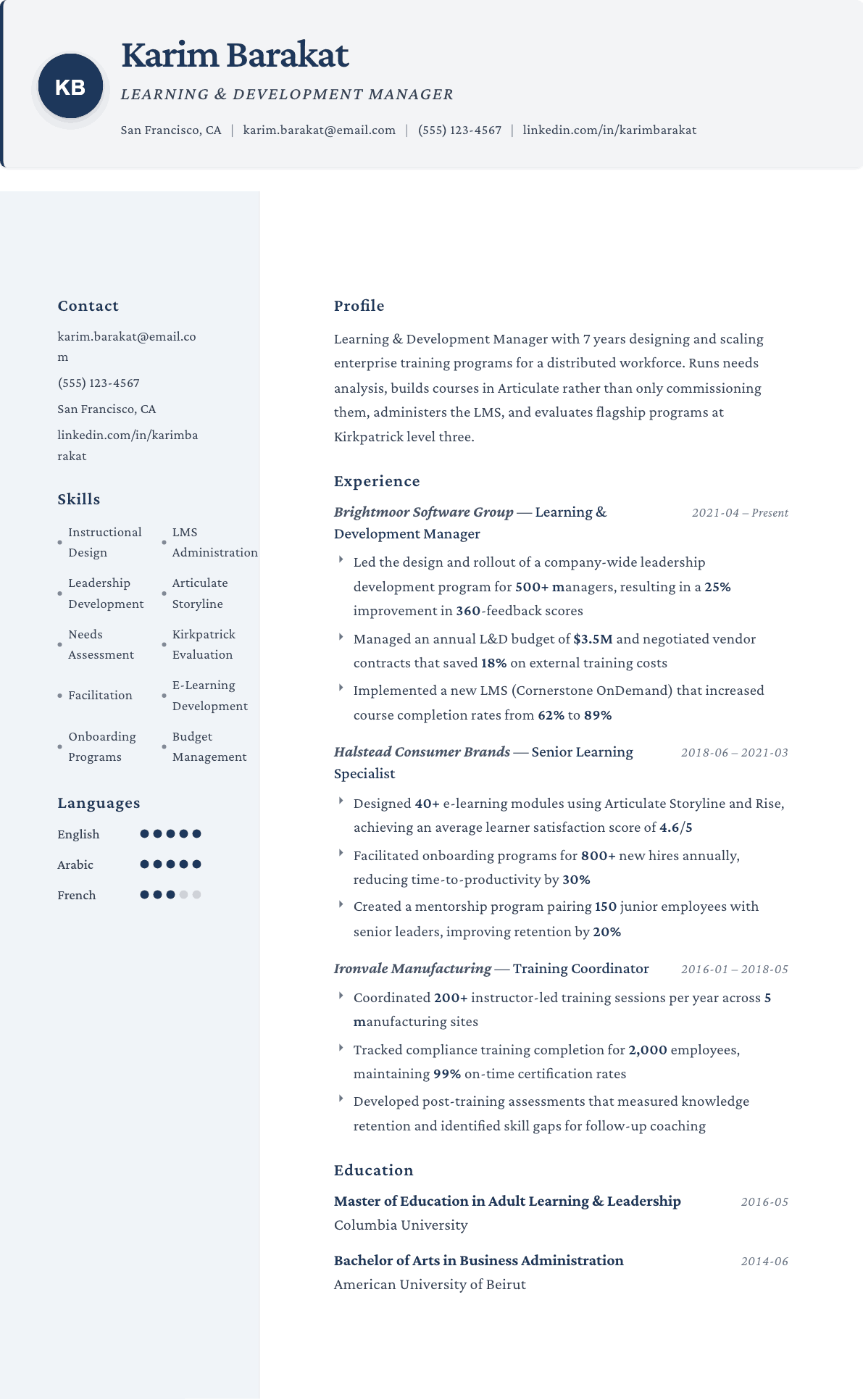
The same learning & development manager content laid out in three CVBooster templates, so you can see what the finished document looks like before you write a word.
Example Learning & Development Manager summary
Learning & Development Manager with 7 years designing enterprise training programs measured on performance rather than attendance. Owned a $3.5M budget across platform, vendors and internal build, lifted course completion from 62% to 89% after an LMS replacement, and launched a leadership program for 500 managers that preceded 35 internal promotions. CPTD certified.
Skills to list on a Learning & Development Manager resume
- Instructional Design
- LMS Administration
- Leadership Development
- E-Learning Development
- Needs Assessment
- Facilitation
- Kirkpatrick Evaluation
- Articulate Storyline
- Onboarding Design
- Coaching & Mentoring
- Budget Management
- Blended Learning
- Change Management
- Compliance Training
What actually gets this resume read
- Quantify learning outcomes: course completion rates, knowledge retention scores, time-to-productivity reductions, and engagement survey improvements.
- Highlight instructional design tools (Articulate, Captivate, Camtasia) and LMS platforms (Cornerstone, Docebo, Moodle).
- Showcase leadership development programs with promotion and retention impact data.
- Include evaluation methodology knowledge such as Kirkpatrick Model, Phillips ROI, or Bloom's Taxonomy.
- Describe budget management responsibilities and vendor negotiation savings.
- Demonstrate alignment between L&D initiatives and broader business goals like revenue growth or safety improvements.
How to write a learning & development manager resume
A learning and development manager resume is judged on one uncomfortable question: did anyone perform differently after your program ran? Completion rates and satisfaction scores are the easiest numbers to collect and the least persuasive to a head of talent, because they measure attendance and mood. Behavior change, time to productivity, promotion rates and error reduction are the numbers that make a hiring committee lean forward.
The second thing the reader looks for is craft. There is a real difference between a manager who books vendors and a manager who can run a needs analysis, write learning objectives, build a course in an authoring tool, administer the platform it lives on, and evaluate the result against a model. Both exist in the market, and the resume has to say which one you are within the first six lines.
This guide covers the structure that shows both business impact and instructional craft, three summaries from training specialist to enterprise learning manager, five rewritten bullets, and the questions L and D managers ask when they need a portfolio of programs to fit on two pages.
Format: a program portfolio, not a duty list
Two pages, reverse chronological, single column. What makes this resume different from other HR files is that the experience section works best as a portfolio: each job holds two or three named programs with their audience, format, scale and result, rather than eight bullets about facilitating training.
Under the summary, add a short tools line covering authoring software, the learning platform, and the video or assessment tools you use. Talent development recruiters filter on those product names, and a manager who can build content rather than only commission it is a different hire.
- Tools line: Articulate Storyline and Rise, Adobe Captivate, Camtasia, Vyond, and the assessment tools you use.
- Platform line: Cornerstone OnDemand, Docebo, Workday Learning, Moodle, or whichever LMS you administered.
- Program entries: audience size, delivery format, duration, and the outcome measured.
Summary: audience, curriculum scope, and the business problem behind it
Say who you train and how many of them there are, what curriculum areas you own, and one program with a result attached. Leadership development for people managers, technical onboarding for a field workforce, and compliance training for a regulated employer are three very different jobs, and the reader will not guess correctly.
Name the business problem the learning function was pointed at. Programs exist because something was going wrong: new hires took too long to become productive, first-time managers were losing people, or safety incidents were rising. Stating the problem makes the program sound designed rather than decorative.
Experience: needs analysis, design, delivery, evaluation
Walk each significant program through the four stages, briefly. Where the need came from and how you validated it, whether through stakeholder interviews, performance data or a skills assessment. What you designed, including format, duration and blend of live and self-paced content. How it was delivered and to how many. What changed afterward, and how you know.
Evaluation is the part most candidates skip and the part that separates a manager from a coordinator. Name the model you use, whether Kirkpatrick levels, the Phillips return on investment methodology, or a defined performance measure agreed with the business before launch. Saying you measured at level three, behavior on the job, and how you observed it is a strong differentiator because most files stop at level one.
Leadership development deserves its own treatment because it is the highest-visibility program in most organizations. Give the cohort size, the length of the program, the components, whether coaching or three-hundred-sixty degree feedback was included, and what happened to the participants afterward in terms of promotion or retention.
Budget, vendors and the operations of a learning function
Managers own money and contracts, and that ownership belongs on the resume. State the annual budget you controlled in general terms, the vendor relationships you managed, the negotiation outcomes you achieved, and the build versus buy decisions you made. Reporting a savings figure as a share of the external training spend is clearer than a bare number and easier to defend.
Platform ownership is the other operational half. Migrations, integrations with the HRIS, compliance assignment automation, reporting to business leaders, and completion enforcement for regulated training are all real work that a talent leader will recognize as difficult. If you have run an LMS migration, give it a full bullet with the population and the content volume migrated.
- Budget scope and the split between internal build, external vendors and platform cost.
- Vendor selection: the criteria, the number of vendors evaluated, and the contract outcome.
- LMS migration: content items moved, users cut over, and the completion history preserved.
- Compliance training: assignment rules, deadlines, and the completion level maintained.
Keywords and how to write about facilitation
Postings in this field repeat a stable vocabulary: instructional design, LMS administration, leadership development, e-learning development, needs assessment, facilitation, blended learning, onboarding design, coaching and compliance training. Use those exact terms and pair them with a named tool or model so each one carries evidence.
Facilitation is worth its own line, but it needs specifics to mean anything. Sessions delivered per year, group sizes, whether virtual or in person, and the hardest audience you have held, such as a room of senior leaders or a shift-based field workforce. Everyone claims strong facilitation skills; almost nobody makes it checkable.
Learning & Development Manager resume summary examples
Training specialist moving into management
Learning and development professional with 3 years designing onboarding and compliance training for a 900-person healthcare employer. Builds courses in Articulate Rise, administers Moodle, facilitates 60 live sessions a year, and cut new-hire time to productivity by two weeks.
Seven years in
Learning and Development Manager with 7 years designing enterprise training programs. Managed a multimillion dollar annual budget, launched a leadership program for 500 managers that lifted 360-feedback scores by 25%, and raised course completion from 62% to 89% after an LMS replacement.
Head of learning
Enterprise learning leader with 12 years across manufacturing and technology, owning curriculum for 8,000 employees in nine countries and a team of six designers and facilitators. Runs Kirkpatrick level three evaluation on flagship programs and owns the global learning platform and vendor portfolio.
Work experience bullets: before and after
Before: Delivered training programs to employees.
After: Facilitated 80 live sessions a year for groups of 12 to 30, covering first-time manager skills and performance conversations, across both plant shift workers and corporate teams.
Session volume, group size and the two very different audiences make facilitation a checkable claim.
Before: Created a leadership development program.
After: Designed and launched a six-month leadership program for 500 managers combining live workshops, peer coaching circles and 360-feedback, which improved 360 scores by 25% and preceded 35 internal promotions.
The components, the duration and a downstream outcome show a designed program rather than a series of workshops.
Before: Implemented a new learning management system.
After: Led the migration to Cornerstone OnDemand for 6,000 users: rebuilt 240 course items, mapped completion history, integrated assignment rules with the HRIS, and lifted completion rates from 62% to 89% in the first year.
Naming the content volume, the integration and the completion movement turns a platform change into a measurable project.
Before: Managed the training budget and vendors.
After: Owned the annual L and D budget across platform, vendors and internal build, ran a competitive review of five external providers, and renegotiated contracts to cut external training spend by 18% without reducing program volume.
The process behind the saving makes the number credible and shows commercial judgment.
Before: Improved onboarding for new hires.
After: Rebuilt technical onboarding into a four-week blended path with role-based tracks, weekly manager checkpoints and a skills assessment at day 30, reducing time to full productivity from 12 weeks to 8.
A named design and a productivity measure move the bullet from activity to business outcome.
Hard skills
- Instructional design and learning objectives
- Needs assessment and skills gap analysis
- Articulate Storyline and Rise
- Adobe Captivate and Camtasia
- LMS administration (Cornerstone, Docebo, Moodle)
- Blended and virtual learning design
- Kirkpatrick and Phillips evaluation
- Leadership and management development
- Compliance training administration
- Facilitation and workshop design
- Vendor selection and contract negotiation
- Learning analytics and reporting
Soft skills
- Stakeholder interviewing
- Executive presence in the room
- Coaching and feedback
- Curriculum prioritization
- Program storytelling
- Cross-functional partnership
Certifications worth listing
- Certified Professional in Talent Development (CPTD) (ATD Certification Institute)
- Associate Professional in Talent Development (APTD) (ATD Certification Institute)
- Kirkpatrick Certified Professional (Kirkpatrick Partners)
- Prosci Change Management Certification (Prosci)
- SHRM Certified Professional (SHRM-CP) (Society for Human Resource Management)
Mistakes that cost learning & development manager candidates the interview
- Reporting only completion and satisfaction scores, which measure attendance rather than the behavior change the business paid for.
- Listing training topics without audience size, format or duration, so the reader cannot judge the scale of the work.
- Omitting the authoring tools and the learning platform, which are the product names talent development recruiters search on.
- Describing a leadership program with no cohort size and no follow-on promotion or retention result.
- Skipping budget and vendor ownership, which is a large part of what distinguishes a manager from a specialist.
- Claiming strong facilitation skills without session volume, group size or the difficulty of the audience.
Learning & Development Manager resume questions
What learning metrics should go on the resume?
Prefer the ones tied to performance: time to productivity, error or incident reduction, promotion and retention among participants, and assessment score movement. Include completion rates only when they moved sharply after something you changed, such as a platform replacement.
Do I need instructional design skills to be an L and D manager?
Not always, but a manager who can write objectives and build a course in an authoring tool is far more employable, especially outside large enterprises where there is no separate design team. If you have the skill, name the tools and the courses you built yourself.
How do I present a learning program portfolio without running long?
Give each job two or three flagship programs with audience, format, scale and outcome, and group everything else into a single line. A reader remembers three well-described programs and remembers nothing from a list of fifteen course titles.
Should I mention evaluation models by name?
Yes, because naming Kirkpatrick or the Phillips methodology signals that you measure deliberately. Say which level you actually reached on a given program rather than implying full return on investment analysis on everything, since an experienced interviewer will test that claim.
How do I move from trainer or facilitator to learning and development manager?
Add evidence of the three things managers own that facilitators usually do not: needs analysis you ran yourself, a program you designed from scratch, and budget or vendor decisions you influenced. Even one documented example of each changes how the file reads.
Related resume examples
- HR Manager Resume example
- Organizational Development Consultant Resume example
- HR Business Partner Resume example
- Corporate Trainer Resume example
- Learning and Development Specialist Resume example
- Training and Development Manager Resume example