Learning and Development Specialist Resume Examples
Write a Learning and Development Specialist Resume That Proves Transfer
By Mustafa Tarabya, founder of CVBooster · Published · Updated
Build a learning and development specialist resume with a full example, the design and evaluation detail employers check, keywords and a guide.
Sample resumes for a learning and development specialist
The same learning and development specialist content laid out in three CVBooster templates, so you can see what the finished document looks like before you write a word.
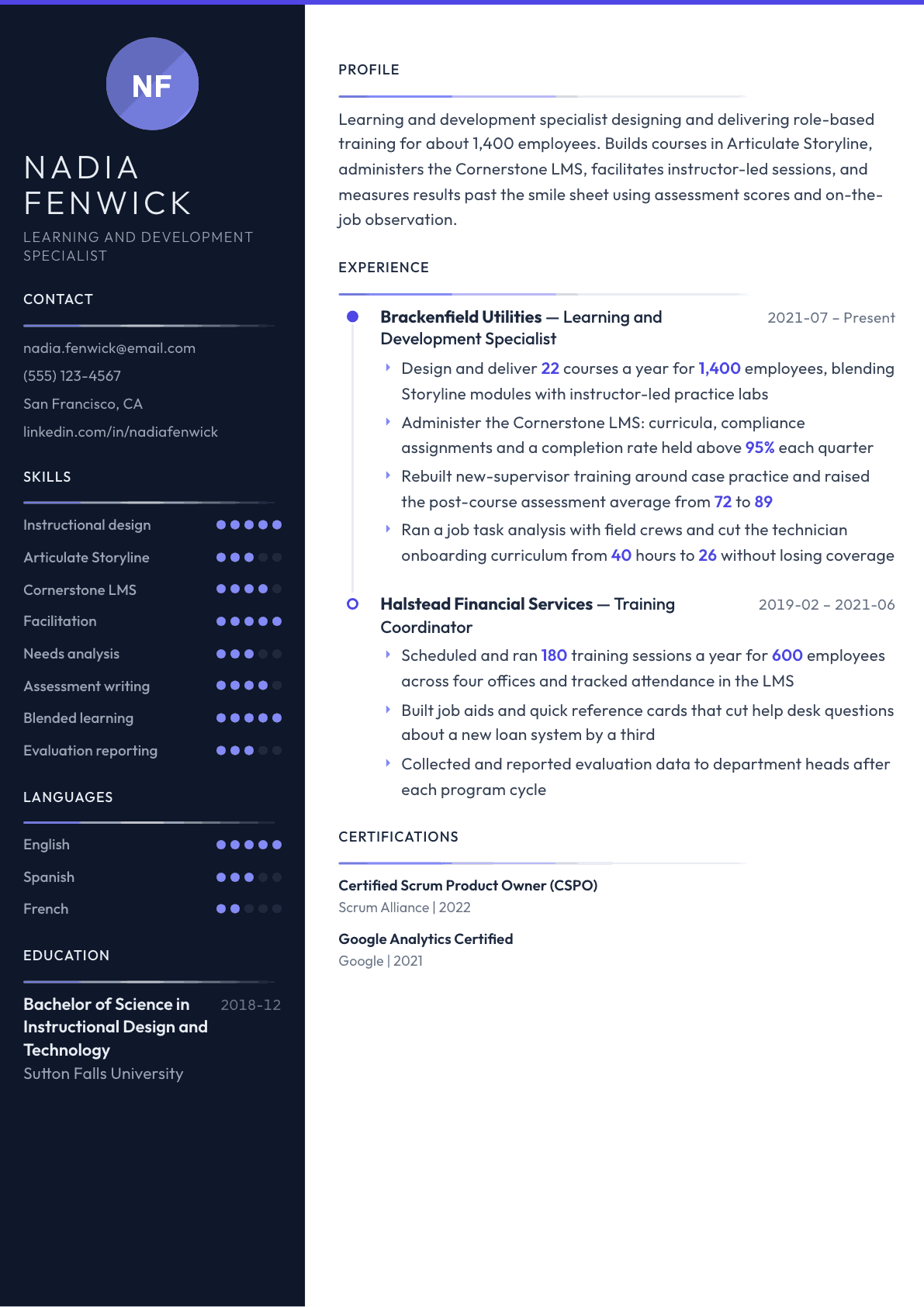
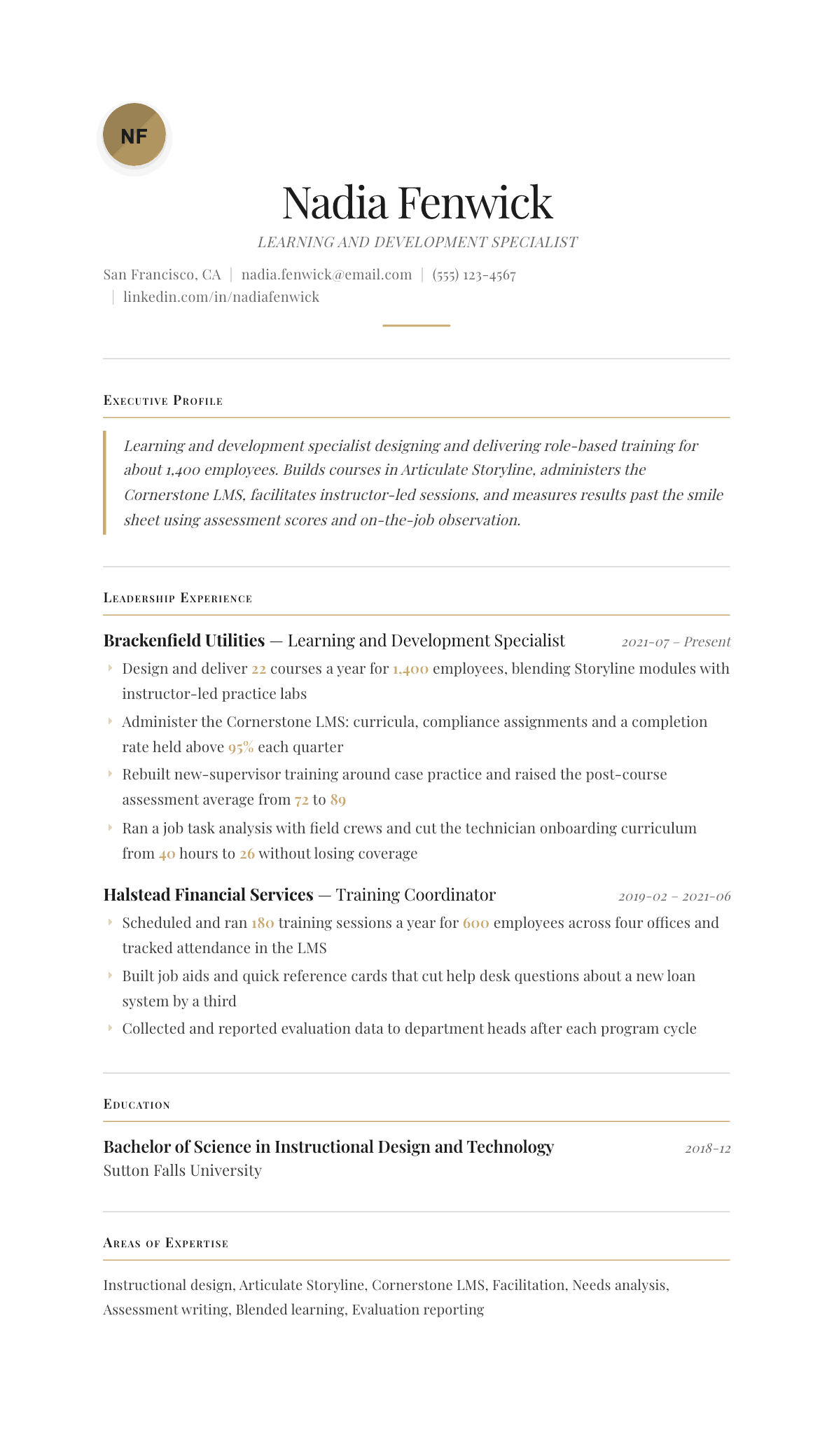
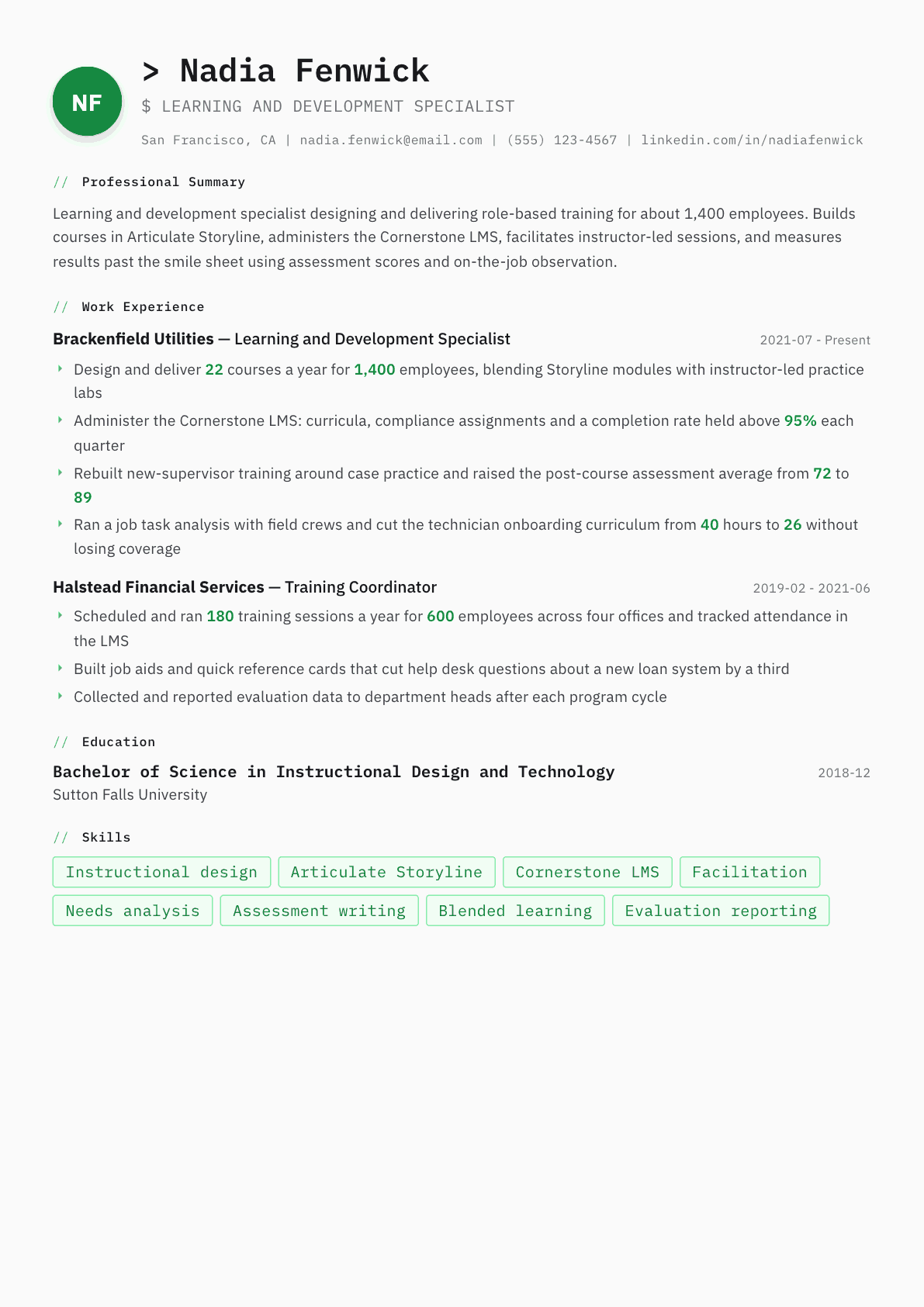
Example Learning and Development Specialist summary
Learning and development specialist designing and facilitating role-based training for roughly fourteen hundred employees. Builds modules in Articulate Storyline, administers a Cornerstone learning management system, and measures results through assessments and on-the-job observation rather than attendance alone. Cut a technician onboarding curriculum by more than a third after a job task analysis with field crews.
Skills to list on a Learning and Development Specialist resume
- Instructional design
- ADDIE
- Adult learning principles
- Articulate Storyline
- Articulate Rise
- Cornerstone LMS
- Docebo
- Facilitation
- Needs and job task analysis
- Assessment design
- Blended learning
- Microlearning
- Kirkpatrick evaluation
- Compliance training administration
- Video and audio editing
What actually gets this resume read
- Name the authoring tools and the learning management system, because these are the first filters on a training posting.
- Give course counts, audience size and delivery mode, separating what you designed from what you facilitated.
- Show measurement beyond attendance: assessment scores, observation checklists or a business metric the training targeted.
- Describe your analysis method, such as a job task analysis or stakeholder interviews, before the design bullets.
- Include compliance training administration if you owned it, with completion rates and audit readiness.
- Keep design models in the skills list and use bullets to show what the model produced in practice.
How to write a learning and development specialist resume
A learning and development specialist resume is read by someone who has sat through bad training. They want evidence that you can find out what people actually cannot do, build something that fixes it, deliver it without losing the room, and then show that behavior changed on the job.
That is why tool names alone do not carry this resume. Plenty of candidates list an authoring tool and a learning management system. Far fewer say how many courses they built last year, for which audience, using what analysis, and what the assessment or observation data looked like afterward.
This guide covers the page structure hiring managers expect, three summaries by career stage, before-and-after bullets from design and delivery work, the credentials that carry weight in the profession, and the questions specialists ask when they write about training results.
Format: one page, with a portfolio link and the toolset visible early
One page until you have around eight years. Reverse chronological. Under each employer state the audience: headcount supported, whether learners are office, field, clinical or plant based, delivery modes used, and the systems you worked in. That scope line stops a reader assuming your courses were all thirty-minute compliance modules.
Include a portfolio link if you have one, because this is a craft role and a sample settles questions no bullet can. Keep it a plain address on a single line rather than a button or graphic, so it survives parsing.
- Header: name, city and state, phone, email, portfolio address, and a credential such as APTD or CPTD.
- Order: summary, experience, tools and methods, education, certifications.
- Group tools by purpose: authoring, learning management system, video, assessment, collaboration.
Summary: audience, output, tools, and the evidence you gather
Three lines: who you build for, how much you produce in a year, what you build it in, and how you know it worked. That last clause is the one most candidates leave out and the one that separates a designer from a course producer.
If you both design and facilitate, say so and give the split, because employers hire for one or the other more often than for both. If you specialize, name it clearly: technical curriculum, clinical education, sales enablement, safety, leadership fundamentals or onboarding curriculum.
Analysis: start the story before the course
Strong learning resumes open each project with how the need was identified. Job task analysis with the people doing the work, observation, error and quality data, stakeholder interviews, or a skills assessment. Naming the method proves you build for a gap rather than for a request.
The most persuasive bullets here are the ones where analysis reduced the work. Cutting a curriculum because half of it taught things people already did well is a better story than building a longer program, and it tells a manager you protect production time.
Design and delivery: name the format and the practice
Say what you build and how it is structured: microlearning modules, scenario branching, simulations, job aids, instructor-led practice labs, blended paths with spaced follow-up. Give counts and durations, and say who reviewed the content for accuracy, because subject matter expert collaboration is a real skill and a real bottleneck.
For facilitation, give session counts, group sizes, delivery locations and whether you ran virtual sessions live. Add anything about facilitating a room that resists training, such as long-tenured technicians or clinicians pulled off a shift, which is where facilitation ability is actually tested.
Evaluation, administration and the keywords
Go past the reaction survey. Assessment scores before and after, observation checklists signed by supervisors, error or rework rates, time to competence for new hires, and completion rates for required curricula. Name the Kirkpatrick levels you actually reached rather than claiming all four.
Learning management administration belongs on the page too: curricula and assignment rules, compliance due dates, reporting to department heads, and audit readiness. Keywords include instructional design, ADDIE, adult learning, needs analysis, blended learning, microlearning, facilitation, learning management system administration and evaluation.
Learning and Development Specialist resume summary examples
Training coordinator
Training coordinator with two years scheduling and running 180 sessions a year for 600 employees across four offices. Built job aids and quick reference cards that cut help desk questions about a new loan system by a third, and reports evaluation data to department heads each cycle.
Designer and facilitator
Learning and development specialist producing 22 courses a year for 1,400 employees, blending Articulate Storyline modules with instructor-led practice labs. Administers the Cornerstone learning management system and raised the new-supervisor assessment average from 72 to 89 after a redesign around case practice.
Senior specialist
Senior learning specialist owning the technical curriculum for a utility field workforce. Ran a job task analysis with crews that cut technician onboarding from 40 hours to 26, built the observation checklist supervisors sign at competency, and mentors two junior designers.
Work experience bullets: before and after
Before: Created training materials for employees.
After: Design and deliver 22 courses a year for 1,400 employees, blending Storyline modules with instructor-led practice labs and supervisor-signed observation checklists.
Output volume, audience size and the blend show a production capacity a manager can plan around.
Before: Conducted a training needs assessment.
After: Ran a job task analysis with field crews and supervisors, then cut the technician onboarding curriculum from 40 hours to 26 without losing a required task.
The analysis leads to a decision with a number, which is what turns needs assessment into a result.
Before: Improved a supervisor training course.
After: Rebuilt new-supervisor training around case practice and feedback rehearsal, raising the post-course assessment average from 72 to 89 across four cohorts.
Naming the design change and the assessment movement shows cause and effect rather than a refresh.
Before: Managed the learning management system.
After: Administer Cornerstone curricula, assignment rules and compliance due dates for 1,400 users, holding required completion above 95% each quarter and producing audit-ready records.
Administration counts when the resume shows the user base, the rules you configured and the standard you held.
Before: Facilitated training sessions.
After: Facilitate 90 sessions a year for groups of 8 to 24, including virtual delivery to three time zones and shift-side sessions for crews who cannot leave the plant floor.
Session count, group size and the hard delivery contexts demonstrate range a generic facilitation claim hides.
Hard skills
- Instructional design
- ADDIE and rapid design methods
- Adult learning principles
- Articulate Storyline
- Articulate Rise
- Cornerstone learning management system
- Needs and job task analysis
- Assessment and checklist design
- Blended and microlearning design
- Facilitation, in person and virtual
- Kirkpatrick evaluation
- Video and audio editing
Soft skills
- Working with subject matter experts
- Room reading during delivery
- Concise writing
- Curiosity about the work being taught
- Feedback delivery
- Project discipline
Certifications worth listing
- Associate Professional in Talent Development (APTD) (Association for Talent Development)
- Certified Professional in Talent Development (CPTD) (Association for Talent Development)
- Certified Technical Trainer (CTT+) (CompTIA)
- Kirkpatrick Certified Professional (Kirkpatrick Partners)
- SHRM Certified Professional (SHRM-CP) (Society for Human Resource Management)
Mistakes that cost learning and development specialist candidates the interview
- Listing authoring tools with no course counts, audience size or delivery mode anywhere on the page.
- Reporting satisfaction scores as the only evidence, which tells a reader people enjoyed the session and nothing else.
- Skipping the analysis step, so every project reads as an order taken rather than a gap diagnosed.
- Claiming all four evaluation levels when only reaction and assessment data exist, which invites a hard interview question.
- Omitting the learning management system administration work that occupies much of the week in most of these roles.
- Sending the same resume for a design-heavy role and a facilitation-heavy role instead of leading with the right half.
Learning and Development Specialist resume questions
Do I need a portfolio for a learning and development role?
For design-heavy roles, yes. Two or three samples showing a module, a job aid and an assessment tell a hiring manager more than any bullet. Remove employer-confidential content, or rebuild a short sample with neutral subject matter for the portfolio.
APTD or CPTD, which should I pursue?
The APTD suits earlier career specialists focused on design and delivery, while the CPTD assumes broader talent development responsibility and more years of practice. Both come from the same professional body, so choose by where you are rather than by prestige.
How do I show training results when nobody measures them?
Build the measurement yourself and say you did. A short assessment, a supervisor observation checklist, or a before and after count of a specific error type all create evidence, and establishing measurement where none existed is itself a strong bullet.
Should I list every course I have built?
No. Give the annual output number and then name the two or three programs with the clearest results or the largest audience. A full course inventory buries the projects that would otherwise win the interview.
How do I move into learning from a subject matter role?
Lead with the training you already did informally: onboarding new colleagues, writing procedures, running toolbox talks or building job aids. Then add a design credential or a completed course you rebuilt, and use the summary to state the transition directly.
Related resume examples
- Learning & Development Manager Resume example
- Human Resources Resume example
- Training and Development Manager Resume example
- Talent Development Manager Resume example
- HR Specialist Resume example
- Occupational Health and Safety Specialist Resume example