Legal Operations Manager Resume Examples: free ATS score
Build a Legal Operations Manager Resume Around Spend and Systems
By Mustafa Tarabya, founder of CVBooster · Published · Updated
Legal operations manager resume example with e-billing, matter management and vendor keywords, plus a writing guide for legal ops hiring.
Sample resumes for a legal operations manager
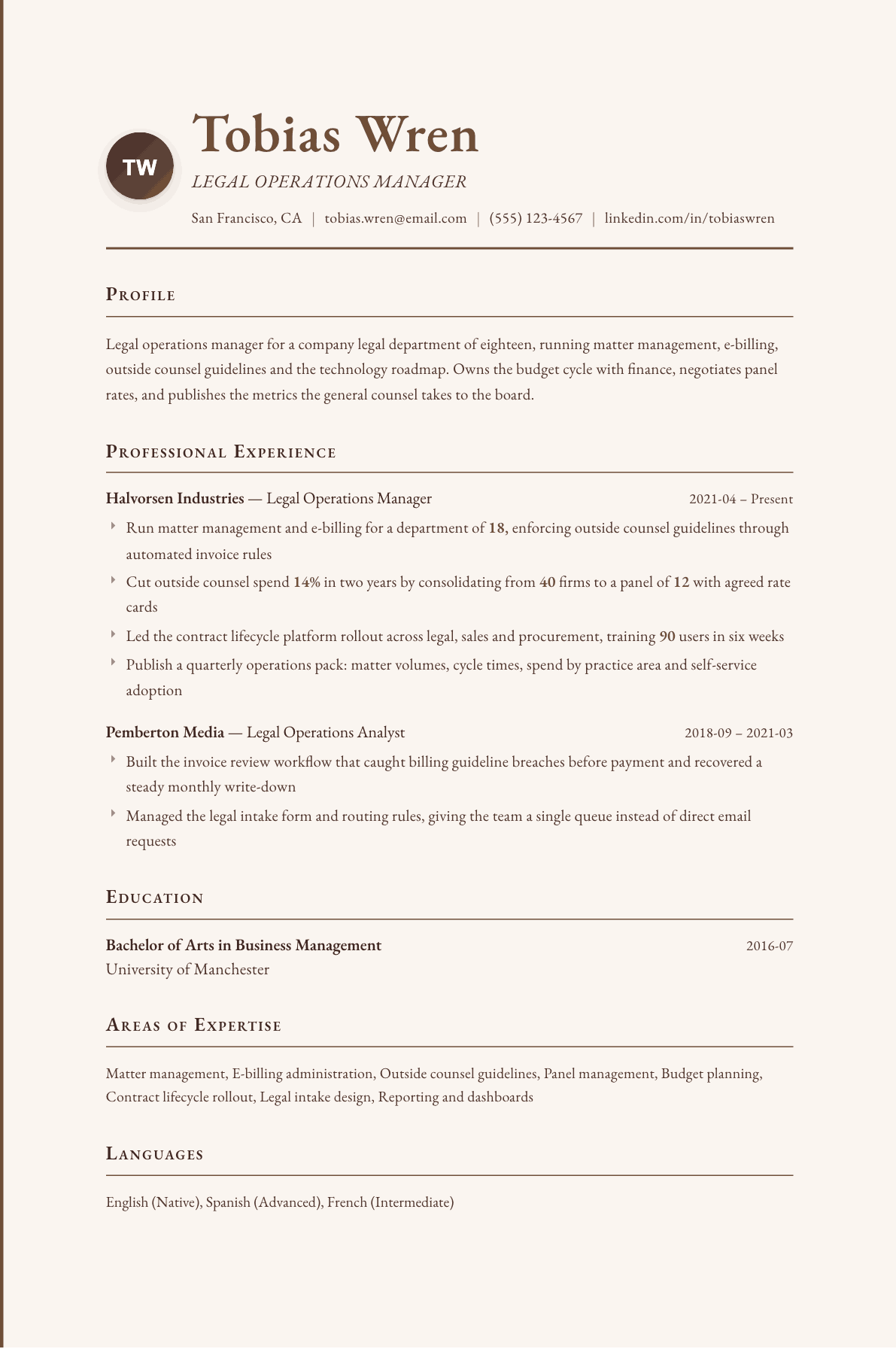
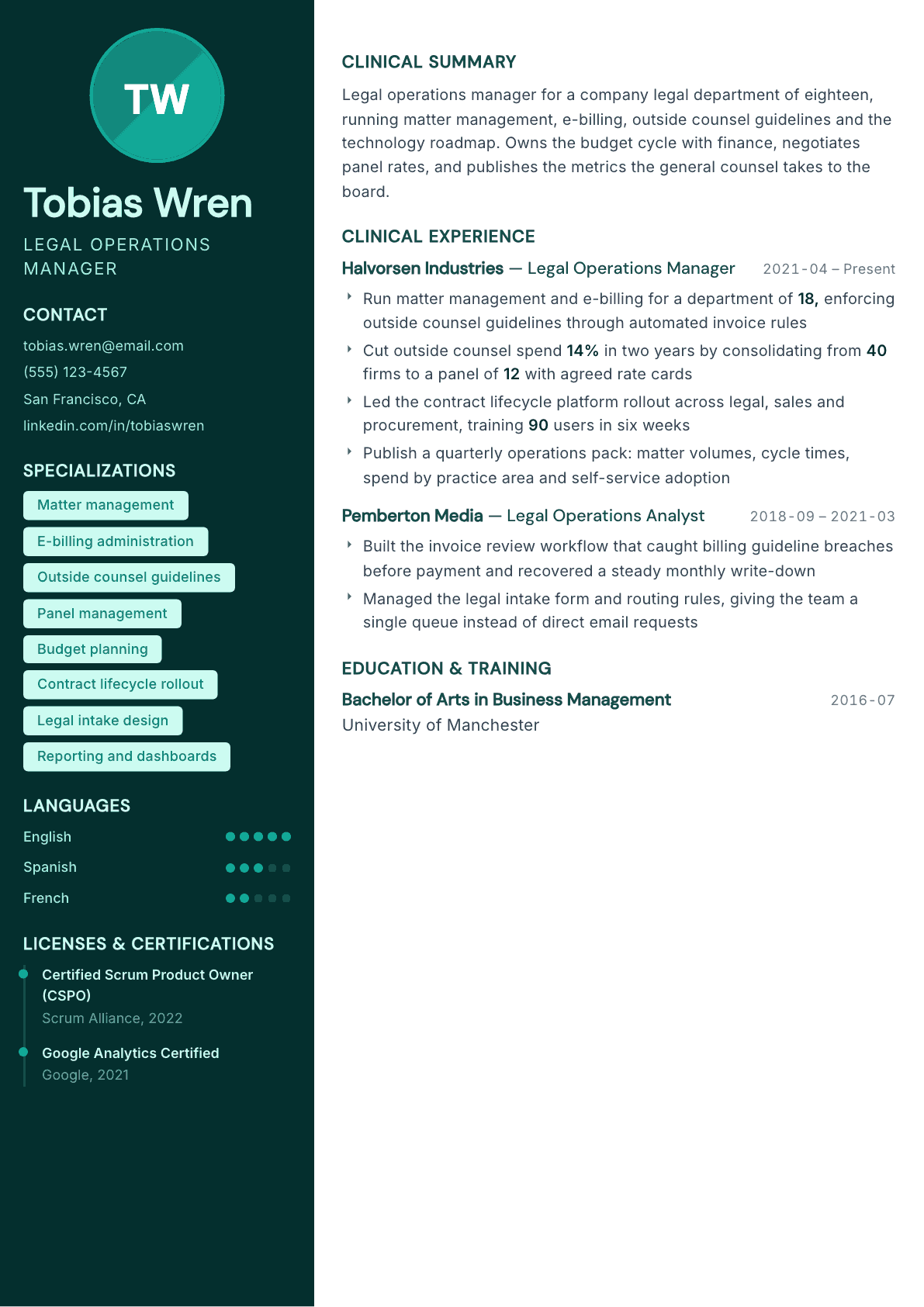
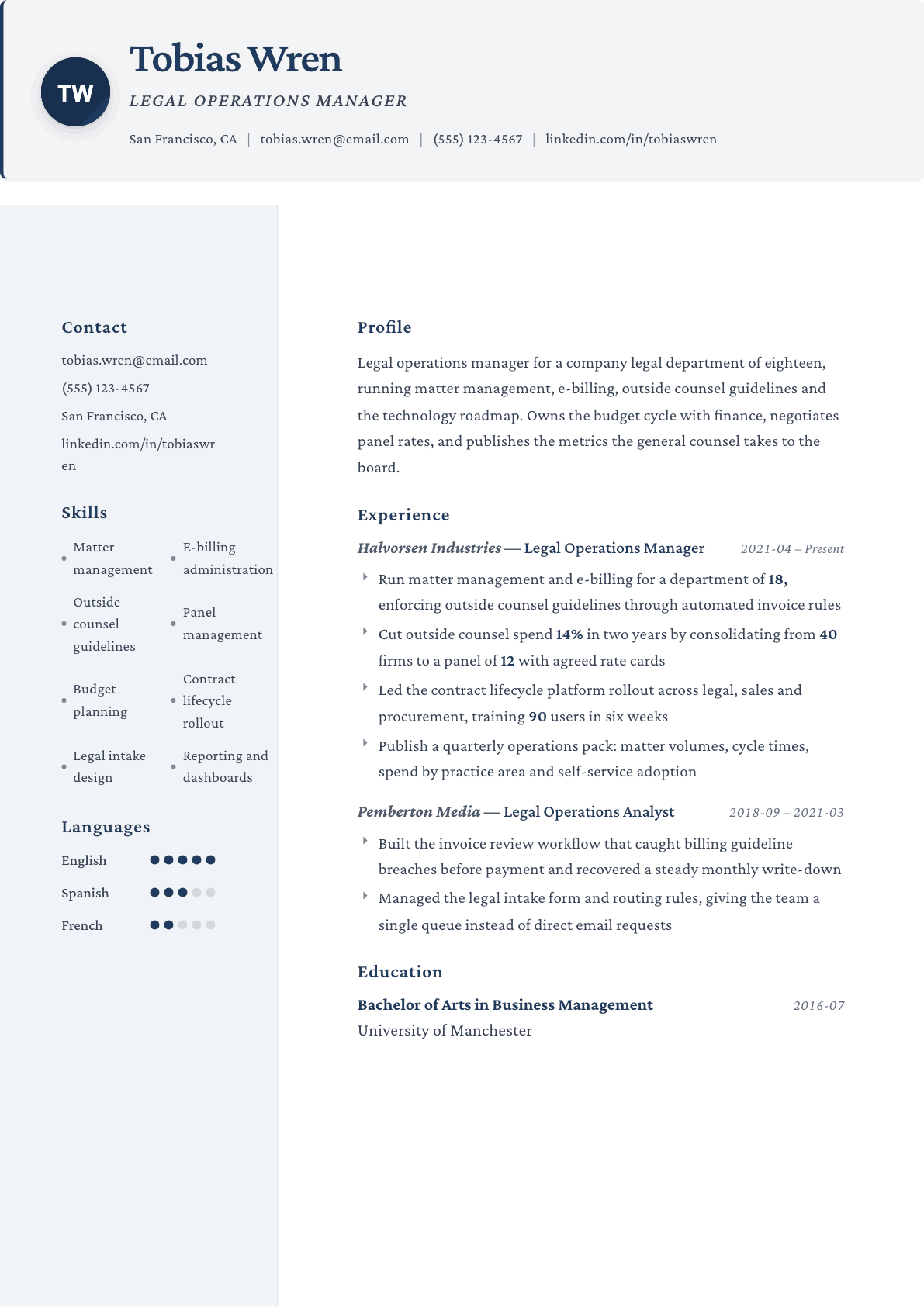
The same legal operations manager content laid out in three CVBooster templates, so you can see what the finished document looks like before you write a word.
Example Legal Operations Manager summary
Legal operations manager with seven years building the systems and reporting behind a company legal department. Administers matter management and e-billing, enforces outside counsel guidelines, and consolidates panels to bring spend down without slowing the lawyers. Has led a contract platform rollout across three functions and publishes the quarterly pack the general counsel presents.
Skills to list on a Legal Operations Manager resume
- Legal operations strategy
- Matter management systems
- E-billing and invoice review
- Outside counsel guidelines
- Panel and vendor management
- Legal spend analysis
- Budget planning and forecasting
- Contract lifecycle management
- Process design and intake
- Legal technology selection
- Change management and training
- Knowledge management
- Reporting and dashboards
- Stakeholder management
What actually gets this resume read
- Give the department size and the spend you administer, because legal ops candidates are sized by the scope they carry.
- Show a systems rollout end to end, from selection through training and adoption, since implementation is the core skill.
- Quantify savings from panel work, billing rules or process change, as this is the one legal function measured in money.
- Name the e-billing and matter management platforms you have administered, because migrations are painful and experience counts.
- Prove you can run an intake process, since routing work correctly is what makes a legal team feel less overloaded.
- Include the reporting you publish and who reads it, because credibility with the general counsel rests on those numbers.
How to write a legal operations manager resume
Legal operations exists because a legal department is a business function that historically measured nothing. The manager who runs it is judged on three questions: what does legal work cost, how long does legal work take, and can the lawyers spend their time on the matters that need a lawyer. A resume for this role has to answer all three with numbers.
The reader is usually a general counsel or a director of legal operations. She has seen candidates who administer a billing system and call it operations, and candidates who talk about transformation with nothing implemented behind it. What earns the interview is a page showing systems you have actually rolled out, spend you have actually moved and processes that people are still using after you built them.
This guide sets out how to organize a legal operations manager resume around scope, systems and savings, gives summaries for an analyst, a manager and a senior manager, rewrites the bullets that make implementation work sound like administration, and answers the questions people ask coming into legal ops from a law firm, from finance or from a paralegal role.
Format: scope line before anything else
Under the summary, state the department you support: number of lawyers and legal staff, the countries covered, the annual outside counsel spend you administer expressed as a range or a firm count, and the systems in place. Legal ops is a scope-driven discipline and the reader is comparing your scope to hers before she reads a single bullet.
Reverse chronological, one clean column. Two pages are normal once you have run implementations, because the detail of a rollout is what proves the experience and it does not compress well.
- Header: name, city and state, phone, email, and any project or process credential.
- Scope line: department size, geography, firm panel size, systems administered.
- Order: summary, scope, experience, systems and tools, education, certifications.
Summary: systems, spend and the pillars you own
Legal operations breaks into recognizable pillars: financial management, vendor management, technology, process design and intake, knowledge management, data and reporting, and strategic planning. Name the three or four you genuinely own and skip the rest. Claiming all of them makes a hiring manager assume you own none deeply.
Then give one financial fact and one systems fact. A panel consolidation, a billing rule set that recovers write-downs, a platform rollout with a user count. Those two facts alone place you within the market more accurately than any summary paragraph of adjectives.
Experience: implementations described end to end
For every system you have introduced, write the whole arc: why it was selected, what the configuration decisions were, who was migrated, how many users were trained, and what adoption looked like afterward. Implementations fail on adoption rather than on software, so the training and adoption half of that sentence is the part a general counsel reads twice.
Financial work needs the same treatment. Outside counsel guidelines are only real when enforced, so describe the billing rules, the invoice review process and what happens when a firm bills outside the guidelines. Panel consolidation deserves the before and after firm counts and the rate arrangement that replaced the old model.
Process work is your third pillar. Intake routing, self-service templates, triage rules and turnaround commitments. Show the queue before and after, because everyone in a legal department has an opinion about intake and a measurable improvement settles the argument.
Reporting: the numbers you publish and who reads them
Name the recurring pack you produce and its measures: matter volumes by type, cycle time, spend by practice area and by firm, accrual accuracy, self-service adoption, contract turnaround. Then name the audience, because a report the general counsel takes to the board is a different achievement from a dashboard nobody opens.
If you built the data layer yourself, say so. Legal departments often have poor data quality, and a manager who cleaned matter taxonomy and made reporting trustworthy has done work that most candidates have only wished for.
Keywords, credentials and the language to avoid
Recurring posting language includes matter management, electronic billing, outside counsel guidelines, spend management, panel management, contract lifecycle management, legal technology, process improvement, intake, knowledge management and vendor management. Mirror the exact phrasing once and prove it once.
Skip transformation language with nothing under it. Optimized legal processes says less than a sentence naming the process, the change and the measured result. Project management and process improvement credentials are worth listing with their issuing body because legal ops teams read them as evidence of method.
Legal Operations Manager resume summary examples
Legal operations analyst
Legal operations analyst supporting a department of 12 lawyers. Administers the electronic billing system, reviews invoices against outside counsel guidelines, and maintains the matter taxonomy behind the monthly reporting pack. Built the intake form that replaced direct email requests and gave the team one routed queue.
Legal operations manager
Legal operations manager for a department of 18, running matter management, electronic billing, outside counsel guidelines and the technology roadmap. Consolidated the firm panel and enforced billing rules that lowered outside counsel spend, and led the contract platform rollout across legal, sales and procurement.
Senior manager, global department
Senior legal operations manager covering a department of 60 across four countries, with a team of three. Owns the technology portfolio, the panel and rate framework, and the annual budget cycle with finance. Publishes the operations pack presented to the executive committee and runs the department planning process each year.
Work experience bullets: before and after
Before: Managed the legal department billing system.
After: Administered electronic billing for a department of 18, enforcing outside counsel guidelines through automated invoice rules that flagged block billing and unapproved timekeepers before payment.
Naming the rules and what they catch turns system administration into a control with a financial effect.
Before: Helped reduce outside counsel costs.
After: Consolidated outside counsel from 40 firms to a panel of 12 with agreed rate cards and volume commitments, lowering spend across two budget cycles without slowing matter turnaround.
The before and after firm counts and the preserved turnaround make the saving credible instead of asserted.
Before: Implemented a contract management system.
After: Led the contract lifecycle platform rollout across legal, sales and procurement: selection, clause library build, intake configuration, and training for 90 users inside six weeks.
Describing the whole arc including training proves implementation experience rather than participation in one.
Before: Created reports for the general counsel.
After: Publish a quarterly operations pack covering matter volumes, cycle times, spend by practice area and self-service adoption, used by the general counsel in the board update.
Naming the measures and the destination shows the reporting reached the level where decisions happen.
Before: Improved the legal intake process.
After: Replaced email requests with a routed intake form and triage rules, giving each request type a stated turnaround and cutting the time work sat unassigned.
The mechanism and the outcome describe process design instead of a general improvement claim.
Hard skills
- Matter management systems
- Electronic billing administration
- Outside counsel guidelines enforcement
- Legal spend analysis and accruals
- Panel and rate negotiation
- Contract lifecycle management rollout
- Legal intake and triage design
- Legal technology selection
- Vendor management
- Budget planning and forecasting
- Reporting and dashboards
- Matter taxonomy and data quality
- Knowledge management
- Process mapping and improvement
Soft skills
- Change management
- Influencing lawyers without authority
- Vendor negotiation
- Training and enablement
- Project discipline
- Translating between legal and finance
Certifications worth listing
- Project Management Professional (PMP) (Project Management Institute)
- Certified Legal Manager (CLM) (Association of Legal Administrators)
- Certified Six Sigma Green Belt (CSSGB) (American Society for Quality)
Mistakes that cost legal operations manager candidates the interview
- Leaving out department size and spend scope, the two facts that let a reader compare your role to the open one.
- Describing a system rollout without the training and adoption half, where implementations usually fail.
- Claiming every legal operations pillar rather than the three or four you actually own.
- Writing transformation language with no named process, no change and no measured result behind it.
- Omitting the reporting audience, which decides whether your numbers influenced anything.
- Presenting savings without saying what happened to turnaround, which invites the obvious objection.
- Hiding data cleanup work, even though a trustworthy matter taxonomy is the foundation everything else sits on.
Legal Operations Manager resume questions
Can I move into legal operations from a paralegal role?
Yes, and it is a common path. Lead with the operational work you already do: intake handling, vendor coordination, system administration and reporting. Add a project or process credential, then target roles at analyst level first rather than applying straight into a manager posting.
Does a legal operations manager need a legal background?
Not necessarily. Many come from finance, procurement, consulting or project management. What matters is credibility with lawyers, which comes from understanding matter lifecycles and billing practice well enough to challenge an invoice or a process without being corrected.
How do I quantify savings without disclosing confidential spend?
Use structure instead of amounts: firm counts before and after, the share of invoices adjusted under billing rules, or the change in average matter cost expressed as a proportion. These communicate the achievement while keeping the actual budget figures private.
Which legal technology should I list?
The platforms you have administered or implemented, named specifically, with what you did in each. General familiarity is not worth much because the value is in configuration, migration and training. If you evaluated a system without buying it, say that honestly.
How do I show impact when my department was already well run?
Focus on maintenance and refinement work that keeps a mature program healthy: rate renewals, accrual accuracy, data quality, adoption recovery after a reorganization. Sustaining performance is a real achievement, and stating it accurately beats inventing a turnaround story.