Character Reference Letter: 7 Samples for Court and Adoption
By Mustafa Tarabya, founder of CVBooster · Published · Updated
10 min read
A character reference letter is a one-page letter from someone who has known a person for years, describing specific things they have seen that person do, for a reader who is deciding something about them: a judge, an adoption agency, an employer or a landlord. The constraint is that the reader cannot check adjectives, only stories, so every claim needs an example. The Child Welfare Information Gateway says adoption references "help the home study specialist form a more complete picture of your family and support network", and that is the job of every character reference. Below are seven complete character reference letter samples, checked in October 2026, for court, adoption, a friend, a neighbor, volunteering and a job. Written by Mustafa Tarabya, who hired for his own company, read every application himself and now writes CVBooster's guides.
Your friend asked you to write a letter saying she is a good person. You have known that for fifteen years. Now you have to prove it in one page to a stranger with a file, and "she is lovely" suddenly feels like weak evidence.
Adoption reference letter
Adoption agencies ask several people to write. The factsheet from the Child Welfare Information Gateway explains who: "references should be people who have known you for years, seen you in many situations, visited your home, and know of your interest in and involvement with children." The letter should cover the relationship, the home, the couple with children, and the support around them.
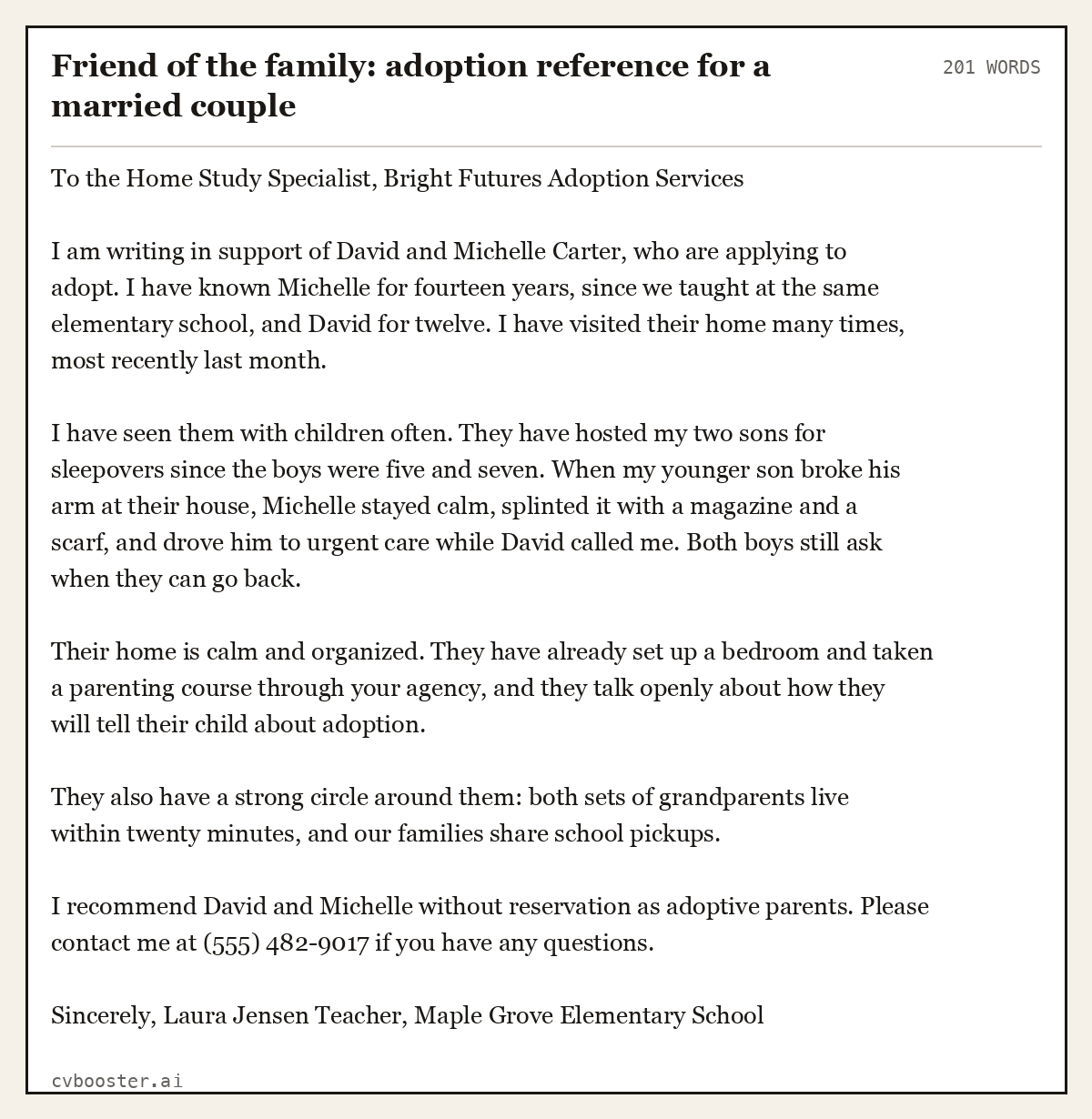
Friend of the family: adoption reference for a married couple (201 words)
To the Home Study Specialist, Bright Futures Adoption Services
I am writing in support of David and Michelle Carter, who are applying to adopt. I have known Michelle for fourteen years, since we taught at the same elementary school, and David for twelve. I have visited their home many times, most recently last month.
I have seen them with children often. They have hosted my two sons for sleepovers since the boys were five and seven. When my younger son broke his arm at their house, Michelle stayed calm, splinted it with a magazine and a scarf, and drove him to urgent care while David called me. Both boys still ask when they can go back.
Their home is calm and organized. They have already set up a bedroom and taken a parenting course through your agency, and they talk openly about how they will tell their child about adoption.
They also have a strong circle around them: both sets of grandparents live within twenty minutes, and our families share school pickups.
I recommend David and Michelle without reservation as adoptive parents. Please contact me at (555) 482-9017 if you have any questions.
Sincerely, Laura Jensen Teacher, Maple Grove Elementary School
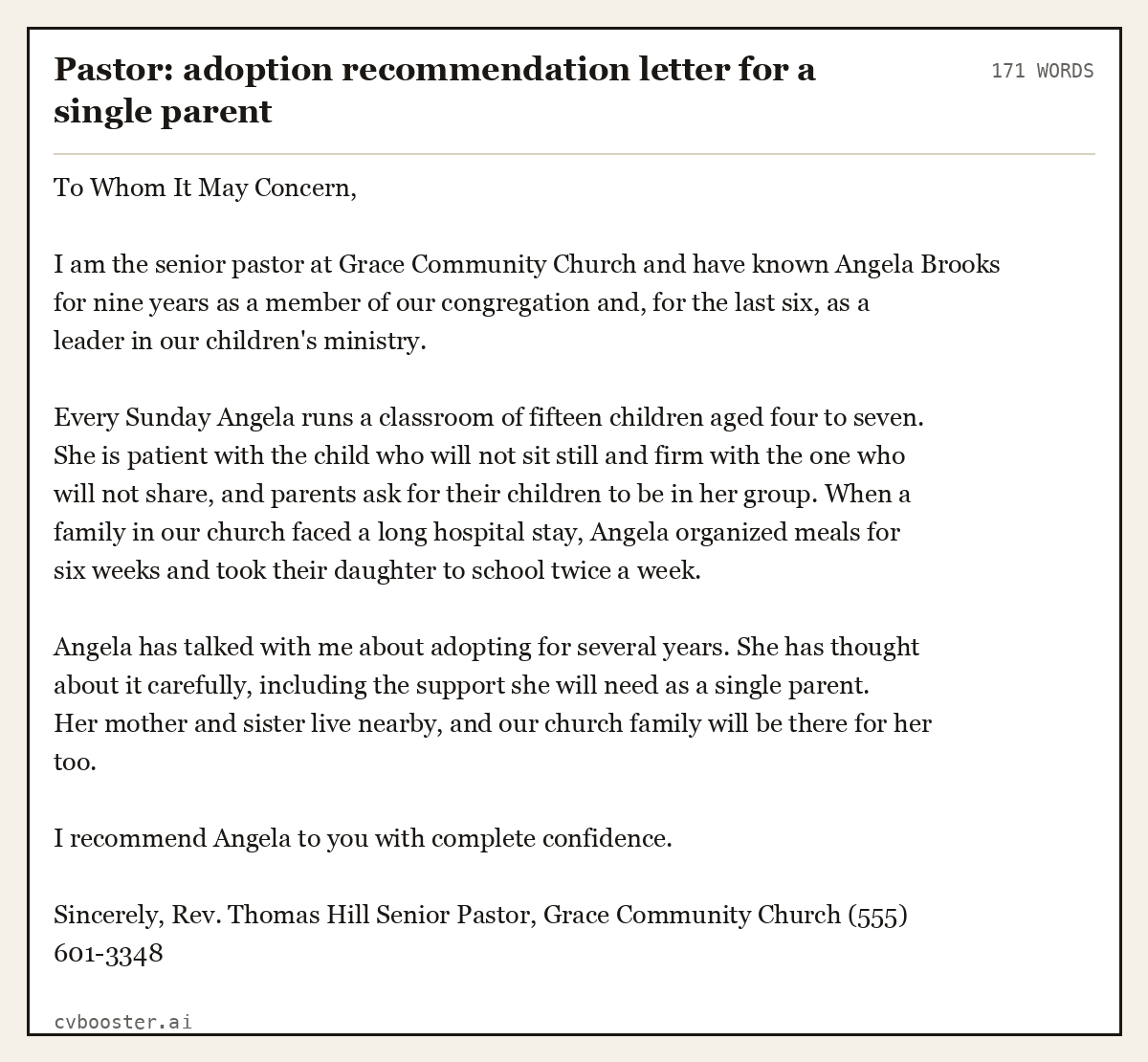
Pastor: adoption recommendation letter for a single parent (171 words)
To Whom It May Concern,
I am the senior pastor at Grace Community Church and have known Angela Brooks for nine years as a member of our congregation and, for the last six, as a leader in our children's ministry.
Every Sunday Angela runs a classroom of fifteen children aged four to seven. She is patient with the child who will not sit still and firm with the one who will not share, and parents ask for their children to be in her group. When a family in our church faced a long hospital stay, Angela organized meals for six weeks and took their daughter to school twice a week.
Angela has talked with me about adopting for several years. She has thought about it carefully, including the support she will need as a single parent. Her mother and sister live nearby, and our church family will be there for her too.
I recommend Angela to you with complete confidence.
Sincerely, Rev. Thomas Hill Senior Pastor, Grace Community Church (555) 601-3348
Character reference letter for court
A court letter is read by a judge before sentencing. In federal cases the information goes through the probation office: the US Courts explain that "Officers conducting presentence investigations provide judges with the information they need to make informed sentencing decisions." Your letter is part of that information. Show you know the charge, describe the person's character with examples, and do not argue the case. Ask the defense attorney how to submit it.
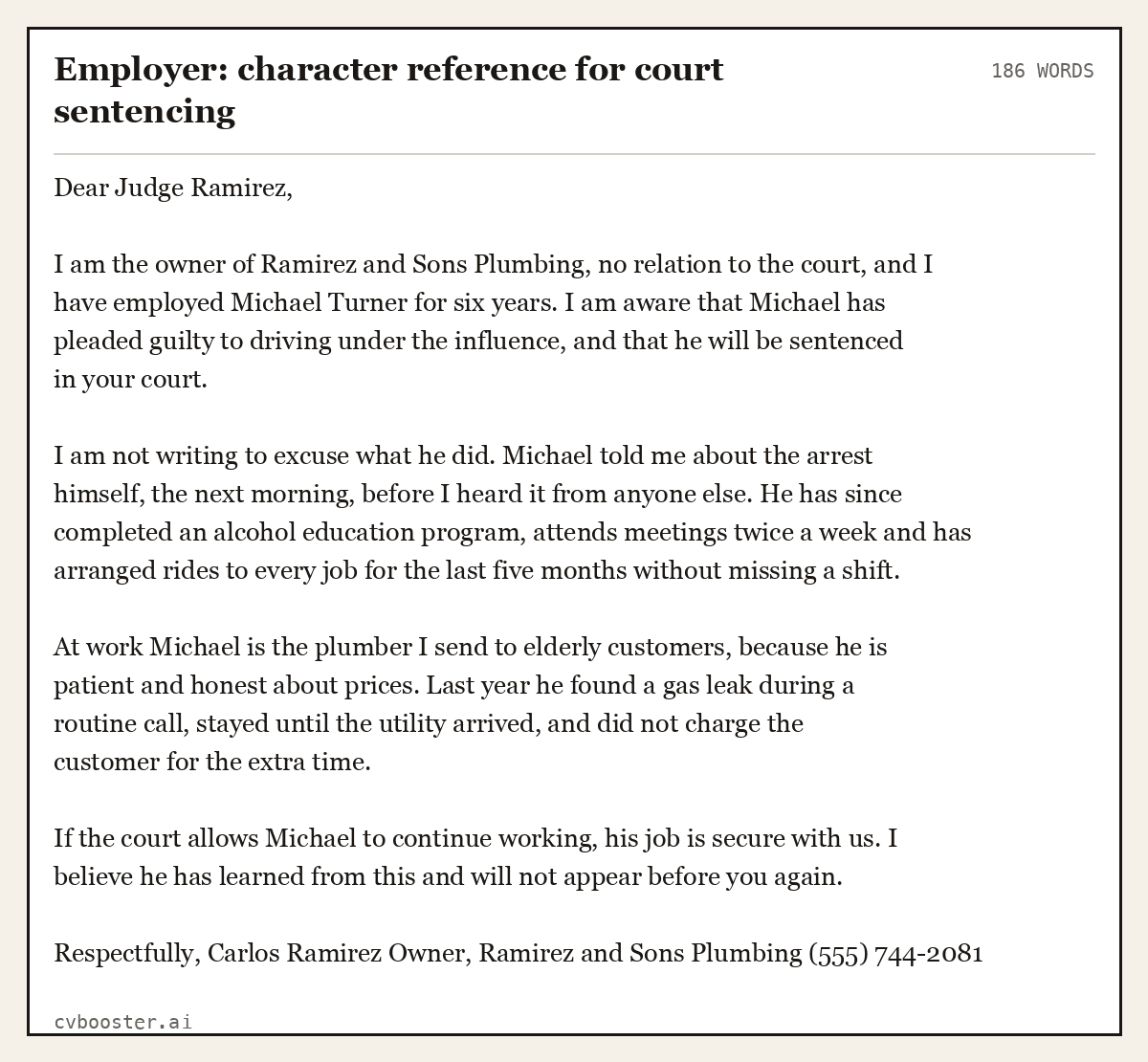
Employer: character reference for court sentencing (186 words)
Dear Judge Ramirez,
I am the owner of Ramirez and Sons Plumbing, no relation to the court, and I have employed Michael Turner for six years. I am aware that Michael has pleaded guilty to driving under the influence, and that he will be sentenced in your court.
I am not writing to excuse what he did. Michael told me about the arrest himself, the next morning, before I heard it from anyone else. He has since completed an alcohol education program, attends meetings twice a week and has arranged rides to every job for the last five months without missing a shift.
At work Michael is the plumber I send to elderly customers, because he is patient and honest about prices. Last year he found a gas leak during a routine call, stayed until the utility arrived, and did not charge the customer for the extra time.
If the court allows Michael to continue working, his job is secure with us. I believe he has learned from this and will not appear before you again.
Respectfully, Carlos Ramirez Owner, Ramirez and Sons Plumbing (555) 744-2081
Personal character reference letter for a friend
A personal character reference letter comes from someone who knows the person outside work: a friend, a neighbor, a coach or a faith leader. It vouches for character rather than job skills. Friends write them for a volunteer role, a club, a scholarship, a rental or a first job. Explain how you know the person and give one or two stories.
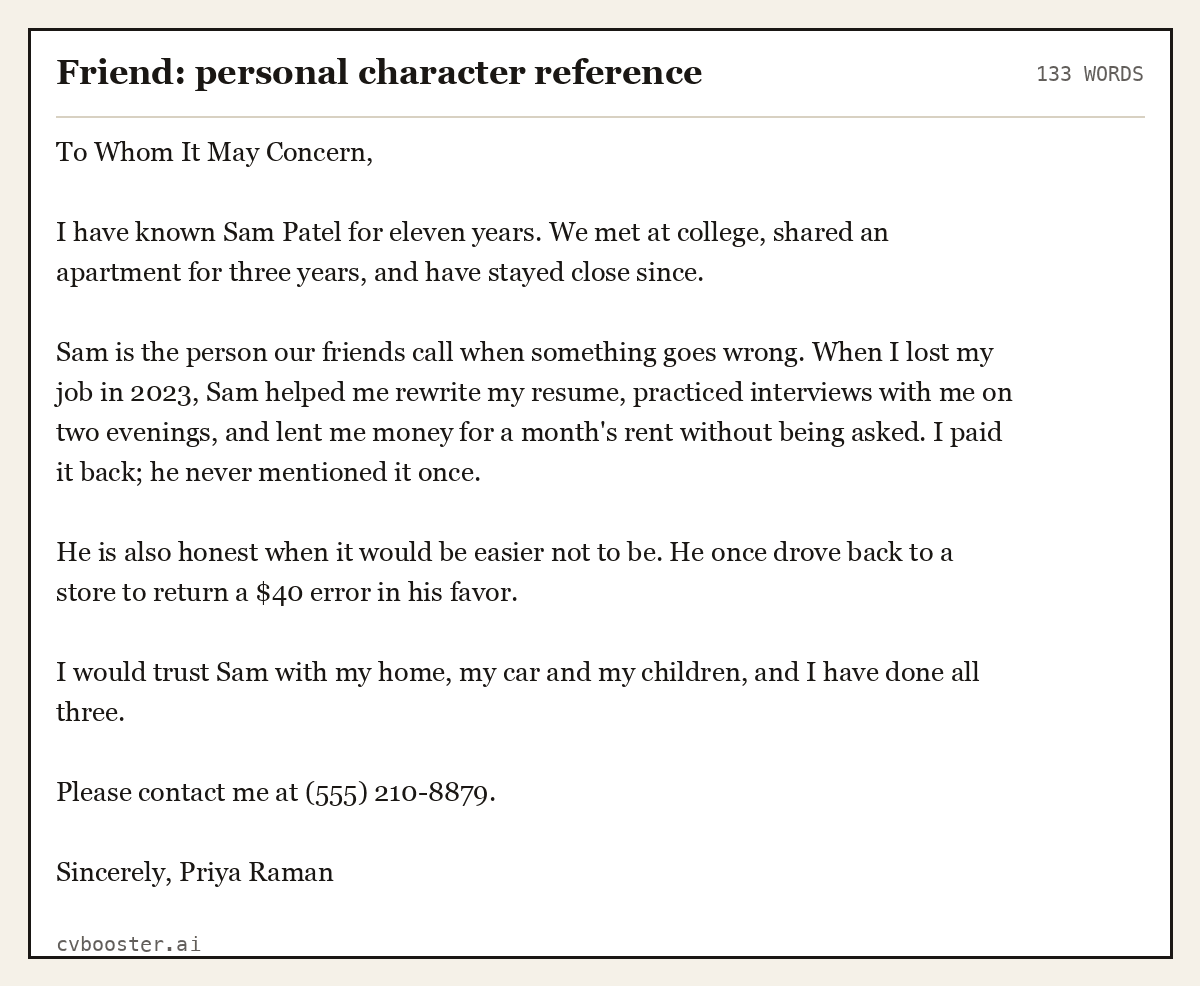
Friend: personal character reference (133 words)
To Whom It May Concern,
I have known Sam Patel for eleven years. We met at college, shared an apartment for three years, and have stayed close since.
Sam is the person our friends call when something goes wrong. When I lost my job in 2023, Sam helped me rewrite my resume, practiced interviews with me on two evenings, and lent me money for a month's rent without being asked. I paid it back; he never mentioned it once.
He is also honest when it would be easier not to be. He once drove back to a store to return a $40 error in his favor.
I would trust Sam with my home, my car and my children, and I have done all three.
Please contact me at (555) 210-8879.
Sincerely, Priya Raman
A personal character reference letter template, if you want to fill one in rather than start from a blank page:
- Opening: "I am writing to recommend [full name] for [the role, place or purpose]."
- Relationship: "I have known [first name] for [number] years as [friend, neighbor, teammate], and we [how often you see each other]."
- First story: one thing you saw them do that shows honesty or reliability, with the year.
- Second story: one thing that shows care for other people or follow-through.
- Recommendation: "I recommend [first name] without reservation."
- Contact line: your phone number or email, with your name and signature.
Neighbor character reference
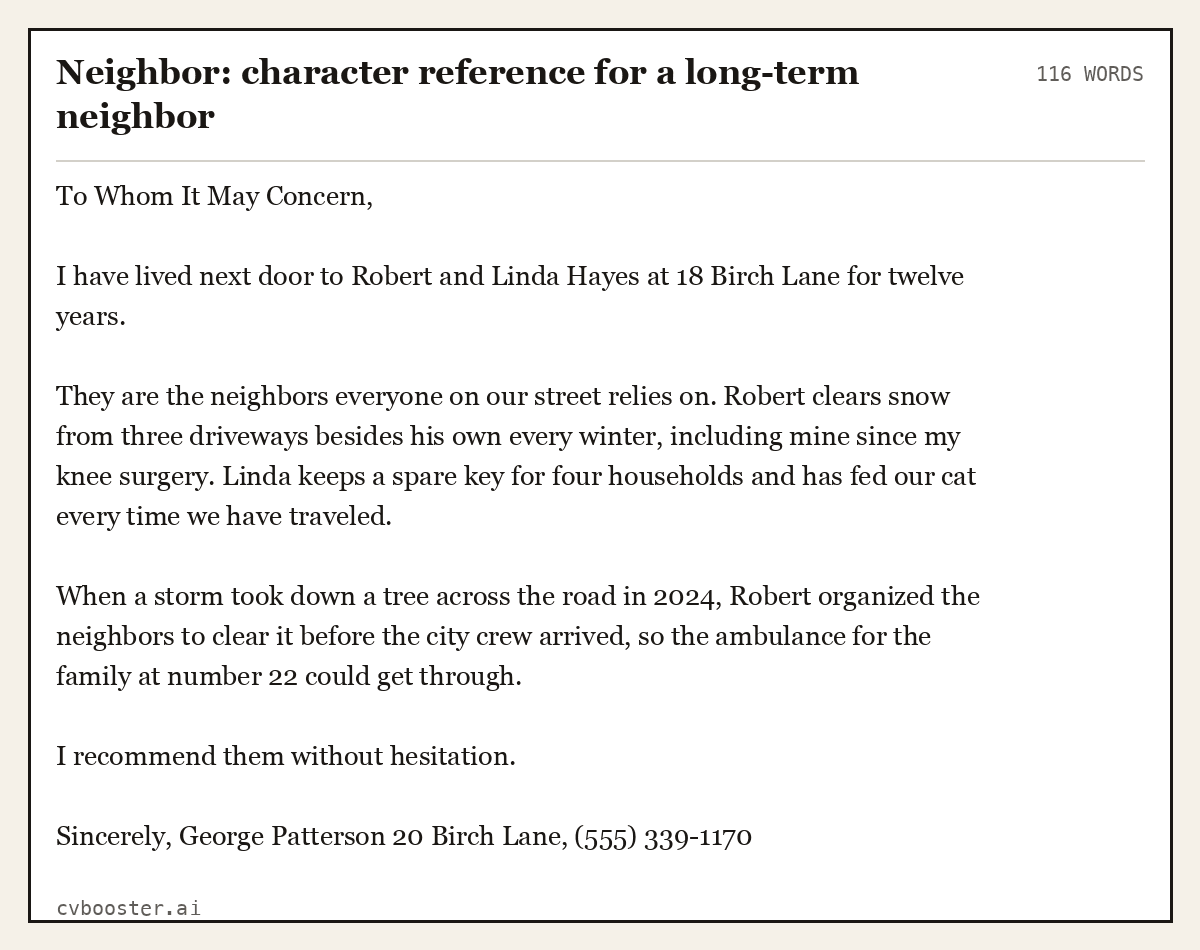
Neighbor: character reference for a long-term neighbor (116 words)
To Whom It May Concern,
I have lived next door to Robert and Linda Hayes at 18 Birch Lane for twelve years.
They are the neighbors everyone on our street relies on. Robert clears snow from three driveways besides his own every winter, including mine since my knee surgery. Linda keeps a spare key for four households and has fed our cat every time we have traveled.
When a storm took down a tree across the road in 2024, Robert organized the neighbors to clear it before the city crew arrived, so the ambulance for the family at number 22 could get through.
I recommend them without hesitation.
Sincerely, George Patterson 20 Birch Lane, (555) 339-1170
Character reference for a job or volunteer role
When an applicant has little work history, an employer may accept a character reference. It should still speak to reliability and trust. For childcare jobs, the nanny reference letter page has a character reference from a daycare director. For a recruiter, an officer program or a veteran's next job, the military reference letter samples show the format boards expect. For business school, the MBA recommendation letter samples show how a supervisor writes about work rather than character.
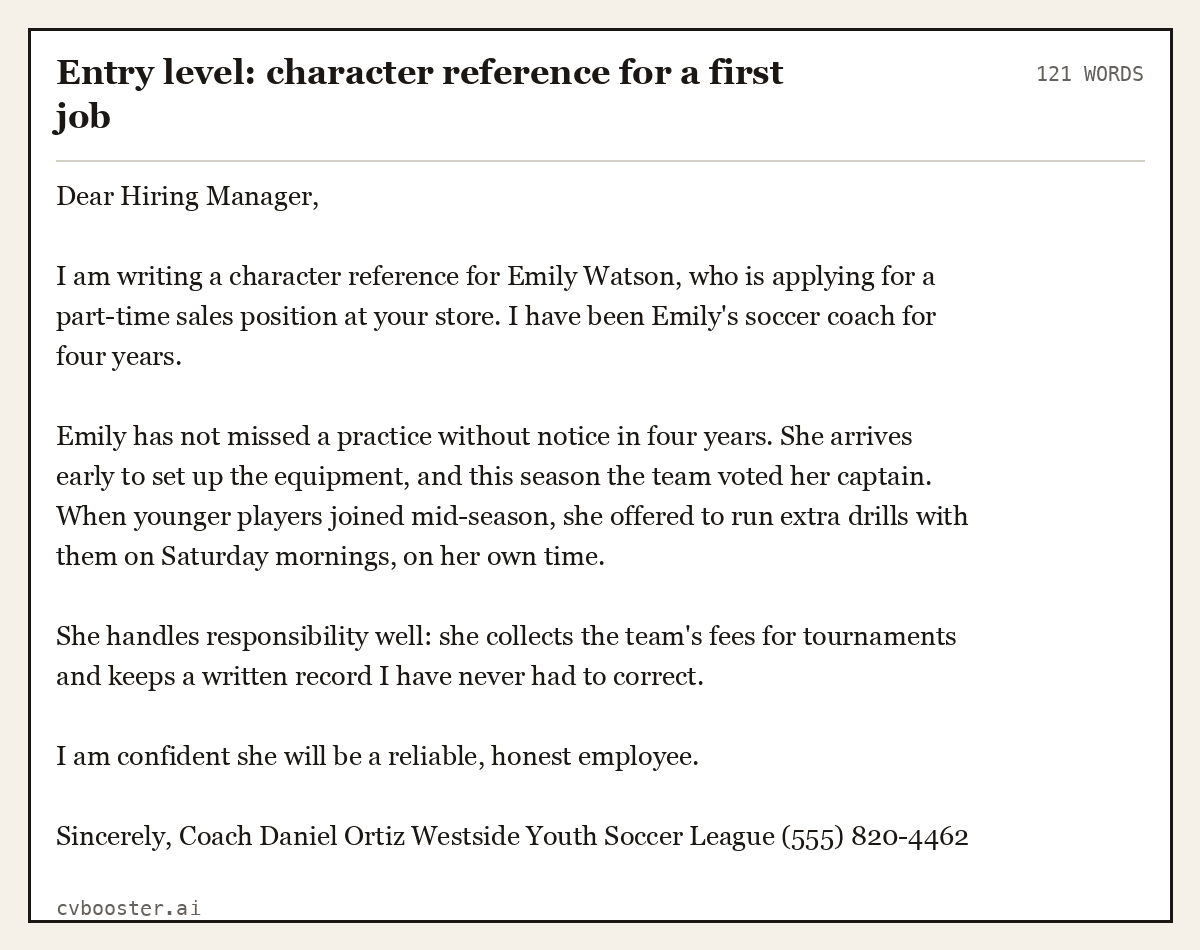
Entry level: character reference for a first job (121 words)
Dear Hiring Manager,
I am writing a character reference for Emily Watson, who is applying for a part-time sales position at your store. I have been Emily's soccer coach for four years.
Emily has not missed a practice without notice in four years. She arrives early to set up the equipment, and this season the team voted her captain. When younger players joined mid-season, she offered to run extra drills with them on Saturday mornings, on her own time.
She handles responsibility well: she collects the team's fees for tournaments and keeps a written record I have never had to correct.
I am confident she will be a reliable, honest employee.
Sincerely, Coach Daniel Ortiz Westside Youth Soccer League (555) 820-4462
What every character reference needs
Use the same structure whatever the purpose:
- Who you are and how you know them: your role, the relationship and how many years.
- Two specific stories: what you saw them do, when, and what it showed.
- Awareness of the purpose: the adoption, the charge, the job.
- A clear recommendation: one plain sentence.
- Contact details: most readers will check.
Write only what you have seen. Do not exaggerate, do not guess, and do not discuss facts of a court case you do not know. For adoption references, the factsheet notes that "Most agencies require that references be people who are not related to you", so ask friends, teachers, colleagues or faith leaders rather than family.
Adoption references: what the agency is checking
Agencies want to know the household is safe, stable and supported. The same factsheet is reassuring: "Your family's approval to adopt would rarely be denied on the grounds of a single negative reference." The reverse is also true: one glowing letter will not carry an application on its own. Every reference adds a piece. For intercountry adoption, the US Department of State explains the home study requirements that the references feed into.
Related letters
For immigration cases, see the separate character reference letter for immigration samples. For job references from a manager, see our reference letter examples. If you would like a first draft, the recommendation letter generator turns a few details into an editable letter.
Frequently asked questions
What do you write in a character reference letter?
State who you are, how you know the person and for how long, then give two specific examples of things you have seen them do that show honesty, responsibility or care. Mention the purpose of the letter, give a clear recommendation and add your contact details. Keep it to one page.
How do I write an adoption reference letter?
Explain how long you have known the applicants and how often you visit their home, describe how you have seen them with children, mention their support network, and say plainly that you recommend them as adoptive parents. Agencies usually want references from people who are not related to the applicants.
Who should write a character reference letter?
Someone who has known the person for years and is not a relative: a friend, neighbor, teacher, coach, employer, colleague or faith leader. The best writer is the one who can give specific examples, not the one with the most impressive job title. Courts and agencies give more weight to detail than to status.
How do you address a character reference letter for court?
Address it to the judge by name if you know it, for example "Dear Judge Ramirez", or "Your Honor" if you do not. Ask the defense attorney how and where to submit it. Acknowledge that you know the charge, and do not argue about the facts of the case.
What is a personal character reference letter?
It is a letter from someone who knows you personally, not through work, describing your character for a reader who is making a decision about you. A friend, neighbor, coach or faith leader writes it for a volunteer role, club, scholarship, rental or first job. It needs the relationship, two specific stories and a clear recommendation.
How long should a character reference letter be?
One page, usually 150 to 300 words. Judges, home study specialists and employers read many letters, and a specific page with two stories is more persuasive than a long list of qualities. If you have more to say, choose the strongest example and cut the rest.
More in this series: related guides
- Nursing Recommendation Letter: 6 Samples for Nurses
- Residency Recommendation Letter: 6 Samples That Get Read
Related articles
- Application Letter for Student: 5 Full Samples to Copy
- Application Letter Format in Word: UK Layout and 5 Letters
- Cover Letter for Artist Jobs: 6 Samples by Art Career
- Cabin Crew Cover Letter: 6 Examples for Airline Jobs
More articles
- Immigration Reference Letter for a Friend: 9 Samples
- Chat GPT Resignation Letter: Prompts and 6 Fixed Examples
- Chief Commercial Officer Resume: 5 Examples and CV Tips
Looking for a worked example for your job title? Browse the resume examples by job title.