E-Discovery Specialist Resume Examples: read this first
Write an E-Discovery Specialist Resume Litigation Teams Hire
By Mustafa Tarabya, founder of CVBooster · Published · Updated
E-discovery specialist resume example with processing and review bullets, platform keywords, and tips on volumes, workflows and privilege logs.
Sample resumes for a e-discovery specialist
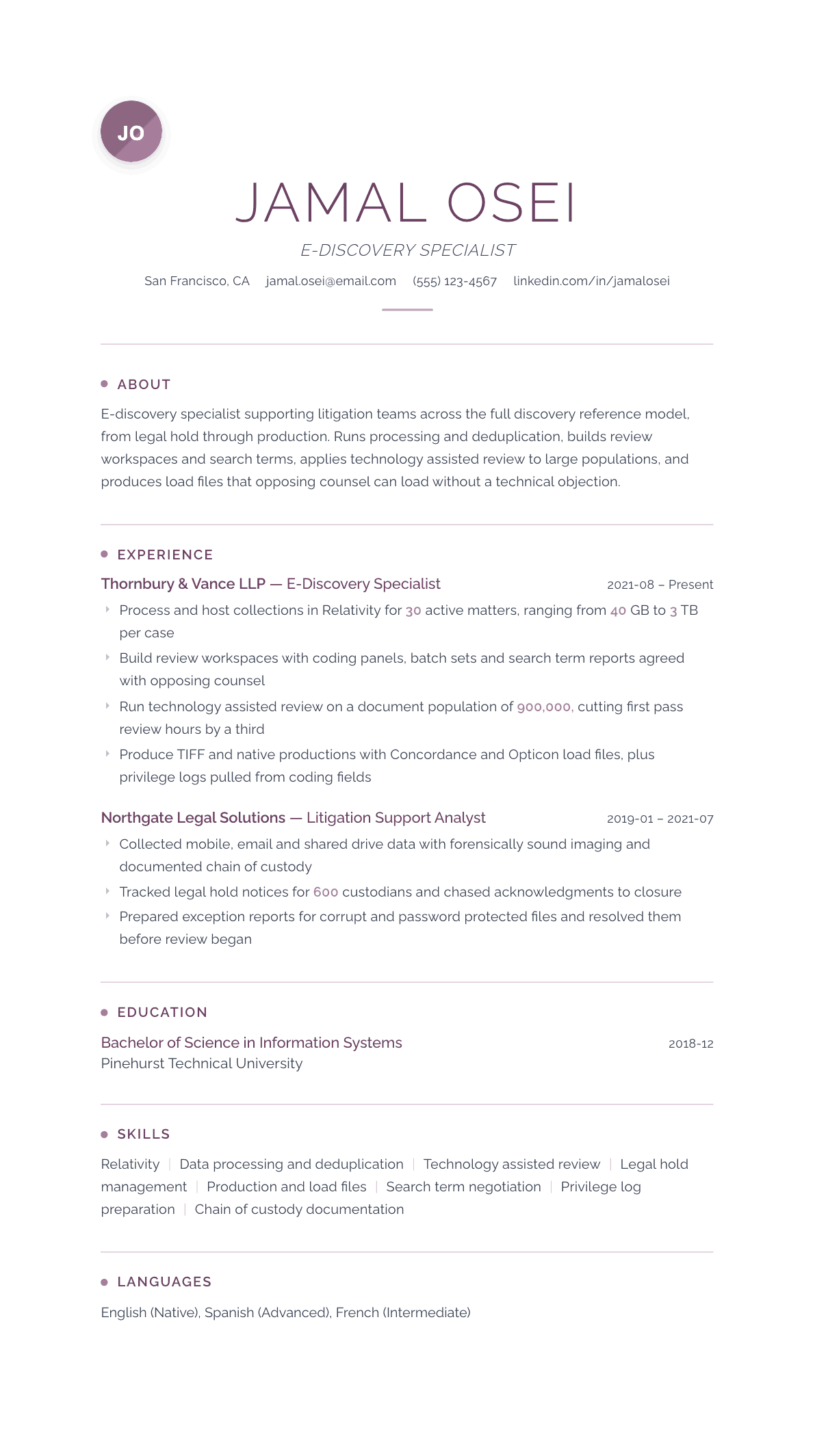
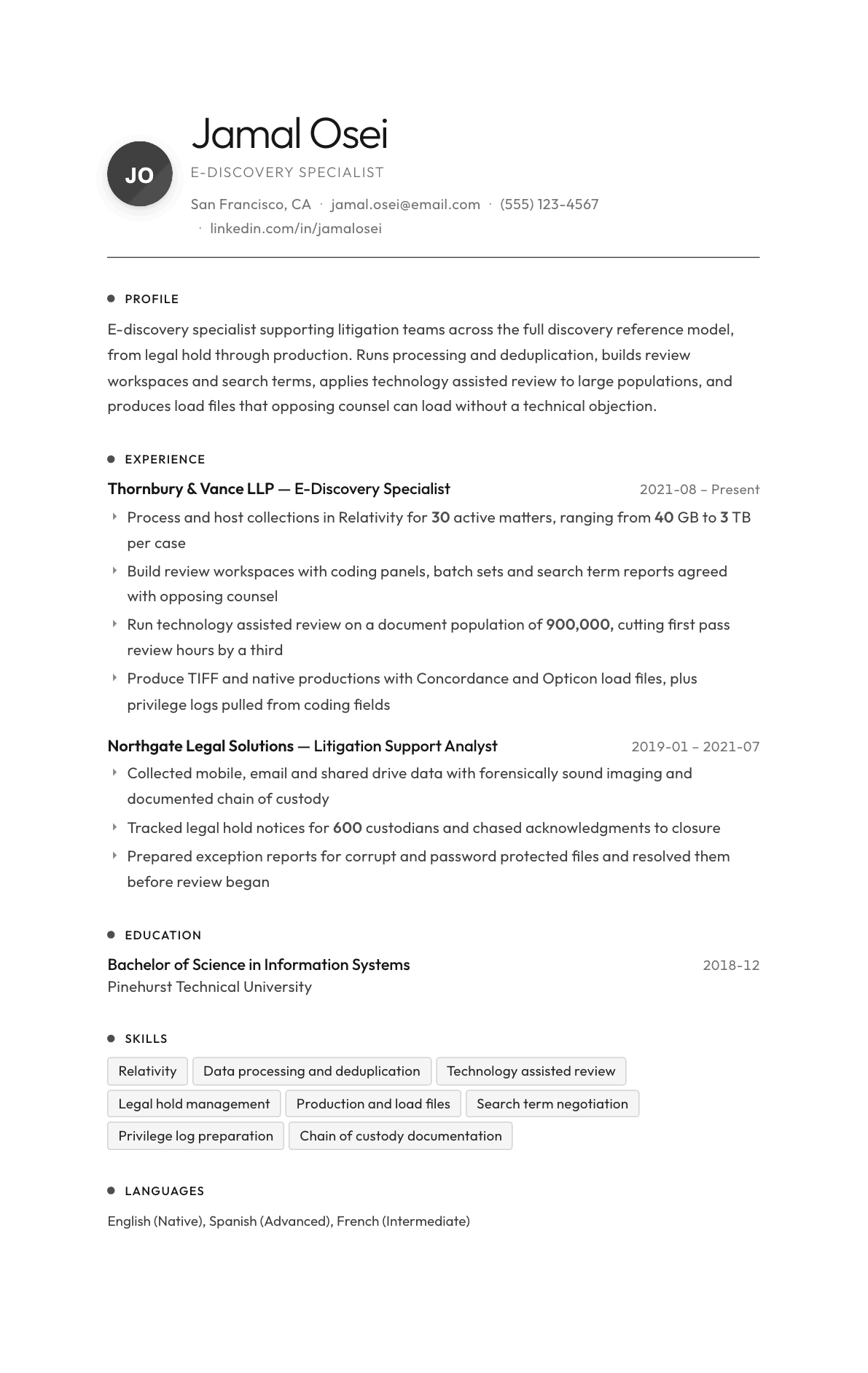
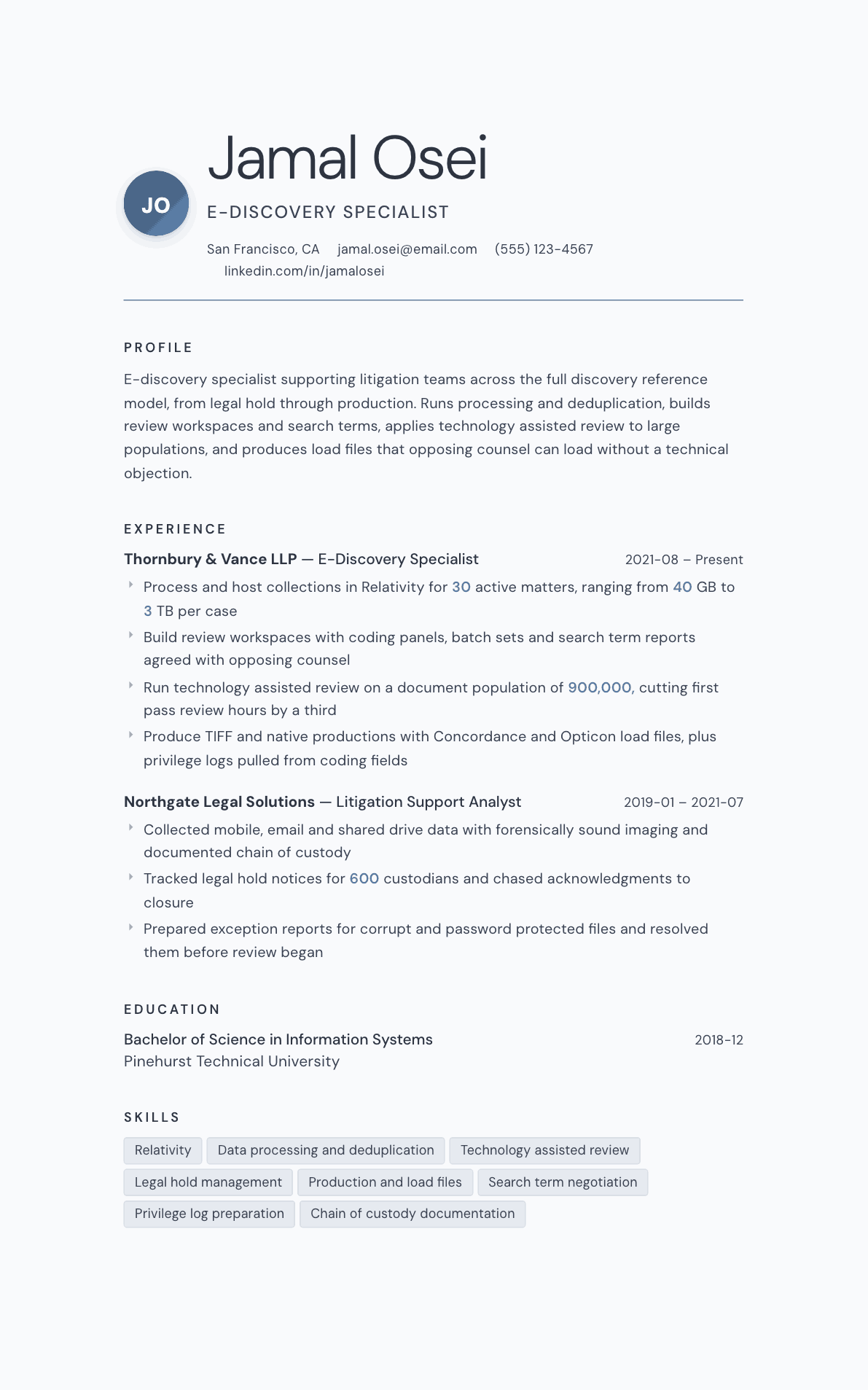
The same e-discovery specialist content laid out in three CVBooster templates, so you can see what the finished document looks like before you write a word.
Example E-Discovery Specialist summary
E-discovery specialist with six years supporting litigation teams from legal hold through production. Administers review workspaces, runs processing and deduplication, negotiates search terms with opposing counsel, and delivers image and native productions with clean load files. Comfortable applying technology assisted review to populations in the hundreds of thousands. Seeking a discovery lead role.
Skills to list on a E-Discovery Specialist resume
- Relativity administration
- Nuix and processing tools
- Deduplication and de-NISTing
- Technology assisted review
- Search term reporting
- Legal hold and preservation
- Forensic collection
- Chain of custody
- Production specifications
- Load file generation
- Redaction workflows
- Privilege log preparation
- Metadata field mapping
- Review quality control
- Data mapping and custodian interviews
What actually gets this resume read
- Lead with the platforms you administer by name and version, because litigation support managers screen on the tool.
- Quantify data volumes in gigabytes or terabytes and document counts, since scale is what separates candidates here.
- Map your bullets to discovery phases: preservation, collection, processing, review, analysis and production.
- Show production mechanics with image and native formats, load file types and how you handled redactions.
- Name your review workflow experience, including batching, quality control sampling and technology assisted review.
- Add any certification with its issuing body, since firms use it to justify a rate to their clients.
How to write a e-discovery specialist resume
An e-discovery specialist sits between the litigation team and the data, and the resume that gets interviews makes that position obvious. Litigation support managers and practice technology directors read for platform depth, data volume and production mechanics, because those three things decide whether a case team can hand you a collection on Friday and expect a review workspace on Monday.
The common failure is a resume written as if the job were document review. Reviewing documents is the work of contract attorneys. Building the environment they review in, defending the process when opposing counsel objects, and producing in a format that loads without error is a different discipline and deserves different words.
Below is the structure hiring managers expect, three summaries across the career, before and after bullets from processing and production work, and the questions specialists ask when they move between a firm, a service provider and a corporate legal department.
Format: platforms first, phases second
Reverse chronological, one page early and two once you have several matter types behind you. Directly under the header, list the platforms you administer with your level on each, then the discovery phases you own end to end. A manager can staff you from that block alone.
Resist a design heavy layout. This is a technical role inside a conservative profession, and a clean single column reads as competence in both directions.
- Header: name, city and state, phone, email, and certifications with the issuing body.
- Order: summary, platforms and certifications, matter experience, technical projects, education, skills.
- Corporate applicants should add legal hold administration and data mapping above review workflow.
Summary: platform, scale, and where in the model you work
State the platforms, the volumes and the phases in the first two lines. Data volume is the honest measure of scale here: gigabytes collected, terabytes hosted, documents promoted to review. A specialist who has only handled small collections is a different hire from one who has managed a multi terabyte matter, and both are needed.
Say whether you work firm side, provider side or in house, since the day looks different in each. Firm work is case team support, provider work is throughput and service level agreements, in house work is preservation, data mapping and vendor oversight.
Experience: preservation through production
Walk the phases. Preservation: legal hold notices, custodian counts, acknowledgment tracking, and interviews to map where the data lives. Collection: the sources you have handled, from email archives and shared drives to collaboration tools and mobile devices, with chain of custody documentation.
Processing: the tools, the filters, deduplication and de-NISTing, exception handling for corrupt and encrypted files, and how you report what fell out. Review: workspace build, coding panels, batching, search term reports, and technology assisted review with the sampling and quality control that defends it.
Production: image and native specifications, load file formats, Bates numbering, redaction workflow, privilege log generation and how you validate a production before it leaves. A specialist who has never had a production rejected should say what the validation step is, because that is why it never happened.
Defensibility, protocols and the parts counsel cares about
Case teams do not hire a specialist to press buttons. They hire someone who can explain the process to a judge. If you have contributed to an ESI protocol negotiation, prepared declarations describing a search methodology, or supported a meet and confer, put it on the page.
Describe your documentation habit: written processing reports, search term hit counts shared with the other side, sampling results retained. Defensibility is a paper trail, and the resume should show you keep one.
Skills and the vocabulary an intake system matches
Use the terms that appear in postings: EDRM, legal hold, custodian interview, forensic collection, chain of custody, processing, deduplication, near duplicate detection, email threading, technology assisted review, continuous active learning, privilege log, load file, Bates numbering, redaction, production specification.
Keep general information technology skills brief unless they are the point. Scripting, database querying and reporting are worth naming because they make you faster on exception handling and field mapping.
E-Discovery Specialist resume summary examples
Litigation support analyst
Litigation support analyst with 2 years of processing, workspace setup and production support on a review platform, plus an information systems degree. Handles imaging, deduplication, exception reports and Bates numbered productions, and is working toward a platform administrator certification.
Five years, firm side
E-discovery specialist supporting 30 active matters at a litigation firm, hosting collections from 40 gigabytes to 3 terabytes. Builds review workspaces with coding panels and batch sets, runs technology assisted review on large populations, and produces image and native sets with clean load files.
Discovery manager
Discovery manager with 11 years across a service provider and a corporate legal department, owning legal hold administration for 4,000 custodians and a hosted review environment. Negotiates ESI protocols alongside counsel, manages vendor budgets, and has prepared declarations describing collection and search methodology.
Work experience bullets: before and after
Before: Used Relativity for document review projects.
After: Administered review workspaces on Relativity for 30 active matters, building coding panels, batch sets, search term reports and propagation rules for family level coding.
Naming the administrative objects proves you built the environment rather than worked inside one someone else built.
Before: Processed data for cases.
After: Processed collections from 40 gigabytes to 3 terabytes with deduplication, de-NISTing and email threading, then published exception reports for corrupt and password protected files before review began.
Volume ranges and the exception step show the part of processing that actually consumes a specialist week.
Before: Helped with productions to opposing counsel.
After: Produced TIFF and native sets with Concordance and Opticon load files, applied Bates numbering and confidentiality endorsements, and validated field mapping against the ESI protocol before delivery.
The formats, the endorsements and the validation step are what stop a production being rejected on receipt.
Before: Managed legal holds.
After: Administered legal hold notices to 600 custodians, tracked acknowledgments to closure and ran custodian interviews to map mailboxes, shared drives and collaboration workspaces.
Custodian counts and the mapping interviews show preservation as a managed process, not an email blast.
Before: Used predictive coding on a big case.
After: Applied continuous active learning to a population of nine hundred thousand documents, with control set sampling and elusion testing documented for the case team.
Sampling and elusion testing are what make an assisted review defensible, and naming them signals real experience.
Hard skills
- Relativity administration
- Data processing and ingestion
- Deduplication and de-NISTing
- Email threading and near duplicate detection
- Technology assisted review
- Search term reporting
- Legal hold administration
- Forensic collection and imaging
- Chain of custody documentation
- Production specifications and load files
- Redaction and privilege log workflows
- Metadata field mapping
- Database querying and scripting
Soft skills
- Translating technical steps for counsel
- Deadline calm during a production window
- Precise written documentation
- Vendor coordination
- Questioning an unclear instruction
Certifications worth listing
- Relativity Certified Administrator (RCA) (Relativity)
- Certified E-Discovery Specialist (CEDS) (Association of Certified E-Discovery Specialists)
- EnCase Certified Examiner (EnCE) (OpenText)
- Certified Computer Examiner (CCE) (International Society of Forensic Computer Examiners)
Mistakes that cost e-discovery specialist candidates the interview
- Writing the resume as a document reviewer when the target job builds and defends the review environment.
- Naming platforms without a level, so a manager cannot tell an administrator from an occasional user.
- Omitting data volumes entirely, which leaves scale invisible on a resume where scale is the main variable.
- Skipping production mechanics, the exact area where an inexperienced hire costs a case team a week.
- Listing certifications without the issuing body, which makes a real credential look invented.
- Ignoring preservation and legal hold work, the phase corporate legal departments hire for most often.
E-Discovery Specialist resume questions
How much technical detail belongs on an e-discovery resume?
Enough that a litigation support manager can picture your workflow: platforms, volumes, processing settings, production specifications. Leave out step by step procedure, because the resume needs to prove capability rather than teach the method.
Do I need a certification to be taken seriously?
A platform administrator certification helps most, because firms bill your time and use it to justify a rate. A broader discovery credential adds process credibility, but neither substitutes for stated volumes and named production work.
How do I describe matters without breaching confidentiality?
Use matter type, industry and scale rather than party names. Saying you supported a multi party construction dispute with a three terabyte collection tells the reader everything useful and identifies no one.
Is service provider experience valued at a law firm?
Yes, because provider work builds throughput discipline and exposure to many production specifications. Translate it for the firm reader by adding how you supported case teams directly rather than only meeting internal service levels.
What if my experience is mostly on one platform?
Say so plainly and show depth: administration, scripting, field mapping and workflow design on that platform. Depth on one system reads better than a shallow list, and most managers assume transferable concepts across tools.