Librarian Resume Examples: free ATS score and gap list
Catalog a Librarian Resume That Checks Out With Hiring Committees
By Mustafa Tarabya, founder of CVBooster · Published · Updated
Create a librarian resume showcasing information literacy instruction, collection development, and digital resource management with measurable community impact.
Sample resumes for a librarian
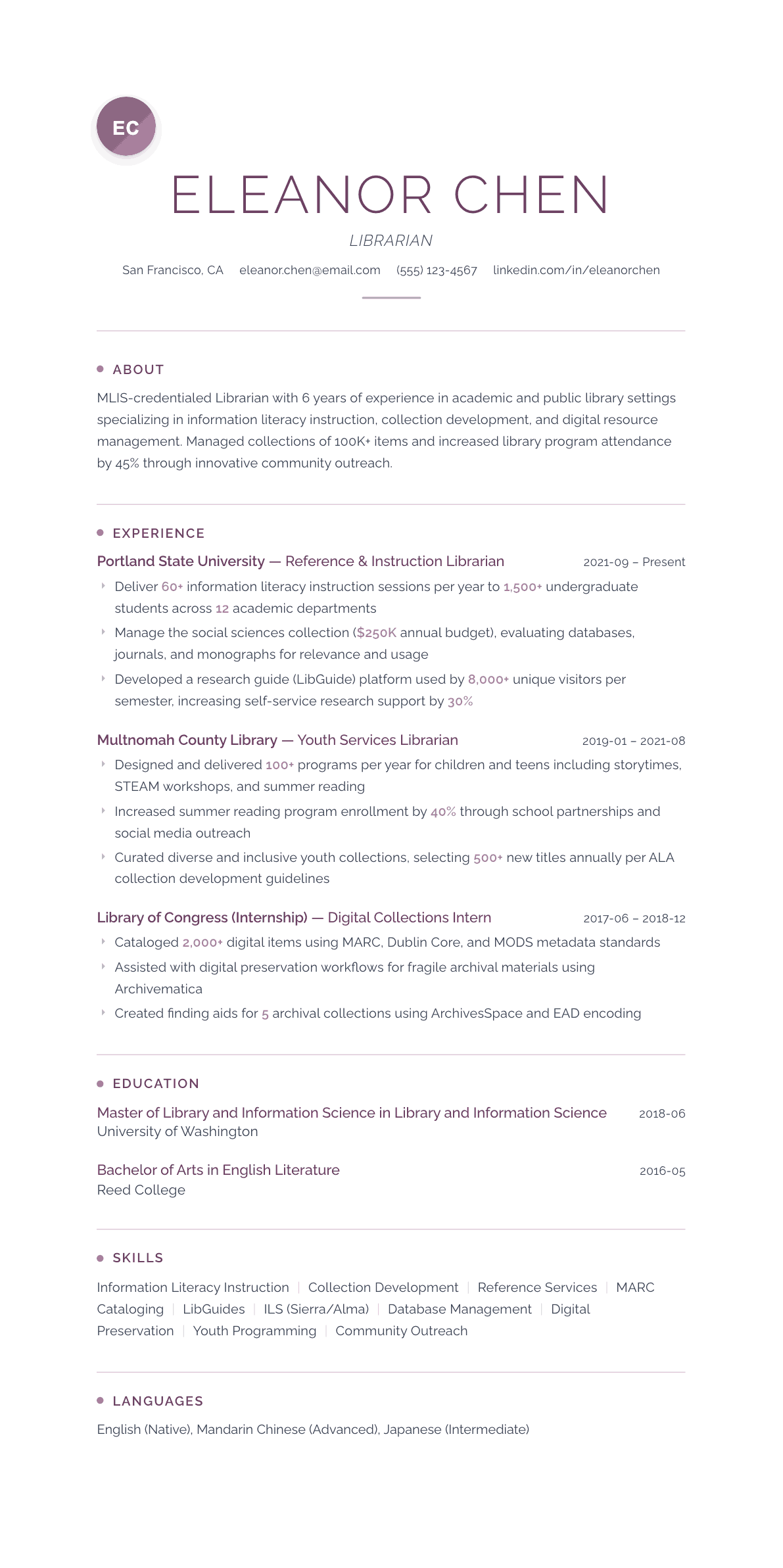
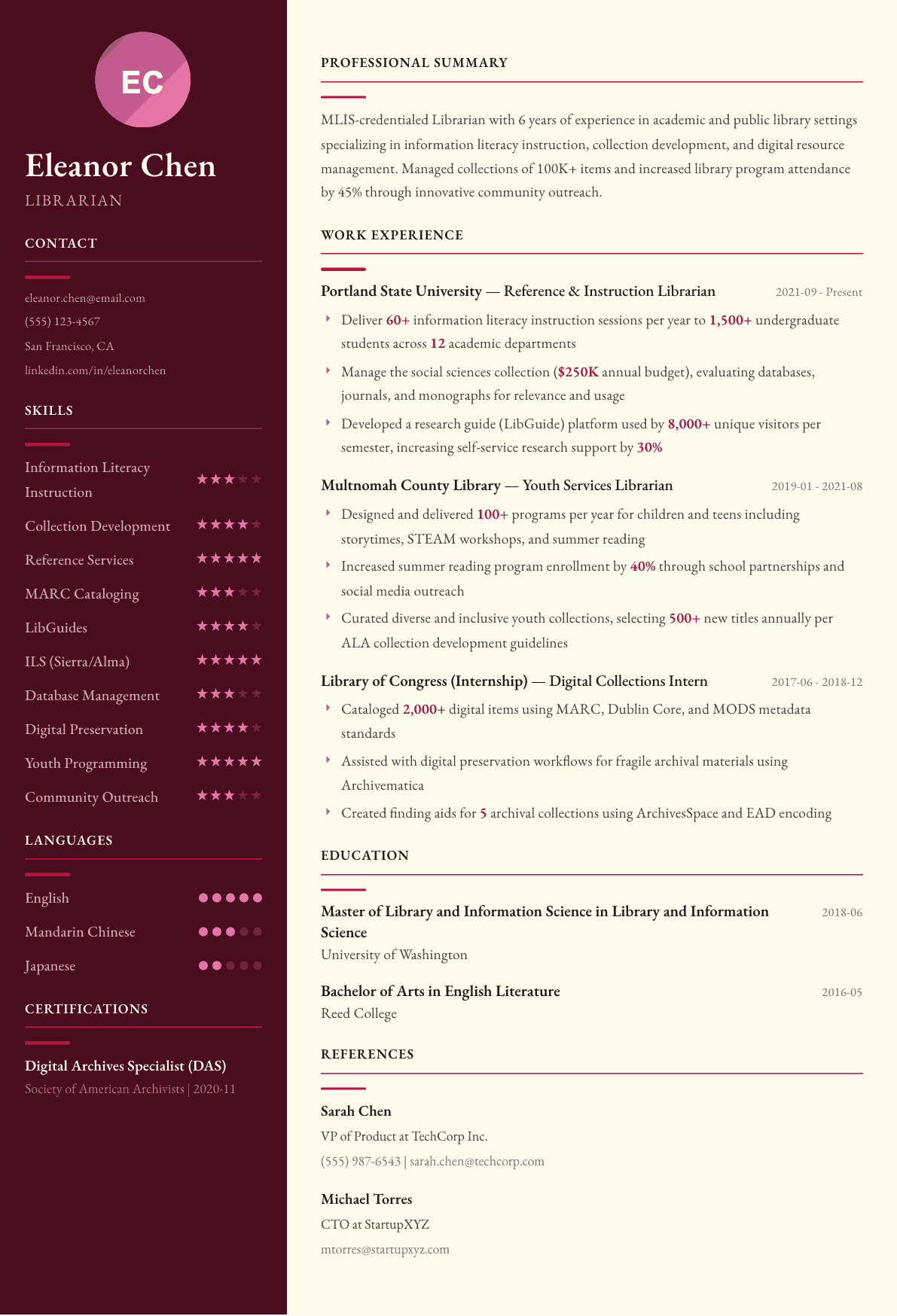
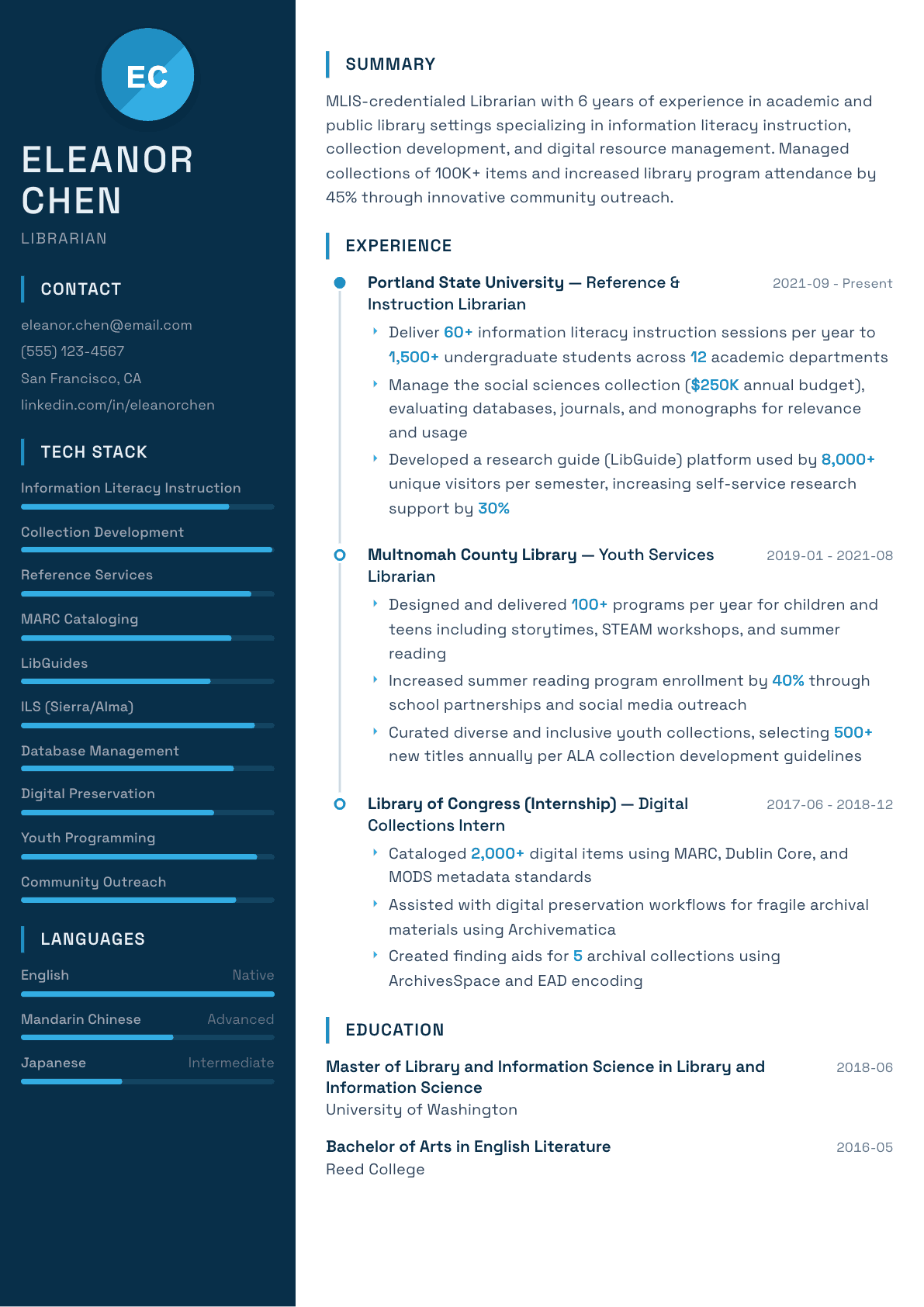
The same librarian content laid out in three CVBooster templates, so you can see what the finished document looks like before you write a word.
Example Librarian summary
MLIS-credentialed Librarian with 6 years of experience in academic and public library settings. Expert in information literacy instruction, collection development, and digital resource management. Increased program attendance by 45% and managed collections of 100K+ items with data-driven acquisition strategies.
Skills to list on a Librarian resume
- Information Literacy Instruction
- Collection Development
- Reference & Research Support
- MARC / Dublin Core Cataloging
- LibGuides / SpringShare
- ILS (Sierra / Alma / Koha)
- Database Evaluation
- Digital Preservation
- Youth Services Programming
- Community Outreach
- Archives Management
- Interlibrary Loan
- Copyright & Fair Use
- Data Management Planning
What actually gets this resume read
- Highlight your MLIS degree from an ALA-accredited program prominently.
- Include library systems: Sierra, Alma, Koha, OCLC WorldCat, LibGuides, ArchivesSpace.
- Quantify impact: instruction sessions, patron interactions, collection budget, program attendance.
- Specify expertise areas: reference, instruction, cataloging, archives, youth services, digital.
- Reference metadata standards: MARC, Dublin Core, MODS, EAD, RDA.
- Describe community engagement and outreach programming.
How to write a librarian resume
Librarian hiring is committee hiring. A public library branch manager, an academic search committee, or a school district media coordinator will read your file against a posted list of required and preferred qualifications, and in many public institutions they score it. That changes how you write: the resume has to make each posted qualification easy to find, in the language the posting used, because a reader with a scoring sheet does not go hunting.
The second thing to understand is that librarian covers very different jobs. Public services, technical services, youth services, instruction, systems, archives and special collections share a degree and almost nothing else day to day. A resume that says "assisted patrons and managed collections" fits all of them and convinces none of them.
This guide covers the file a search committee expects, how to write reference, instruction and cataloging work so it reads as professional practice rather than desk coverage, summaries at three career stages, and the questions librarians ask when they move between library types.
Format: two pages in public and school libraries, longer in academic ones
Public and school library applications follow ordinary resume conventions: two pages, reverse-chronological, clean. Academic library searches are different. Many are faculty or faculty-equivalent lines, which means a curriculum vitae with publications, presentations, service and grants, and no page limit. Read the posting to see which document is being asked for, and never send a two-page resume to a search that asked for a CV.
Put the degree in the header line, because it is a screening threshold. "Marisol Vega, MLIS" answers the first question the committee has. If your program was accredited by the American Library Association, say so in the education section, since many public postings require it by name.
- Header: name, degree abbreviation, city and state, email, phone, and a professional profile link.
- Order for public and school posts: summary, education, professional experience, service and committees, skills, presentations.
- Academic curriculum vitae order: education, appointments, instruction, publications, presentations, grants, service, professional development.
Summary: library type, function, collection scale, community
Name the setting and the function first: academic reference and instruction, public youth services, technical services and cataloging, school library media, or special collections. Then the scale you have worked at, expressed as the committee thinks about it: collection size, budget responsibility, gate count, service population, instruction sessions per year, or items processed.
Add the community you serve. A librarian who has built programming for a bilingual neighborhood, a rural service area, an undergraduate first-year program or a corrections outreach service is describing a specific competence, and committees hire for the community they have.
Experience: reference, instruction, collections and programs
Break each position into the functions the posting names. Reference and research support: the questions you handled, the consultation format, the chat or text service you staffed, the research guides you maintained. Instruction: how many sessions a year, at what level, in which departments or grades, and whether you designed the sequence or delivered someone else's.
Collection development is where librarians undersell themselves. Say the subject areas you selected in, how you evaluated a database or serial for renewal, the usage evidence you used, and the weeding project you carried out. A committee reading for a collections line wants to see that you have canceled something as well as bought something.
Programming and outreach need attendance and partners. Storytime, summer reading, maker programs, author visits, community partnerships with schools or agencies, and the promotion that filled the room. Say how you counted attendance, because a committee that runs its own programs knows the difference between a registration list and bodies in chairs.
Technical skills: standards, systems, and metadata
Technical services work is described in standards, so name them precisely: MARC 21, RDA, Dublin Core, MODS, EAD for finding aids, and the subject vocabularies you apply, such as Library of Congress Subject Headings or a specialist thesaurus. Say what you cataloged, at what level, and whether it was original or copy cataloging.
Then the systems. The integrated library system or library services platform you work in, the discovery layer, the electronic resource management and link resolver, the interlibrary loan system, the institutional repository, and the guide platform. Committees write postings around the system they own, and a candidate who has migrated between two systems should say so, because migrations are a rare and valued experience.
Service, presentations and professional activity
Library culture treats professional service as part of the job. Committee work in your institution, an office or roundtable role in a state or national association, a conference poster, a workshop you led for colleagues, and continuing education all belong on the file. In academic searches this section is scored; in public library searches it signals that you will contribute past your own desk.
Keep the entries short and specific: the body, your role, and the years of service. A list of association memberships with no roles attached reads as dues paid rather than work done.
Librarian resume summary examples
New graduate
Recent librarian graduate with an accredited master's degree and two practicum placements in academic reference and digital collections. Cataloged 600 items using MARC and Dublin Core, staffed a chat reference service, and taught four first-year information literacy sessions under supervision.
Six years in
Public services librarian with six years in a mid-sized public library system, covering adult reference, technology instruction and a bilingual programming series. Selects in three subject areas against an annual materials allocation and led a weeding project that reclaimed an entire wing for study seating.
Department head
Head of research and instruction supervising five librarians and two staff at a comprehensive university library. Owns the information literacy program across the general education curriculum, the liaison model for eight departments, and a library services platform migration completed across two academic terms.
Work experience bullets: before and after
Before: Assisted patrons with reference questions at the service desk.
After: Answered roughly 1,400 reference and research questions a year across the desk, chat and scheduled consultations, and maintained 18 subject research guides used by four academic departments.
Volume, channels and the guides you own show a reference practice rather than desk hours.
Before: Taught library instruction sessions.
After: Taught 55 information literacy sessions a year to first-year composition and nursing students, rebuilding the source evaluation lesson around a hands-on database comparison exercise with a graded worksheet.
Session count, audience and one concrete redesign prove instruction is a skill you have developed.
Before: Managed the library collection.
After: Selected in social sciences and local history against an annual allocation, canceled three low-use databases after a usage and overlap review, and redirected the funds into an interlibrary loan-driven purchase program.
A cancellation decision and the evidence behind it demonstrate real collection stewardship.
Before: Ran children's programs at the branch.
After: Delivered weekly toddler and preschool storytimes averaging 35 children, and grew summer reading registration by partnering with four elementary schools for classroom sign-up visits before the last week of term.
Attendance and the partnership that produced it explain how the growth actually happened.
Before: Cataloged materials for the library.
After: Performed original cataloging for 900 special collections items in MARC 21 with RDA descriptions and Library of Congress Subject Headings, and authored finding aids for two manuscript collections in EAD.
Original versus copy cataloging, the standards and the formats are exactly what a technical services committee scores.
Hard skills
- Reference and research consultation
- Information literacy instruction
- Collection development and assessment
- Original and copy cataloging
- MARC 21 and RDA
- Dublin Core, MODS and EAD metadata
- Library of Congress Subject Headings
- Integrated library systems and discovery layers
- Electronic resource management
- Interlibrary loan workflows
- Research guide platforms
- Digital preservation workflows
- Usage statistics and collection analytics
- Programming and community outreach
Soft skills
- Reference interviewing
- Instructional presence
- Committee collaboration
- Patron de-escalation
- Faculty and teacher liaison
- Written communication
Certifications worth listing
- Academy of Health Information Professionals (AHIP) (Medical Library Association)
- Certified Public Library Administrator (CPLA) (American Library Association Allied Professional Association)
- Digital Archives Specialist (DAS) (Society of American Archivists)
- Certified Archivist (Academy of Certified Archivists)
- Project Management for Libraries certificate (Library Juice Academy)
Mistakes that cost librarian candidates the interview
- Sending a two-page resume to an academic search that asked for a curriculum vitae, which reads as not having understood the posting.
- Describing desk coverage instead of professional practice, so nothing distinguishes you from a paraprofessional colleague.
- Omitting the integrated library system by name when the posting was written around the system the institution runs.
- Leaving out collection budget responsibility and weeding decisions, the two things a collections committee reads for.
- Listing association memberships without any role, which shows dues rather than service.
- Writing the same file for a youth services post and a technical services post, when the required qualifications barely overlap.
Librarian resume questions
Do I need an accredited degree to be a librarian?
For most professional positions in academic, public and special libraries, yes, and the posting will name accreditation explicitly. School library media positions usually require a state school librarian certification instead, sometimes alongside a teaching license, so read the state requirement before applying.
Should I send a resume or a curriculum vitae?
Follow the posting. Public library and school district applications want a resume of about two pages. Academic libraries with faculty or faculty-equivalent status want a curriculum vitae with publications, presentations, grants and service listed in full, and there is no length limit on it.
How do I show library experience gained while still a student?
Give practicum, internship and student worker positions their own entries with the institution, the hours and the functions you performed. Committees hiring new graduates expect this, and the specifics matter: items cataloged, sessions taught, hours on a reference service, projects completed.
How do I move from a public library to an academic one?
Translate the work into academic functions. Reader advisory and adult programming become instruction and outreach; technology classes become information literacy teaching; local history work becomes special collections experience. Then add evidence of scholarly service, such as a conference poster or a committee role in a state association.
What belongs in a librarian skills section?
Systems and standards, not personality traits. Name the integrated library system, the discovery layer, the metadata schemas, the vocabularies and the statistical tools you use. Committees search the file for those exact strings when they check a candidate against a required qualifications list.