Research Assistant Resume Examples: the lines they read
Write a Research Assistant Resume That Gets You Into the Lab
By Mustafa Tarabya, founder of CVBooster · Published · Updated
How to put research assistant experience on a resume, with entries for lab, clinical and social science roles, resume examples and a full writing guide.
Sample resumes for a research assistant
The same research assistant content laid out in three CVBooster templates, so you can see what the finished document looks like before you write a word.
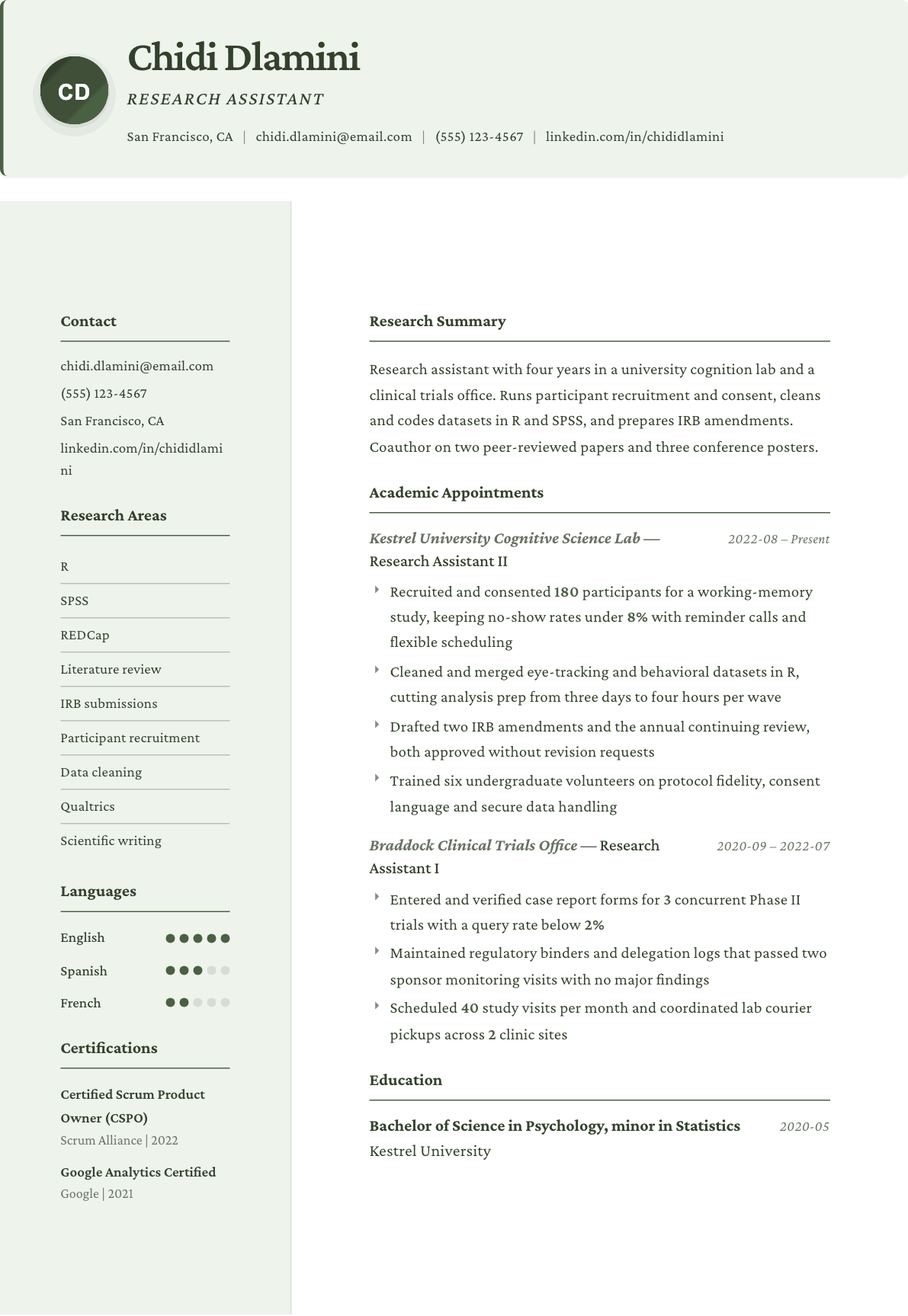
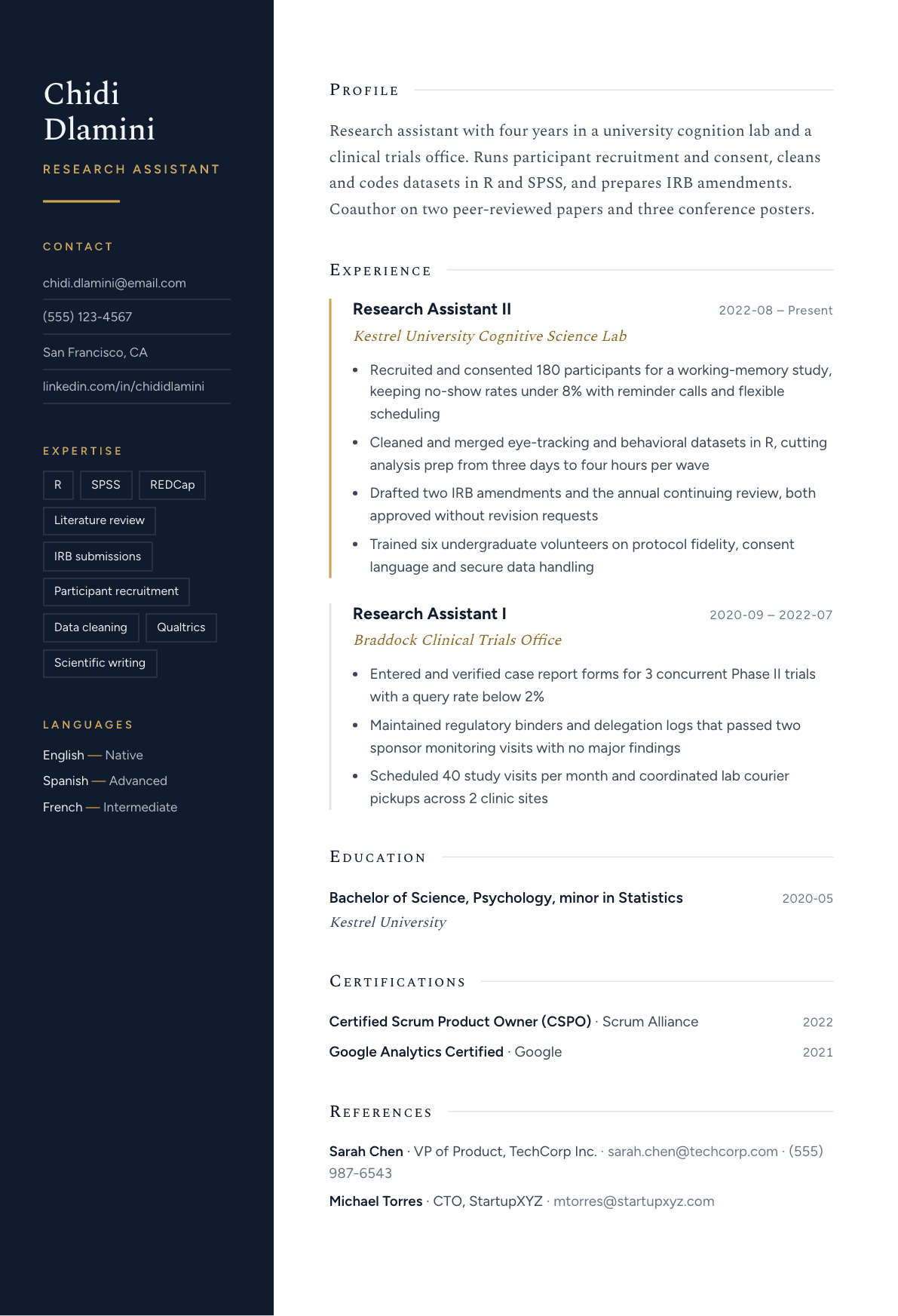
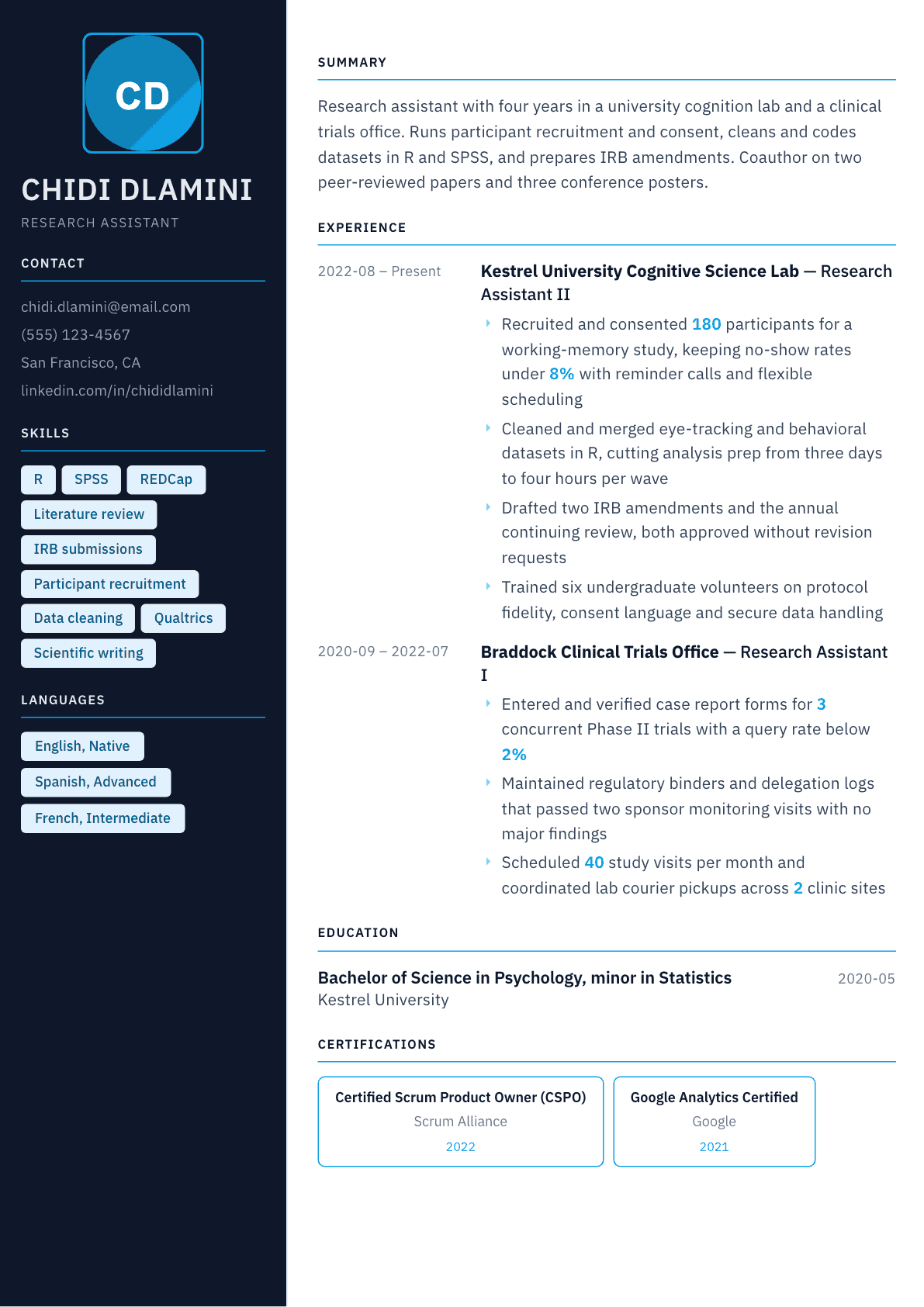
Example Research Assistant summary
Research assistant with four years supporting behavioral and clinical studies at a university lab and a trials office. Recruits and consents participants, manages REDCap databases, and prepares datasets in R for principal investigators. Coauthor on two peer-reviewed articles and comfortable with IRB submissions, protocol fidelity monitoring and training undergraduate volunteers on secure data handling.
Skills to list on a Research Assistant resume
- Literature review
- Data collection
- Data cleaning
- R
- SPSS
- Python
- REDCap
- Qualtrics
- IRB protocols
- Informed consent
- Statistical analysis
- Scientific writing
- Lab notebook documentation
- Participant recruitment
- Reference management
What actually gets this resume read
- Name the lab, the principal investigator area of study and the funding source so a reader places your work immediately.
- List the exact analysis stack you touched, such as R, SPSS, Python, MATLAB, REDCap or Qualtrics, rather than the word software.
- Put publications, posters and presentations in their own section with full citations, including submitted and under review items.
- Show the human protocol side: consent, IRB submissions, protocol fidelity checks and secure handling of identifiable data.
- Quantify the study, not yourself: sample size, number of visits, waves of data collection, or instruments administered.
- Keep a one page resume for lab positions and switch to an academic CV only when the posting asks for one.
How to write a research assistant resume
A research assistant resume is usually read by the principal investigator who will supervise you, sometimes with a lab manager filtering first. Neither of them is looking for polish. They want to know which methods you can already run unsupervised, which software you have touched with real data, and whether you can be trusted alone with consent forms and identifiable records.
The mistake most applicants make is writing the resume around courses taken rather than work done. A methods class is not evidence. Two hundred hours of running participants through a protocol, cleaning the resulting file and catching the coding error before analysis is evidence, and it belongs in the experience section with the sample size attached.
This guide covers the section order labs expect, how to write about studies you supported rather than led, how to list publications and posters at every status, and the questions applicants ask most when they move between academic, clinical and industry research settings.
Format: one page for a lab job, an academic CV only when asked
For a paid research assistant post the expected document is a one-page resume in reverse-chronological order. Save the multi-page academic CV for doctoral applications and faculty-adjacent postings that ask for one by name. Sending a six-page CV with every course listed to a lab manager filling a technician line reads as a misunderstanding of the job.
Keep the layout single column and plain. Many university applicant tracking systems parse poorly, and department hiring portals often strip formatting entirely before the principal investigator sees the file.
- Header: name, city, email, phone, and a link to a code repository or portfolio if you have one.
- Order: summary, research experience, technical skills, education, publications and presentations.
- Undergraduates and recent graduates put education first and add a relevant coursework line with methods and statistics courses only.
Research experience: the study, your role, the volume
Give each position the institution, the lab or center by name, and the subject area in one line. A reader who studies infant language acquisition wants to know instantly whether your lab ran neuroimaging, survey panels or bench work, because the transferable part depends on it.
Then write bullets that separate what the study did from what you personally did. Applicants blur this constantly, claiming credit for the design when they ran the sessions. Owning the session running honestly reads better than an inflated claim that collapses in the interview.
Attach volume to everything. Participants recruited, sessions run, samples processed, records abstracted, interviews transcribed, waves of data collected. Numbers turn a generic duty into a measurable one, and they let a supervisor estimate how quickly you would come up to speed.
- Name the design: longitudinal panel, randomized trial, cross-sectional survey, case-control chart review, in-lab behavioral session.
- Say whether you worked with human subjects, animal protocols, secondary datasets or bench samples.
- Include the regulatory work: consent, protocol amendments, adverse event logs, data use agreements.
Technical skills: the stack, not the category
Write the actual tools. R with tidyverse, Stata, SPSS, Python with pandas, MATLAB, SAS, REDCap, Qualtrics, NVivo, ImageJ, or whatever your lab really ran. The word software tells a supervisor nothing, and skills sections are where automated filters look for exact matches with the posting.
Group them so the reader can scan: analysis languages, data collection platforms, laboratory or instrumentation skills, and reference management. If you can only run a tool with a template someone else wrote, leave it off. You will be asked to open it in week one.
Publications and presentations: list the status honestly
Give this its own section with full citations in whichever style your field uses, and put your own name in bold-free plain text with the author position preserved. Never reorder authors to move yourself up. Include posters and conference talks, and mark manuscripts as under review or in preparation rather than implying they are published.
If you have no publications yet, that is normal and not a gap to hide. A thesis, an honors project, a departmental symposium poster or a data blitz talk all belong here and all show you can carry a project to an output.
Keywords a lab posting repeats
University job descriptions for this role are written from templates, so the same phrases recur: data collection, data entry and verification, literature review, participant recruitment, informed consent, protocol adherence, regulatory documentation, and the specific analysis package. Mirror the exact wording once in your skills section and once inside a bullet where it is demonstrated.
Clinical research postings add their own vocabulary: case report forms, source documentation, monitoring visits, query resolution, delegation logs and good clinical practice. Use those words only if you have done the work, because an interviewer will test them immediately.
Research assistant on a resume: how to list it
Research assistant work goes on a resume as a job, not as a hobby, even when it was part time, paid by the hour or done for course credit. Give it a normal experience entry with the lab or principal investigator, the department, the dates and the hours per week, then bullets that name the study, your tasks and the methods. If you have several research roles, put them under a heading called Research Experience above any unrelated jobs.
The three entries below show how research assistant experience on a resume reads at different stages. Use the one closest to yours and keep the order: study, your role, the method, the volume.
- Undergraduate: Research Assistant, Cognitive Development Lab, Department of Psychology, 10 hours a week, two semesters. Ran 46 child participant sessions under an IRB approved protocol, coded video data in Datavyu and checked inter rater reliability with a second coder.
- Graduate or post baccalaureate: Research Assistant, Department of Molecular Biology, full time, two years. Ran qPCR and Western blots for a study of kidney injury markers, maintained the mouse colony records and drafted the methods section of one published paper as second author.
- Clinical: Clinical Research Assistant, Cardiology Research Unit, full time, 18 months. Consented and enrolled 112 participants in two industry sponsored trials, entered visit data in REDCap within 48 hours and prepared source documents for monitoring visits.
- Social science: Research Assistant, Center for Housing Policy, 15 hours a week, one year. Cleaned and merged three waves of survey data in Stata, ran descriptive tables and wrote the first draft of a policy brief.
Research Assistant resume summary examples
Recent graduate
Psychology graduate with two years of volunteer and paid work in a developmental lab, running 90 in-person sessions and coding video data to an agreement rate above 0.85. Comfortable in R and Qualtrics, trained in human subjects protection, and seeking a full-time research assistant position.
Three years in
Research assistant with three years supporting a longitudinal panel study of 1,800 households. Owns recruitment, retention calls and REDCap database maintenance, cleans each wave in R, and drafts protocol amendments for principal investigator review. Coauthor on one article and four conference posters.
Lab coordinator track
Senior research assistant coordinating two federally funded studies, supervising four undergraduate assistants and serving as the lab contact for the review board. Manages consent workflows, monitoring visit preparation and analysis-ready datasets, and has trained incoming staff on protocol fidelity for five consecutive cohorts.
Work experience bullets: before and after
Before: Assisted with data collection for a research study.
After: Ran 180 in-lab sessions for a working-memory study, administering the task battery, monitoring eye-tracker calibration and logging protocol deviations the same day.
The session count and the named procedures show exactly what a supervisor can hand over on day one.
Before: Used statistical software to analyze data.
After: Cleaned and merged four waves of behavioral and eye-tracking data in R, writing a documented script that regenerates the analysis file from raw exports.
Naming the language and the reproducible script proves independent capability rather than exposure.
Before: Helped with IRB paperwork.
After: Drafted two protocol amendments and the annual continuing review for a review board submission, both approved without a request for revisions.
The document type and the outcome tell a principal investigator that regulatory work can be delegated to you.
Before: Did literature reviews for the lab.
After: Screened 640 abstracts against inclusion criteria for a systematic review, resolving conflicts with a second screener and maintaining the extraction table in Covidence.
A screening count, a criteria step and the tool convert a vague task into a defined methodological contribution.
Before: Trained new students in the lab.
After: Trained six undergraduate volunteers on consent language, protocol fidelity checks and secure handling of identifiable data, with a signed competency check before solo sessions.
The competency check shows the training was verified, which matters when the topic is human subjects protection.
Hard skills
- Participant recruitment and retention
- Informed consent administration
- Data collection and entry
- Data cleaning and verification
- R
- SPSS
- Stata
- Python
- REDCap
- Qualtrics
- NVivo
- Literature screening
- Review board submissions
- Reference management
Soft skills
- Attention to protocol detail
- Discretion with confidential records
- Clear written handoffs
- Scheduling around participant availability
- Taking direction and asking early
- Patience with repetitive tasks
Certifications worth listing
- Human Subjects Research (CITI Program) (Collaborative Institutional Training Initiative)
- Good Clinical Practice (GCP) (Collaborative Institutional Training Initiative)
- Certified Clinical Research Coordinator (CCRC) (Association of Clinical Research Professionals)
- Certified Clinical Research Professional (CCRP) (Society of Clinical Research Associates)
Mistakes that cost research assistant candidates the interview
- Listing coursework as if it were research experience, which a principal investigator discounts within seconds.
- Claiming credit for study design when your role was running sessions, a gap the interview exposes immediately.
- Writing software or statistics instead of the actual package names the posting is filtering on.
- Leaving sample sizes and session counts off, so the reader cannot judge the scale you have worked at.
- Presenting manuscripts under review as published, which damages trust with the one audience that checks.
- Sending a full academic CV to a technician posting that clearly asked for a one-page resume.
- Omitting human subjects training, which many labs treat as a screening requirement rather than a bonus.
Research Assistant resume questions
Do I need publications to get a research assistant job?
No. Most people hired into these roles have none. A thesis, a departmental poster or a conference abstract shows you can carry work to an output, and hands-on method skills matter far more to a hiring lab than an author line.
Should I send a resume or an academic CV?
Send a one-page resume unless the posting says CV. Staff research positions are filled through human resources portals built for resumes, and a long CV listing every course and seminar buries the two method skills the lab is actually screening for.
How do I describe volunteer lab work on a research assistant resume?
Put it in the research experience section with the same detail as paid work and label the position volunteer research assistant. Include hours per week and duration so the reader can see the commitment was substantial rather than a single semester of shadowing.
What should I list if my lab used a dataset I did not collect?
Name the dataset and describe the work you did with it: variable construction, merging across waves, missingness handling, weighting and the analyses you ran. Secondary data analysis is a real skill and many research groups hire specifically for it.
How do I put research assistant experience on a resume?
As a normal experience entry: your title, the lab or principal investigator, the department, the dates and the hours per week. Under it, name the study, what you did, the methods and the volume, such as 46 participant sessions or three waves of survey data. Several research roles can sit under their own Research Experience heading.