School Librarian Resume Examples: the lines they read
Craft a School Librarian Resume Districts Shortlist
By Mustafa Tarabya, founder of CVBooster · Published · Updated
School librarian resume examples with collection development, information literacy and licensure keywords, and a full writing guide.
Sample resumes for a school librarian
The same school librarian content laid out in three CVBooster templates, so you can see what the finished document looks like before you write a word.
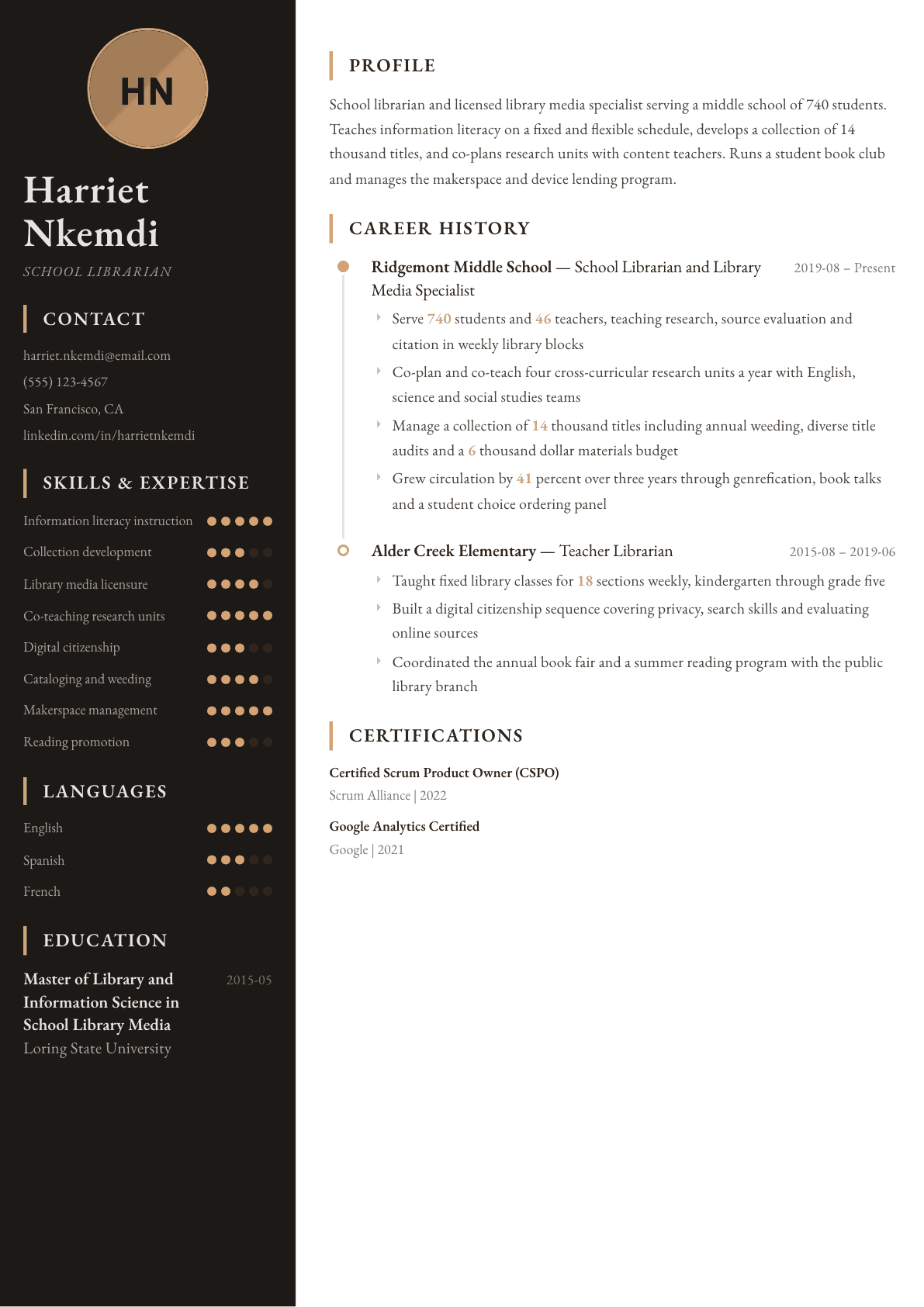
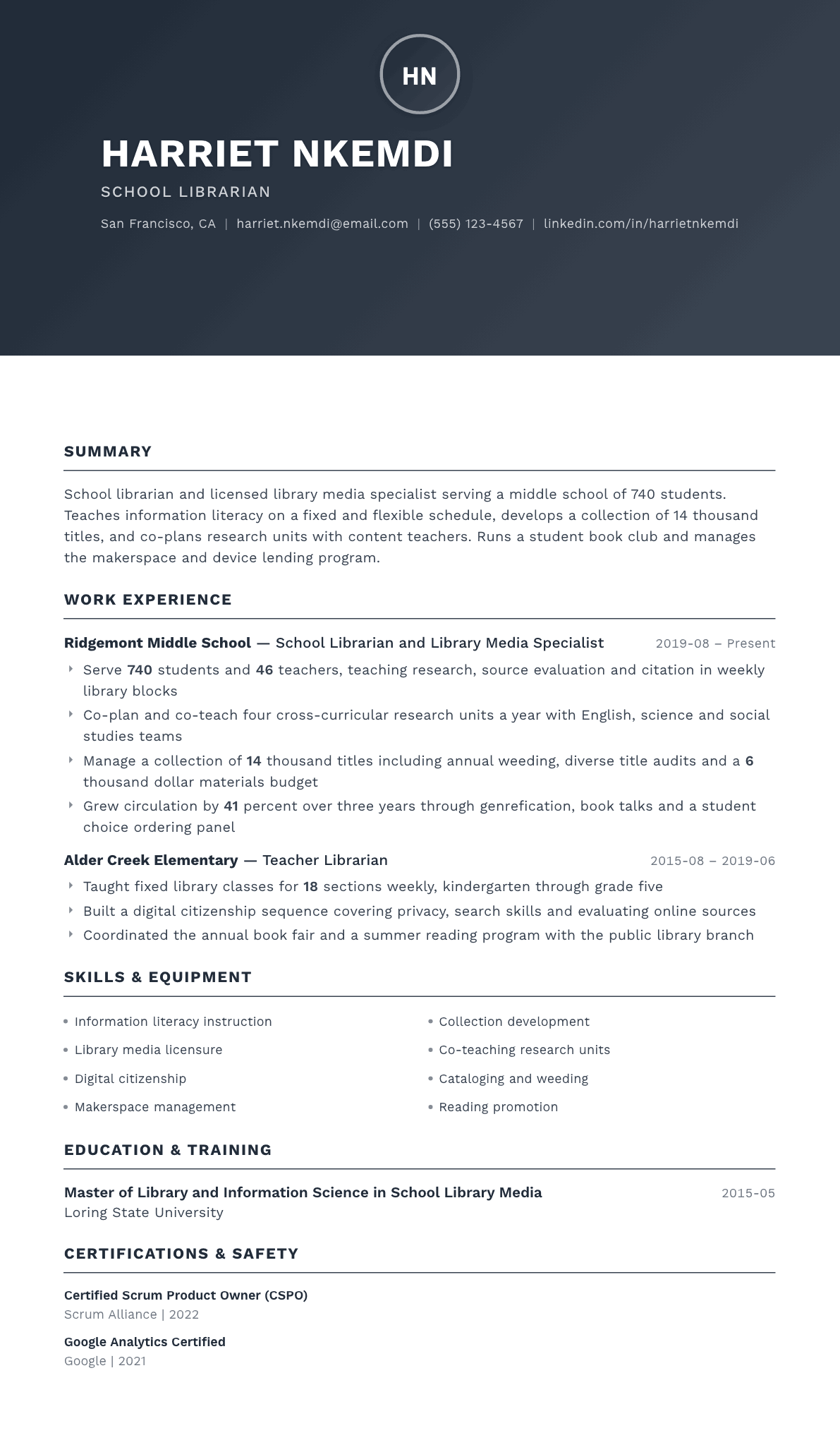
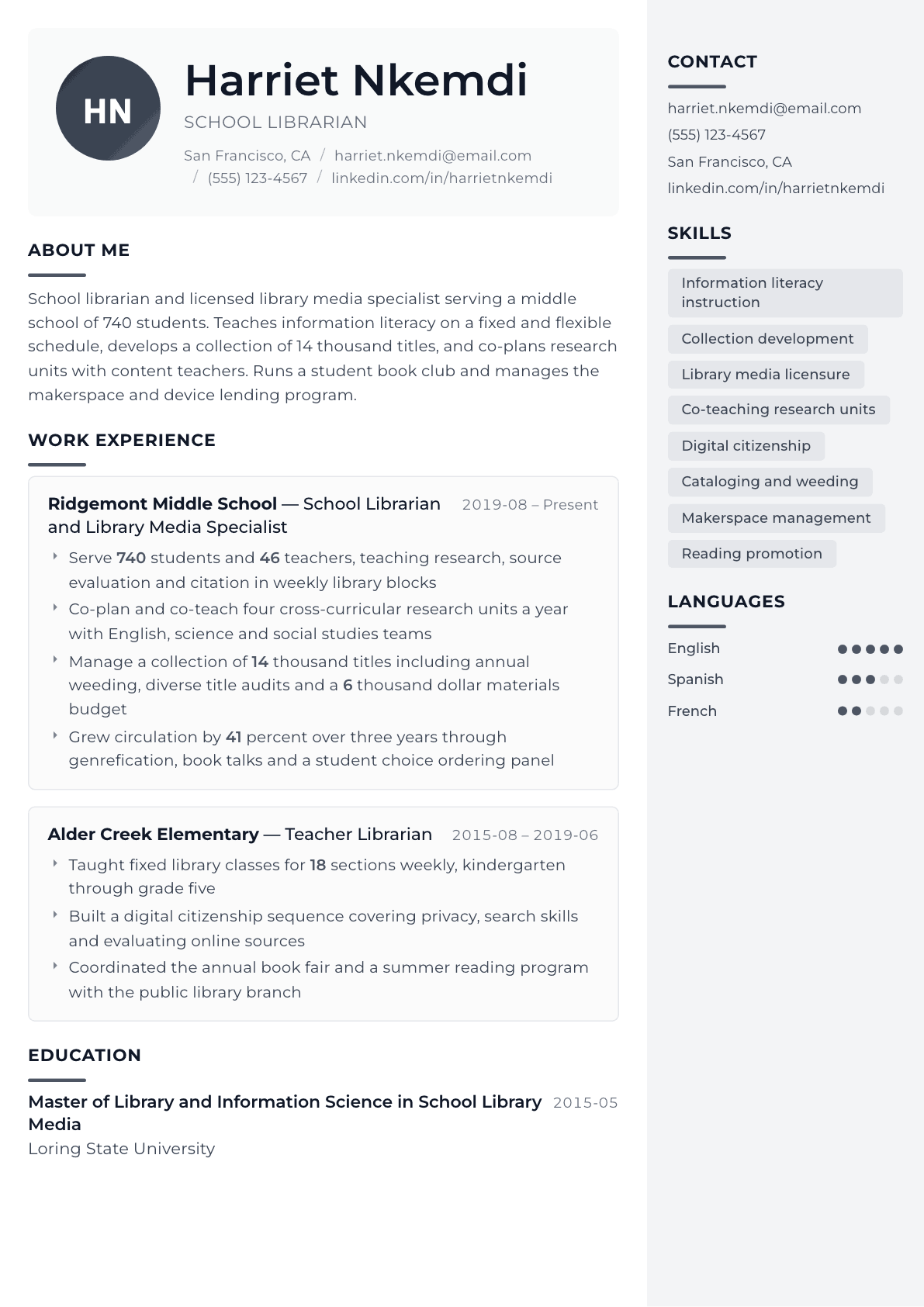
Example School Librarian summary
School librarian and licensed library media specialist serving a middle school of seven hundred forty students. Teaches research, source evaluation and citation, co-plans four cross-curricular units a year, and manages a collection of fourteen thousand titles with an annual materials budget. Grew circulation sharply through genrefication and a student ordering panel, and runs the makerspace and device lending program.
Skills to list on a School Librarian resume
- Information literacy instruction
- Collection development and weeding
- Cataloging and classification
- Co-planning with content teachers
- Digital citizenship curriculum
- Database and research instruction
- Reading promotion and book talks
- Library management systems
- Makerspace and STEM programming
- Device lending and support
- Budget and vendor ordering
- Intellectual freedom policy
- Student book clubs
- Family and community outreach
What actually gets this resume read
- State your library media license and teaching license in the header, because districts filter applications on them.
- Give school level, enrollment and whether your schedule is fixed, flexible or a mix of both.
- Show instruction, not just management: the research skills you teach and the units you co-plan with teachers.
- Include collection numbers, weeding cycles and budget size so a principal sees you can run the space.
- Name circulation growth, reading initiatives or diverse collection audits, since those are the visible outcomes.
- Cover technology work such as device lending, databases and digital citizenship, because that often sits with you.
How to write a school librarian resume
A school librarian resume has to satisfy two readers who disagree about what the job is. District human resources treats the position as a licensed teaching role and screens for the library media credential, the teaching license and the endorsement code. The principal treats it as a program to be run and screens for whether you can teach research skills, partner with content teachers, manage a budget and keep students reading.
The resumes that stall are the ones written as library management: a collection tended, a schedule kept, books circulated. That version reads as a caretaker of a room. The version that gets shortlisted shows instruction first, with the collection and the technology as the material you teach through.
This guide sets out the section order that satisfies both readers, summaries for a new library media specialist, an established one and a district level lead, before and after bullets that turn library duties into instructional evidence, and the questions that come up when a classroom teacher moves into the library.
Format: licensure in the header, instruction before management
Put your license and endorsement in the header line under your name, with the state and the code where you know it. District screening systems filter on that string, and a librarian without it visible can be rejected before a human reads the file. Add your teaching license too if you hold one, since many districts require both.
Then order the body so instruction comes first. Teaching and co-teaching, then collection and program management, then technology, then leadership and outreach. Two pages is acceptable for an experienced school librarian, because the licensure block, instruction record and program work do not compress well.
- Header: name, city, phone, email, library media license and endorsement, teaching license.
- Sections: summary, licensure, instructional experience, collection and program management, technology, professional service.
- Under each school: level, enrollment, staff size, and whether the schedule is fixed, flexible or mixed.
Summary: level, enrollment, schedule type, instructional focus
Name the school level and enrollment first, because an elementary library on a fixed schedule and a high school library on a flexible one are almost different professions. The fixed schedule librarian teaches every class on a rotation. The flexible one negotiates for time and lives or dies on teacher partnerships.
Then your instructional focus: information literacy, source evaluation, research process, digital citizenship, citation, or inquiry units. Add one program outcome such as circulation growth, a collection diversity audit, or a makerspace you built. Loving books is not a qualification a principal can use.
Instruction: what you teach and who you teach it with
Lead with the teaching. Say how many students and teachers you serve, what you teach in library blocks, and how often. Research question framing, keyword strategy, database searching, evaluating a source for authority and bias, note taking, citation and academic honesty are the content, and naming it stops the role reading as supervision.
Then the co-teaching, which is the part principals value most and candidates describe least. Name the departments you plan with, the number of units a year, and what you owned inside them. A librarian who co-plans research units with English, science and social studies teams is embedded in the school rather than adjacent to it.
Include differentiation and support work: reading level matching, accommodations for students with plans, English learners, and reluctant readers. A librarian who can put the right book in the hand of a student who hates reading is doing instruction, and it should be written as such.
Collection, budget and program management
Give collection size, the classification in use, your weeding cycle and your materials budget as an operation rather than a boast. Then the selection work: how you choose titles, whose input you take, and whether you have run a diversity or currency audit. Selection is the part of the job that occasionally becomes a public matter, so showing a defensible process is worth doing.
Circulation is your visible outcome. If you moved it, say what you changed: genrefication, book talks, displays, a student ordering panel, a reading challenge, or opening before school. Add program work such as book clubs, author visits, book fairs and summer reading partnerships with the public library.
- Collection size, classification, weeding cycle and materials budget managed.
- Selection process and any diversity, currency or representation audit run.
- Circulation trend and the specific changes that moved it.
- Clubs, author visits, book fairs and community reading partnerships.
Technology, policy and the keywords districts screen on
In many schools the librarian carries the technology load: device lending and repair triage, subscription databases, ebook and audiobook platforms, the learning management system, and digital citizenship instruction covering privacy, search literacy and online conduct. Name the platforms, because postings list them and screening tools match on them.
Policy matters too. Intellectual freedom, collection development policy, a reconsideration procedure for challenged material, copyright and fair use, and student data privacy are all things a principal would rather hire someone who already understands. State plainly which of these you have worked with rather than only read about.
School Librarian resume summary examples
Newly licensed
Newly licensed library media specialist with a master of library and information science and 4 years of classroom teaching in grade 5. Completed a full year practicum across an elementary and a middle school library, co-planning 3 research units and building a digital citizenship sequence.
Established school librarian
School librarian serving a middle school of 740 students and 46 teachers, teaching research, source evaluation and citation in weekly library blocks. Co-plans 4 cross-curricular research units a year, manages a collection of 14 thousand titles, and grew circulation by 41% over 3 years.
District library lead
District library media coordinator supporting 9 school libraries and 11 librarians, setting collection development policy, negotiating database subscriptions and running professional learning. Previously ran a high school library program with an inquiry curriculum embedded across 4 departments.
Work experience bullets: before and after
Before: Ran the school library and helped students find books.
After: Served 740 students and 46 teachers, teaching research question framing, database searching, source evaluation and citation across weekly library blocks.
Naming the instructional content shows a licensed teacher at work rather than a room being supervised.
Before: Worked with teachers on projects.
After: Co-planned and co-taught 4 cross-curricular research units a year with English, science and social studies teams, owning the source evaluation and citation lessons in each.
Departments, unit count and your specific share prove genuine partnership instead of occasional assistance.
Before: Managed the library collection.
After: Managed a collection of 14 thousand titles with an annual weeding cycle, a representation audit against the student population, and a materials budget with vendor ordering.
The cycle, the audit and the budget describe a defensible process, which matters when selection is questioned.
Before: Increased how much students used the library.
After: Grew circulation by 41% over 3 years through genrefication of the fiction collection, weekly book talks in classrooms and a student choice ordering panel.
The result plus the three named tactics gives a principal something reproducible rather than a claim.
Before: Taught students about using the internet safely.
After: Built a digital citizenship sequence across grades covering privacy settings, search strategy, evaluating online sources and academic honesty, delivered in library blocks and in advisory.
A described sequence with real topics reads as curriculum rather than an assembly talk.
Hard skills
- Information literacy instruction
- Co-planning and co-teaching
- Research process and inquiry design
- Database and source evaluation instruction
- Digital citizenship curriculum
- Collection development and weeding
- Cataloging and classification
- Library management systems
- Budget administration and vendor ordering
- Reading promotion and book talks
- Makerspace and STEM programming
- Device lending and technology support
- Intellectual freedom and reconsideration policy
- Copyright and fair use guidance
Soft skills
- Building teacher partnerships
- Advocacy for the program
- Reading recommendation instinct
- Calm handling of challenged material
- Flexibility across grade levels
- Collaboration with administration
Certifications worth listing
- School Library Media Specialist License (State Department of Education)
- National Board Certification, Library Media (National Board for Professional Teaching Standards)
Mistakes that cost school librarian candidates the interview
- Leaving the library media license and endorsement out of the header, where district screening looks for it.
- Describing the job as managing a library rather than teaching, which reads as a support role to a principal.
- Omitting co-planning with content teachers, the collaboration principals weigh most heavily.
- Giving no collection size, weeding cycle or budget, so the management side cannot be judged.
- Skipping the technology load when the librarian carries devices, databases and the learning platform.
- Failing to show any circulation or reading outcome, which leaves the program without visible results.
School Librarian resume questions
Do I need a teaching license to be a school librarian?
Most states require a library media endorsement, and many require an initial teaching license underneath it. Requirements differ by state and by school type, so name the license you hold, the state and any endorsement still in progress.
How do I move from classroom teaching into the school library?
Complete the library media endorsement your state requires, then rewrite your classroom experience as instruction in research, source evaluation and reading engagement. Practicum hours, a school technology role or running a book club all strengthen the transition.
What is the difference between a fixed and a flexible library schedule?
A fixed schedule gives you every class on a rotation, usually elementary, and often serves as teacher planning time. A flexible schedule means teachers book you for units. Say which you have run, because they demand different collaboration skills.
How should I handle challenged material on my resume?
Do not describe a specific case. Say you have worked under a collection development policy with a formal reconsideration procedure and that selection decisions are documented against stated criteria. That tells a principal you would handle it correctly.
Should a school librarian resume be one page or two?
Two pages is normal once you have several years, because licensure, instruction, collection management, technology and professional service all need space. New librarians should stay to one page and lead with practicum and teaching experience.