Lifeguard Resume Examples: free ATS score and gap list
Lifeguard Resume: Description Examples and Certifications First
By Mustafa Tarabya, founder of CVBooster · Published · Updated
Lifeguard resume examples with four job description entries for pool, fitness center, waterfront and head guard work, plus certifications and keywords.
Sample resumes for a lifeguard
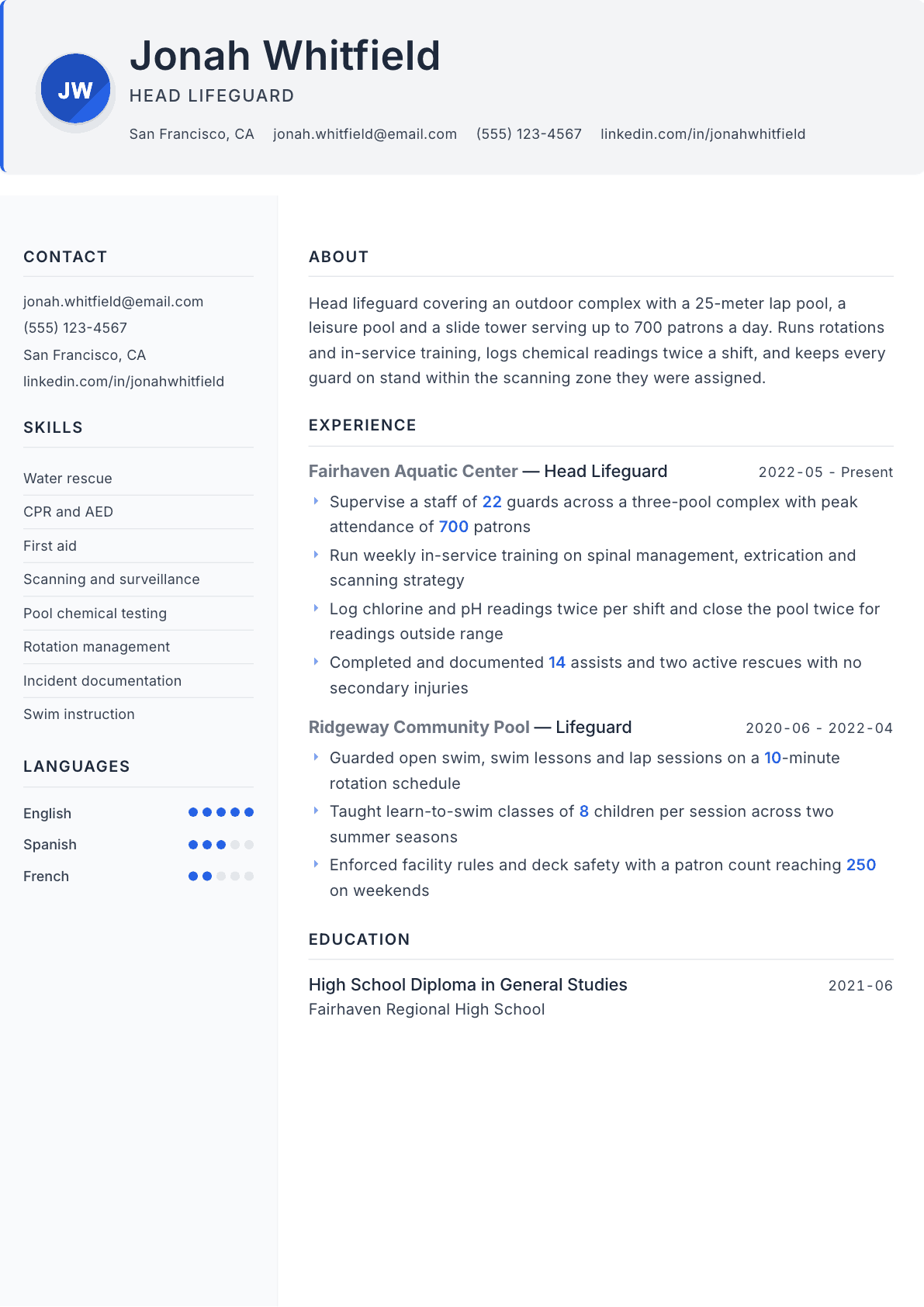
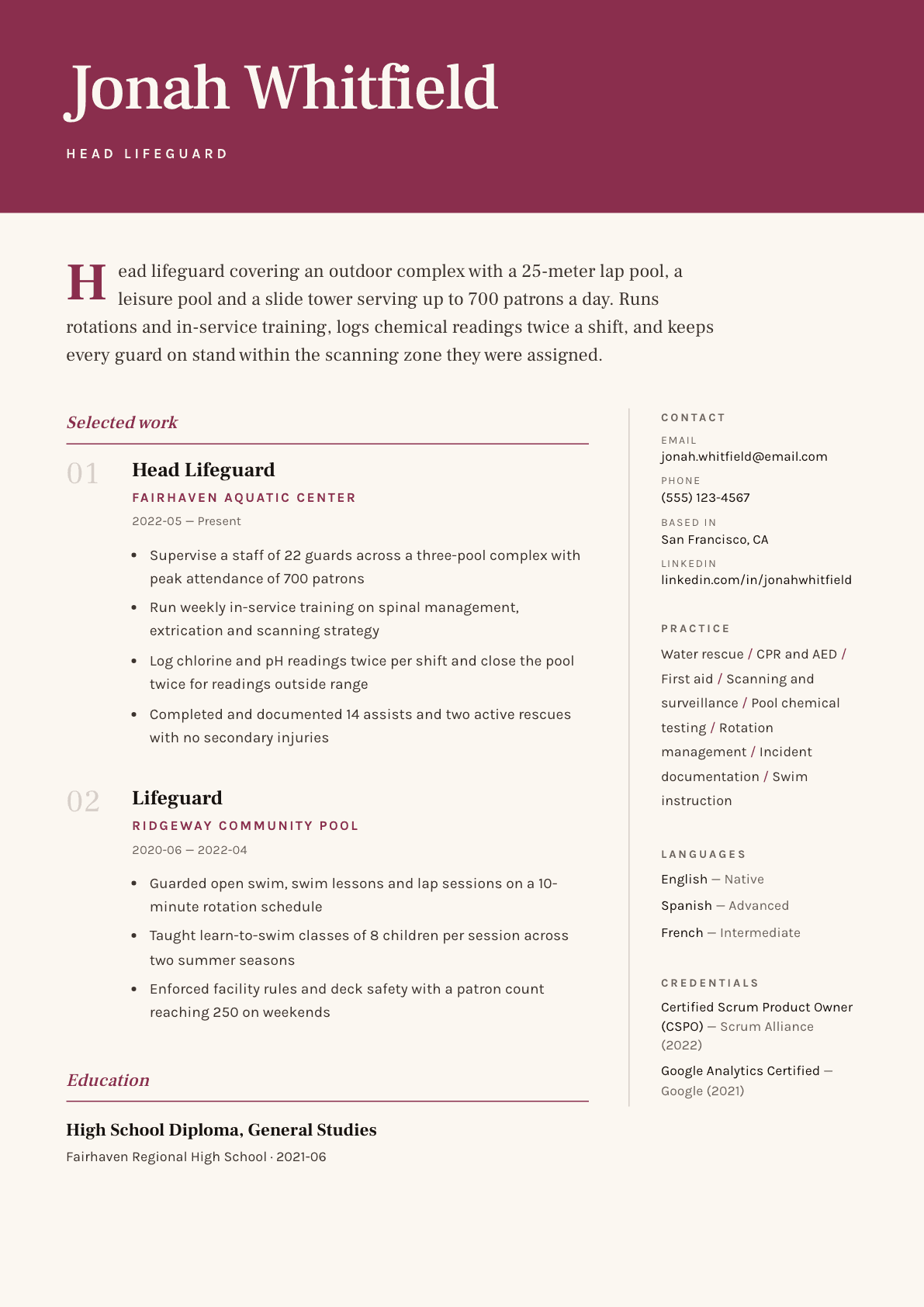
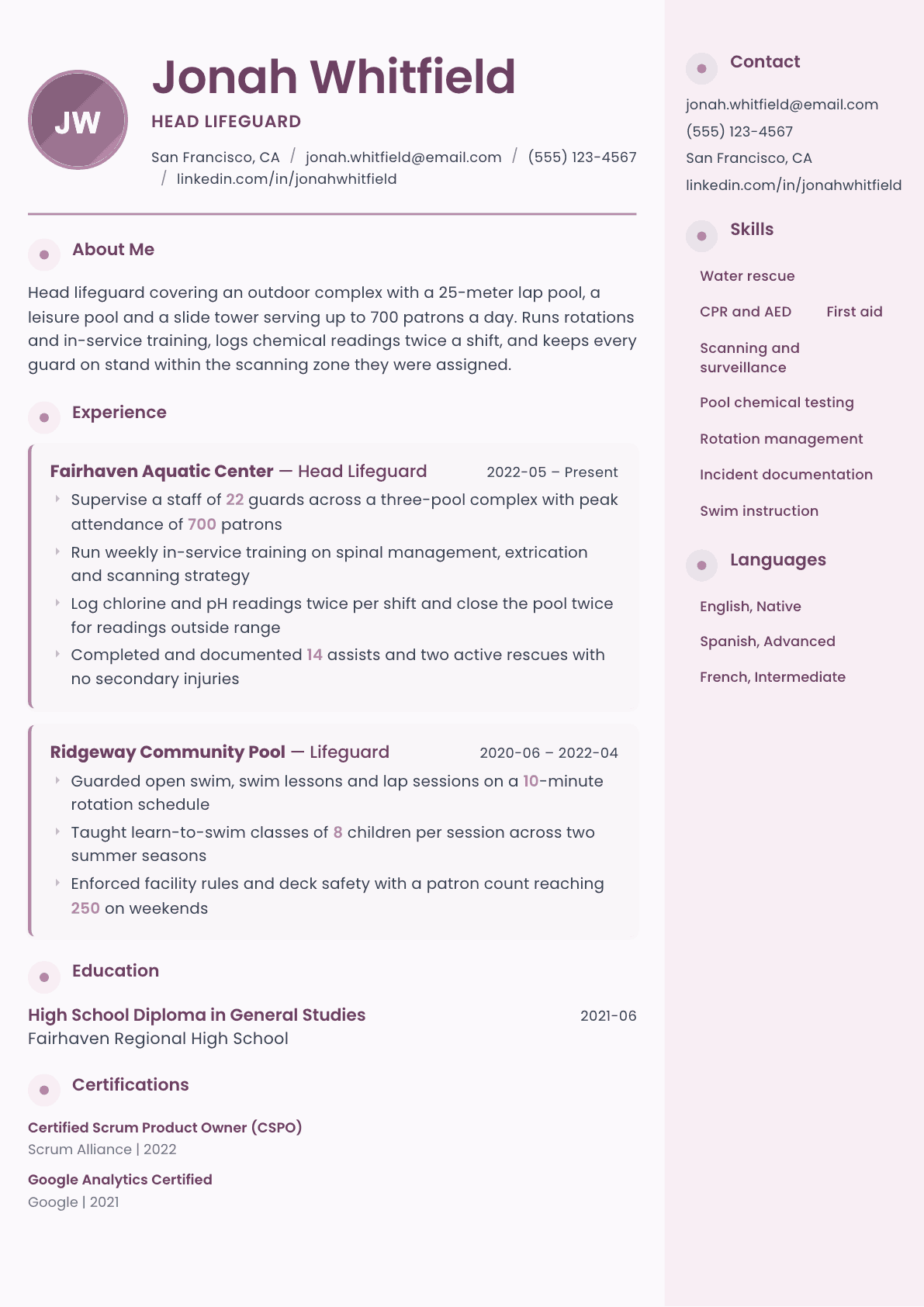
The same lifeguard content laid out in three CVBooster templates, so you can see what the finished document looks like before you write a word.
Example Lifeguard summary
Certified lifeguard with three seasons at a multi-pool aquatic center, currently leading a guard staff of 22 through rotations and weekly in-service training. Holds current lifeguarding, CPR for the professional rescuer and first aid credentials, tests water chemistry every shift, and documents every assist. Seeking a head lifeguard or aquatics coordinator position.
Skills to list on a Lifeguard resume
- Water rescue
- CPR and AED for the professional rescuer
- First aid
- Spinal injury management
- Scanning and zone coverage
- Rotation management
- Pool chemical testing
- Emergency action plans
- Incident reporting
- Swim instruction
- In-service training
- Deck and facility safety
- Patron rule enforcement
- Oxygen administration
What actually gets this resume read
- Put your lifeguarding, CPR and first aid certifications in a block near the top with the issuing body and expiry.
- Describe the water you guarded: pool size, depth, waterfront, wave pool or slide tower all screen differently.
- Give the patron load you covered at peak, since a quiet lap pool and a summer water park are different jobs.
- Report rescues and assists as counts with documentation, not as dramatic stories, because aquatics directors want records.
- Include the facility work that fills the day: chemical testing, deck maintenance, opening checks and closing procedures.
- List swim instruction, in-service training or head guard duties, as those move you from seasonal to year-round hiring.
How to write a lifeguard resume
A lifeguard resume is checked for one thing before anything else: current certification. The aquatics director or recreation coordinator opening your file looks for lifeguarding, CPR for the professional rescuer and first aid, the issuing organization and the expiry date. If those are missing or expired, the resume stops there regardless of how many summers you have worked.
After certification the reader is sizing the water. Guarding a lap pool at a fitness center, a municipal outdoor complex with a slide tower, a waterfront with no bottom visibility and a hotel pool with no dedicated guard stand are four different jobs with four different risk profiles. A resume that just says lifeguard forces the director to ask.
This guide covers how to put credentials where they get found, how to describe the facility and the patron load, three summaries from first season through head guard, before and after bullets that turn deck duties into evidence of vigilance, and the questions guards ask when they want year-round aquatics work.
Format: one page, certifications above the experience
One page, single column, plain. Put a certifications block directly under your contact details with each credential, the issuing organization and the expiry. This is the only section that can disqualify you on sight, so it goes where the eye lands first.
If you are still in school, education can sit near the top as well, but keep it short. An aquatics director cares far more that your credentials are current than where you are studying.
- Header: name, city and state, phone, email, and a guardian contact if you are a minor.
- Sections in this order: certifications, aquatic experience, additional experience, education, skills.
- Every certification line carries the issuing organization and the expiry date.
Describe the water, not just the job
Give each facility its own scope line: pool count and size, depth range, whether there is a slide tower, a wave feature, a diving well or open water, and the peak patron count you covered. A director reading that line knows immediately whether you have guarded conditions like hers.
Say what the rotation was and how many guards were on stand at peak. Rotation length and zone coverage are the operating language of aquatics, and using them correctly tells a director you were trained by someone who ran a real in-service program.
Rescues, assists and documentation
Report rescues and assists as counts with the documentation that followed, not as narratives. Aquatics directors are risk managers, and a guard who logs an assist, completes the incident report and follows the emergency action plan is the guard they want on the busiest stand.
If you have never made a save, that is not a weakness and you should not invent one. Write about the near misses you prevented instead: the swimmer you moved out of deep water, the rule enforcement that kept the slide runout clear, the scanning strategy you used on a crowded weekend.
The rest of the shift: chemistry, deck and opening checks
Guarding is roughly half the job at most facilities. Write about the water chemistry testing you performed and how often, the readings that made you close the pool, opening and closing checks, deck maintenance, equipment checks on the backboard and rescue tube, and the chair or locker room duties that came with the shift.
Naming the chemistry work is the fastest way to look like a guard who can be left with the facility rather than one who only sits the stand.
Getting from seasonal to year-round
Instruction and leadership are what turn a summer job into an aquatics career. List swim lessons taught, class sizes and age groups, any in-service training you delivered, and head guard duties like rotations, scheduling and incident review.
Use the words postings use: zone coverage, scanning, ten-twenty rule, emergency action plan, in-service, spinal management, chemical logs and patron surveillance. Attach each to real work rather than listing them in a block.
Lifeguard resume description: four job entries written out
A strong lifeguard resume description names the facility, the water and the patron load in the first line, then gives three or four bullets for surveillance, emergency response, facility duties and anything you taught or led. This is the part where most lifeguard resumes go generic. Below are four entries for different settings. The names and facilities are invented; copy the shape and put in your own numbers.
- Community pool, first season: Lifeguard, Maple Grove Municipal Pool, June to August. Outdoor 25 meter pool and a shallow children's pool, up to 300 swimmers on hot weekends. Rotated through four stands on a 20 minute rotation with zone scanning; enforced deep water and slide rules; tested chlorine and pH every two hours and logged the readings; opened the deck and checked rescue equipment before each shift.
- Fitness center pool, year-round part time: Lifeguard, Riverside Athletic Club, two years to present. Indoor lap pool and spa, lap swim, aquatic fitness classes and early morning masters training. Single guard on duty on weekday mornings, responsible for surveillance, first aid and the emergency action plan until backup arrives; completed monthly in-service drills on spinal management and AED use.
- Waterfront or beach: Waterfront Lifeguard, Pine Lake Summer Camp, two seasons. Roped swim area with no bottom visibility, buddy board checks every 15 minutes for groups of up to 60 campers; ran swim tests on the first day of each session; used rescue tubes and paddleboards; wrote incident reports for two assists, both documented and reviewed with the waterfront director.
- Head lifeguard: Head Lifeguard, Sunburst Water Park, one full season. Supervised 14 guards per shift across a wave pool, lazy river and four slides; built the daily rotation and break schedule; ran morning audits and weekly in-service training; reviewed every incident report before it went to the aquatics manager.
Lifeguard resume summary examples
First season
Certified lifeguard with current lifeguarding, CPR for the professional rescuer and first aid credentials, trained on spinal management and extrication. Competitive swimmer for four years with strong deep-water skills. Seeking a first guarding position at a community pool or seasonal outdoor complex.
Two seasons in
Lifeguard with two seasons at a community pool covering open swim, lap sessions and lessons on a 10-minute rotation with weekend attendance near 250. Taught learn-to-swim classes of eight children, tested water chemistry each shift, and documented every assist against the facility emergency action plan.
Head lifeguard
Head lifeguard at a three-pool complex with a slide tower and peak attendance of 700, supervising 22 guards through rotations and weekly in-service training. Logs chlorine and pH twice a shift, has closed the facility twice for readings outside range, and documented 14 assists with no secondary injuries.
Work experience bullets: before and after
Before: Watched swimmers and enforced pool rules.
After: Guarded a 25-meter lap pool, a leisure pool and a slide tower serving up to 700 patrons a day on a 10-minute rotation with six guards on stand at peak.
The facility, the patron load and the rotation show the conditions you actually held, which is what a director is sizing.
Before: Performed rescues when needed.
After: Completed and documented 14 assists and two active rescues against the facility emergency action plan, with no secondary injuries and every incident report filed the same shift.
Counts plus documentation speak to risk management, which is the language aquatics directors think in.
Before: Tested the pool water.
After: Logged chlorine and pH readings twice per shift and closed the pool twice for readings outside the permitted range until levels were corrected and verified.
Testing is a task; closing the pool on a reading is judgment, and that is what the bullet needs to show.
Before: Helped train other lifeguards.
After: Ran weekly in-service sessions for 22 guards on spinal management, extrication and scanning strategy, then observed each guard on stand and gave feedback the same day.
Head guard work is training plus observation, and naming both shows leadership rather than attendance.
Before: Taught swim lessons to kids.
After: Taught learn-to-swim classes of eight children across two summer seasons, moving beginners from wall-supported floats to independent front crawl within a session.
Class size and a concrete progression prove instruction actually happened and worked.
Hard skills
- Water rescue and extrication
- CPR and AED for the professional rescuer
- First aid and oxygen administration
- Spinal injury management
- Scanning and zone coverage
- Rotation management
- Pool chemical testing and logs
- Emergency action plan execution
- Incident reporting
- Swim instruction
- In-service training delivery
- Deck and facility safety checks
Soft skills
- Sustained vigilance
- Calm under an emergency
- Firm rule enforcement
- Communication with parents
- Teamwork on a rotation
- Reliability on early shifts
Certifications worth listing
- Lifeguarding with CPR/AED for the Professional Rescuer and First Aid (American Red Cross)
- Waterfront Lifeguarding (American Red Cross)
- Waterpark Lifeguarding (American Red Cross)
- StarGuard Lifeguard Certification (StarGuard ELITE)
- Certified Pool Operator (CPO) (Pool and Hot Tub Alliance)
- Water Safety Instructor (American Red Cross)
Mistakes that cost lifeguard candidates the interview
- Leaving the certification expiry off, which forces the director to ask and delays the file behind candidates who included it.
- Writing lifeguard with no facility description, so a waterfront director cannot tell whether you have guarded open water.
- Turning a single rescue into a paragraph instead of reporting assists and rescues as documented counts.
- Skipping the chemistry, opening checks and deck work, which is most of the shift at a small facility.
- Ignoring swim instruction and in-service work, which are the credentials that lead to year-round aquatics jobs.
- Sending an identical resume to a hotel pool and a water park when the risk profile and the duties differ sharply.
Lifeguard resume questions
What certifications does a lifeguard resume need?
At minimum a current lifeguarding certification that includes CPR for the professional rescuer and first aid, listed with the issuing organization and the expiry date. Waterfront or waterpark modules matter when the facility has open water or attractions, and a pool operator credential helps for head guard roles.
Can I write a lifeguard resume with no work history at all?
Yes. Lead with the certifications block, then add a training section describing the course hours and skills covered, competitive swimming or swim team background, and any volunteer or school responsibility that shows reliability. Aquatics directors hire first-season guards every year and expect exactly this shape.
What should a lifeguard job description on a resume say?
Open with the facility, the type of water and the peak patron load, then add bullets for surveillance and rotation, emergency response, water chemistry and opening checks, and any teaching or supervising. Report rescues as counts documented under the emergency action plan rather than as stories, because directors are checking that you follow protocol under stress.
How do I turn summer guarding into a year-round aquatics job?
Add instruction and leadership. Water safety instructor certification, in-service training you delivered, head guard duties like rotations and scheduling, and a pool operator credential all move you toward aquatics coordinator roles that run through the whole year.
Should a lifeguard resume include non-aquatic jobs?
Include them briefly if they show reliability, cash handling or working with children, especially early in your career. Keep them below the aquatic experience and give them one line each, since the director is reading for water skills and will not spend long on a retail entry.
Related resume examples
- Camp Director Resume example
- Concierge Resume example
- Valet Attendant Resume example
- Food Service Resume example
- Restaurant Supervisor Resume example
- Food and Beverage Manager Resume example