Security Manager Resume Examples: the lines they read
Write a Security Manager Resume That Owns a Site Program
By Mustafa Tarabya, founder of CVBooster · Published · Updated
Security manager resume example and guide covering guard force budgets, risk assessments, vendor contracts and incident trend reporting.
Sample resumes for a security manager
The same security manager content laid out in three CVBooster templates, so you can see what the finished document looks like before you write a word.
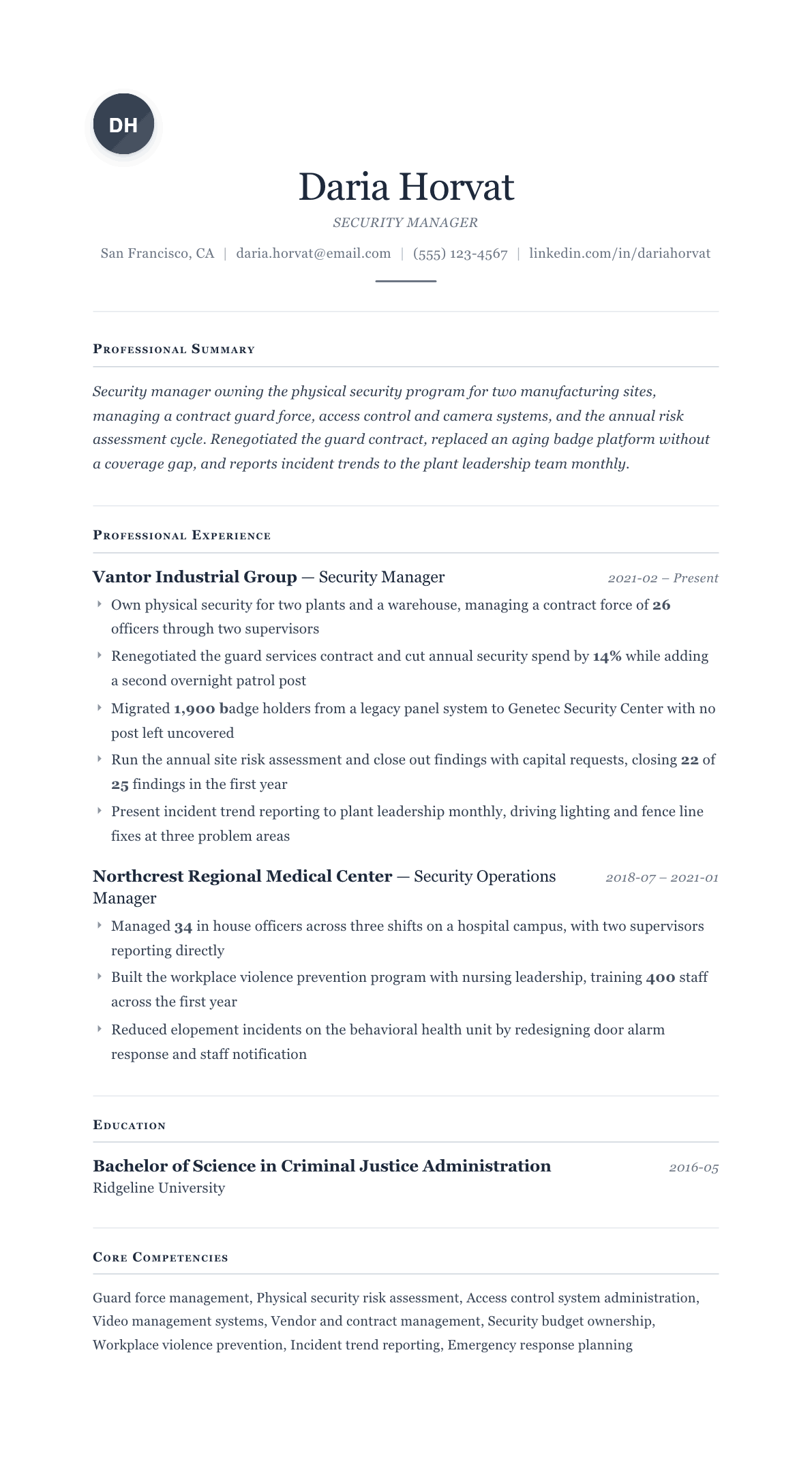
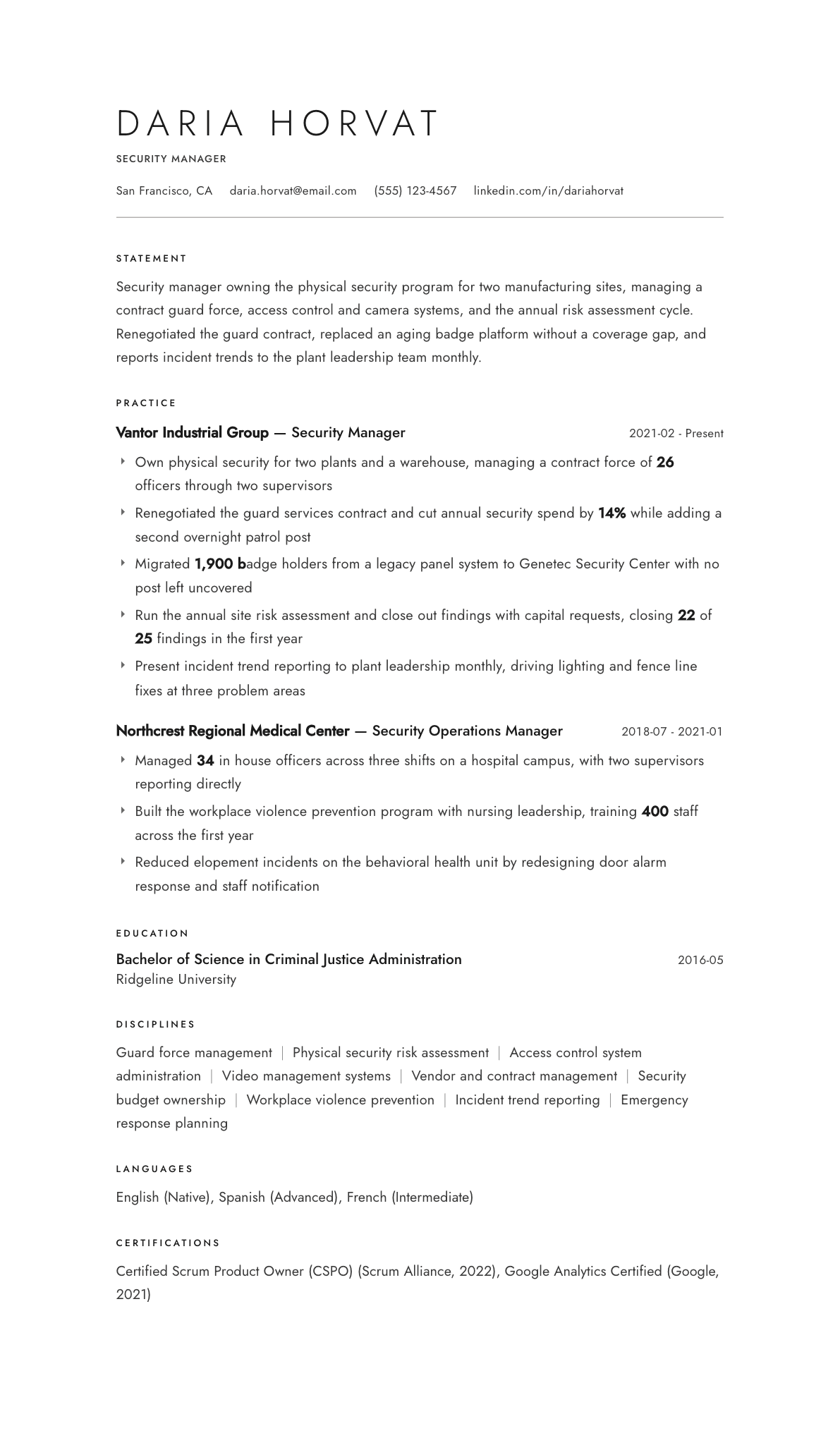
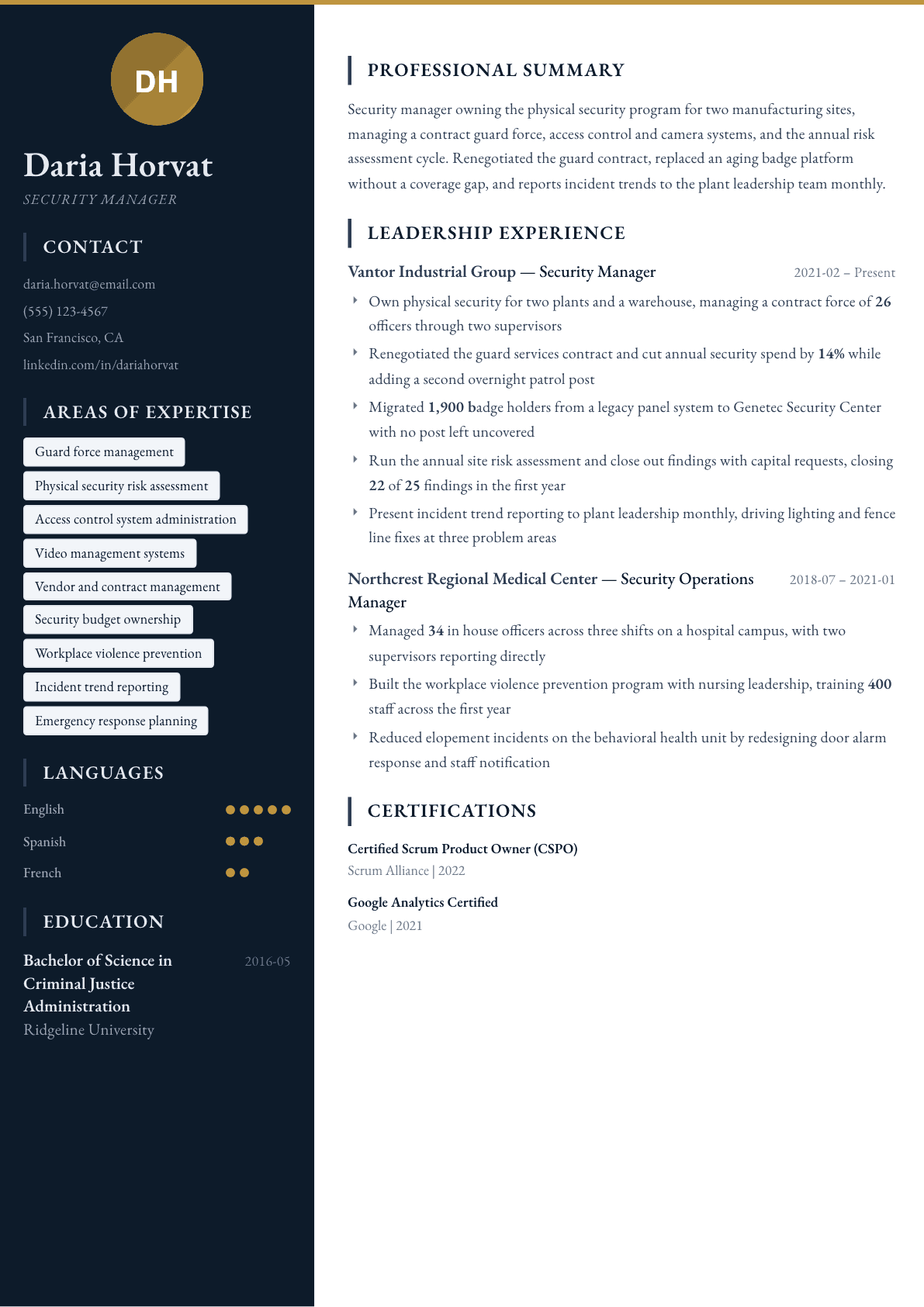
Example Security Manager summary
Security manager with eight years running site security programs in manufacturing and healthcare, currently covering two plants and a warehouse with a contract force of twenty six officers. Renegotiated the guard contract, migrated the badge platform without a coverage gap, runs the annual risk assessment cycle to closure, and briefs plant leadership on incident trends every month. Holds a recognized protection credential.
Skills to list on a Security Manager resume
- Physical security program ownership
- Contract guard force management
- Security vendor and contract negotiation
- Security budget planning
- Physical security risk assessment
- Access control administration
- Video management system administration
- Intrusion alarm system oversight
- Workplace violence prevention programs
- Emergency and crisis response planning
- Investigation oversight
- Incident trend analysis and reporting
- Post order and standard operating procedure authoring
- Regulatory and audit response
- Supervisor development and coaching
- Security technology migration projects
What actually gets this resume read
- State the size of the force you manage and whether it is contract, in house or a mix, since the job differs sharply.
- Name the access control and video platforms you administer, because a migration is the first project handed to you.
- Give the budget you own in relative terms and what you changed about it, without quoting a raw dollar figure.
- Show your risk assessment cycle and how many findings you actually closed, because open findings are what auditors read.
- Include workplace violence prevention if you have built or run a program, since it is the top ask at most sites.
- Describe the reporting you deliver upward, because a manager who cannot brief plant leadership does not last long.
- List your certification and its issuing body, because many postings screen on it before a human reads the page.
How to write a security manager resume
A security manager owns a program, not a shift. The plant manager or facilities director doing the hiring wants somebody who can run a guard force through supervisors, keep the access control and camera systems working and current, close the findings from the last risk assessment, hold a vendor to a contract, and explain security to a leadership team that would rather talk about output.
The applications that fail read like inflated supervisor resumes. They list post coverage, scheduling and incident response, all of which a supervisor already does, and never touch budget, vendor management, risk assessment or the reporting a manager owes upward. A hiring director scanning for program ownership finds none of it.
This guide covers the manager resume: how to state the scope of the program you own, how to write technology and vendor work without turning into a systems administrator, how to present risk assessment findings honestly, and what a leadership team wants to read about incident trends.
Format: program scope block, then projects, then the force
Two pages is acceptable at this level and one is still better if you can manage it. Under each job put a program scope block: sites covered, buildings and square footage, headcount protected, officers managed and through how many supervisors, whether the force is contract or in house, and the systems you administer. That block is the level indicator.
Then order the bullets by project rather than by duty. A manager is judged on what changed while she held the program: a contract renegotiated, a platform migrated, an assessment closed out, a violence prevention program built. Duty statements about oversight of daily operations belong at the bottom, compressed.
- Scope block: sites, buildings, protected headcount, officer count, supervisor count, contract or in house.
- Systems block: access control platform, video management system, intrusion and mass notification tools you administer or own.
- Budget line: what you own, described by category and by what you changed, without quoting raw figures.
- Assessment line: the risk assessment cycle you run and the closure rate on findings.
- Governance line: the procedures, post orders and standards you authored or revised.
Summary: sites, force, systems, and what you changed
Four elements in three lines: the estate you cover, the force you manage, the systems you own, and one change that mattered. The change is the part most managers leave out, and it is the only part that distinguishes program ownership from program maintenance.
Name your industry context if it carries requirements. Manufacturing, healthcare, data center, higher education, utility and pharmaceutical sites each bring regulatory and audit obligations that shape the job, and a hiring director in that sector reads the match as reduced onboarding risk.
Experience: force, technology, vendors, assessments
Guard force management at manager level is about structure and cost, not rosters. Write the force size, how you manage it through supervisors, the service level you hold the contractor to, and what you did about turnover, training or coverage cost. If you moved work between contract and in house officers, that is a decision with a rationale worth a bullet.
Technology bullets should stay at the ownership level. Say what you migrated, standardized, expanded or retired, how many doors or cameras were involved, whether coverage was maintained during the change, and what it cost the operation in downtime. Leave panel configuration detail to the technician resume unless you personally did the work.
Vendor and contract work is where managers prove commercial credibility. Scope writing, competitive bidding, service level definition, invoice validation and holding a vendor to a remediation schedule are all real. Say what you renegotiated and what changed as a result, using relative movement rather than raw money.
Risk assessment is the backbone of the program. Describe the cycle, what it covers, who participates and, most importantly, the closure rate on findings. Open findings are what auditors read, and a manager who can show twenty two of twenty five closed in a year is showing follow through that most cannot.
The parts of the manager job that get left off
Workplace violence prevention has become a standard expectation at manager level and is missing from most resumes. If you have built a threat assessment process, trained staff, run a behavioral concern reporting route or worked with human resources on termination security, put it on the page with numbers.
Investigations are the other gap. Managers oversee internal cases involving theft, policy violations, harassment and misuse of assets. Say how many cases a year, what your role was, how you handled evidence and interviews, and how outcomes were documented, all without a single identifying detail.
Upward reporting is the third. A manager who never presents to plant or site leadership is invisible when budget season arrives. Name the forum, the cadence and the kind of decision your reporting has driven, such as lighting, fencing, camera coverage or a staffing change.
- Workplace violence prevention program design, training reach and reporting route.
- Investigation case volume, your role in each stage, and evidence handling standards applied.
- Emergency and crisis planning: plans authored, drills run, and how the plans were tested.
- Regulatory or customer audits you responded to, and the outcome.
- Supervisor development: how many you manage, what you coach, and who advanced.
Skills and keywords a manager posting screens on
Manager postings recycle a specific set of phrases: physical security program, guard force management, risk assessment, access control administration, video management, workplace violence prevention, vendor management, security budget, incident trend reporting, emergency response planning. Use them exactly once in the skills block and once in a bullet that shows the work.
Resist listing every technology brand you have touched. Two or three platforms you genuinely administer carry more weight than a wall of product names, and an interviewer will test any name on the page with a question about how you handled a migration or a failure on it.
Security Manager resume summary examples
Supervisor stepping up
Security supervisor moving into program ownership, currently managing 18 officers across two shifts and administering the access control system for a single manufacturing site. Ran the last site risk assessment with the corporate team and closed 14 of 17 findings within the year.
Site security manager
Security manager owning physical security for two plants and a warehouse, managing a contract force of 26 officers through two supervisors. Renegotiated the guard contract while adding an overnight patrol post, migrated 1,900 badge holders to a new platform with no post uncovered, and reports incident trends monthly.
Senior manager, multiple sites
Senior security manager covering five sites in two states with 60 officers and three supervisors, owning guard services, access control, video and the annual assessment cycle. Built the workplace violence prevention program, trained more than 900 staff, and closes assessment findings at above 90% within the cycle.
Work experience bullets: before and after
Before: Managed the security guard force at the site.
After: Owned physical security for two plants and a warehouse, managing a contract force of 26 officers through two supervisors against a defined service level for coverage, training hours and report turnaround.
Estate, force size, management layer and the service level define program ownership instead of shift oversight.
Before: Saved money on the security contract.
After: Renegotiated the guard services contract and cut annual security spend by 14% while adding a second overnight patrol post, by restructuring post hours around the actual incident pattern.
A relative saving achieved alongside added coverage, with the method stated, shows commercial judgment rather than a cut.
Before: Upgraded the access control system.
After: Migrated 1,900 badge holders from a legacy panel system to a current access control platform across eleven months, with no post left uncovered and no door offline during production hours.
Badge volume, timeline and the operational constraints held during the change turn an upgrade into a managed project.
Before: Completed annual security risk assessments.
After: Ran the annual site risk assessment with plant engineering and environmental health, then closed 22 of 25 findings within the year by attaching each to an owner, a date and a capital or expense request.
Closure rate plus the mechanism for closing shows the assessment as a program, not an annual document.
Before: Reported security incidents to management.
After: Presented incident trend reporting to plant leadership monthly, which drove lighting replacement at two parking areas and fence line repair at a third after theft reports clustered in those locations.
Naming the audience, the cadence and the decisions your reporting caused proves influence above the security function.
Hard skills
- Physical security program ownership
- Contract and in house guard force management
- Security vendor selection and contract negotiation
- Security budget planning and expense control
- Physical security risk assessment and finding closure
- Access control system administration
- Video management system administration
- Intrusion detection and mass notification oversight
- Workplace violence prevention program design
- Emergency response and crisis planning
- Internal investigation oversight
- Incident trend analysis and reporting
- Standard operating procedure and post order authoring
- Regulatory and customer audit response
Soft skills
- Explaining a security spend to an operations leader who wants the money elsewhere
- Holding a vendor to a remediation date without losing the relationship
- Developing supervisors instead of solving their problems for them
- Keeping an investigation confidential inside a small site
- Saying no to a client request that would create liability
Certifications worth listing
- Certified Protection Professional (CPP) (ASIS International)
- Physical Security Professional (PSP) (ASIS International)
- Professional Certified Investigator (PCI) (ASIS International)
- Certified in Security Supervision and Management (CSSM) (International Foundation for Protection Officers)
Mistakes that cost security manager candidates the interview
- Writing a supervisor resume with a manager title, full of scheduling and post coverage and empty of program ownership.
- Leaving out the scope block, so a reader cannot tell whether you run one building or an estate.
- Ignoring vendor and contract work when commercial credibility is half of what the role requires.
- Reporting assessments completed without the finding closure rate, which is the number auditors actually check.
- Turning technology bullets into product configuration detail that belongs on a technician resume.
- Omitting workplace violence prevention when it is now expected at manager level in most sectors.
- Never naming who you brief upward, which leaves the reader assuming your program has no visibility above security.
Security Manager resume questions
How do I move from supervisor to security manager?
Take on the pieces a manager owns while you are still a supervisor: the vendor relationship, the assessment findings, the access control administration, the reporting pack. Then write the resume around those rather than around the shift, and lead with what changed under your ownership.
Should I put budget figures on my resume?
Describe scope and movement rather than raw amounts. Say you own the guard services, technology maintenance and capital request lines, and give changes as relative movement. Exact figures often breach an employer confidence and rarely change a hiring decision anyway.
How technical should a security manager resume be?
Technical enough to prove you can own a system and lead a migration, not so technical that you look like the integrator. Name the platforms you administer, describe one project you led on them, and leave device level configuration off unless you personally performed it.
What if my site has never had a formal risk assessment?
Say what you did instead: a walk of the perimeter with findings, a camera coverage gap analysis, an after action review that changed a procedure. Managers who create structure where none existed are attractive candidates, but only if the page shows the structure they built.
How do I write about investigations without breaching confidentiality?
Give case volume by category, your role at each stage, the evidence standards you applied and how outcomes were documented. Never name people, dates, locations or amounts. A reader judges investigative competence from process discipline, not from the story of a case.
Related resume examples
- Security Engineer Resume example
- Loss Prevention Manager Resume example
- Security Supervisor Resume example
- Security Director Resume example
- Security Consultant Resume example
- Environmental Health and Safety Manager Resume example