Loss Prevention Detective Resume Examples: free score
Write a Loss Prevention Detective Resume That Earns the Floor
By Mustafa Tarabya, founder of CVBooster · Published · Updated
Loss prevention detective resume example, keyword list and writing guide covering apprehensions, camera case building and organized retail crime files.
Sample resumes for a loss prevention detective
The same loss prevention detective content laid out in three CVBooster templates, so you can see what the finished document looks like before you write a word.
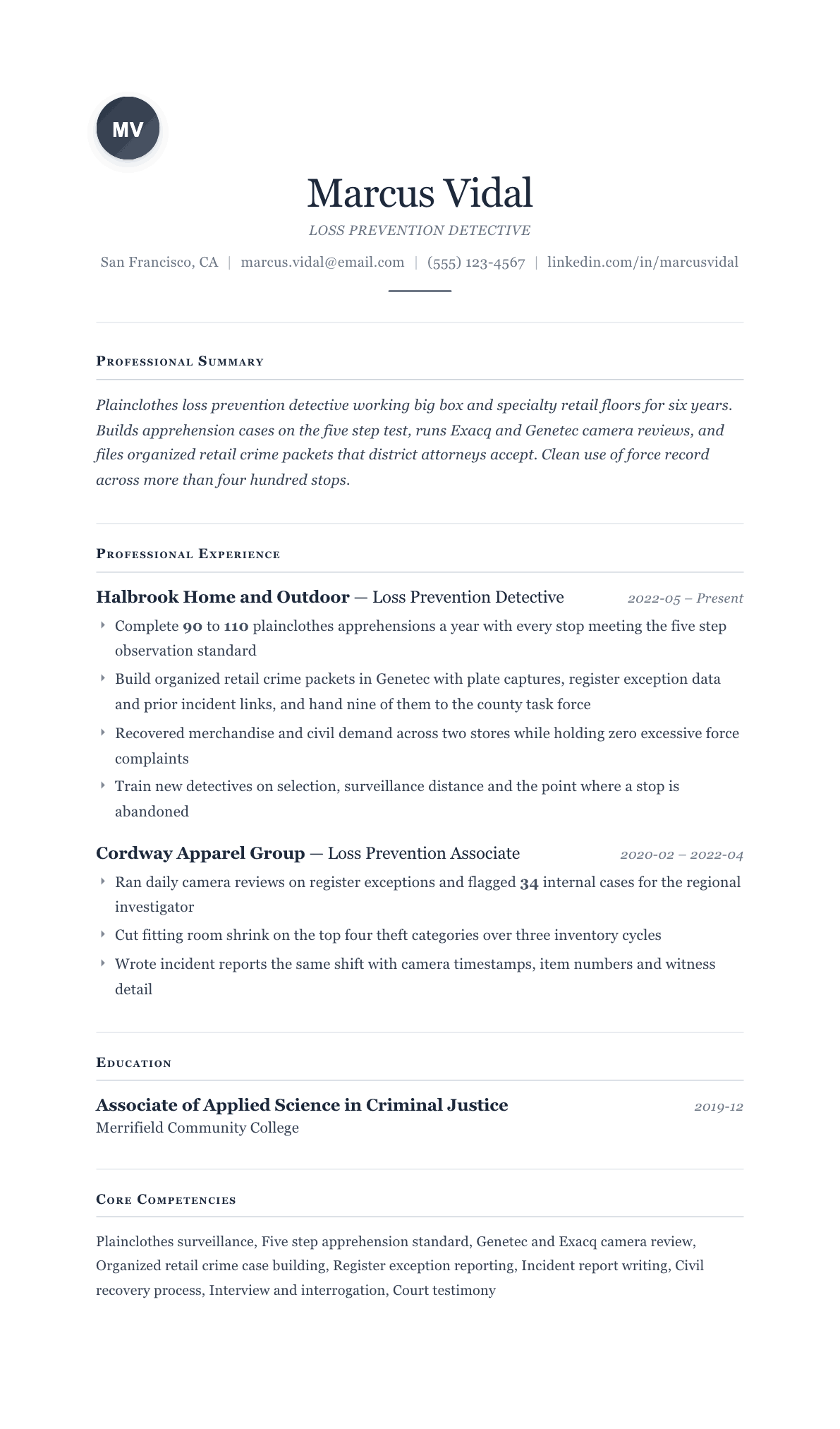
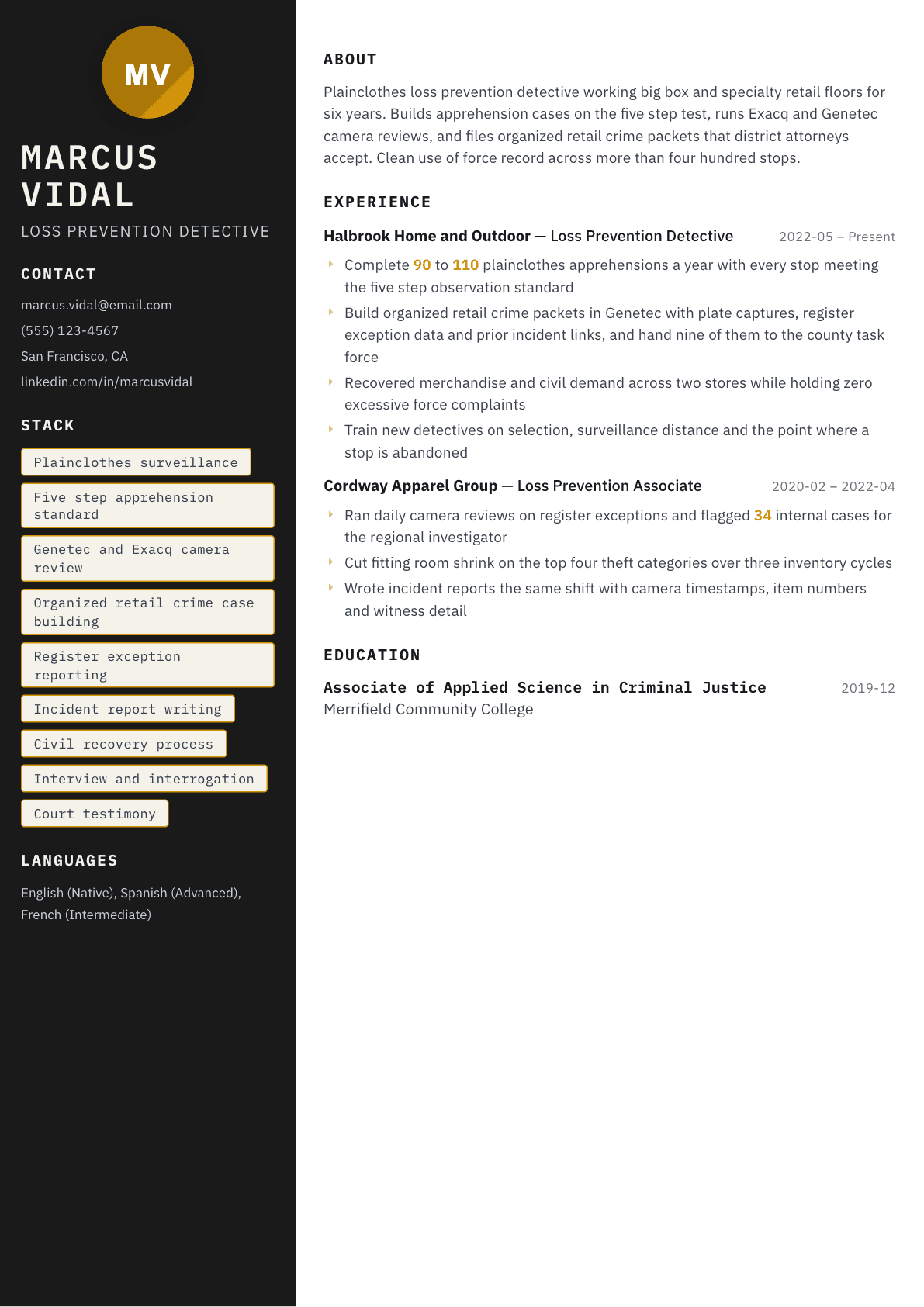
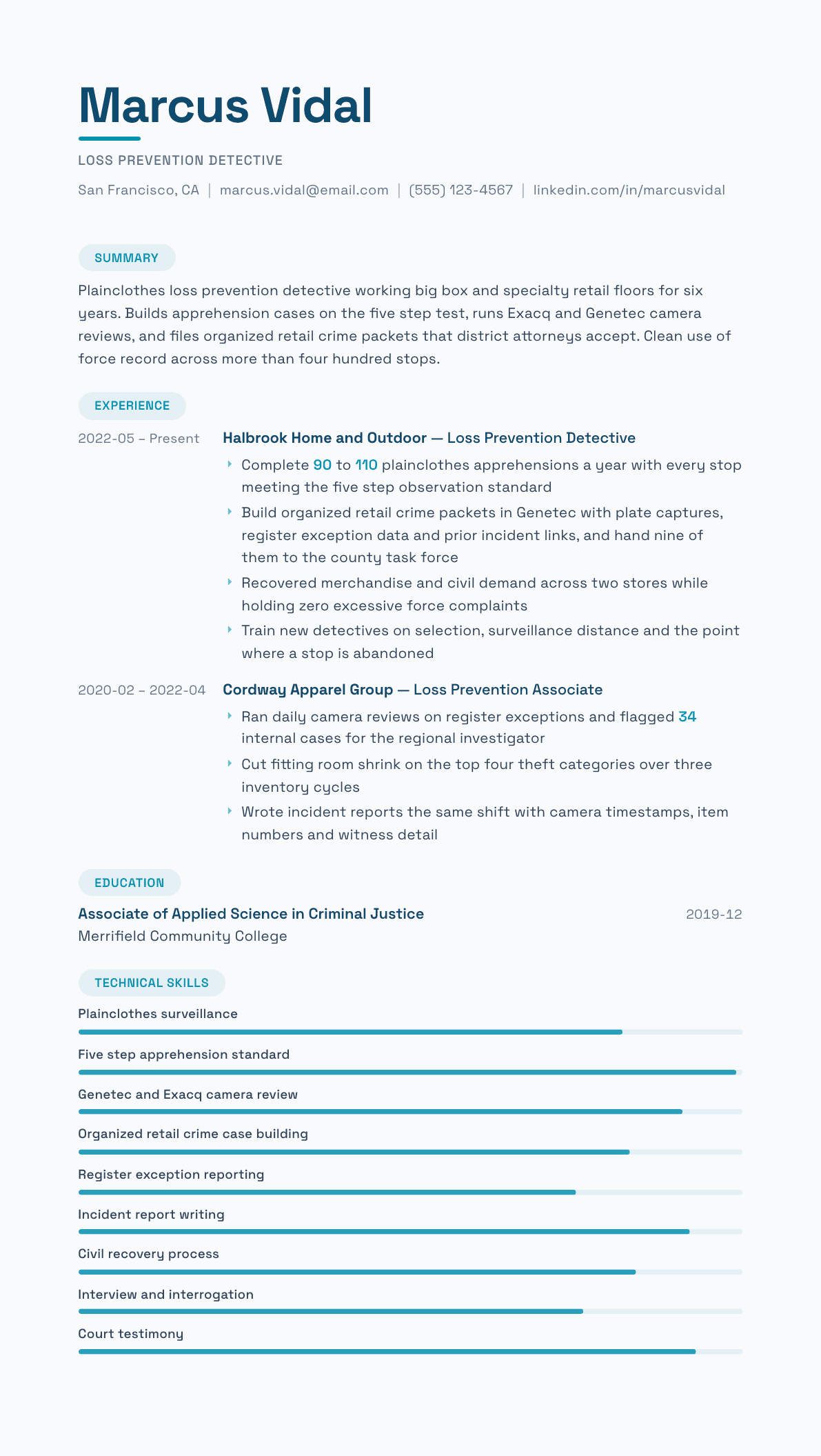
Example Loss Prevention Detective summary
Loss prevention detective with six years of plainclothes work across big box and apparel floors. Runs a five step observation standard on every stop, builds camera and exception based cases in Genetec, and files organized retail crime packets that the county task force takes forward. Holds a clean use of force record across several hundred apprehensions and testifies in county court without a coach.
Skills to list on a Loss Prevention Detective resume
- Plainclothes surveillance
- Apprehension and detention procedure
- Five step observation standard
- Video review and export
- Genetec Security Center
- Exacq and Milestone platforms
- Point of sale exception reporting
- Organized retail crime investigation
- Internal dishonesty cases
- Interview and admission statements
- Civil recovery filing
- Incident and case report writing
- Court testimony
- Electronic article surveillance systems
- Shrink and inventory analysis
What actually gets this resume read
- State the apprehension standard you work to, because a store that stops without one carries the liability.
- Give your apprehension count per year with the recovery outcome so a district manager can size your floor.
- Name the camera platform, the exception reporting tool and the case management system you already know.
- Say plainly that you hold a clean use of force and false detention record, and give the case volume behind it.
- Show one organized retail crime packet you built and where it went, whether task force, police or prosecutor.
- List any interview certification and how many admission interviews you have run under it.
- Add court testimony if you have given it, with the court level and roughly how many appearances.
How to write a loss prevention detective resume
A district asset protection manager reading your resume is weighing two risks at once. The first is theft he cannot stop. The second is you: a detective who makes a bad stop costs the chain a false imprisonment claim, a viral clip and a store manager who never trusts loss prevention again. Everything on the page is read through that second risk.
So the resume that gets called is the one that shows discipline before it shows numbers. A detective who names the observation standard he works to, states what makes him abandon a stop, and only then gives his apprehension count reads as someone who has been trained rather than someone who likes the chase.
This guide covers the format an asset protection team reads, how to write the apprehension and recovery numbers without sounding like a bounty sheet, three summaries at different career stages, before and after bullets, and the questions detectives ask when they move from one retailer to another.
Format: one page, standard first, apprehension record second
Reverse chronological, one page for anything under a decade on the floor. The order matters more here than in most roles, because a hiring manager wants to see procedural discipline before volume. Put a short standards line under your summary naming the observation standard you work to and the point at which you break off, then let the jobs carry the counts.
Keep your license and training in one block. Many states license loss prevention or private security separately from guard work, and a manager checking whether you can legally detain in his state should not have to hunt for the answer inside a job bullet.
- Standards line under the summary: observation standard used, detention policy followed, and the conditions under which you abandon a stop.
- Each store names the format first: big box, specialty apparel, grocery, electronics or pharmacy, with square footage or door count.
- License block: state security or loss prevention license, interview certification, first aid, and any court appearance training.
- Newer detectives put associate level camera and exception work above any unrelated retail sales history.
Writing apprehensions without sounding like a scoreboard
Give apprehensions per year rather than a career total, because the annual figure tells a manager what a normal week looks like for you. Pair it with the recovery value in plain words, the number of stops that ended in a civil demand, and the number of complaints filed against you, which for a good detective is zero and should be stated rather than implied.
The strongest resumes add a line about restraint. A detective who writes that he broke off eleven developing stops last year because selection was never confirmed is telling a manager something the apprehension count cannot: that he knows the difference between a case and a hunch. That sentence does more for a hiring decision than another twenty apprehensions would.
Camera work, exception reporting and building a real case
Plainclothes work is only half the job. The other half is sitting with video and register data until a pattern has a name. Say which video management platform you use, whether you export clips yourself, and how you tie a transaction to a face. Name the exception reporting tool, because a detective who can pull a void and refund report and read it is doing work a camera alone never delivers.
Organized retail crime is where a detective earns a promotion. If you have built a packet, describe what went into it: linked incidents across stores, vehicle information, register data, prior contacts, and who received the file. Say whether it moved, to a task force, a prosecutor or a regional investigator, because a packet nobody acted on still shows the skill but a packet that closed shows the judgment too.
Internal cases deserve their own line. Interviewing an employee is a different discipline from following a booster around a store, and a manager filling an internal heavy role will screen for it directly. Give the number of admission interviews you have run and the training model behind them.
Reports, testimony and what happens after the back room
A stop that is not documented properly is a liability sitting in a file cabinet. Write that your reports go in the same shift with camera timestamps, item numbers, the observation sequence and witness detail. Managers who have watched a case collapse in court because a narrative was written three days later read that line closely.
Court testimony belongs on the page if you have given it. Name the court level and roughly how many appearances. Add anything you have done with the police relationship: how you present a case at the counter, whether the department will accept your reports as filed, and whether you have trained store managers on what to preserve when an incident happens on their shift.
Skills and the words asset protection postings recycle
Retail postings use a narrow vocabulary and screen against it: apprehension, shrink, organized retail crime, electronic article surveillance, exception reporting, civil recovery, chain of custody, safety audit. Use the exact words from the posting once in your skills block and once inside a bullet where the work is visible, and let the second mention carry a number.
Do not neglect safety and operational duties. Many detective roles carry store safety audits, alarm response, key holding and opening or closing coverage. A candidate who shows that half of the job is boring and that he does the boring half properly is a safer hire than one whose resume is nothing but chases.
Loss Prevention Detective resume summary examples
First detective role
Loss prevention associate with two years on camera review and exception reporting in a big box store, moving into plainclothes work. Flagged 34 internal cases for the regional investigator in 2024 and completed a five step observation standard course. Holds a state security license and a clean record.
Six years on the floor
Plainclothes loss prevention detective with six years across big box and apparel. Completes roughly 100 apprehensions a year on a five step observation standard, breaks off any stop where selection is unconfirmed, and holds zero use of force or false detention complaints across more than 400 stops.
Lead detective and trainer
Lead loss prevention detective covering three stores and training four detectives on selection, surveillance distance and abandonment criteria. Built nine organized retail crime packets accepted by the county task force, runs internal admission interviews under a certified model, and testifies in district court.
Work experience bullets: before and after
Before: Apprehended shoplifters and recovered merchandise.
After: Completed 104 plainclothes apprehensions in 2024 under a five step observation standard, with every stop witnessed on camera and zero false detention complaints filed.
The standard, the volume and the complaint record together answer the liability question a manager is actually asking.
Before: Used cameras to investigate theft.
After: Tied 26 refund fraud transactions to four repeat subjects by matching Genetec camera exports against point of sale exception reports, then packaged the set as a single case.
It shows the two data sources being joined, which is the skill, instead of naming a camera as a tool.
Before: Worked with police on retail crime.
After: Built nine organized retail crime packets with linked incidents, plate captures and register data, and handed them to the county task force; four resulted in charges across multiple stores.
Naming what went into the packet and where it landed turns cooperation into a measurable outcome.
Before: Conducted employee interviews when theft was suspected.
After: Ran 18 internal admission interviews under a non confrontational model, documented each statement the same shift, and closed twelve with signed admissions and restitution agreements.
The model, the count and the documented outcome show trained interviewing rather than a manager confrontation.
Before: Trained new loss prevention staff.
After: Trained four incoming detectives on subject selection, surveillance distance and the specific conditions that require abandoning a stop before the doors.
Training on abandonment criteria signals judgment, which is the trait a district manager promotes on.
Hard skills
- Plainclothes surveillance and subject selection
- Apprehension and detention procedure
- Video management system operation
- Video export and evidence preservation
- Point of sale exception reporting
- Organized retail crime case building
- Internal dishonesty investigation
- Non confrontational interview technique
- Civil recovery filing
- Incident report writing
- Electronic article surveillance systems
- Shrink and inventory shortage analysis
- Court testimony
Soft skills
- Restraint under pressure at the doors
- Blending into a sales floor without drawing attention
- Working store managers who resent the interruption
- Keeping a neutral tone in the back room
- Writing a narrative a stranger can follow a year later
Certifications worth listing
- LPQualified (LPQ) (Loss Prevention Foundation)
- LPCertified (LPC) (Loss Prevention Foundation)
- Wicklander-Zulawski Interview and Interrogation Certification (Wicklander-Zulawski and Associates)
Mistakes that cost loss prevention detective candidates the interview
- Leading with a career apprehension total, which reads as a chase count rather than a working year.
- Never naming the observation standard, leaving a manager to assume you stop on instinct.
- Omitting the complaint record entirely when zero complaints across hundreds of stops is the strongest line available.
- Treating camera and exception reporting as background noise when case building is what separates a detective from a guard.
- Describing organized retail crime work without saying who received the packet or whether anything came of it.
- Hiding the state security license and interview certification inside a job bullet where nobody checks them.
Loss Prevention Detective resume questions
How many apprehensions should a loss prevention detective resume show?
Give the annual figure for your current store rather than a career total, and let it sit next to the observation standard and the complaint record. A moderate number with clean procedure beats a high number with nothing around it, because the second one reads as risk.
Do I need a license to work as a loss prevention detective?
It depends on the state, and some require a private security or investigator license before you may detain anyone. Put whatever you hold on the resume with the issuing state, and if you are applying across state lines say plainly which credentials transfer and which you would need to obtain.
Should internal theft cases go on the same resume as external work?
Yes, but keep them separate on the page. Interviewing an employee and following a booster are different disciplines, and a role weighted toward internal cases will screen for interview training, statement handling and human resources coordination rather than surveillance distance.
What if I have never testified in court?
Leave the line out rather than inventing courtroom experience, and lean on report quality instead. Say that your narratives are written the same shift with timestamps and item detail, since that is exactly what makes testimony straightforward when it eventually comes.
How do I move from associate to detective?
Show the case building half of the job before you have the apprehension half. Camera review volume, exception reports you have pulled and read, internal cases you flagged to a regional investigator, and any interview training you have completed will all carry a first plainclothes application.
Related resume examples
- Loss Prevention Specialist Resume example
- Private Investigator Resume example
- Loss Prevention Officer Resume example
- Security Officer Resume example
- Loss Prevention Manager Resume example
- Surveillance Operator Resume example