Bodyguard Resume Examples: free ATS score and gap list
Create a Professional Bodyguard Resume
By Mustafa Tarabya, founder of CVBooster · Published · Updated
Build a compelling bodyguard resume that highlights your executive protection experience, threat assessment skills, and security clearances.
Sample resumes for a bodyguard
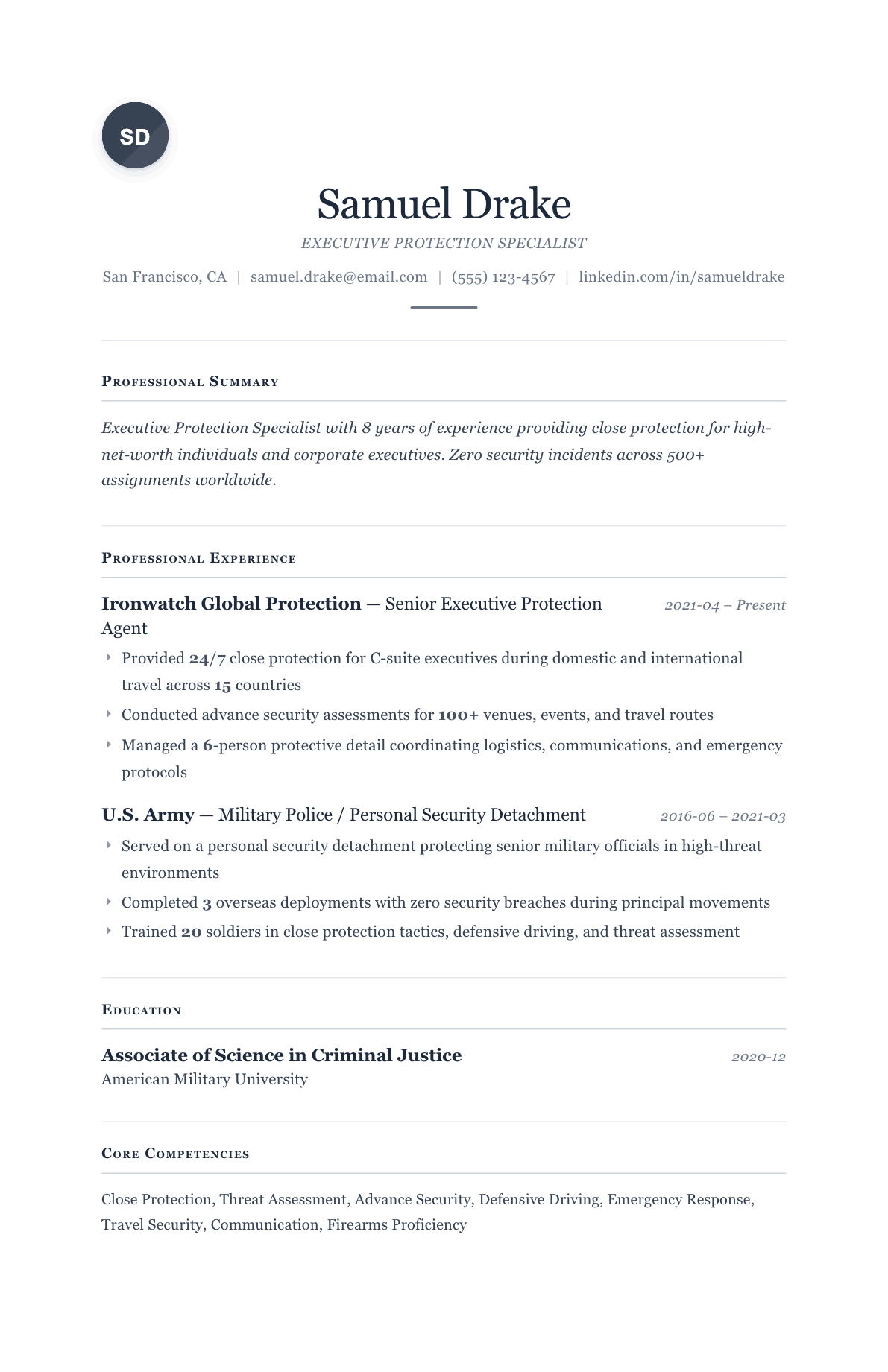
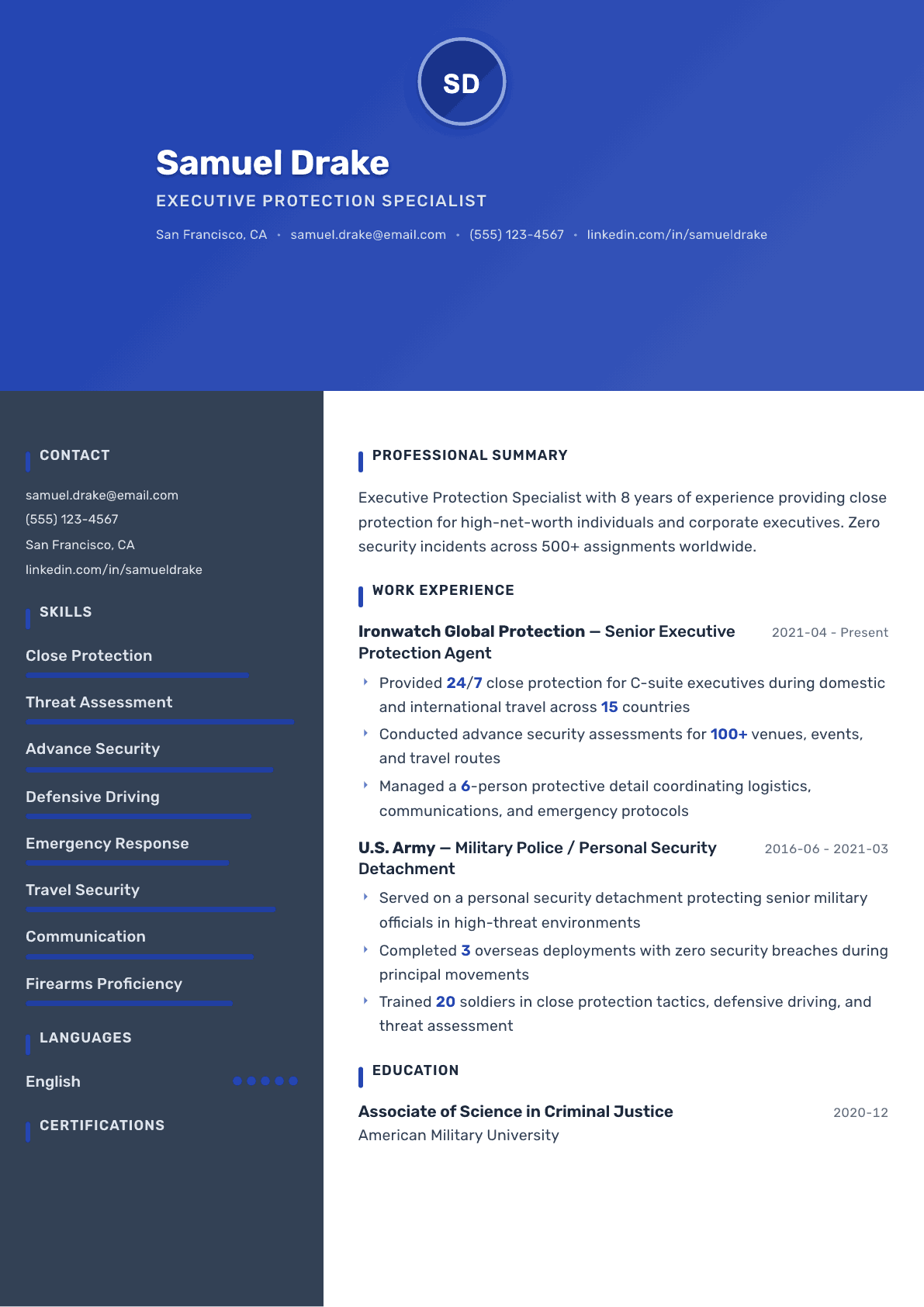
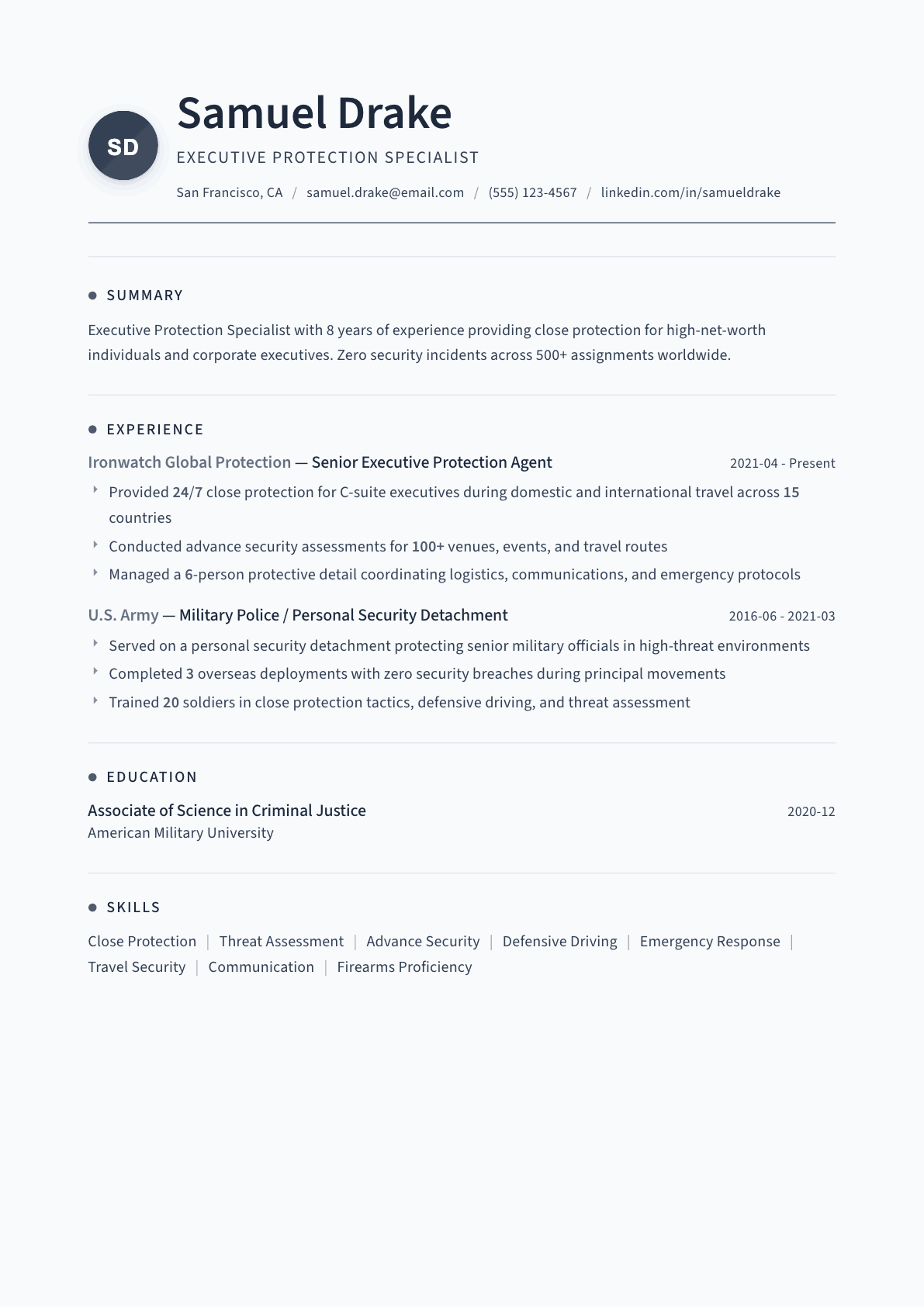
The same bodyguard content laid out in three CVBooster templates, so you can see what the finished document looks like before you write a word.
Example Bodyguard summary
Executive Protection Specialist with 8 years of military and private-sector experience. Zero incidents across 500+ global assignments protecting HNWIs and corporate executives.
Skills to list on a Bodyguard resume
- Executive Protection
- Threat Assessment
- Advance Operations
- Defensive Driving
- Emergency Medical Response
- Route Planning
- Surveillance Detection
- Firearms Handling
- Detail Management
- Conflict De-escalation
What actually gets this resume read
- Emphasize your zero-incident record and the number of assignments completed successfully.
- Highlight military or law enforcement background as it is highly valued in executive protection.
- Include international travel experience and any language skills beyond English.
- List relevant certifications like EP, defensive driving, and firearms qualifications.
How to write a bodyguard resume
Close protection hiring runs on discretion, and that shapes the resume in ways no other field requires. The detail leader reading your file wants proof that you can plan and run a movement, work inside a team, and stay invisible while doing it. At the same time you cannot name most of your principals, so the whole document has to convey capability without identifying anybody.
The screen itself is mechanical. State security licensing, an armed endorsement where the work requires one, a driving record and any protective driving training, medical certification, and a clean background. Those items decide whether the file moves at all, so they belong in their own block near the top rather than buried in a paragraph.
This guide covers how to describe protective work without breaching confidentiality, three summaries from a first close protection role through a detail leader, before-and-after bullets, and the questions bodyguards ask when a resume has to be both credible and discreet.
Format: credentials block first, then the details you worked
One page for most protective specialists, two once you have led details or run programs. Reverse chronological with clean dates, because gaps in a protection resume trigger the background investigation questions early.
Put a credentials block directly under the header: security license and the state, armed endorsement, protective driving course, medical certification, passport status, and any government clearance by level and status without naming the agency detail.
- Header: name, city and state, phone, email, license number if the state requires it on applications.
- Order: summary, licenses and training, protective experience, military or law enforcement service, education.
- Note languages, international travel readiness and whether your passport is current.
Summary: principal type, environment, posture
Three lines. Describe the type of principal without identifying anyone: corporate executives, high-net-worth families, entertainers, diplomatic figures. Then the environment: domestic residential, international travel, event and venue, high-threat overseas. Then the posture you are trained for, armed or unarmed, low profile or overt.
Avoid the language of action films. A detail leader reads phrases about neutralizing threats as a warning sign, because the job is measured in incidents that never happened, not in confrontations won.
Experience: advance work, movements, and the team around you
Advance work is the professional core of this job and the part that separates a trained protection specialist from a large person at a door. Show route surveys, venue assessments, hospital and safe-haven identification, liaison with local law enforcement and venue security, and the written advance reports you produced.
Describe movements by structure rather than by story: number of vehicles, positions covered, how you handled arrivals and departures, how communications were run, and what the emergency plan was. Give the volume you have worked so scale is visible, and state the environment without naming the client.
Show teamwork explicitly. Most protective work happens in a detail, and the leader wants to know which position you have held, whether you have run a shift, and how you handle handover between shifts. A candidate who only describes solo work reads as difficult to integrate.
Training, driving and medical
List the protective training by course name and provider. Protective driving, surveillance detection, executive protection courses, firearms qualification and the schedule you requalify on, defensive tactics, and any counter-surveillance or protective intelligence training all belong here with the year removed if you prefer, but with the provider named.
Medical training carries real weight. A protection specialist with current emergency medical certification or tactical casualty care training is often the first medical responder for the principal, and hiring firms treat that as a differentiator rather than a nice extra.
Discretion: what to leave out
Never name a principal, never describe a residence or a route in identifiable detail, and never describe a real incident in a way that could be matched to a news report. Say the sector and the environment instead: a technology executive, a family office, an entertainment tour, a corporate board. Employers in this field read discretion on the page as a direct sample of discretion on the job, and a resume that overshares gets rejected precisely because it is impressive.
Bodyguard resume summary examples
Transitioning from military service
Infantry noncommissioned officer with three deployments and a squad leadership record, now licensed as an unarmed and armed security officer and trained in executive protection and protective driving. Current emergency medical certification and a clean driving record. Seeking a residential or corporate detail position.
Five years in close protection
Executive protection specialist with five years on corporate and family details covering domestic travel and event coverage. Runs advance surveys, drives the principal vehicle, and holds an armed license, protective driving certification and current medical training. No reportable incidents across assignments.
Detail leader
Detail leader with eight years in close protection, managing a six-person team across domestic and international movements in fifteen countries. Owns advance planning, vehicle and route selection, communications, and the emergency plan, and briefs the principal office weekly on travel risk.
Work experience bullets: before and after
Before: Provided personal security for high-profile clients.
After: Provided close protection for corporate executives on domestic and international travel, covering airport movements, hotel arrivals and offsite meetings across fifteen countries.
Naming the environments and the movement types shows the work without identifying a single principal.
Before: Conducted advance work before client visits.
After: Completed advance surveys for over one hundred venues and routes: entry and exit points, nearest trauma center, safe-haven locations, and liaison with venue security and local law enforcement.
The checklist tells a detail leader you were trained properly, where the vague version could describe a walkthrough.
Before: Drove the client to appointments safely.
After: Drove the principal vehicle on a two-car package, planning primary and alternate routes daily and adjusting for traffic, construction and predictable pattern-of-life exposure.
Package structure and route discipline turn driving into protective driving, which is the skill being hired.
Before: Worked as part of a security team.
After: Served as shift lead on a six-person residential detail, running post assignments, radio checks, shift handovers and the written daily log for the client office.
A named position with concrete duties shows where you fit in a detail rather than merely being present on one.
Before: Trained other security personnel.
After: Delivered close protection instruction to twenty personnel covering advance procedures, embus and debus drills, defensive driving and threat recognition.
Listing the syllabus proves the depth of your own knowledge in a way the word trained never does.
Hard skills
- Close protection and detail operations
- Advance surveys and venue assessment
- Route planning and alternate routing
- Protective and evasive driving
- Surveillance detection
- Threat and risk assessment
- Emergency medical response
- Firearms handling and qualification
- Radio and detail communications
- Travel and international logistics security
- Access control and residential security
- Incident and after-action reporting
Soft skills
- Discretion and confidentiality
- Situational awareness over long shifts
- De-escalation without confrontation
- Working invisibly around family and staff
- Composure under sudden pressure
Certifications worth listing
- Personal Protection Specialist (PPS) (Executive Protection Institute)
- Certified Protection Professional (CPP) (ASIS International)
- Physical Security Professional (PSP) (ASIS International)
- Emergency Medical Technician (EMT) (National Registry of Emergency Medical Technicians)
- Tactical Emergency Casualty Care (TECC) (National Association of Emergency Medical Technicians)
- Basic Life Support (BLS) (American Heart Association)
Mistakes that cost bodyguard candidates the interview
- Naming principals or describing residences and routes in identifiable detail, which reads as a confidentiality breach whatever the intent.
- Writing in action-movie language about confrontations rather than the planning that keeps confrontations from happening.
- Omitting the license state, armed endorsement and requalification status, which are the first items a compliance check looks for.
- Leaving out advance work entirely, when advance planning is the part of the trade that proves formal training.
- Hiding the medical certification at the bottom, when it is often the differentiator between two otherwise equal candidates.
- Unexplained date gaps, which slow down the background investigation this field always runs.
Bodyguard resume questions
How do I describe protective work without breaking client confidentiality?
Describe the sector, the environment and the structure of the work: a technology executive, international travel, a two-car package, a six-person residential detail. Give volumes rather than events. Employers read that restraint as evidence you will protect their client the same way.
Does military or law enforcement experience help on a bodyguard resume?
It carries real weight and should stay on the resume, but translate it. Firms hire for advance planning, movement discipline, medical response and driving, so describe your service in those terms rather than by unit designations a civilian reader will not recognize.
Should I list my firearms qualifications?
Yes when the work is armed. Give the license and state, the endorsement type, and the requalification cadence you maintain. Leave out weapon model preferences and range scores, which read as hobbyist rather than professional to a detail leader.
Is a zero-incident record worth claiming?
It is worth stating once, plainly, as no reportable incidents across assignments. Written that way it is a verifiable professional record. Written as dramatic language about threats stopped, it invites skepticism and hard questions in the interview.
What certifications matter most for executive protection work?
The state security license is mandatory and comes first. After that, a recognized protective specialist course, protective driving training, and current emergency medical certification are the three that hiring firms consistently look for on the page.
Related resume examples
- Cybersecurity Manager Resume example
- Loss Prevention Manager Resume example
- Private Investigator Resume example
- Executive Protection Agent Resume example
- Security Guard Resume example
- Security Consultant Resume example