General Contractor Resume Examples: the lines they read
General Contractor Resume and Construction Contractor Resume Examples
By Mustafa Tarabya, founder of CVBooster · Published · Updated
General and construction contractor resume examples, bid and schedule keywords, licensing tips and a guide for residential, commercial and trade builders.
Sample resumes for a general contractor
The same general contractor content laid out in three CVBooster templates, so you can see what the finished document looks like before you write a word.
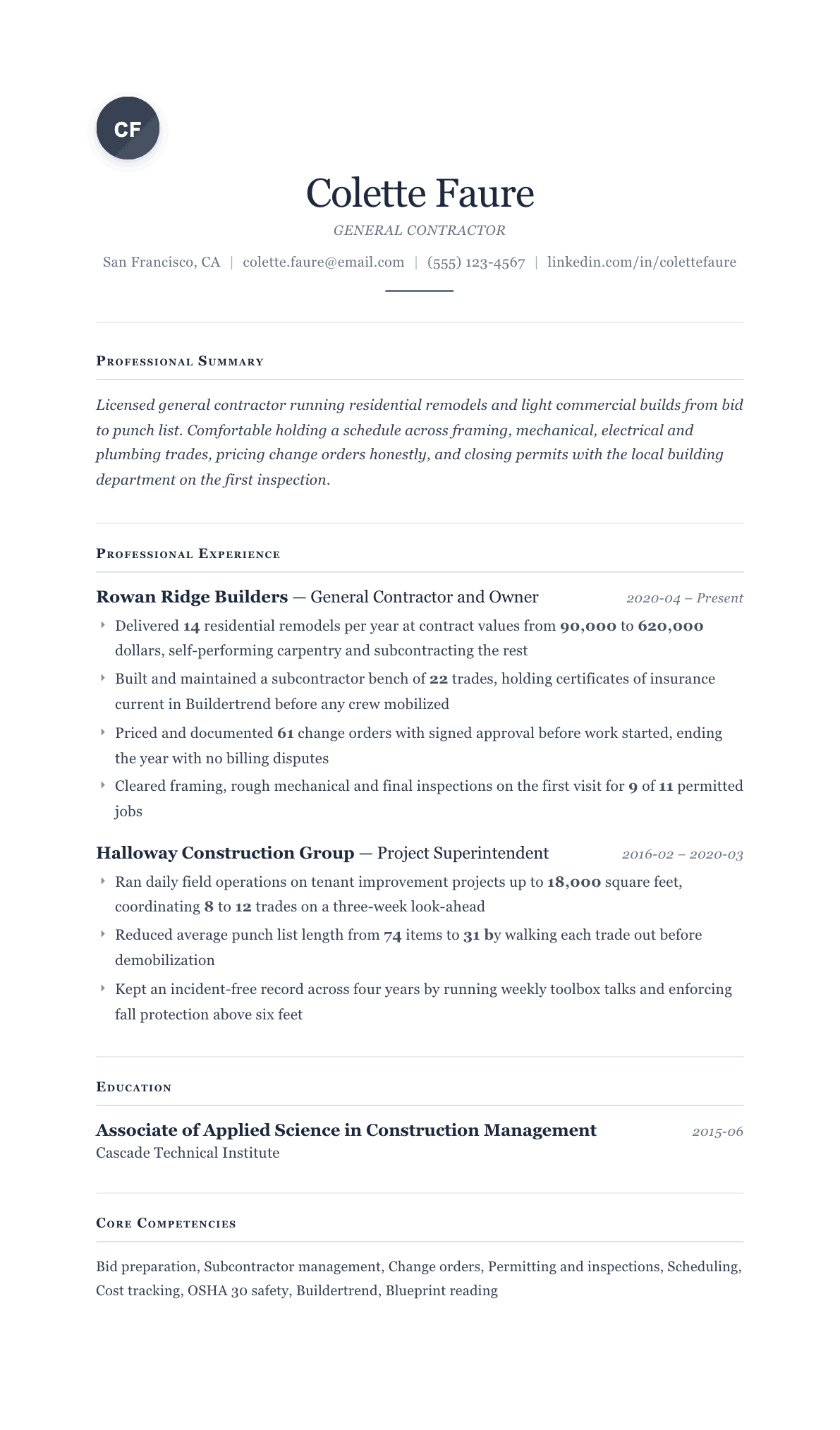
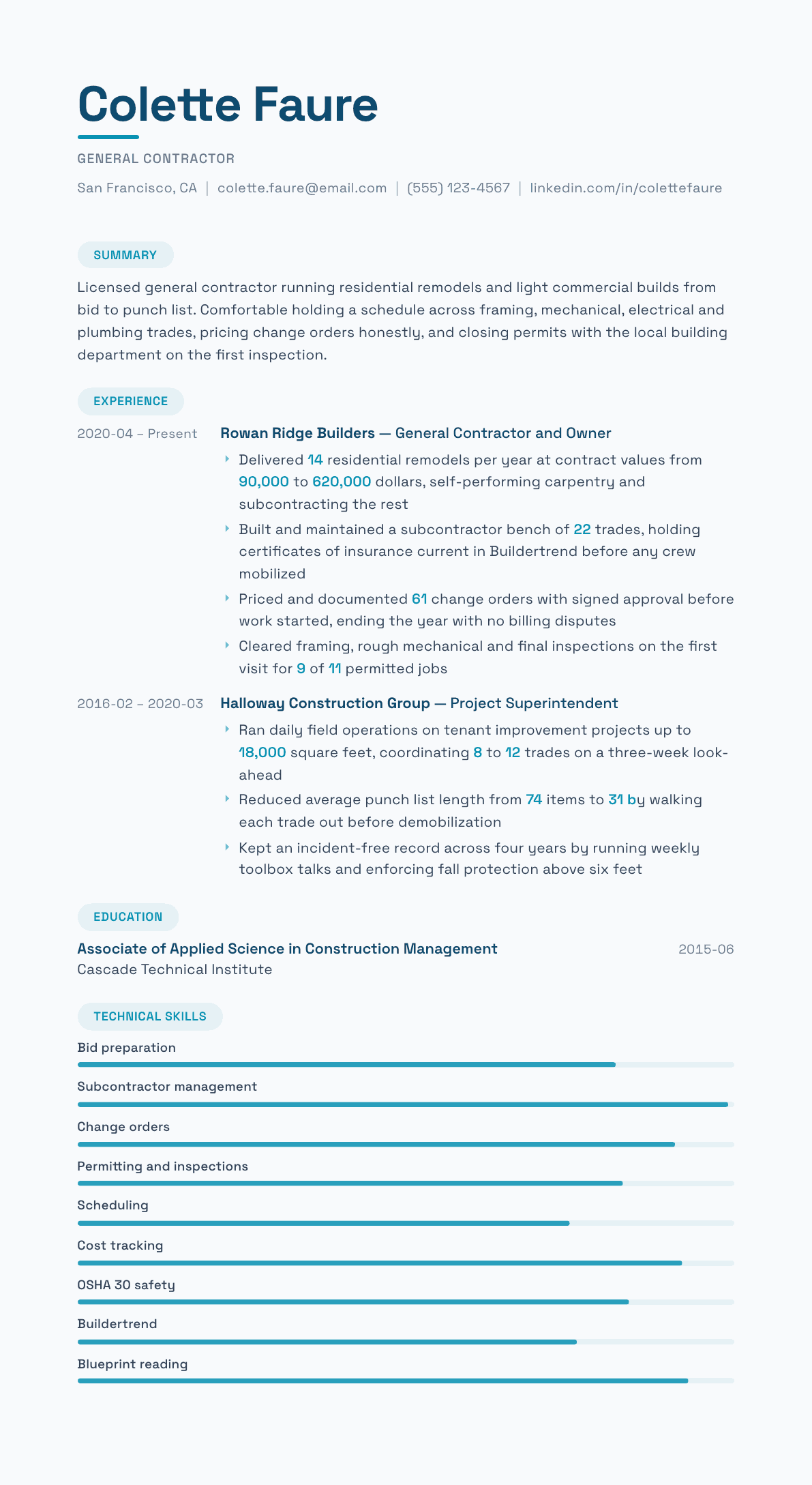
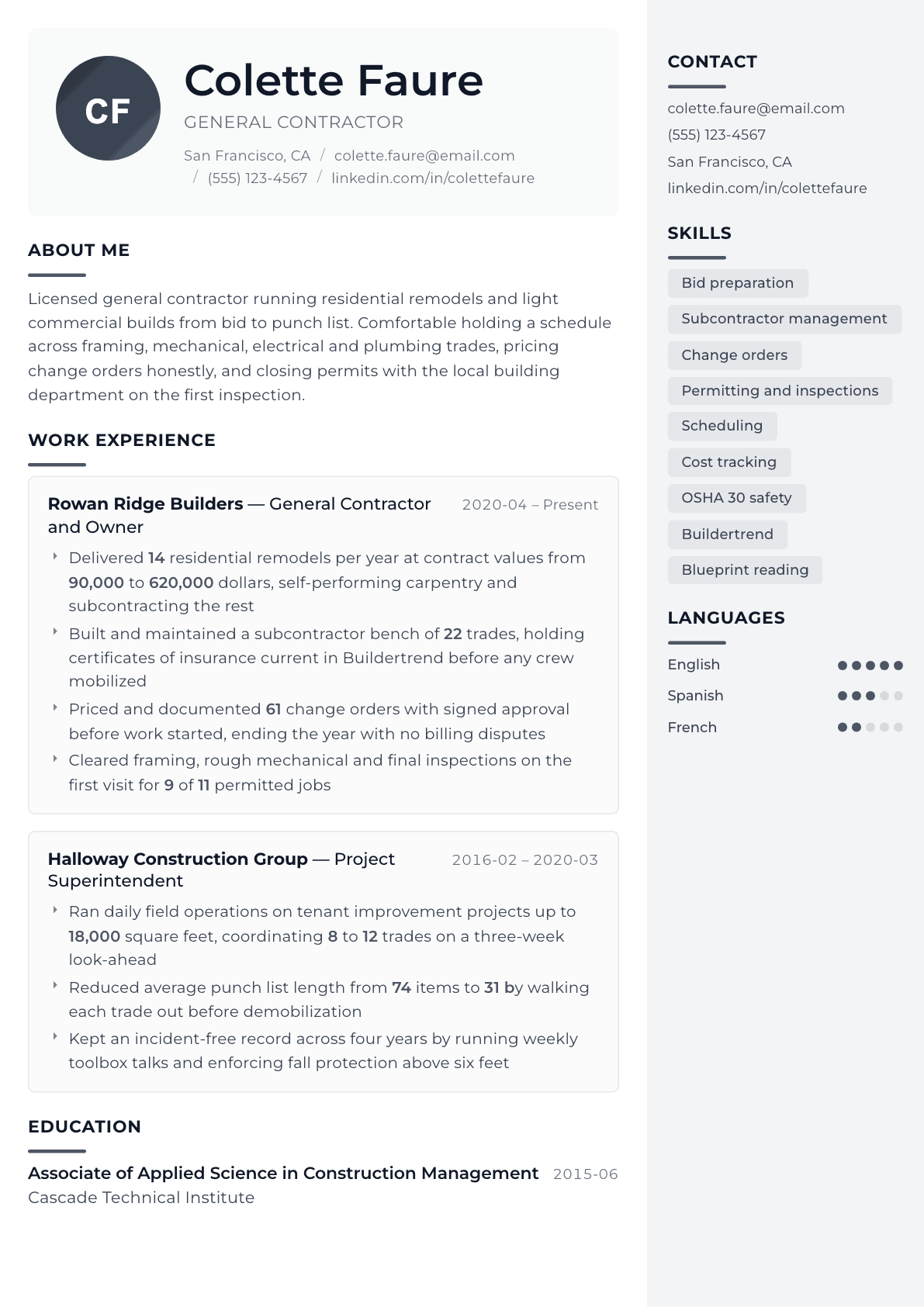
Example General Contractor summary
Licensed general contractor with nine years running residential and light commercial work from takeoff through closeout. Manages a bench of more than twenty subcontractors, prices change orders before crews mobilize, and holds three-week look-ahead schedules that keep inspections on the first visit. Delivered fourteen remodels last year with zero billing disputes and an incident-free safety record.
Skills to list on a General Contractor resume
- Bid and estimating
- Subcontractor scheduling
- Change order management
- Building code compliance
- Permit coordination
- Job costing
- Blueprint and spec reading
- Site safety management
- Framing and rough carpentry
- Client communication
- Punch list closeout
- Contract negotiation
- Material procurement
- Quality control inspections
- Lien waivers and billing
What actually gets this resume read
- Put your contractor license number, the state that issued it, and your bond and insurance status in the header where a client looks first.
- Give every project a type, a contract value range, a square footage and a delivery method so a reader can size your work instantly.
- Show that you control money: budget variance, change order discipline, and how you handled owner allowances on real jobs.
- Name the trades you self-perform and the trades you subcontract, because that distinction decides which builders can use you.
- List the estimating and field software you actually use daily, such as Buildertrend, Procore, PlanSwift or QuickBooks for job costing.
- Prove your safety record with the program you ran, not with an adjective: toolbox talks, fall protection, and an incident count.
How to write a general contractor resume
A general contractor resume is judged on control. Whoever reads it, a developer picking a builder, a construction manager hiring a working GC, or a homeowner comparing three bids, wants to know that money, schedule and inspections stay where you said they would. Everything else on the page is decoration.
That means the license, the bond and the insurance belong in the header, and every project needs a type, a size, a contract band and the delivery method. A reader who cannot tell whether you built kitchens or a four story shell has no way to decide whether your experience transfers to the work in front of him.
The same rules make a construction contractor resume, whether you hold the prime contract or run a specialty trade under someone else. This guide takes the page section by section: how to format it, what belongs in the summary, how to write project experience that shows cost and schedule discipline, which licenses and safety credentials to list, and the questions builders ask most when they finally sit down to write it.
Format: license first, projects second, everything else last
Reverse chronological, one page if you are under ten years in the trade and two once you have a real project list. Skip the columns and the icons. A construction firm that runs applications through a tracking system will lose your license number if it sits in a sidebar graphic.
The header carries your name, the state license number, the classification, and one line confirming bond and general liability coverage. If you carry workers compensation for your own crew, say so. Those four facts decide whether a client can legally hire you, and burying them costs you calls.
- Header: name, city and service radius, phone, email, license number and classification, bond and insurance status.
- Sections in this order: summary, selected projects or experience, licenses and safety credentials, skills and software, education or apprenticeship.
- Self-performing builders should add a short trades line naming what the in house crew does.
- Construction contractor resume for a specialty trade: put the trade classification in the title line, such as concrete or framing contractor, and say whether you work as prime or as a subcontractor.
Summary: what you build, at what size, with what crew
Four lines at most. Name the work type, the contract range you operate in, whether you self-perform or broker trades, and the market you serve. A builder who says he manages residential remodels between ninety thousand and six hundred thousand dollars with an in house carpentry crew has already told the reader more than a paragraph of adjectives could.
If you are moving from field superintendent to running your own contracts, say it directly and name the transferable half: schedule control, trade coordination and inspection history all move with you. Owners will still want to see who carries the license and the risk, so answer that in the same breath.
Experience: contract value, trades held, and how the money behaved
Lead each job with the scope line: project type, size in square feet or unit count, contract value band, and delivery method such as fixed price, cost plus or design build. That single line is what a hiring construction manager reads before any bullet.
Then three to five bullets, and make at least two of them about money and time. Budget variance against the original contract, how change orders were priced and approved, whether the schedule held through the mechanical rough in, and how many inspections passed on the first visit. These are the numbers that separate a contractor who tracks his jobs from one who reacts to them.
Leave out bullets that describe contracting itself. Coordinated subcontractors and ensured quality workmanship are true of every applicant and take the room a real detail needs.
Licenses, safety and the paperwork clients check
Give licenses their own block with the issuing state, the classification and the number. Add the safety training you hold, most commonly an OSHA thirty hour construction card, plus first aid and CPR if current. If you have completed lead safe renovator training for pre war housing, list it, because it gates whole categories of remodel work.
Note any prequalification you carry with a general contractor, a public agency or an insurer. A builder who has passed a subcontractor prequalification process has already survived a financial review, and saying so shortens the conversation.
Skills and software: the tools you run the business on
Split this into three short lines. Field and trade skills such as framing, concrete flatwork or finish carpentry. Business skills such as estimating, takeoff, scheduling and job costing. Software you use daily, whether that is Buildertrend, Procore, PlanSwift, Bluebeam or a job costed accounting file. Naming the platform matters because a company on one system will pay to avoid retraining you.
- Estimating and takeoff, including how you price labor separately from material.
- Scheduling method: three week look ahead, critical path, or a simple trade calendar.
- Documentation habits: daily reports, photo logs, signed change orders, lien waivers.
Keywords a construction ATS is matching against
Postings for builders repeat a small vocabulary: bid, takeoff, submittals, RFIs, change orders, punch list, closeout, permit, inspection, subcontractor management and site safety. Use the exact words from the posting once in your skills block and once inside a bullet where you can prove it. Keyword blocks with no evidence behind them get caught by the person who reads the file after the software does.
General Contractor resume summary examples
Newly licensed
Newly licensed general contractor with six years as a lead carpenter on residential remodels. Holds an active state license, bond and general liability coverage, self-performs framing and finish work, and has run kitchen and bath projects up to 140K dollars from permit through final inspection.
Nine years running contracts
General contractor delivering fourteen residential remodels a year at contract values between 90K and 620K dollars. Manages a bench of twenty two trades, prices every change order before crews mobilize, and cleared framing and final inspections on the first visit for nine of eleven permitted jobs last year.
Commercial builder
Commercial general contractor with eighteen years on ground up retail, medical office and tenant improvement work up to 12 million dollars. Runs three concurrent projects with two superintendents, closed the last four jobs within 2% of contract value, and holds an incident free record across the current portfolio.
Work experience bullets: before and after
Before: Managed subcontractors on residential projects.
After: Held a bench of 22 trades across 14 concurrent remodels, verifying insurance certificates and scheduling each trade on a three week look ahead.
The count, the verification step and the scheduling method show a system rather than a claim.
Before: Handled change orders for clients.
After: Priced and documented 61 change orders with owner signature before any work started, closing the year with no billing disputes.
Naming the approval sequence and the outcome proves the financial discipline an owner is actually buying.
Before: Responsible for job site safety.
After: Ran weekly toolbox talks and enforced fall protection above six feet, finishing four seasons with no recordable incidents.
A safety program with a specific rule and a record beats the word responsible every time.
Before: Worked with the building department on permits.
After: Submitted permit applications and cleared framing, rough mechanical and final inspections on the first visit for 9 of 11 jobs.
First pass inspection rates are a cost and schedule signal every construction manager understands.
Before: Estimated projects and prepared bids.
After: Produced takeoffs in PlanSwift and priced labor and material separately on 40 bids, winning 11 at an average gross margin above target.
The tool, the volume and the split between labor and material show how the estimate was actually built.
Hard skills
- Bid preparation and takeoff
- Job costing and budget tracking
- Change order pricing
- Subcontractor scheduling
- Building code and permit compliance
- Inspection coordination
- Blueprint and specification reading
- Framing and rough carpentry
- Site safety program management
- Punch list and closeout
- Contract and scope negotiation
- Material procurement
- Buildertrend and Procore
- Bluebeam markup
Soft skills
- Owner communication
- Trade partner negotiation
- Field problem solving
- Scheduling under weather delays
- Crew leadership
- Written documentation habits
Certifications worth listing
- OSHA 30-Hour Construction (Occupational Safety and Health Administration)
- Lead-Safe Renovator (RRP) (United States Environmental Protection Agency)
- Certified Professional Constructor (CPC) (American Institute of Constructors)
- Certified Construction Manager (CCM) (Construction Manager Certification Institute)
Mistakes that cost general contractor candidates the interview
- Hiding the license number and classification below the education section, where a client scanning three bids will never find it.
- Listing companies without project detail, so a reader cannot tell a deck rebuild from a four unit ground up build.
- Writing only about quality and craftsmanship while saying nothing about budget variance or schedule performance.
- Claiming to self-perform every trade, which reads as inexperience to anyone who has managed a real subcontractor bench.
- Leaving out bond and insurance status, which forces the reader to assume you do not carry either.
- Using a decorative two column template that a construction firm tracking system reads out of order.
General Contractor resume questions
Should a general contractor resume list every project?
No. Pick eight to twelve projects that show range in type, size and delivery method, then group the rest into one line such as forty additional residential remodels. A long undifferentiated list buries the jobs that prove you can handle the posted work.
How do I show my license if I work in more than one state?
List each state, its classification and the license number in a dedicated credentials block, newest first. Add whether any of them came through reciprocity, because a company expanding into a new market often hires specifically for the license you already hold.
What if I have always worked for someone else as a superintendent?
Write the resume around scope and control rather than ownership. Name the contract values you ran, the trades you scheduled, the inspections you cleared and the reports you produced. Then say plainly that you now hold the license and carry the bond yourself.
Do I need to include dollar figures for my projects?
Ranges are enough and are safer than exact contract sums that may be confidential. Saying you run jobs between two hundred thousand and one million dollars tells a reader your operating band without exposing a client agreement you signed.
Is a construction contractor resume the same as a general contractor resume?
Close, with one difference. A general contractor holds the prime contract and coordinates every trade, so the resume leads with project size and schedule control. A specialty construction contractor, such as concrete, framing or roofing, leads with the trade classification, the scopes you self perform and the general contractors you have worked under.
Related resume examples
- Construction Manager Resume example
- Carpenter Resume example
- Construction Superintendent Resume example
- Construction Estimator Resume example
- Construction Project Manager Resume example
- Site Manager Resume example