Health and Safety Officer Resume Examples: free score
Write a Health and Safety Officer Resume That Regulators Would Recognize
By Mustafa Tarabya, founder of CVBooster · Published · Updated
A health and safety officer resume example with audit, training and reporting tips, the compliance keywords employers search for, and a writing guide.
Sample resumes for a health and safety officer
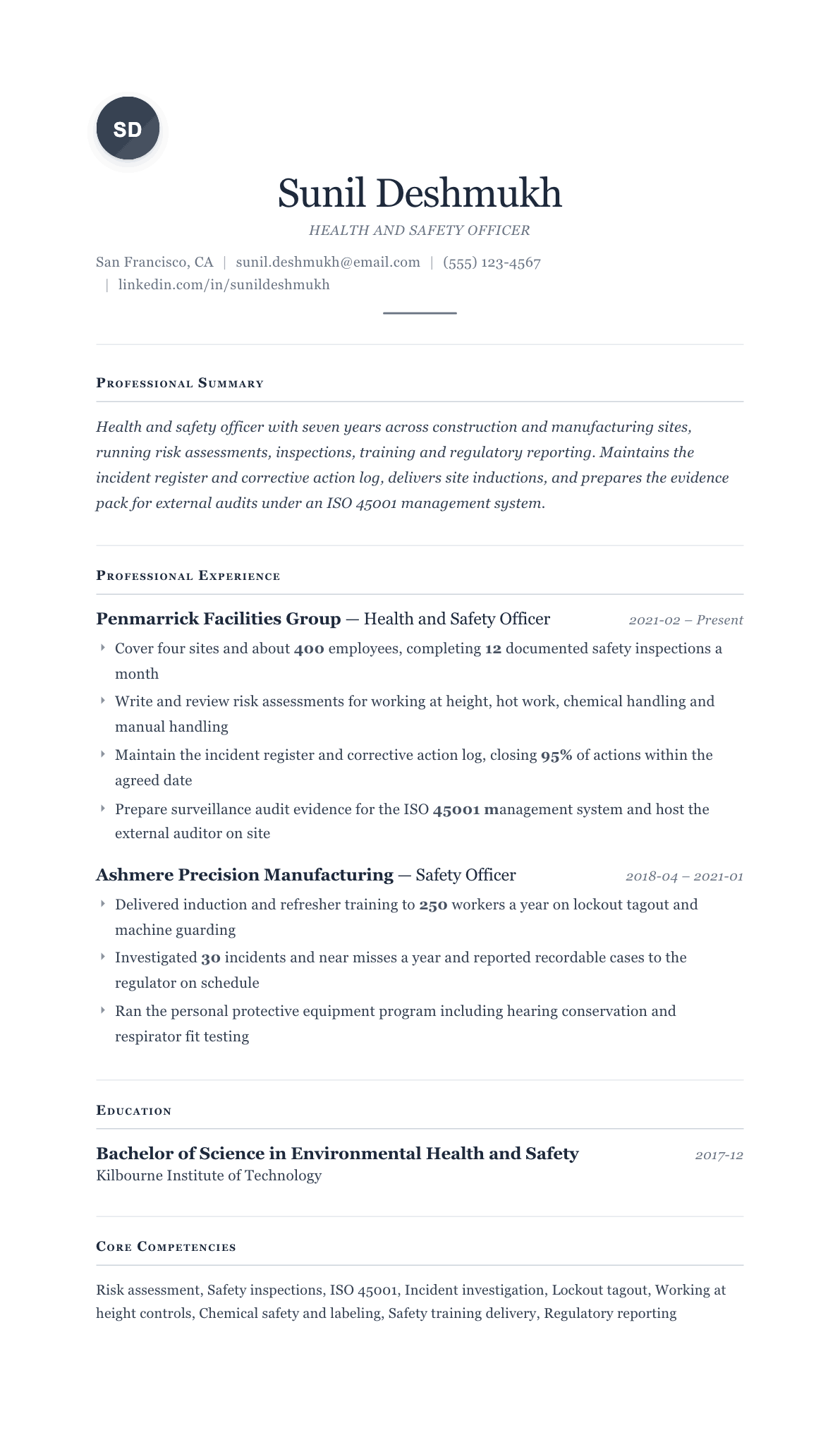
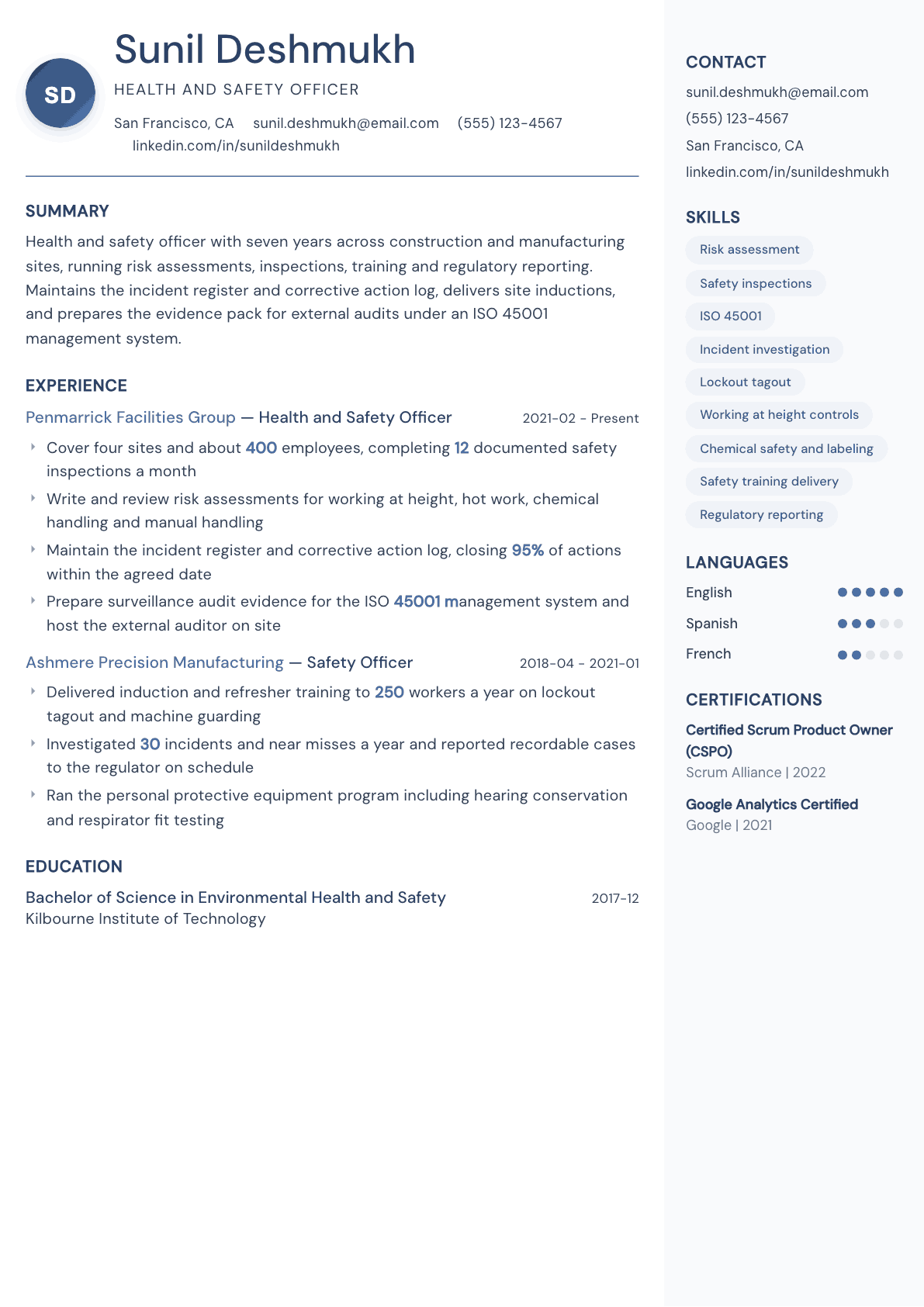
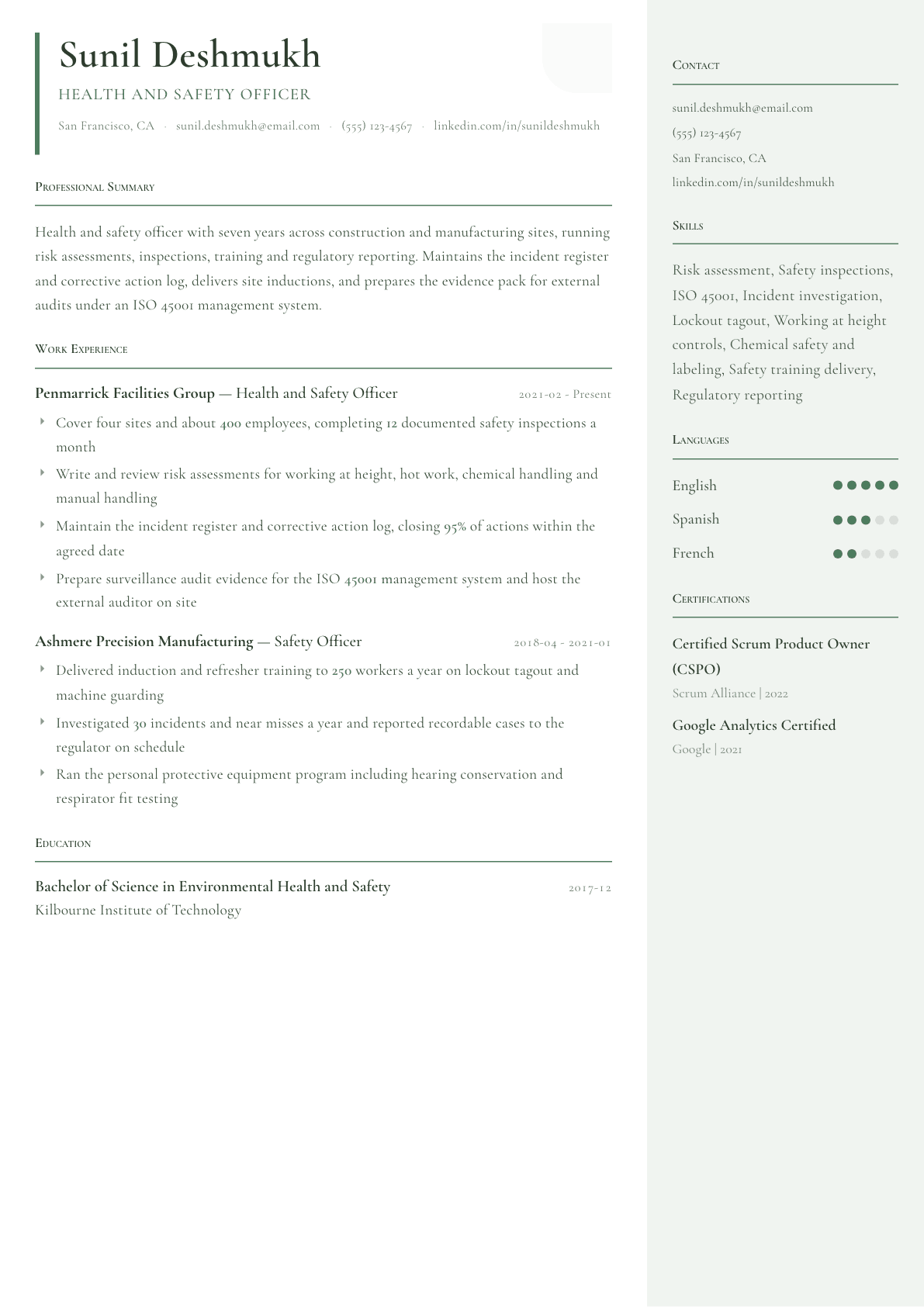
The same health and safety officer content laid out in three CVBooster templates, so you can see what the finished document looks like before you write a word.
Example Health and Safety Officer summary
Health and safety officer with seven years across construction and manufacturing, covering four sites and roughly four hundred workers. Writes risk assessments for work at height, hot work and chemical handling, runs a monthly documented inspection routine, and drives corrective actions to closure inside the agreed date. Delivers induction and refresher training, and prepares the evidence pack that carries an ISO 45001 surveillance audit.
Skills to list on a Health and Safety Officer resume
- Risk assessment
- Documented safety inspections
- ISO 45001 management systems
- Incident investigation and reporting
- Corrective action tracking
- Working at height controls
- Confined space and permit to work
- Lockout tagout
- Hazard communication and chemical safety
- Personal protective equipment programs
- Respirator fit testing
- Safety induction and training delivery
- Emergency preparedness drills
- Contractor safety management
What actually gets this resume read
- State how many sites and workers you cover, because a single-site officer and a regional officer do very different jobs.
- Name the management system you work under, ISO 45001 or a corporate standard, and your part in the audit cycle.
- Quantify inspections, risk assessments and training sessions per month, since a safety officer role is measured in documented activity.
- Show the corrective action loop, not just the finding, because closure rate is what an auditor actually tests.
- Separate construction site work from manufacturing or facilities work, since the hazards and the regulations differ.
- List the specific hazard controls you own, working at height, confined space, hot work, chemical handling, lockout tagout.
How to write a health and safety officer resume
A health and safety officer sits between the workforce and the paperwork that proves the workforce is protected. The manager hiring you wants to know three things: how many people and sites you cover, whether your risk assessments are living documents or a folder nobody opens, and whether an external auditor would find the evidence pack in order. Everything worth putting on the page answers one of those.
The title travels across industries, which is why so many of these resumes read as vague. A health and safety officer on a construction site, in a food factory and in a hospital face different hazards, different regulators and different training obligations. Name your setting in the first line and the rest of the resume becomes readable.
This guide covers scope, the risk assessment cycle, inspection and corrective action tracking, training delivery, and how to present management system and audit work so it reads as competence instead of administration.
Format: scope line, then evidence
Reverse-chronological, one to two pages. Under the summary add a scope line: number of sites, headcount covered, industries and whether you report to a safety manager or directly to site leadership. Then experience, then a short block for training you are qualified to deliver.
Put certifications near the top with the awarding body. Employers running a certified management system often need the credential named in the audit records, so it is not decorative.
- Header: name, city and state, phone, email, safety credentials.
- Order: summary, scope, certifications, experience, training delivered, education.
- Say whether the role was single site, multi-site or a contractor assurance role.
Summary: setting, hazards, system
Name the industries you have covered, the principal hazards you manage, and the management system you work inside if there is one. Someone running work at height, hot work and chemical handling across four sites has described the job accurately in one sentence.
Add whether you own the incident register and the corrective action log, because that ownership is the difference between advising and running the function.
Experience: assessments, inspections, actions
Begin with risk assessment. State how many you author and review, for which activities, and how often they are revisited. A risk assessment that has not been reviewed since the process changed is worthless, and an employer who has been audited knows that.
Then inspections. Give a monthly count, say what a documented inspection covers on your sites, and connect every finding to the corrective action log. Closure rate against the agreed date is the number that proves the loop functions, and it is the number an auditor tests first.
Then incidents. Investigation volume, the method you use, reporting obligations to the regulator and to the insurer, and how findings feed back into the assessments and the training plan. Finish with permit systems: work at height, hot work, confined space entry and isolation, naming who authorizes and who verifies.
- Assessments authored and reviewed, by activity type and review interval.
- Documented inspections per month and the closure rate on findings.
- Permit to work systems you administer and the isolations you verify.
Management systems and audits: name the standard
If you work under a certified occupational health and safety management system, say which standard, what your role is in the audit cycle, and whether you have hosted an external surveillance visit. Internal auditor training belongs here too, along with the nonconformance and corrective action process you run afterward.
Also cover the contractor and visitor side. Contractor safety management, induction of external crews, and verification of their method statements are a large part of the role in most facilities, and they are commonly left off the resume entirely.
Keywords employers screen health and safety resumes on
Job descriptions repeat risk assessment, method statement, permit to work, safe system of work, incident investigation, corrective action, hazard identification, personal protective equipment, hazard communication, lockout tagout, occupational health surveillance, emergency preparedness and contractor management. Match the ones that are genuinely yours and use the same phrasing the posting uses, including the management system standard number when it appears.
Health and Safety Officer resume summary examples
Safety officer, first role
Environmental health and safety graduate with two years on a manufacturing site of two hundred employees. Delivers induction and refresher training on lockout tagout and machine guarding, completes weekly documented inspections, and maintains the incident register and safety data sheet library.
Seven years in
Health and safety officer covering four sites and about four hundred workers across construction and facilities. Authors risk assessments for work at height, hot work and chemical handling, completes twelve documented inspections a month, and closes corrective actions within the agreed date on nearly every finding.
Lead safety officer
Lead health and safety officer for a manufacturing group, supervising two officers across three plants. Owns the certified management system evidence pack, hosts external surveillance audits, runs the permit to work regime, and manages occupational health surveillance with the provider and the plant leadership team.
Work experience bullets: before and after
Before: Carried out risk assessments.
After: Authored and reviewed risk assessments for work at height, hot work, chemical handling and manual handling, revisiting each one whenever the process or the equipment changed.
Naming the activities and the review trigger shows assessments that stay current rather than sit in a binder.
Before: Did safety inspections regularly.
After: Completed twelve documented safety inspections a month across four sites, logging every finding into the corrective action register with an owner and a due date.
A monthly count plus the register mechanics is what an auditor would actually ask to see.
Before: Followed up on issues found.
After: Drove corrective actions to closure within the agreed date on 95% of findings, escalating the remainder to site leadership with a revised control in place meanwhile.
A closure figure and an escalation path prove the loop works even when a fix takes longer than planned.
Before: Trained staff on health and safety.
After: Delivered induction and annual refresher training to about 250 workers a year covering lockout tagout, machine guarding and hazard communication.
Audience size and named topics turn training from a duty statement into a measurable output.
Before: Helped with external audits.
After: Prepared the surveillance audit evidence pack for the certified management system and hosted the external auditor on site across two consecutive cycles without a major nonconformance.
Hosting an audit and the result is the strongest available proof that the documentation holds up.
Hard skills
- Risk assessment authoring and review
- Documented safety inspections
- Occupational health and safety management systems
- Incident investigation and regulatory reporting
- Corrective action tracking
- Permit to work administration
- Work at height and fall prevention controls
- Confined space entry procedures
- Lockout tagout and machine guarding
- Hazard communication and chemical safety
- Personal protective equipment programs and fit testing
- Emergency preparedness and evacuation drills
- Contractor safety management
Soft skills
- Persuading without authority
- Training delivery to mixed audiences
- Meticulous record keeping
- Calm incident response
- Working with regulators and auditors
Certifications worth listing
- Associate Safety Professional (ASP) (Board of Certified Safety Professionals)
- Certified Safety Professional (CSP) (Board of Certified Safety Professionals)
- Occupational Health and Safety Technologist (OHST) (Board of Certified Safety Professionals)
- Certified Industrial Hygienist (CIH) (Board for Global EHS Credentialing)
- NEBOSH International General Certificate in Occupational Health and Safety (NEBOSH)
Mistakes that cost health and safety officer candidates the interview
- Failing to state how many sites and workers you cover, which makes the scope of the role unreadable.
- Listing risk assessment as a skill with no indication of the activities assessed or how often they are reviewed.
- Reporting findings without closure rates, when closure is the part an auditor actually examines.
- Blurring construction work with factory or facilities work, since the hazards and obligations differ sharply.
- Leaving contractor management off the page even though inducting and verifying external crews takes real time.
- Presenting training as a duty rather than as a delivered output with an audience size and a topic list.
Health and Safety Officer resume questions
What does a health and safety officer resume need that a general safety resume does not?
Scope and evidence. State the number of sites and people covered, then show the documented cycle: assessments authored, inspections completed, findings closed and training delivered. That cycle is the whole job in four numbers.
Which certification should I pursue first?
Start with an entry board credential such as the occupational health and safety technologist or associate safety professional designation, then work toward the certified safety professional credential. Employers recognize the certifying board, so always name it beside the letters.
How do I move between industries as a safety officer?
Lead with the transferable system work: assessments, permits, investigations, audits and training. Then name the hazards in the target industry you have genuinely handled, and be direct about which of their hazards you would be learning.
Should I include incident numbers on the resume?
Include what you can explain. Investigation volume, near miss reporting levels and closure rates are safer and more informative than a headline injury figure that depended on factors well outside your control.
Is a degree required for a health and safety officer role?
Not always. Many officers move across from operations or a trade with a recognized safety qualification and site experience. A degree in occupational or environmental health helps at larger employers and speeds the path toward board certification.
Related resume examples
- Construction Manager Resume example
- Production Supervisor Resume example
- Construction Safety Manager Resume example
- Safety Coordinator Resume example
- Site Manager Resume example
- Insulation Installer Resume example