Arbitrator Resume Examples: free ATS score and gap list
Write an Arbitrator Resume That Earns Panel Appointments
By Mustafa Tarabya, founder of CVBooster · Published · Updated
Arbitrator resume example with hearing management and award writing bullets, panel roster keywords, and tips for neutrals seeking appointments.
Sample resumes for a arbitrator
The same arbitrator content laid out in three CVBooster templates, so you can see what the finished document looks like before you write a word.
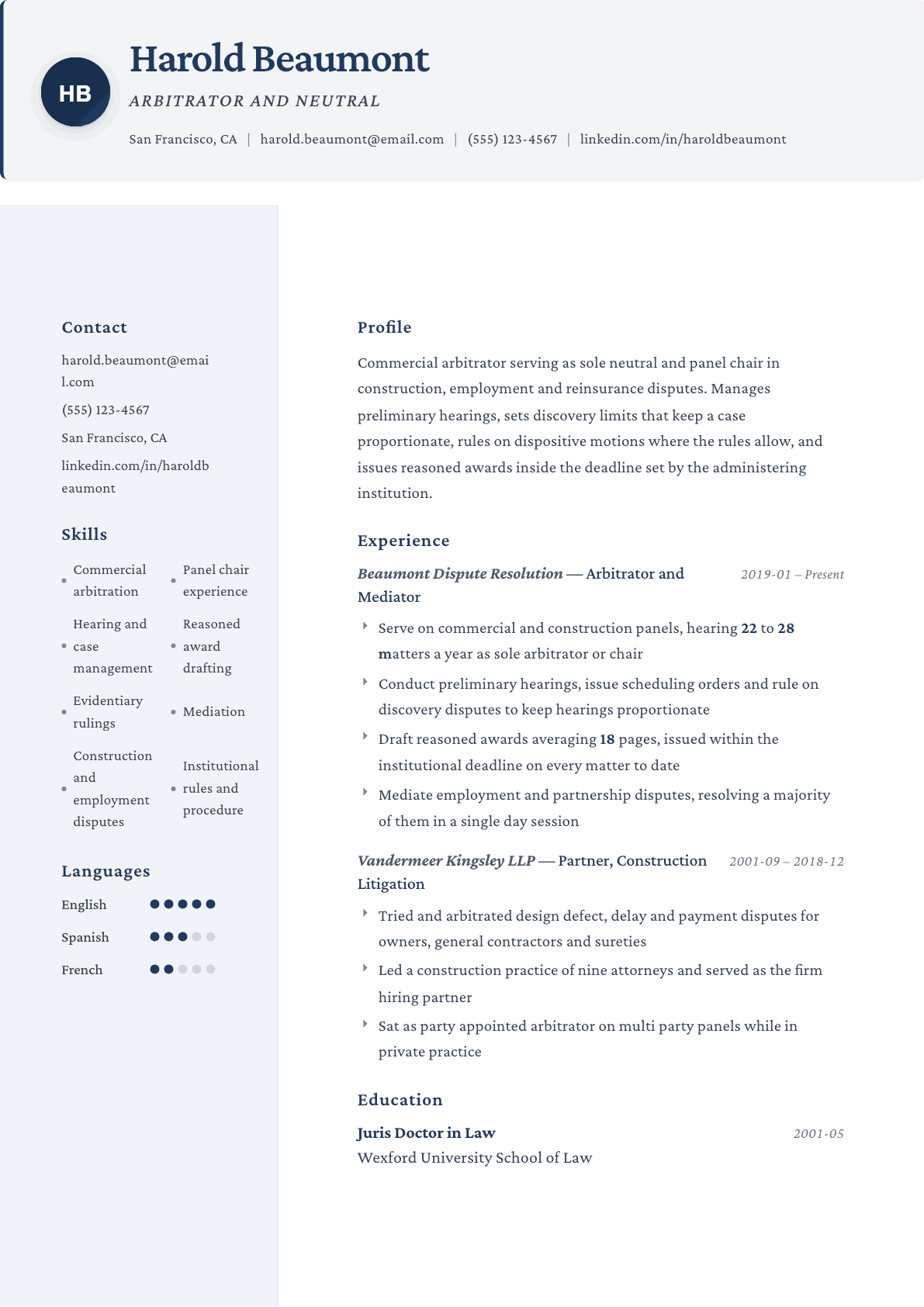
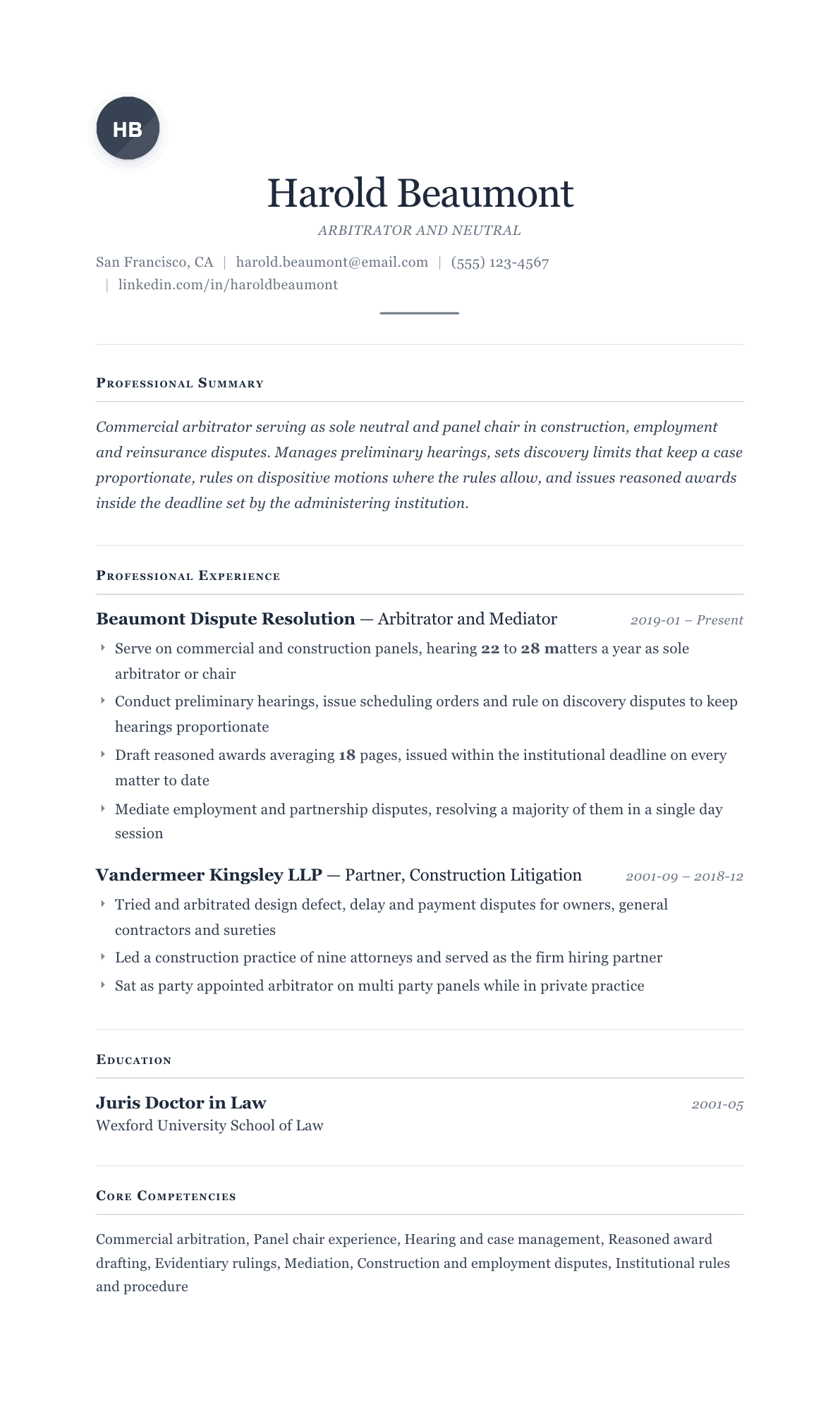
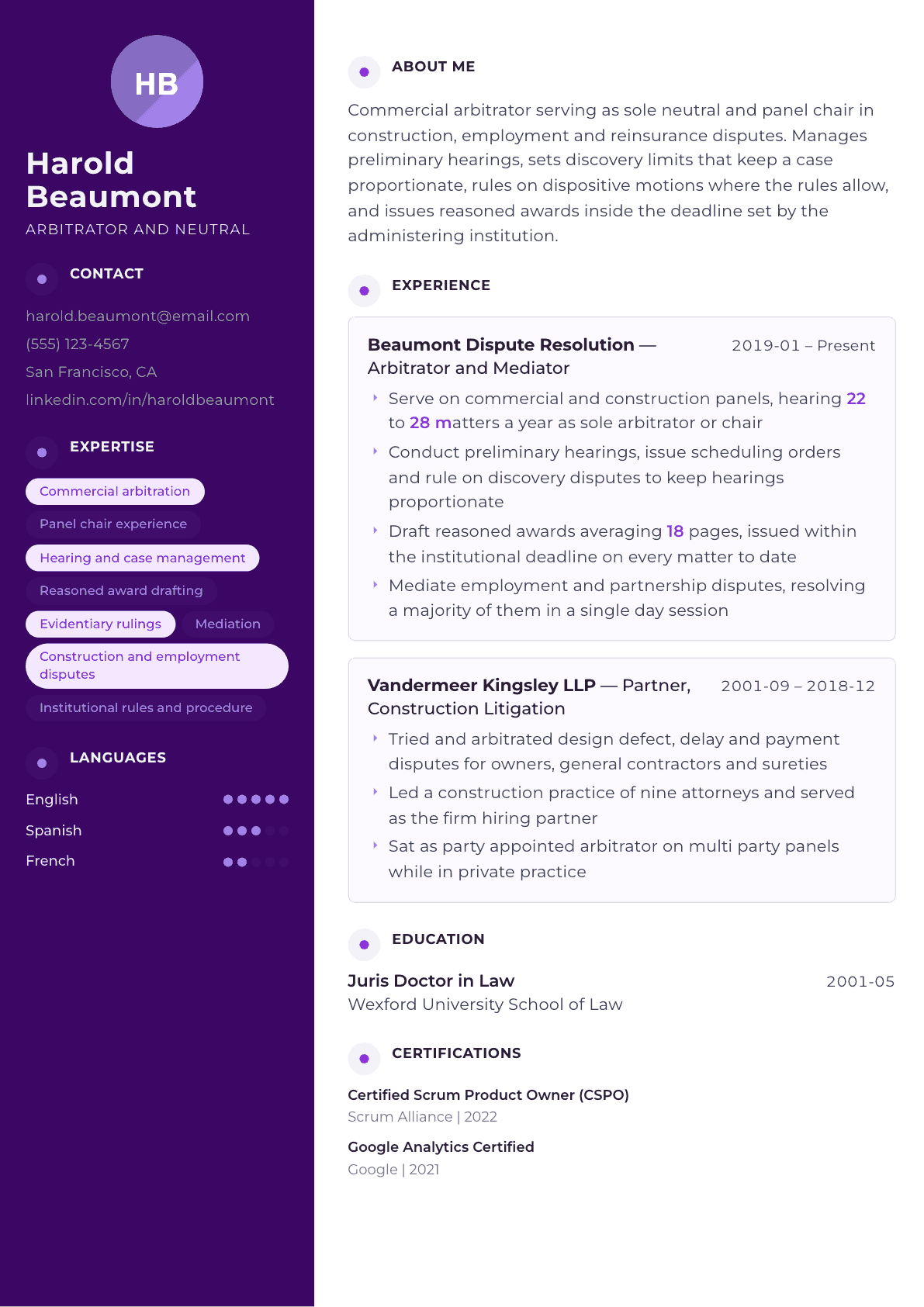
Example Arbitrator summary
Commercial arbitrator and mediator with two decades of construction and employment litigation behind the appointment. Sits as sole neutral and panel chair, manages preliminary hearings and discovery limits, rules on evidentiary objections, and issues reasoned awards on schedule. Seeking additional roster appointments in construction, surety and complex commercial matters.
Skills to list on a Arbitrator resume
- Commercial arbitration
- Construction disputes
- Employment disputes
- Preliminary hearing management
- Scheduling orders
- Discovery proportionality
- Evidentiary rulings
- Dispositive motion practice
- Reasoned award writing
- Interim and emergency relief
- Mediation and settlement conferences
- Institutional arbitration rules
- Conflict disclosure
- Multi party proceedings
What actually gets this resume read
- Lead with the panels and rosters you sit on, since appointing parties and institutions read that line first.
- Break your neutral work out by subject matter, because counsel strike names based on industry familiarity above all.
- Count matters heard, sole versus chair versus party appointed, and the average time from close of record to award.
- Name the institutional rules you work under and any experience with expedited or emergency arbitrator procedures.
- Keep advocacy history separate from neutral service, so a reader can see your independence at a glance.
- Include arbitrator training and any published writing or teaching, because it signals how you reason on the record.
How to write a arbitrator resume
An arbitrator resume has an unusual audience. It is read by roster administrators deciding whether to admit you to a panel, and then by opposing counsel choosing whom to strike from a list of names. The first reader checks qualifications and disclosures. The second is looking for a reason to cross you off, and gives you about ninety seconds to survive.
That second reader changes how the page should be written. Counsel wants to know your subject matter, whether you have decided cases like hers, how you run a hearing, and how quickly you issue an award. Anything that looks like advocacy for one side, or a career spent only on one side of a dispute type, is what gets you struck.
This guide covers how to separate neutral service from advocacy history, how to describe hearing management and award writing without breaching confidentiality, and how to build the page when your appointments are still few.
Format: a neutral profile, not a litigator resume
Two pages is standard, and a longer neutral biography can live separately. Lead with a short profile: the institutions and rosters you sit on, your subject matter areas, and the capacities you serve in as sole arbitrator, chair or party appointed member.
Keep advocacy history in its own clearly labeled section below the neutral work. Counsel reading a resume where the two are mixed cannot tell whether you have decided ten cases or merely appeared in them, and that ambiguity works against you.
- Header: name, city and state, phone, email, and the rosters you are admitted to.
- Order: neutral profile, subject matter areas, neutral service, prior practice, education and admissions, training and writing.
- New neutrals should show training, mock hearings and any court connected or small claims panel service.
Summary: subject matter and the seat you take
Name the disputes you decide before anything else. Construction, employment, reinsurance, franchise, health care, technology licensing and consumer matters draw from separate rosters, and counsel filters by subject before reading a word about method.
Then say how you sit. Sole arbitrator, chair of a three member panel, party appointed wing, or emergency arbitrator. Each is a different skill and each is staffed differently, so listing them tells an administrator exactly where you fit.
Neutral service: matters, management, awards
Give counts rather than case names. Matters heard per year, split between sole and panel service, and the range of amounts in dispute described in general terms. Add the institutions whose rules you have applied and whether you have handled expedited or documents only procedures.
Describe how you run a hearing, because this is what parties are really choosing. Preliminary conferences, scheduling orders, proportional discovery limits, rulings on dispositive motions where the rules permit them, and how you handle a party that will not meet deadlines.
Award writing deserves its own bullets. Reasoned awards versus bare awards, typical length, and the time from close of record to issue. A neutral who reliably issues inside the institutional deadline is a neutral who gets reappointed.
Disclosure, independence and the strike test
Show that you take conflict disclosure seriously. Mentioning that you maintain a current conflicts database and disclose relationships at appointment and on an ongoing basis signals a neutral who will not create a vacatur risk.
Balance the record. If your practice career was spent representing employers, say what you have done since to serve on both sides of employment disputes, or name the training and panels that broadened you. Counsel is scanning for tilt, and addressing it directly is stronger than hoping it goes unnoticed.
Training, writing and how a roster indexes you
List arbitrator and mediator training with the provider and the hours, along with any advanced or chair specific curriculum. Add teaching, published articles and panel appearances, because they let counsel sample your reasoning before appointing you.
For keywords, use roster vocabulary: commercial arbitration, construction arbitration, employment arbitration, sole arbitrator, panel chair, reasoned award, interim relief, emergency arbitrator, scheduling order, evidentiary hearing, mediation, dispute resolution clause.
Arbitrator resume summary examples
New neutral
Commercial litigator with 15 years in construction and surety disputes, recently admitted to a commercial arbitration roster after completing arbitrator training and 3 mock hearings. Has served as a court connected mediator on 20 matters and is available for documents only and expedited proceedings.
Established arbitrator
Commercial arbitrator hearing 22 to 28 matters a year as sole neutral or panel chair in construction, employment and partnership disputes. Runs preliminary conferences, sets proportional discovery limits, and issues reasoned awards averaging 18 pages inside the institutional deadline.
Chair and roster fellow
Arbitrator with 20 years of neutral service on domestic and international commercial panels, frequently appointed chair in multi party construction and reinsurance matters. Handles emergency relief applications, teaches award writing to new neutrals, and maintains a current conflicts disclosure system.
Work experience bullets: before and after
Before: Served as an arbitrator on commercial cases.
After: Heard 22 to 28 commercial and construction matters a year as sole arbitrator and panel chair, applying institutional rules and expedited procedures where the parties elected them.
Matter volume, the seat you hold and the procedures used tell counsel exactly what kind of neutral she is considering.
Before: Managed the arbitration process efficiently.
After: Held preliminary conferences within 3 weeks of appointment, issued scheduling orders capping depositions and document requests, and resolved discovery disputes on written submissions.
Concrete case management steps show proportionality in practice rather than a promise of efficiency.
Before: Wrote awards for the parties.
After: Drafted reasoned awards averaging 18 pages with separate findings on liability and damages, issued within the institutional deadline in every matter to date.
Award style, length and timeliness are the criteria administrators use when deciding on reappointment.
Before: Handled difficult parties during hearings.
After: Kept a 4 day evidentiary hearing on schedule with a self represented respondent, ruling on objections from the bench and explaining procedure without advising either side.
A specific hearing problem and how you solved it demonstrates control while preserving neutrality.
Before: Also do mediation work.
After: Mediated employment and partnership disputes, resolving a majority in a single day session and drafting settlement terms the parties signed before leaving.
Naming the outcome and the closing step makes the mediation practice credible alongside the arbitration record.
Hard skills
- Commercial arbitration
- Construction and surety disputes
- Employment arbitration
- Preliminary conference and case management
- Scheduling orders and discovery proportionality
- Evidentiary rulings
- Dispositive motion practice under institutional rules
- Reasoned award drafting
- Interim measures and emergency relief
- Multi party and consolidated proceedings
- Conflict disclosure practice
- Mediation and settlement conferences
Soft skills
- Impartiality
- Hearing room control
- Patient listening
- Decisiveness on the record
- Clear written reasoning
Certifications worth listing
- Fellow of the Chartered Institute of Arbitrators (FCIArb) (Chartered Institute of Arbitrators)
- Member of the Chartered Institute of Arbitrators (MCIArb) (Chartered Institute of Arbitrators)
Mistakes that cost arbitrator candidates the interview
- Presenting a litigator resume with an arbitration line at the end, so counsel cannot find the neutral record.
- Listing case names or party identities, which breaches the confidentiality parties chose arbitration to protect.
- Leaving the seat unstated, so a reader cannot tell chair service from a party appointed wing appointment.
- Ignoring the appearance of tilt when an entire practice career sat on one side of the disputes you now decide.
- Skipping award timeliness, the single measure administrators track most closely for reappointment.
- Padding the page with speaking engagements while omitting the subject matter areas counsel filters on.
Arbitrator resume questions
How do I build an arbitrator resume with few appointments?
Lead with subject matter depth from practice, then add arbitrator training with hours, mock hearings, mediation service and any court connected or small claims panel work. Administrators expect a thin appointment record early and read the rest closely.
Can I describe cases I have decided?
Describe types, industries and issues, never parties or outcomes. A line about deciding a delay and disruption claim between an owner and a general contractor is informative and keeps the confidentiality obligation intact.
Should mediation experience appear on an arbitrator resume?
Yes, in its own section. It shows dispute resolution range and settlement skill, but keep it separate so counsel evaluating you as a decision maker is not left wondering which role you prefer.
How important is time to award?
It is one of the few objective measures a roster tracks. Stating that you issue within the institutional deadline, and giving a typical interval from close of record, addresses the concern parties raise most often about arbitration.
Do I need a law degree to serve as an arbitrator?
Not always. Industry arbitrators with engineering, accounting or construction backgrounds sit regularly on technical panels. If you are not a lawyer, emphasize the industry expertise and the procedural training that shows you can run a hearing.