Attorney Resume Examples: free score, then the gap list
Write an Attorney Resume That Reads Like Real Practice
By Mustafa Tarabya, founder of CVBooster · Published · Updated
Attorney resume examples, bar admission and practice area keywords, and a guide to writing matters, outcomes and representative experience.
Sample resumes for a attorney
The same attorney content laid out in three CVBooster templates, so you can see what the finished document looks like before you write a word.
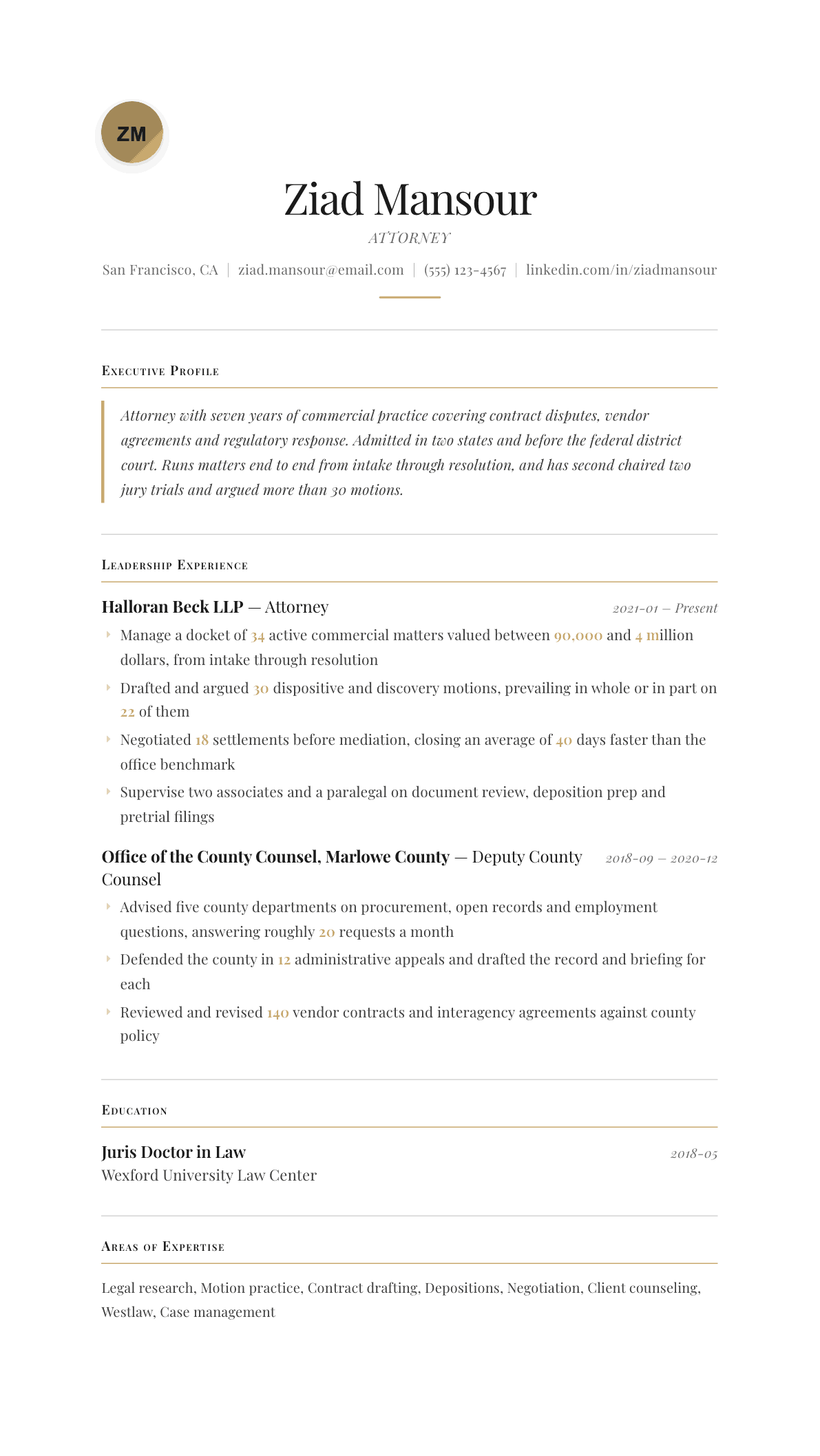
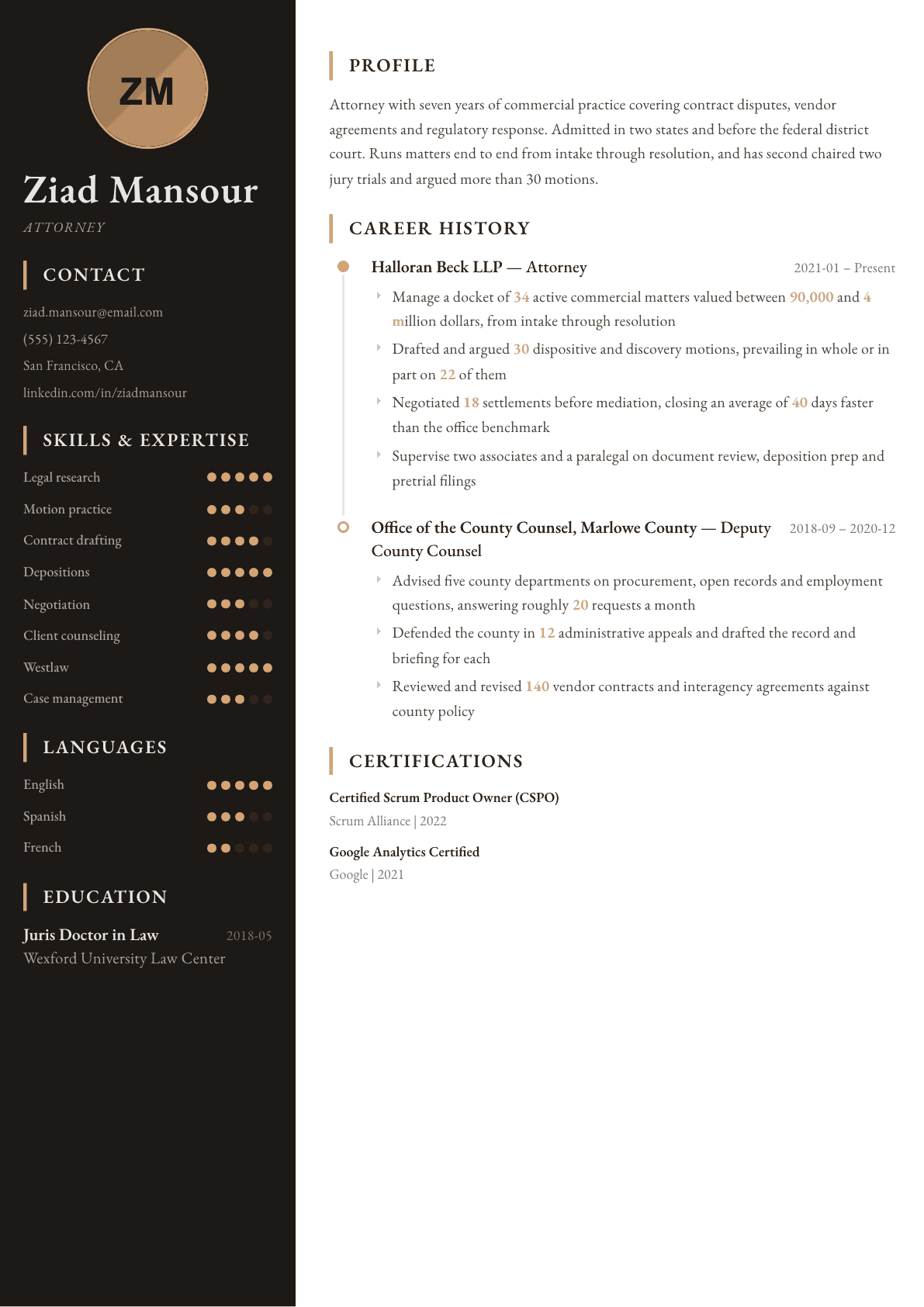
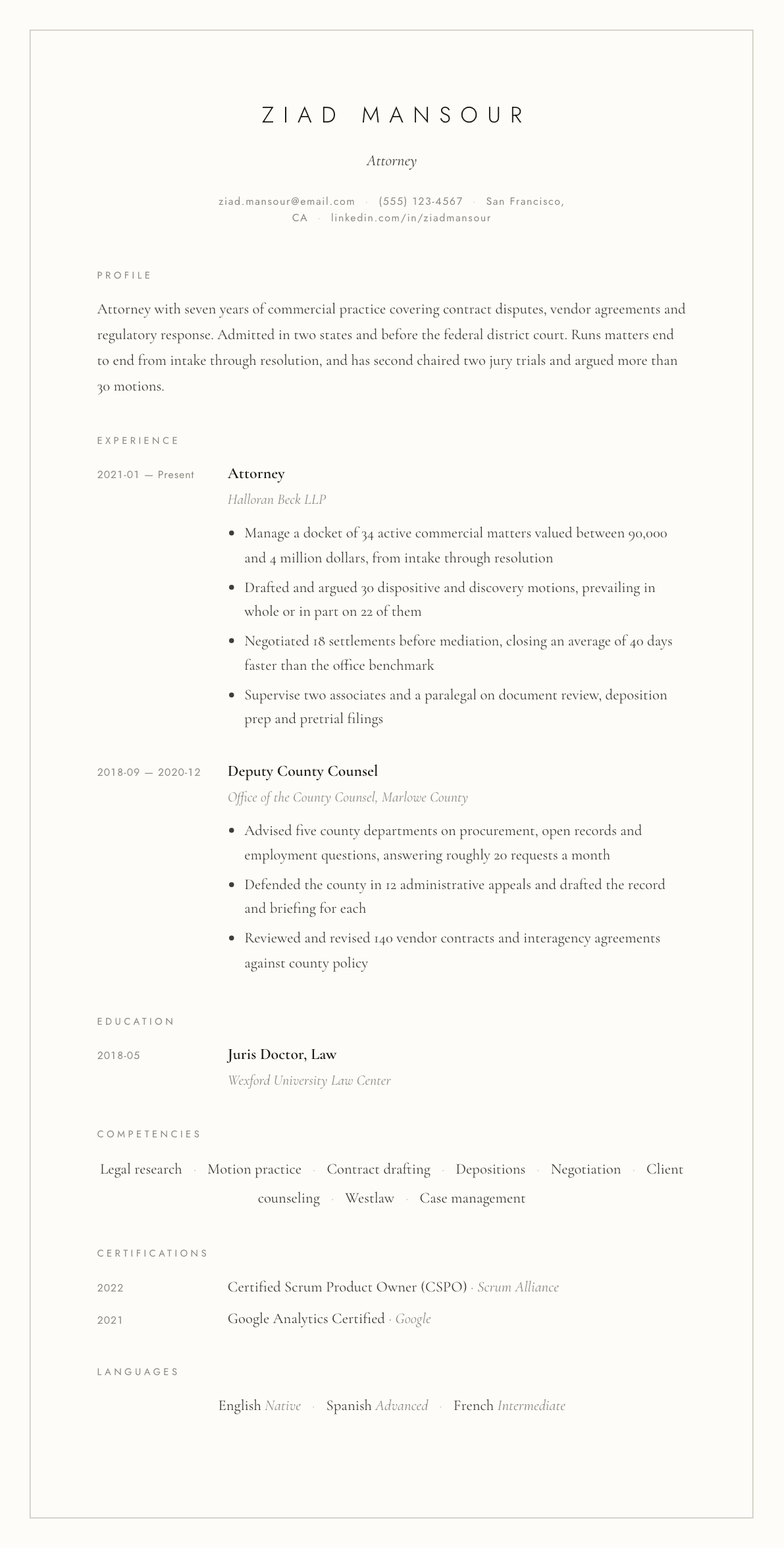
Example Attorney summary
Attorney with seven years of commercial and public sector practice, admitted in two states and before the federal district court. Carries a docket of more than 30 active matters, has argued 30 motions and negotiated 18 settlements, and second chaired two jury trials. Known for early case assessment that tells a client what a dispute is worth before the discovery spend begins.
Skills to list on a Attorney resume
- Legal research
- Legal writing
- Motion practice
- Contract drafting and review
- Discovery management
- Depositions
- Settlement negotiation
- Client counseling
- Regulatory compliance
- Mediation and arbitration
- Trial preparation
- Westlaw and Lexis
- Docket management
- Associate supervision
What actually gets this resume read
- Put bar admissions, the states and the admission year in a labeled block near the top, because screeners check it first.
- Describe matters by type, forum and stage rather than listing duties every licensed attorney performs.
- Quantify your docket: number of active matters, motions argued, depositions taken, settlements negotiated, trials tried.
- Add a representative matters section when the practice area is specialized and the client names must stay confidential.
- Name the research and document platforms you actually use, such as Westlaw, Lexis, Relativity or a case management system.
- Keep clerkships, journal roles and moot court on the resume through your fifth year, then let practice results carry it.
How to write a attorney resume
An attorney resume is read in two passes by two different readers. A legal recruiter or hiring coordinator runs the first pass, checking bar admissions, graduation date, firm or agency names and practice area against the job description. A practicing lawyer runs the second pass and reads only the experience section, asking one question the whole time: could this person take a matter off my desk next month.
Both passes are lost by the same mistake, which is writing responsibilities instead of practice. Every licensed attorney researches, drafts and advises clients. What distinguishes one attorney resume from the next is the subject matter, the forum, the stage of the matters, and the volume you carried while doing it.
This guide covers the admissions block, how to describe matters when confidentiality limits what you can say, how to quantify a practice honestly, and how long law school credentials should stay on the page.
Format: admissions block, then practice, then education
Use reverse chronological order and a single column. Legal hiring is credential driven and dates are load bearing, so a layout that scatters dates into a sidebar creates avoidable friction with both the parser and the reader.
Directly under your contact information, build an admissions block: each state bar with the admission year, then the federal district and appellate courts where you are admitted. If an application is pending, say pending rather than leaving a gap that a screener will read as a problem.
- Header: name, city and state, phone, email, and a professional profile link if you keep one current.
- Bar admissions with jurisdictions and years, including federal courts.
- Experience, then a representative matters section if your practice needs one.
- Education with degree, school and honors, then publications, speaking and bar activity.
Describe matters, not duties
A useful experience bullet names the subject matter, the forum and the posture. Contract dispute in state trial court through summary judgment. Administrative appeal before a state licensing board. Asset purchase for a manufacturing client through closing. Those descriptions let a reader place you against their own docket in a second.
Then say what you personally did. Drafted and argued, negotiated, took the deposition, ran the diligence, wrote the opinion letter. Attorneys read for ownership because staffing decisions turn on whether you have carried a matter or supported someone who did.
Where confidentiality prevents naming a client, describe the client by type and size: a regional health system, a family owned construction company, a municipal water district. That is specific enough to be meaningful and general enough to be safe.
Quantify the practice without inflating it
Numbers on a legal resume should be countable things you could defend in an interview. Active matters on your docket, motions drafted and argued, depositions taken and defended, contracts negotiated, hearings covered, closings completed, opinions issued. Ranges are acceptable and safer than false precision.
Avoid claiming outcomes you did not control. Saying you obtained a favorable result on a matter you second chaired invites a question you will not enjoy answering. Saying you drafted the briefing that supported the ruling is accurate and reads as more confident, not less.
A representative matters section, when the practice calls for it
Specialized practices benefit from a short representative matters list under the job entries, three to six lines describing engagements by type and scope. It works well for regulatory, transactional and appellate practices where the value of your experience lives in the subject matter rather than the volume.
Keep each line to one sentence, keep the client anonymous, and pick matters that map to the posting. A representative matters section that repeats the same case type six times tells a reader your range is narrow, which may be the opposite of your intent.
Education, credentials and what to cut
Law school details earn their space for roughly the first five years of practice: the degree, honors, law review or journal, moot court, clinics and any judicial clerkship. A clerkship stays on the resume permanently because it signals both selection and writing ability.
After the fifth year, compress the education section and give the space to practice results, bar leadership, published articles and continuing legal education in your specialty. Also name your research and workflow tools, since a firm evaluating a lateral wants to know whether you will need retraining on a document review platform or a case management system.
Attorney resume summary examples
Newly admitted
Attorney admitted this year after a judicial clerkship, with drafting experience across 60 bench memoranda and 25 proposed orders on civil motions. Comfortable with research, brief writing and hearing preparation. Seeking a civil litigation associate position with a firm that gives new lawyers early drafting responsibility.
Seven years in
Attorney with seven years of commercial and public sector practice, admitted in two states and the federal district court. Carries more than thirty active matters, has argued 30 motions, negotiated 18 settlements and second chaired two jury trials. Supervises associates and a paralegal on discovery and pretrial work.
Practice group leader
Attorney with sixteen years leading a commercial practice group, responsible for client relationships, staffing and budget across the group docket. Handles the most exposed matters personally, mentors associates through their first depositions, and advises boards on risk before disputes reach a filing.
Work experience bullets: before and after
Before: Handled legal matters for clients.
After: Managed a docket of 34 active commercial matters from intake through resolution, covering contract disputes, vendor claims and regulatory responses.
Docket size and subject matter let a reader place you against their own caseload instantly.
Before: Wrote legal documents and motions.
After: Drafted and argued 30 dispositive and discovery motions in state and federal court, prevailing in whole or in part on 22 of them.
Counting motions drafted and argued separates authorship from assistance, which is what a hiring partner reads for.
Before: Negotiated settlements for clients.
After: Negotiated 18 settlements before mediation was required, closing an average of 40 days faster than the office benchmark for comparable matters.
A comparison against a benchmark gives the number meaning instead of leaving it floating.
Before: Advised clients on legal issues.
After: Advised five county departments on procurement, public records and employment questions, answering roughly 20 requests a month with written guidance.
Naming the client type, the subjects and the volume turns generic advice into a describable practice.
Before: Supervised junior staff.
After: Supervised two associates and a paralegal on document review, deposition preparation and pretrial filings, reviewing every draft before it left the office.
Saying what you supervised, and how, demonstrates leadership a reader can picture.
Hard skills
- Legal research
- Legal writing and brief drafting
- Motion practice
- Contract drafting and negotiation
- Discovery management
- Deposition practice
- Settlement negotiation
- Regulatory and administrative practice
- Client counseling and opinion letters
- Mediation and arbitration
- Trial preparation
- Docket and matter management
- Legal research platforms
- Conflicts and engagement procedures
Soft skills
- Client relationship management
- Judgment under uncertainty
- Written persuasion
- Oral advocacy
- Delegation and review
- Deadline discipline
Certifications worth listing
- Bar admission (State bar admissions authority)
- Admission to the United States District Court (United States District Court)
- Board Certified in Civil Trial Law (National Board of Trial Advocacy)
- Certified Information Privacy Professional (CIPP/US) (International Association of Privacy Professionals)
Mistakes that cost attorney candidates the interview
- Omitting the admissions block, which forces a recruiter to email you a question before the file can move at all.
- Writing tasks every licensed lawyer performs instead of the subject matter, forum and posture of your matters.
- Claiming credit for outcomes you supported rather than controlled, which collapses under the first interview question.
- Keeping a full page of law school detail into your tenth year while practice results get one line each.
- Naming confidential clients rather than describing them by industry and size.
- Using a template with columns and icons, which scrambles the dates that a credential driven screen depends on.
Attorney resume questions
How long should an attorney resume be?
One page through the first few years, two pages once you have several employers, a real matter list and bar or publication activity. Partners and general counsel candidates sometimes run longer, but only when representative matters justify the space.
Where do bar admissions go on the resume?
Immediately below your contact information, before experience. List each jurisdiction with the year admitted and include federal district and appellate courts. If you have an application pending in another state, label it pending rather than leaving it out.
How do I write about matters that are confidential?
Describe the client by industry, size or type instead of by name, and describe the matter by subject and posture. A regional hospital system in a payer reimbursement dispute through summary judgment is specific, useful and discloses nothing protected.
Should I include a representative matters section?
Include one when your value lies in subject matter rather than volume, which is common in regulatory, transactional and appellate work. Keep it to a handful of one sentence entries chosen to match the posting rather than a full catalog.
When should I drop law school honors from my resume?
Compress them around your fifth year of practice, keeping only the degree, any journal and any clerkship. A federal clerkship stays permanently. Everything else should give way to the matters you have handled since admission.