Physical Education Teacher Resume Examples: free score
Coach Your Way to a Great PE Teacher Resume
By Mustafa Tarabya, founder of CVBooster · Published · Updated
Build a physical education teacher resume highlighting your fitness program design, athletic coaching, and commitment to promoting lifelong health and wellness habits.
Sample resumes for a physical education teacher
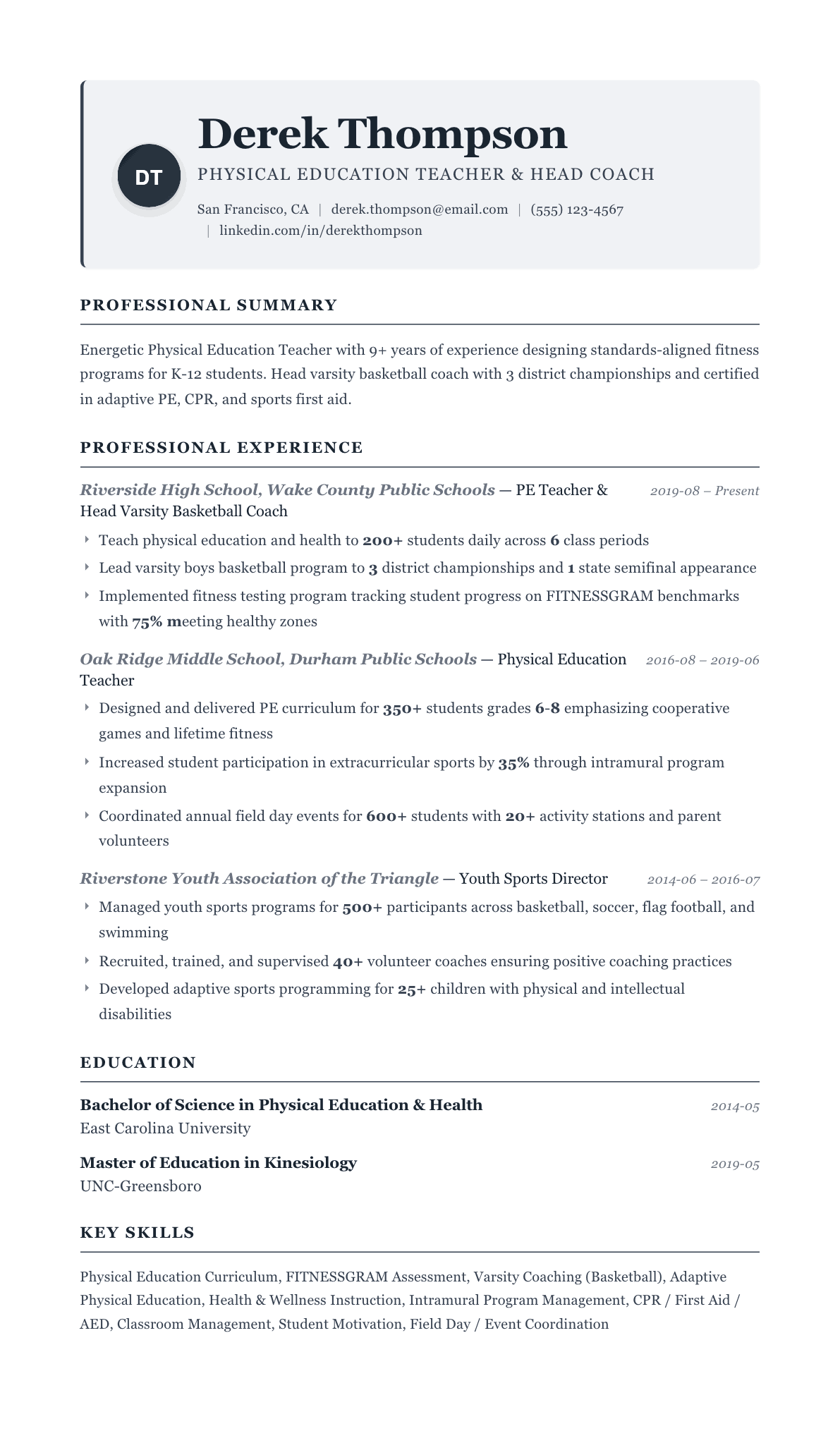
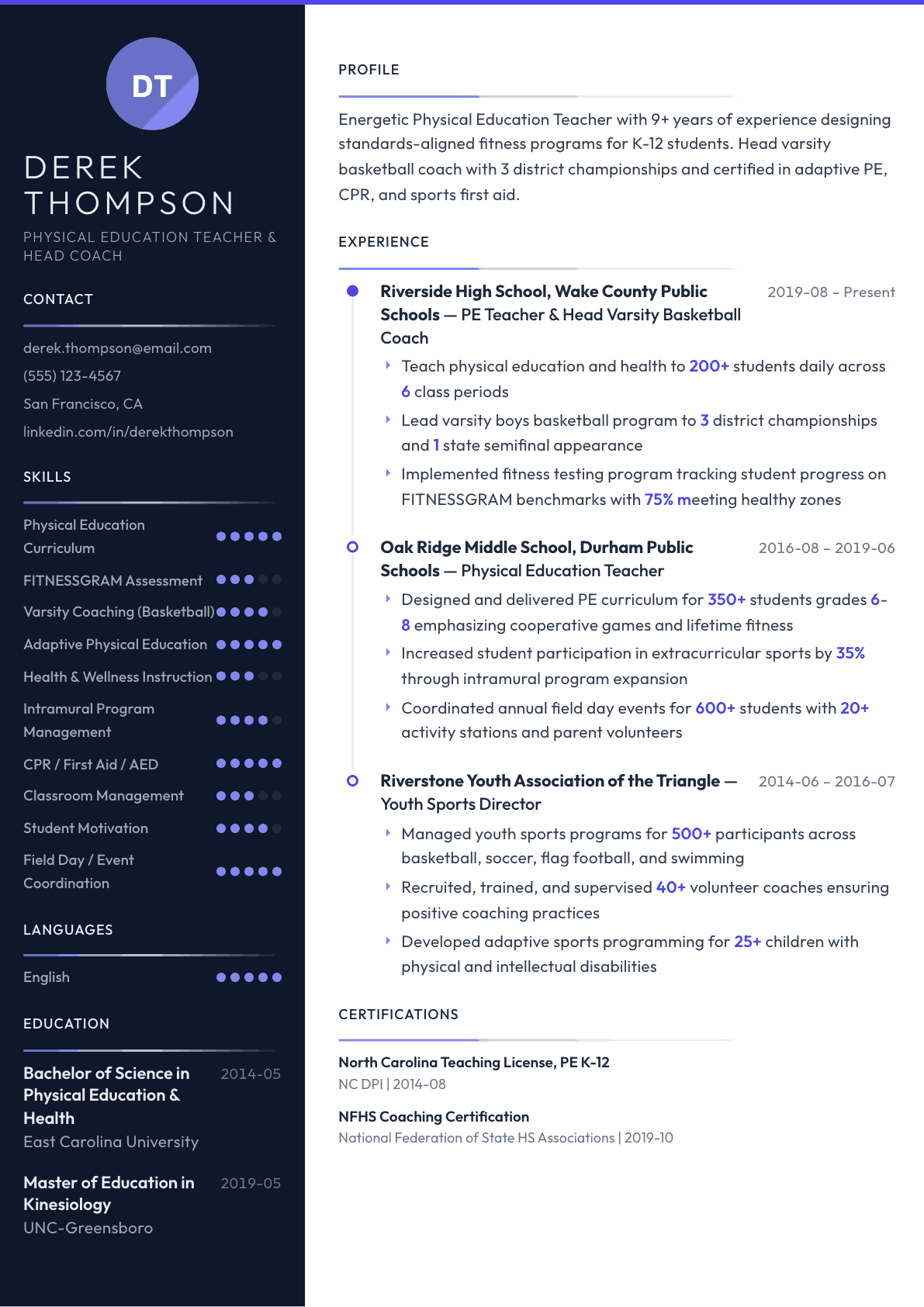
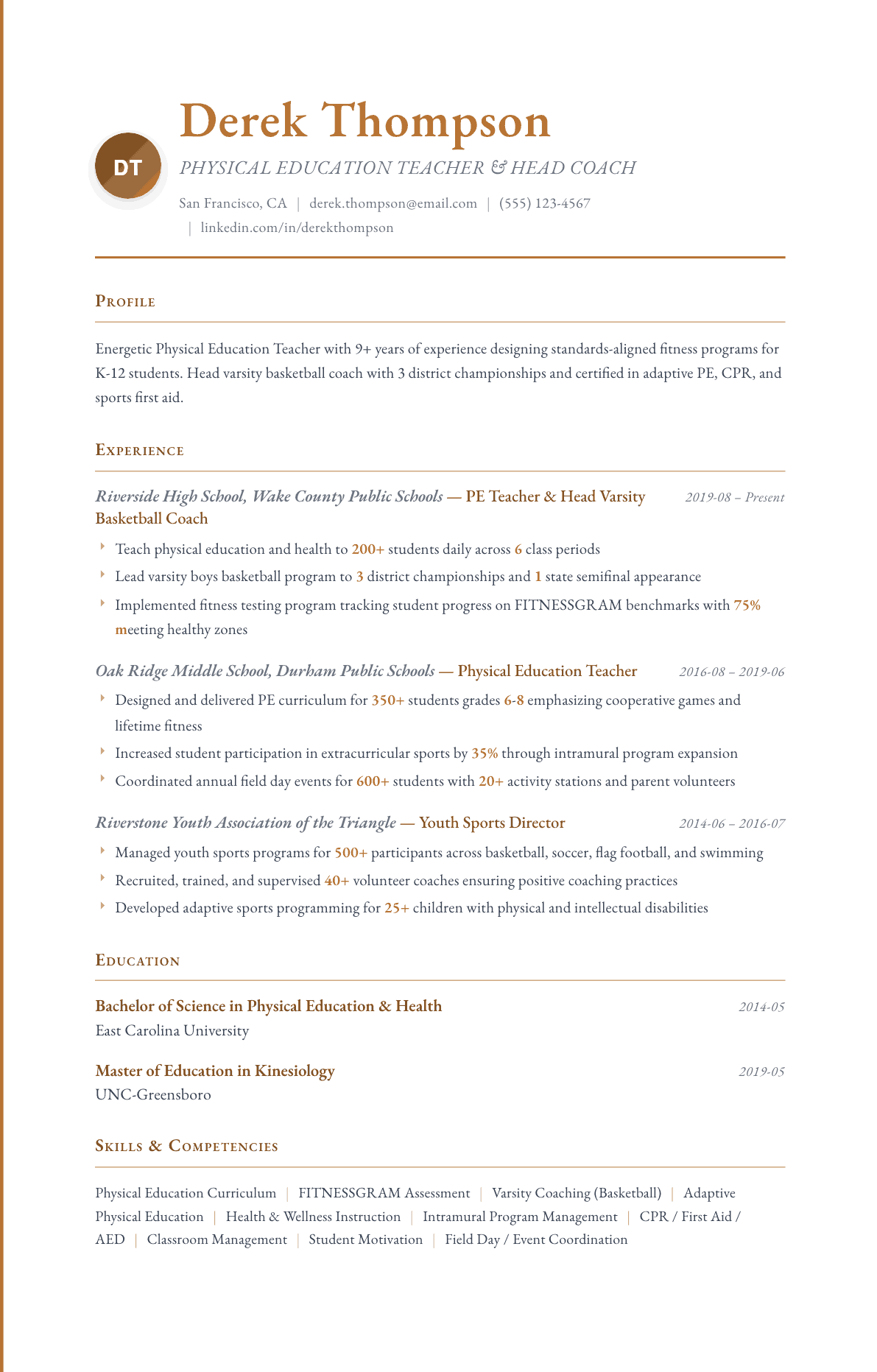
The same physical education teacher content laid out in three CVBooster templates, so you can see what the finished document looks like before you write a word.
Example Physical Education Teacher summary
Physical Education Teacher with 9 years of K-12 experience and head varsity basketball coach with 3 district championships. Designs FITNESSGRAM-aligned programs for 200+ students with 75% healthy fitness zone achievement.
Skills to list on a Physical Education Teacher resume
- PE Curriculum Design
- FITNESSGRAM / Fitness Assessment
- Varsity & JV Coaching
- Adaptive Physical Education
- Health & Wellness Education
- Intramural Programs
- CPR / First Aid / AED
- Classroom Management
- Student Motivation
- Event Coordination
- Sportsmanship Education
- Team Building Activities
What actually gets this resume read
- Highlight coaching records and achievements: championships, playoffs, and all-conference selections.
- Include fitness assessment data: FITNESSGRAM results, participation rates, and fitness improvements.
- Mention adaptive PE experience for students with disabilities. It is a growing specialization.
- List CPR, First Aid, and AED certifications as they are required and demonstrate safety preparedness.
- Showcase extracurricular contributions: intramurals, field day, health fairs, wellness initiatives.
How to write a physical education teacher resume
A physical education teacher resume is usually read alongside a coaching need. Very few schools hire a PE teacher in isolation: the posting exists because a teaching position and one or two coaching stipends came open together, and the principal is trying to fill both with one person. The resume that names the sports you can coach, at what level, next to the grade bands you can teach, solves the principal's actual problem.
The second reader is the district health and physical education coordinator, who cares about the instructional side that the coaching conversation tends to bury. Standards-aligned units, fitness assessment, adapted physical education for students with disabilities, and the health curriculum are the parts of the job that get audited, and they are exactly what most PE resumes leave out.
This guide covers the format districts expect, how to write teaching load, safety responsibility and coaching record so both readers find what they need, three summaries from a first appointment to a department lead, and the questions PE teachers ask when their resume has to carry two jobs at once.
Format: teaching first, coaching second, both on page one
Two pages, reverse-chronological, with a coaching section that stands on its own rather than being scattered through the teaching entries. Splitting them lets a principal read the teaching record straight through and then check the coaching record without losing her place, and it means one file works for a teaching-only posting and a combined one.
Put the license line under the header with the endorsement and grade band, for example health and physical education K-12, plus any adapted physical education authorization your state issues. Add current CPR, first aid and automated external defibrillator certification with the issuing body, because supervising activity without it is a liability question and districts confirm it early.
- Header: name, city and state, phone, email, license with endorsement and grade band, and current life support certification.
- Order: summary, certification, teaching experience, coaching record, education, professional development, skills.
- A first-year candidate leads with student teaching across two grade bands and any assistant coaching or camp work.
Summary: grade bands, daily student load, sports, and one instructional result
Give the grade bands you have taught, the number of students you see in a day, and whether you also teach health. Daily student contact in physical education is far higher than in a classroom subject, and stating it honestly shows you understand the pace of the job.
Then the coaching in one clause: the sports, the levels, and the record or program outcome. Finish with something instructional, such as a fitness assessment result, a participation increase or a unit you built, so the summary does not read as a coach who teaches on the side.
Experience: class sizes, safety, standards and adapted instruction
Open each entry with the teaching assignment: grade levels, class sizes, periods a day, the total students you see weekly, and the facilities you worked in, including whether you shared a gymnasium or taught outdoors and in hallways during weather. Facility constraints are real and a principal respects a candidate who has managed them.
Then the instruction. Name the units you teach and the standards framework you plan against, whether that is a national physical education standards set or your state framework. Describe the fitness assessment you administer, how you report results to families, and what the data changes about your units. Skill themes, invasion games, net and wall games, dance, outdoor pursuits and personal fitness are the units a coordinator recognizes.
Adapted physical education deserves its own bullets. Say how many students with individualized education programs you served, how you modified activities, how you worked with special education staff and therapists, and whether you attended meetings as the physical education representative. It is the fastest way to separate yourself from candidates who only describe games.
Safety and supervision run underneath everything. Equipment inspection, emergency action plans, heat and hydration protocols, concussion recognition, locker room supervision and incident documentation are ordinary parts of the job, and naming them shows a principal you understand where the risk lives.
The coaching record
Give each coaching position the sport, the level, the years, the roster size and the outcome. Conference and district finishes, tournament appearances, and athletes who continued to the college level are all fair to list. So is taking over a program with six players and finishing with twenty, which is a harder achievement than a winning season with a full roster.
Add the parts of coaching that transfer to school leadership: budget and equipment, transportation and schedule coordination, eligibility and academic monitoring, parent meetings, fundraising, and supervising assistant coaches. Principals hire coaches who create fewer problems, not more.
Skills and certifications the district will verify
List the fitness assessment system you administer, the heart rate or activity tracking technology you use, the health curriculum you teach from, and any aquatics or outdoor pursuit qualifications such as lifeguard or water safety instructor, since a pool changes what a school can offer.
Coaching certifications are checked in most states before you can be on a sideline. Name the coaching education body, the concussion training you completed, and any sport-specific credential. Keep the expiry dates current on the resume, because an out-of-date life support card delays a start date.
Physical Education Teacher resume summary examples
First appointment
Physical education teacher licensed K-12 with student teaching across an elementary building of 480 students and a middle school program of 340. Trained in adapted physical education, certified in first aid and life support, and served two seasons as an assistant track and cross country coach.
Eight years in
Physical education and health teacher with eight years at the secondary level, seeing about 210 students a day across six periods. Head girls soccer coach for five seasons with three district tournament appearances, and moved the share of students in the healthy fitness zone from 58% to 74%.
Department lead
Health and physical education department lead supervising five teachers across a 1,500-student high school, responsible for the four-year course sequence, adapted physical education services and the athletics equipment budget. Rewrote the personal fitness elective, which now enrolls three sections a semester.
Work experience bullets: before and after
Before: Taught physical education classes to middle school students.
After: Taught six periods a day of physical education and health to grades 6 through 8, about 220 students a week in classes of 38, sharing one gymnasium with a second teacher on a split schedule.
Class size, daily periods and the shared facility describe the working conditions you have actually managed.
Before: Coached the varsity basketball team.
After: Coached varsity boys basketball for six seasons with a roster of 14, reaching the district tournament four times, and managed the program budget, transportation and eligibility monitoring for all three levels.
Seasons, roster, results and the administrative load show a program manager rather than a bench coach.
Before: Conducted fitness testing with students.
After: Administered fall and spring fitness assessments for 600 students, reported individual results home with an explanation of the healthy fitness zone, and rebuilt the winter unit around the two components with the weakest results.
Testing means little on its own; reporting home and changing the unit is what a coordinator wants to see.
Before: Worked with students with special needs.
After: Served 26 students with individualized education programs in general physical education, modifying equipment and rules for each unit and attending annual meetings as the physical education representative.
The caseload, the modification practice and the meeting role prove adapted instruction rather than good intentions.
Before: Organized school sports and activity events.
After: Built an intramural program running four seasons a year that drew 180 participants, and coordinated a field day for 600 students across 20 activity stations staffed by parent volunteers.
Participation counts and the operational scale turn an event into evidence you can run a program.
Hard skills
- Standards-aligned physical education curriculum
- Fitness assessment administration and reporting
- Adapted physical education and modification
- Health education instruction
- Skill theme and movement concept instruction
- Invasion, net and target games units
- Personal fitness and strength training instruction
- Emergency action planning and incident documentation
- Equipment inspection and inventory
- Concussion recognition protocols
- Intramural and activity program design
- Heart rate and activity tracking technology
- Athletic budget and transportation coordination
Soft skills
- Managing large groups in open space
- Voice and signal control
- Motivating reluctant participants
- Working with parents of athletes
- Composure during injuries
- Collaboration with special education staff
Certifications worth listing
- CPR, AED and First Aid for Schools and Community (American Red Cross)
- Basic Life Support for Healthcare and Public Safety (American Heart Association)
- Fundamentals of Coaching and Concussion in Sports (National Federation of State High School Associations Learning Center)
- Certified Adapted Physical Educator (CAPE) (National Consortium for Physical Education for Individuals with Disabilities)
- Lifeguarding and Water Safety Instructor (American Red Cross)
- National Board Certification, Physical Education (National Board for Professional Teaching Standards)
Mistakes that cost physical education teacher candidates the interview
- Writing the resume as a coaching resume, so the district coordinator sees no evidence of standards-based instruction.
- Leaving life support and first aid certification off or letting the dates lapse, which delays clearance to supervise activity.
- Omitting class sizes and daily student contact, the numbers that show whether you have handled a full secondary load.
- Saying nothing about students with disabilities, when adapted physical education is a required part of the position.
- Listing sports coached without levels, seasons or roster sizes, which reads as participation rather than responsibility.
- Ignoring facility and equipment constraints, when managing a shared gymnasium is a skill principals actively look for.
Physical Education Teacher resume questions
Should coaching go on the same resume as teaching?
Yes, in its own section. Most secondary openings pair a teaching assignment with coaching stipends, and a principal needs to see both at once. Keep the teaching record complete first so the file still works for an elementary or teaching-only posting.
How do I show instructional quality in physical education?
Name the standards framework you plan against, the units in your yearly plan, and the assessment you use for skill and fitness. Then show one instance where assessment results changed what you taught, which is the evidence a district coordinator looks for during a curriculum review.
Do I need an adapted physical education credential?
Not in every state, but experience serving students with individualized education programs is expected everywhere, since general physical education is a common placement. If your state offers an authorization or endorsement, listing it makes you noticeably easier to place.
How do I move from elementary to secondary physical education?
Confirm your endorsement covers the grade band, then lead with anything secondary in your record: middle school student teaching, coaching adolescents, camp or club work with teenagers, and any health course content. Elementary experience is an advantage for a district that wants continuity across buildings.
What if I have coached for years but never taught?
Apply for the teaching position on the strength of your license and student teaching, and use the coaching record to show group management, planning and safety practice. Be explicit about the alternative certification route you are on if you do not yet hold the endorsement.