Reading Specialist Resume Examples: the lines they read
Open New Chapters with a Reading Specialist Resume
By Mustafa Tarabya, founder of CVBooster · Published · Updated
Build a reading specialist resume highlighting your literacy assessment expertise, intervention program design, and ability to accelerate reading growth for struggling learners.
Sample resumes for a reading specialist
The same reading specialist content laid out in three CVBooster templates, so you can see what the finished document looks like before you write a word.
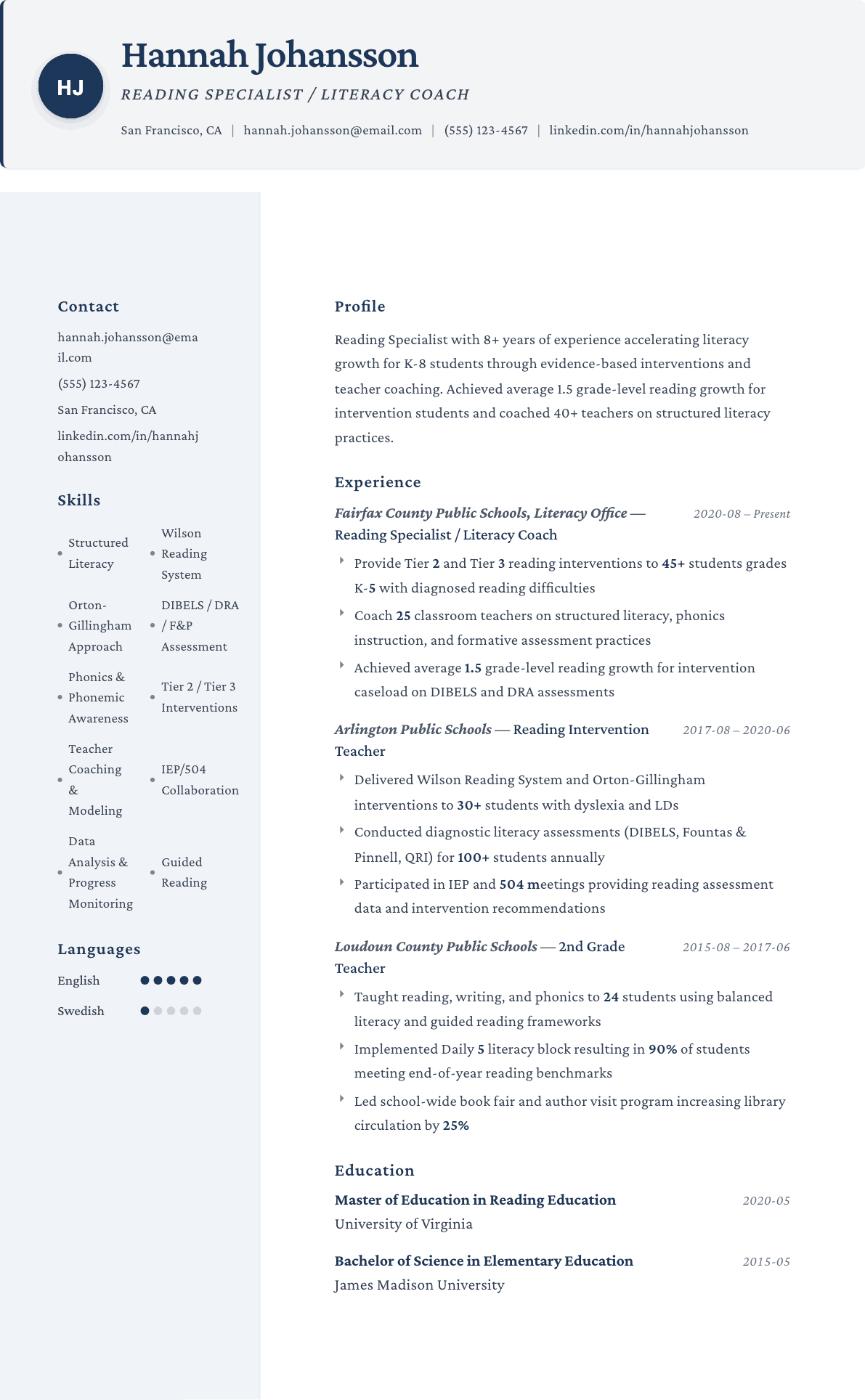
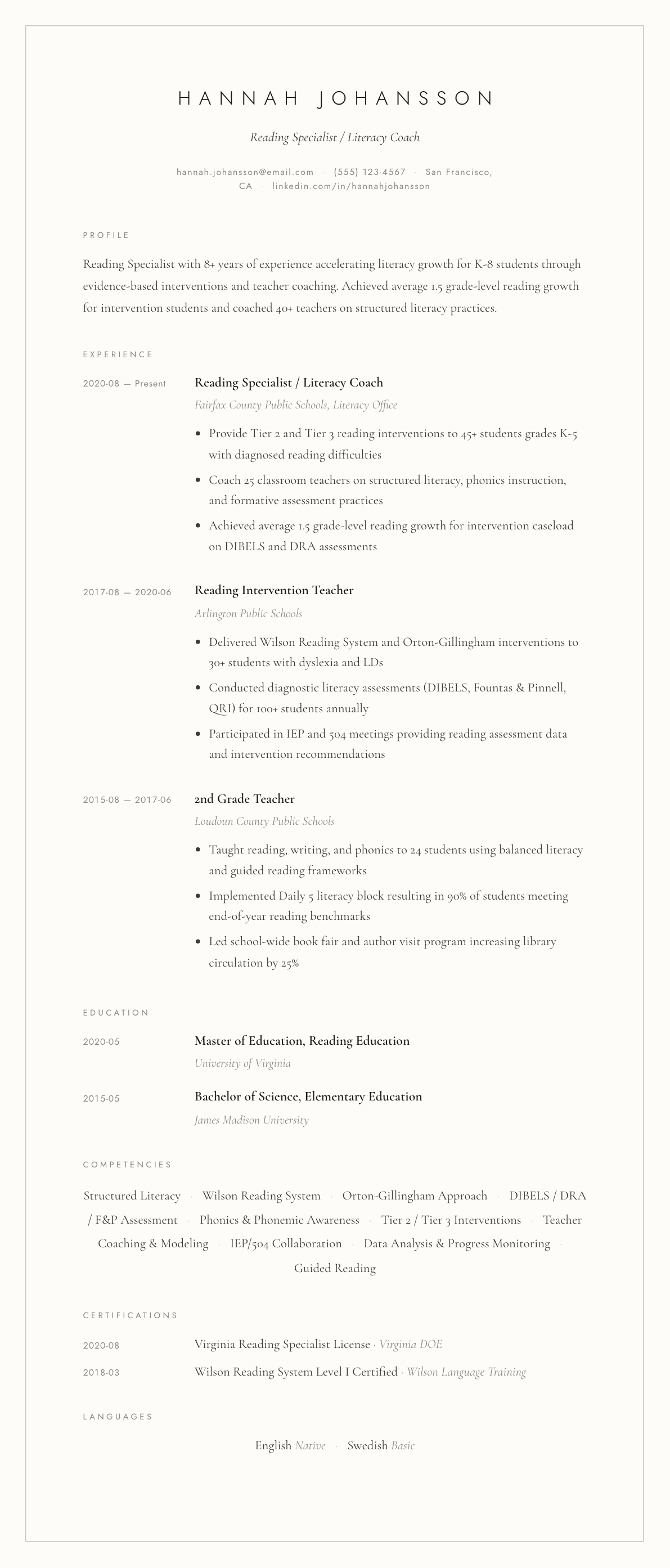
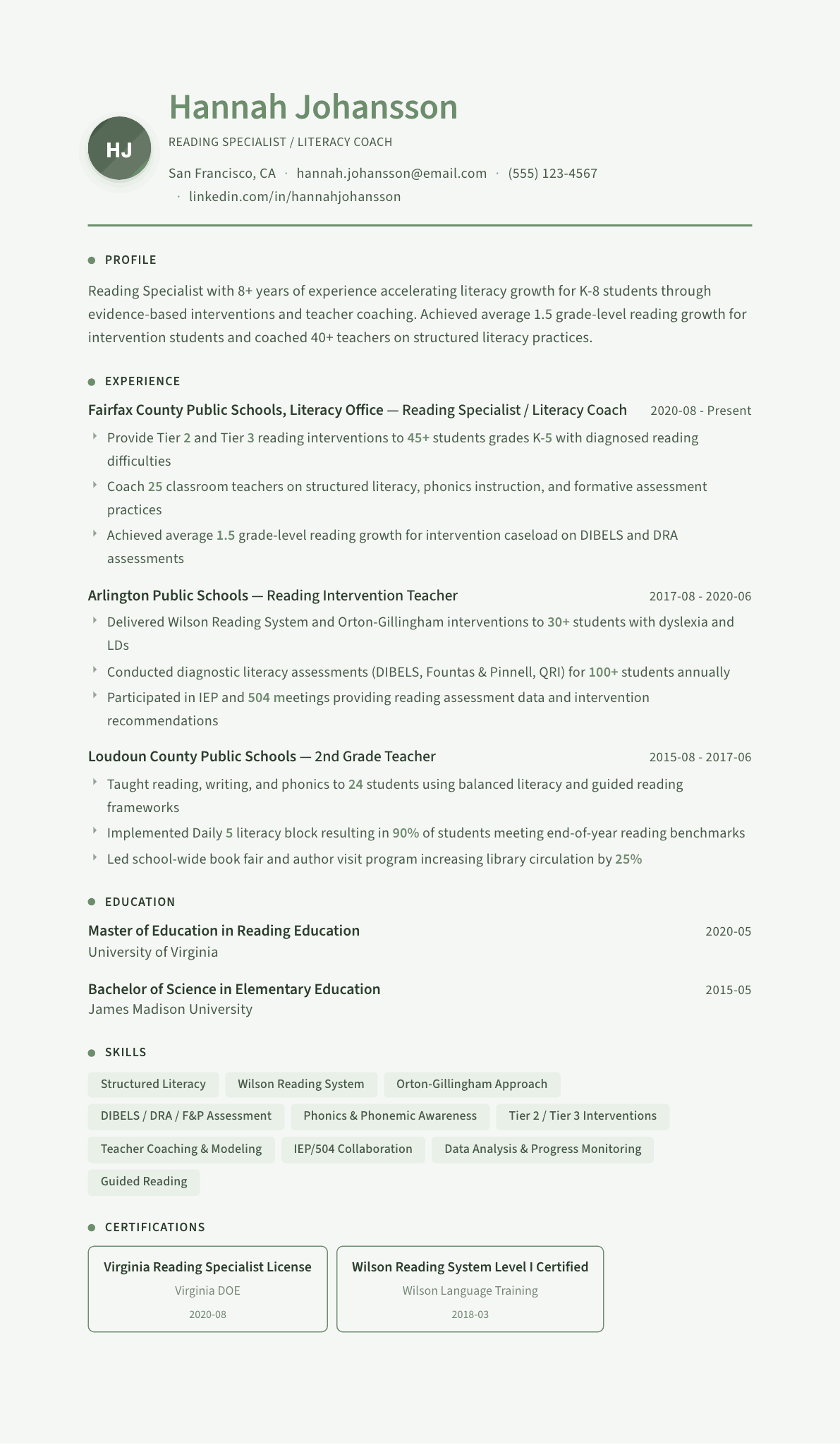
Example Reading Specialist summary
Reading Specialist with 8 years of literacy education experience achieving 1.5 grade-level reading growth for intervention students. Wilson and Orton-Gillingham certified, coaching 40+ teachers on structured literacy and phonics instruction.
Skills to list on a Reading Specialist resume
- Structured Literacy Instruction
- Wilson Reading System
- Orton-Gillingham
- DIBELS / DRA Assessment
- Phonics & Phonemic Awareness
- Tier 2 / Tier 3 Interventions
- Literacy Coaching
- IEP / 504 Collaboration
- Progress Monitoring
- Guided Reading / Balanced Literacy
- Dyslexia Screening
- Data-Driven Instruction
What actually gets this resume read
- Quantify student reading growth: grade-level gains, benchmark achievement percentages, assessment scores.
- List literacy programs and curricula you use: Wilson, Orton-Gillingham, LLI, Fundations, UFLI.
- Include diagnostic assessment tools: DIBELS, DRA, Fountas & Pinnell, QRI, PAST.
- Highlight teacher coaching and professional development facilitation as key leadership activities.
- Mention IEP/504 collaboration and knowledge of dyslexia and learning disability accommodations.
How to write a reading specialist resume
A reading specialist resume is read by a literacy coordinator or a principal who has a specific problem: a cohort of students who are not reading at grade level, a state early literacy requirement to satisfy, and a staff that needs coaching more than it needs another pull-out group. The resume that gets a call names the assessments, the intervention programs and the training that answer that problem directly.
The field has also changed underfoot. Districts have moved toward structured literacy and explicit phonics, and many states now require teachers to complete training grounded in the reading research. A resume that still describes balanced literacy, leveled guided reading and three-cueing strategies without any mention of that shift reads as out of date to the person hiring, even when the candidate is excellent.
This guide covers how to present assessment expertise, intervention delivery and adult coaching, three summaries from a first specialist role through a district literacy lead, and the questions reading specialists ask when moving from a classroom into an intervention or coaching position.
Format: two pages, with licensure and training near the top
Reverse-chronological, two pages, plain formatting. Put the reading specialist license or endorsement under your header with the state and grade range, since it is a legal requirement for the title in many places and the first thing a human resources office verifies.
Add a short training line immediately beneath it listing the intervention programs you are certified to deliver and the professional learning you have completed in the science of reading. That block does more work than anything else on the page, because it tells a coordinator which of her programs you could run on day one.
- Header: name, city and state, phone, email, and the reading specialist license with state and grade range.
- Order: summary, licensure and literacy training, intervention and coaching experience, classroom experience, education, assessment skills.
- A classroom teacher moving into the role leads with intervention groups, data team work and any coaching of colleagues.
Summary: grade range, caseload, tier of service, and growth
State the grades you serve, the size of your caseload, whether you deliver Tier 2 or Tier 3 support, and how much of your week goes to coaching adults rather than teaching children. Those two halves of the job are weighted differently in every district, and a coordinator is trying to work out which half you are strong in.
Then one growth result with the measure named. Reading growth is measurable in this role in a way it is not for most educators, so use it, and give the caseload size and the interval so the number can be read properly.
Assessment: name the instruments and what you do with the results
Assessment fluency is the core technical skill. List the screeners, diagnostics and progress monitoring tools you administer and interpret, and be precise about which is which. A universal screener that flags risk, a diagnostic that locates the broken skill, and a progress monitoring probe run every week or two are three different instruments doing three different jobs.
Then show the reasoning. Say how you move from a screening flag to a diagnostic decision, how you set a growth goal and an aim line, how often you monitor, and what triggers a change in the intervention. A specialist who describes a decision rule for changing course is describing expertise; a specialist who lists test names is describing training.
Include the dyslexia side of the work explicitly, since many states now require screening and specific parent notification. Phonological awareness, rapid automatized naming, nonsense word decoding and spelling inventories are the measures a coordinator expects a specialist to be comfortable with.
Intervention: the program, the group, the minutes, the fidelity
Write intervention entries the way a scheduler thinks about them: the program name, group size, minutes per session, sessions per week, and the grade span. "Thirty minutes daily in groups of three, kindergarten through second grade" tells a principal exactly what your day looked like and whether it matches her master schedule.
Name the programs you are trained in rather than describing them generically, because certification in a structured literacy program is a real credential with hours attached. Then say what you did when a group was not responding: regrouping, adding a phonological awareness layer, shortening the text, increasing repetition, or referring for evaluation.
Cover the special education boundary carefully. Contributing assessment data to eligibility meetings, writing present levels for reading goals, and collaborating with speech language pathologists and special educators are ordinary parts of the job, and saying so shows you know where your role ends.
Coaching adults, which is half the job in most districts
Say how many teachers you coached, what the cycle looked like, and what changed in classrooms as a result. Modeling a lesson, co-teaching, observing with a focus, and a debrief with a next step are the steps of a coaching cycle, and a coordinator wants to know that you can do it with a resistant colleague as well as an eager one.
Add the systems work: leading a data team meeting, building the intervention block into a master schedule, selecting or piloting a core program, running professional learning for a staff, and serving on a multi-tiered support team. That is the work that turns a specialist into a district literacy lead.
Reading Specialist resume summary examples
First specialist role
Reading specialist licensed for kindergarten through grade six, moving from four years as a second grade teacher running daily small-group intervention. Trained in a structured literacy program, fluent in universal screening and progress monitoring, and experienced in leading grade-level data meetings.
Seven years in the role
Reading specialist serving a caseload of 48 students in grades kindergarten through five with Tier 2 and Tier 3 intervention, plus coaching for 14 classroom teachers. Intervention students averaged more than a year of growth per year on the district reading measure across three consecutive cohorts.
District literacy lead
District literacy lead supporting nine elementary buildings and 22 interventionists, responsible for the screening calendar, the intervention program inventory and the state early literacy plan. Led the transition to a structured literacy core program and trained 180 teachers across two summers.
Work experience bullets: before and after
Before: Provided reading intervention to struggling students.
After: Delivered Tier 3 intervention to 18 students in kindergarten through second grade in groups of three, 30 minutes daily, using a structured literacy program with weekly decoding probes.
Tier, group size, minutes and the monitoring schedule let a principal place you on a real intervention block.
Before: Assessed students to determine reading levels.
After: Administered universal screening three times a year for 420 students, followed flagged students with a phonics and phonological awareness diagnostic, and used the results to build intervention groups by skill rather than by grade.
The screen, the diagnostic and the grouping decision show the assessment reasoning rather than the test names.
Before: Coached teachers on reading instruction.
After: Ran six-week coaching cycles with 14 classroom teachers, modeling a phonics lesson, co-teaching the following week, then observing with an agreed focus and setting one next step in the debrief.
Naming the cycle structure proves coaching practice instead of informal advice in the hallway.
Before: Tracked student progress over the year.
After: Monitored progress every two weeks against a goal line, and changed the intervention for any student with four consecutive points below the line, documenting each change for the support team.
A written decision rule is the difference between collecting data and using it.
Before: Participated in special education meetings.
After: Presented reading assessment data at 30 eligibility and annual review meetings a year, wrote the reading portion of present levels, and helped draft measurable decoding and fluency goals with the special education team.
Specific meeting volume and the documents you contributed to show where your expertise lands in the process.
Hard skills
- Structured literacy instruction
- Explicit systematic phonics
- Phonological and phonemic awareness instruction
- Universal screening administration
- Diagnostic literacy assessment
- Progress monitoring and goal setting
- Orton-Gillingham based intervention
- Multi-tiered systems of support
- Dyslexia screening and indicators
- Fluency and comprehension intervention
- Vocabulary and morphology instruction
- Instructional coaching cycles
- Data team facilitation
- Individualized education program collaboration
Soft skills
- Coaching resistant colleagues
- Explaining data to families
- Patience with slow growth
- Confidentiality
- Team facilitation
- Persuading without authority
Certifications worth listing
- Wilson Reading System Level I and Level II Certification (Wilson Language Training)
- Certified Academic Language Therapist (CALT) (Academic Language Therapy Association)
- Structured Literacy Certification (Center for Effective Reading Instruction)
- Orton-Gillingham Classroom Educator or Associate Level (Academy of Orton-Gillingham Practitioners)
- National Board Certification, Literacy Reading Language Arts (National Board for Professional Teaching Standards)
Mistakes that cost reading specialist candidates the interview
- Describing the role in balanced literacy language when the district has adopted a structured literacy approach and says so in the posting.
- Listing assessment names without distinguishing a screener from a diagnostic from a progress monitoring probe.
- Reporting growth with no caseload size and no interval, which leaves the claim impossible to interpret.
- Leaving out coaching entirely, when adult support is half of the position in most elementary schools.
- Omitting the intervention programs you are certified in, the exact strings a coordinator searches the file for.
- Blurring the line with special education by implying you diagnose disabilities rather than contribute assessment evidence.
Reading Specialist resume questions
Do I need a reading specialist license to apply?
In most states the title itself requires a specialist license or endorsement, usually built on a teaching license plus graduate coursework and a practicum. Interventionist and literacy tutor positions often do not, so read the posting carefully and state where you are in the licensure process.
How do I move from classroom teaching into a reading specialist role?
Surface the intervention work you already do. Small-group instruction by skill, screening administration, data team participation, and any colleague you have modeled a lesson for all belong on the resume. Then add the specialist coursework or program certification you are pursuing with the expected completion term.
Which intervention programs should I name?
Name the ones you are trained in, with the training level, since certification hours differ enormously between a short overview and a full practicum-based credential. If you have delivered a program without formal certification, say that plainly rather than implying a credential you do not hold.
How much should I say about the science of reading?
Show it rather than announce it. Name the training you completed, the structured literacy practices you use, and the assessment decisions you make from decoding and phonological data. A coordinator can tell from the vocabulary of your bullets whether the training changed your practice.
Should I include growth numbers for my intervention students?
Yes, when you can state the measure, the caseload size and the time period. Report growth in the terms your district uses, such as points on a benchmark measure or the share of students who exited intervention, and avoid grade level equivalents when a more precise measure exists.