First-Year Teacher Resume Examples: the lines they read
Write a First-Year Teacher Resume Without Years of Experience
By Mustafa Tarabya, founder of CVBooster · Published · Updated
First-year teacher resume example that turns student teaching, certification and tutoring into evidence a principal can hire on.
Sample resumes for a first-year teacher
The same first-year teacher content laid out in three CVBooster templates, so you can see what the finished document looks like before you write a word.
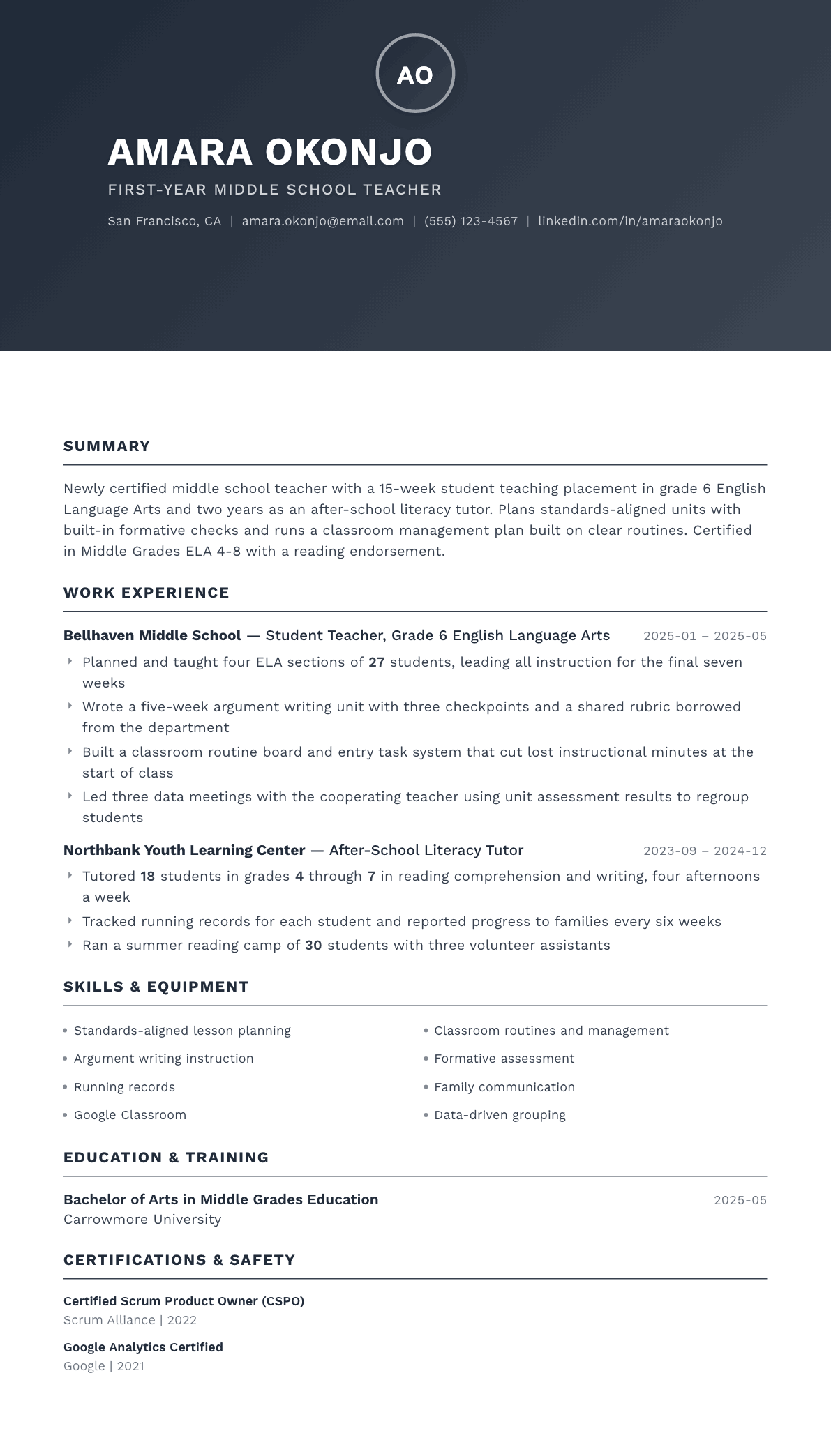
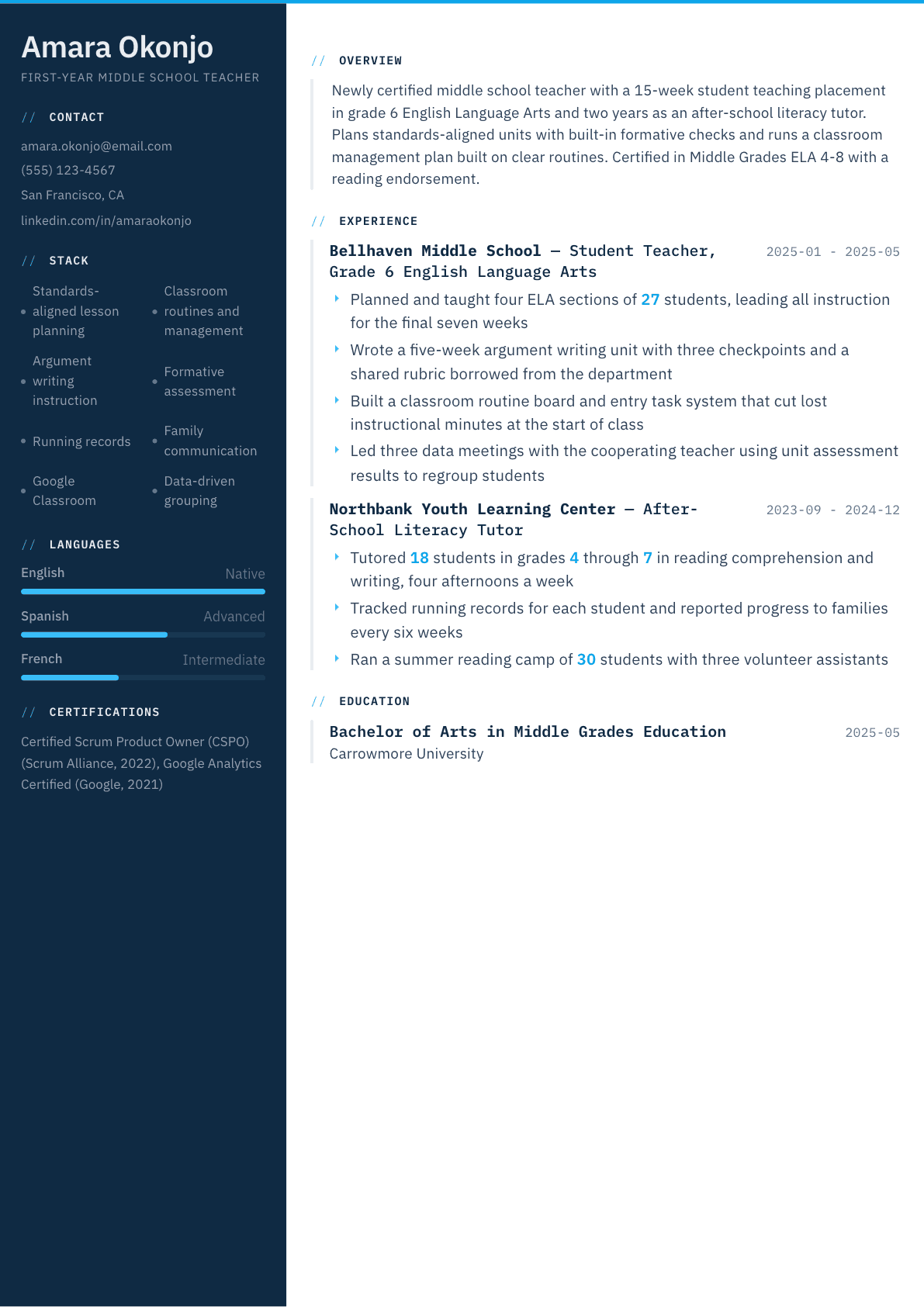
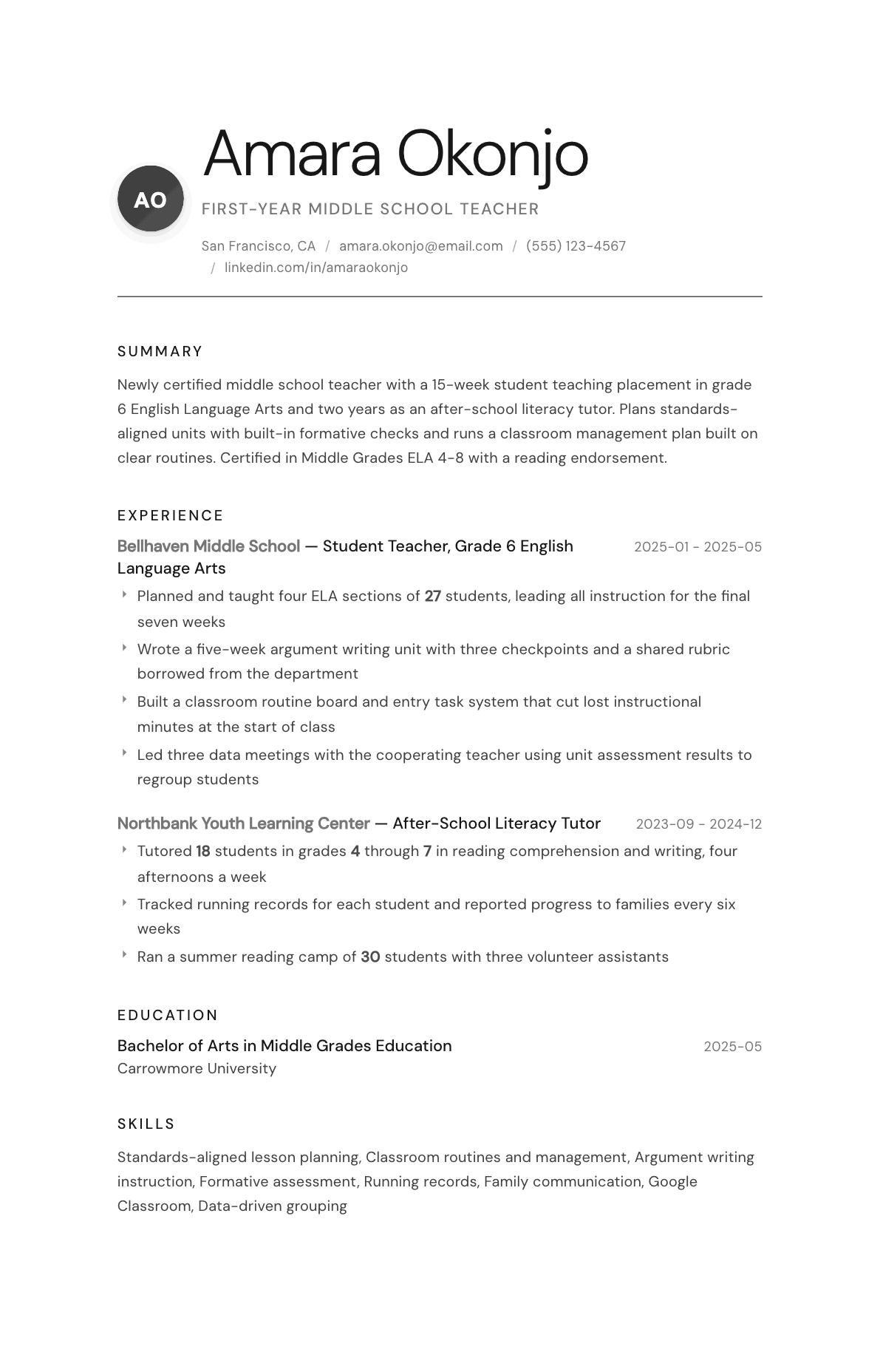
Example First-Year Teacher summary
Newly certified middle grades teacher with a 15-week grade 6 English Language Arts placement, leading all four sections alone for the final seven weeks. Wrote a five-week argument writing unit with three checkpoints and led data meetings that regrouped students after each assessment. Two years tutoring 18 students in reading. Certified Middle Grades ELA 4-8 with a reading endorsement and seeking a first classroom.
Skills to list on a First-Year Teacher resume
- Standards-aligned lesson planning
- Classroom management systems
- Formative assessment
- Differentiated instruction
- Small group instruction
- Reading comprehension instruction
- Argument and expository writing
- Running records
- Data-driven grouping
- Family communication
- Google Classroom
- Behavior support routines
- Co-teaching
- Curriculum pacing guides
What actually gets this resume read
- Lead with certification area and grade band, because a principal with a specific vacancy screens on that line first.
- Turn student teaching into a job entry with school, grade, class size, subject and the weeks you led alone.
- Describe your classroom management plan in one concrete sentence rather than claiming strong classroom management skills.
- Count tutoring, camp, coaching and paraprofessional hours as experience, with student numbers and how long you did it.
- Show you can read data by naming an assessment you used to regroup students or reteach a standard.
- Keep the resume to one page and drop unrelated retail or service jobs older than your teaching preparation.
How to write a first-year teacher resume
The first-year teacher application is judged against a question the posting never states: can this person survive September without the building having to rescue them. A principal filling a vacancy with a new hire is accepting a known risk, so the file that wins is the one that reduces it. Certification settled, a placement that produced real evidence, and a classroom management plan described concretely rather than promised.
Most candidates work the opposite way. They lead with enthusiasm, list coursework, and describe lessons as engaging and student-centered. Every file in the stack says that, so it carries no weight at all. What carries weight is a unit you planned, the checkpoints inside it, what the data showed, and what you changed afterward.
This guide covers how a first-year candidate should order the page, how to describe management without adjectives, how to count tutoring and camp work as experience, three example summaries, before and after bullets, and the questions new teachers ask during spring hiring season.
Format: certification first, one page, no objective
One page, reverse chronological, single column, no icons. Put the certification area and grade band directly under your header. A principal with one grade 6 English vacancy is screening for that line, and a file that makes them hunt for it competes at a disadvantage against thirty others that do not.
Drop the objective statement. It repeats what the application already says and spends four lines that belong to your placement. Drop coursework lists as well, unless a specific course matches an unusual posting requirement such as a reading endorsement.
- Header: name, city and state, phone, email, certification area with grade band and status.
- Order: summary, certification, teaching experience including placements, related work, education, skills.
- Cut: objective statement, high school, coursework lists, unrelated jobs older than the program.
Summary: certification, placement, and one piece of evidence
Three lines. Certification area and grade band, the placement with grade, subject and weeks led alone, and one result. Then close with what you are seeking, stated as a specific assignment rather than an opportunity to grow.
The weeks you led alone is the number that matters most. A first-year teacher who took four sections by themselves for seven weeks has already done the job at a smaller scale, and saying so in the first three lines changes how the rest of the page is read.
Classroom management described, not claimed
Strong classroom management on a resume from a candidate with no classroom years is an empty phrase, and experienced readers discount it instantly. Replace it with the system you actually ran: a posted agenda, an entry task students begin without prompting, a routine board, a seating chart with a reason behind it, a redirection sequence, and how you handled the same two students who needed more.
One sentence of that beats a paragraph of assurance. It also gives the interview panel something to ask about, and answering a management question with a real routine you have used is the single strongest moment a first-year candidate can have.
Turning placements and side work into experience
Write your student teaching placement as a job entry: school, grade, subject, section count, class size, dates, and the weeks you led all instruction. Then bullets on the unit you designed, the assessment you built, the data meetings you took part in, and the regrouping decisions that followed.
Count everything else that put you in front of students. Tutoring with student numbers and duration, summer camps with headcounts and staff you supervised, coaching, after-school programs and paraprofessional work. Two years tutoring eighteen students in reading four afternoons a week is a real teaching history, and a principal reads it that way when you present it with numbers.
If you completed a second placement, a practicum or observation hours in a different grade band, name it. Range reassures a principal who might need to move you between grades in year two.
Skills, references and tailoring to each vacancy
Keep the skills list to things you have done: standards-aligned planning, formative assessment, small group instruction, running records, behavior support routines, the learning platform and the assessment tools you used. A skills block that claims capabilities the experience section never shows is the fastest way to look inexperienced.
Tailor per vacancy. Change the summary line to name the exact grade and subject on the posting, and reorder your bullets so the closest work sits first. Ten tailored applications produce more interviews than fifty identical ones, and as a first-year candidate you need the reader to feel the file was written for their opening.
- Name the assessments you have administered rather than saying you are data driven.
- Ask your cooperating teacher and a tutoring supervisor to serve as references.
- Rewrite the summary line for every posting so the grade and subject match exactly.
First-Year Teacher resume summary examples
Applying before graduation
Teacher candidate graduating this spring with certification pending in Middle Grades English Language Arts, grades 4 to 8. Completed a 15-week grade 6 placement teaching four sections and led all instruction for the final seven weeks. Seeking a middle school ELA classroom.
Certified and hunting
Newly certified middle grades teacher with a 15-week grade 6 English Language Arts placement of four sections and two years tutoring 18 students in reading. Wrote a five-week argument writing unit with three checkpoints and led three data meetings using unit results to regroup students.
Career changer entering teaching
Career changer completing an alternative certification in Middle Grades English Language Arts after eight years managing a youth literacy program. Led a 12-week placement teaching three grade 7 sections, and previously supervised six tutors serving 90 students a week. Seeking a middle school classroom.
Work experience bullets: before and after
Before: Student taught in a middle school English classroom.
After: Planned and taught four grade 6 ELA sections of 27 students, leading all instruction for the final seven weeks.
Section count, class size and solo weeks answer the question every principal asks about a new hire.
Before: Created engaging lessons for students.
After: Wrote a five-week argument writing unit with three checkpoints and a shared rubric adopted from the department.
A unit with structure and a rubric is a document that exists, unlike an engaging lesson.
Before: Had strong classroom management.
After: Built a routine board and entry task system that cut lost instructional minutes at the start of every class period.
A named system with an effect gives the panel something concrete to ask about in the interview.
Before: Used student data to inform teaching.
After: Led three data meetings with the cooperating teacher using unit assessment results to regroup students for reteaching.
Meetings, source data and the resulting decision show the full cycle instead of a slogan.
Before: Tutored students after school.
After: Tutored 18 students in grades 4 to 7 in reading comprehension and writing four afternoons a week for two school years.
Numbers, grade range, frequency and duration turn side work into a genuine teaching history.
Hard skills
- Standards-aligned lesson planning
- Unit design with formative checkpoints
- Classroom routines and management systems
- Small group instruction
- Reading comprehension instruction
- Argument and expository writing instruction
- Running records and benchmark assessment
- Data-driven student grouping
- Differentiated instruction
- Google Classroom
- Behavior support routines
- Family communication
Soft skills
- Taking coaching feedback quickly
- Consistency with routines under pressure
- Collaboration with grade-level teams
- Asking for help early
- Organization across multiple preps
- Patience with repeated redirection
Certifications worth listing
- edTPA Performance Assessment (Pearson)
- Praxis Principles of Learning and Teaching (Educational Testing Service)
- Praxis Middle School English Language Arts (Educational Testing Service)
- Adult and Pediatric First Aid and CPR (American Red Cross)
Mistakes that cost first-year teacher candidates the interview
- Claiming strong classroom management with no routine, system or example anywhere on the page.
- Opening with an objective statement that spends four lines saying what the application already said.
- Leaving certification area, grade band and status off the top where the screener is looking.
- Listing college coursework instead of the unit you planned and the assessment evidence it produced.
- Treating tutoring, camp and coaching work as unrelated when it is the closest thing to teaching you have.
- Sending the same file to twenty postings without changing the grade and subject named in the summary.
First-Year Teacher resume questions
What should a first-year teacher put on a resume with no full-time experience?
Certification area and status at the top, your placement written as a job entry with grade, sections, class size and solo weeks, then tutoring, camp, coaching or paraprofessional work with student numbers and duration.
How do I write about classroom management before I have my own classroom?
Describe the system you ran during your placement: the entry task, the posted agenda, the seating logic, the redirection sequence and what you did for the students who needed more. A named routine is credible where an adjective is not.
Should a new teacher list coursework or a grade point average?
Generally no. Include a grade point average only if it is strong and you are within a year of graduating, and list coursework only when a specific course matches an unusual posting requirement such as a reading or gifted endorsement.
How many applications should a first-year teacher send?
Fewer, tailored ones. Rewrite the summary to name the exact grade and subject on each posting and reorder bullets so the closest work sits first. Ten targeted applications produce more interviews than fifty identical submissions.
When is the best time to apply for a first teaching job?
Start in late winter as districts post known retirements and resignations, and keep applying through summer, when late resignations and enrollment changes open positions that are filled quickly by whoever already has a complete file on hand.