Part-Time Job Resume Examples: free ATS score and gap list
A Part-Time Job Resume or CV That Gets You on the Rota
By Mustafa Tarabya, founder of CVBooster · Published · Updated
Part-time resume samples and a CV template for part time jobs: an availability block, a filled-in UK example and how to write shifts and reliability.
Sample resumes for a part-time job
The same part-time job content laid out in three CVBooster templates, so you can see what the finished document looks like before you write a word.
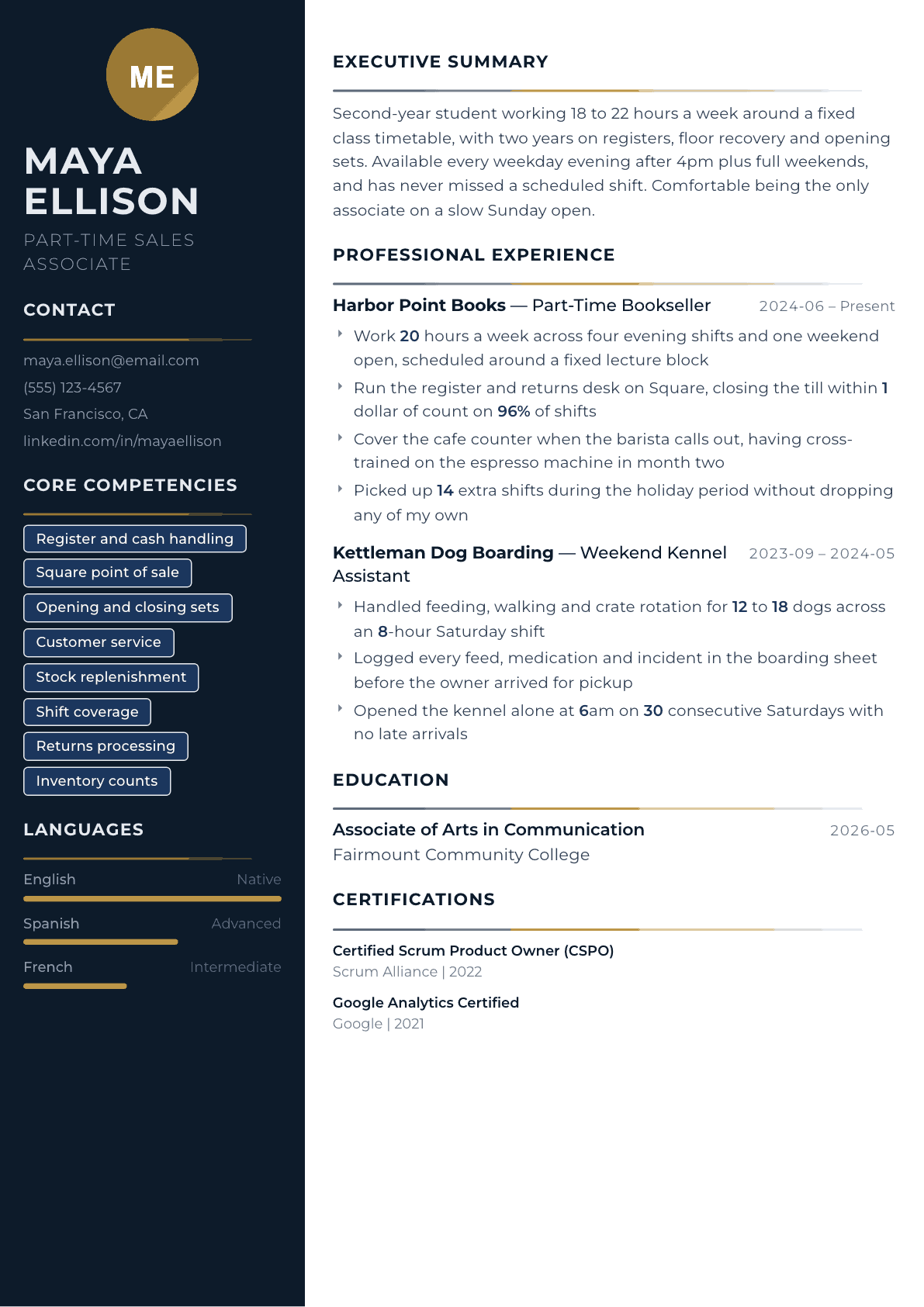
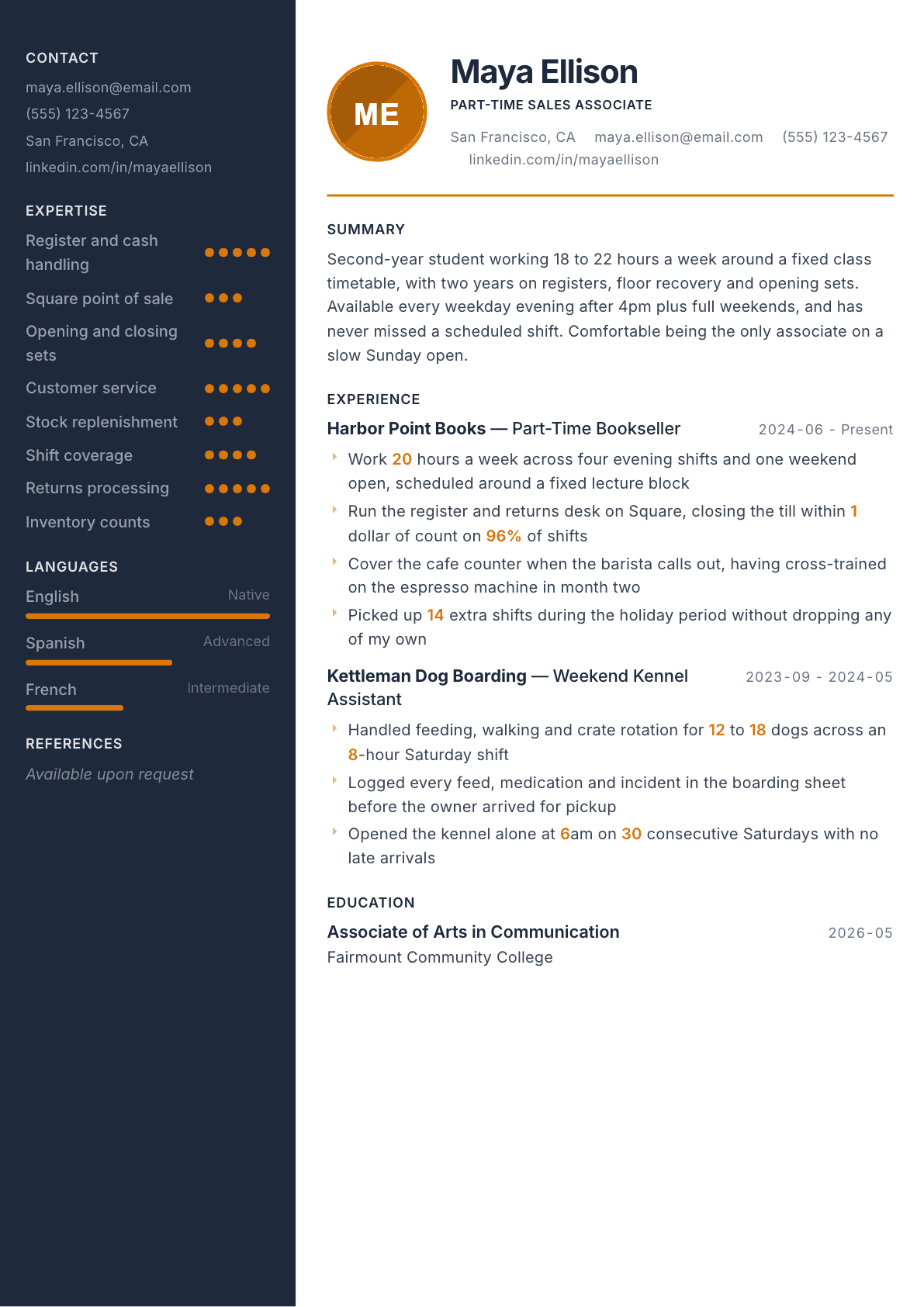
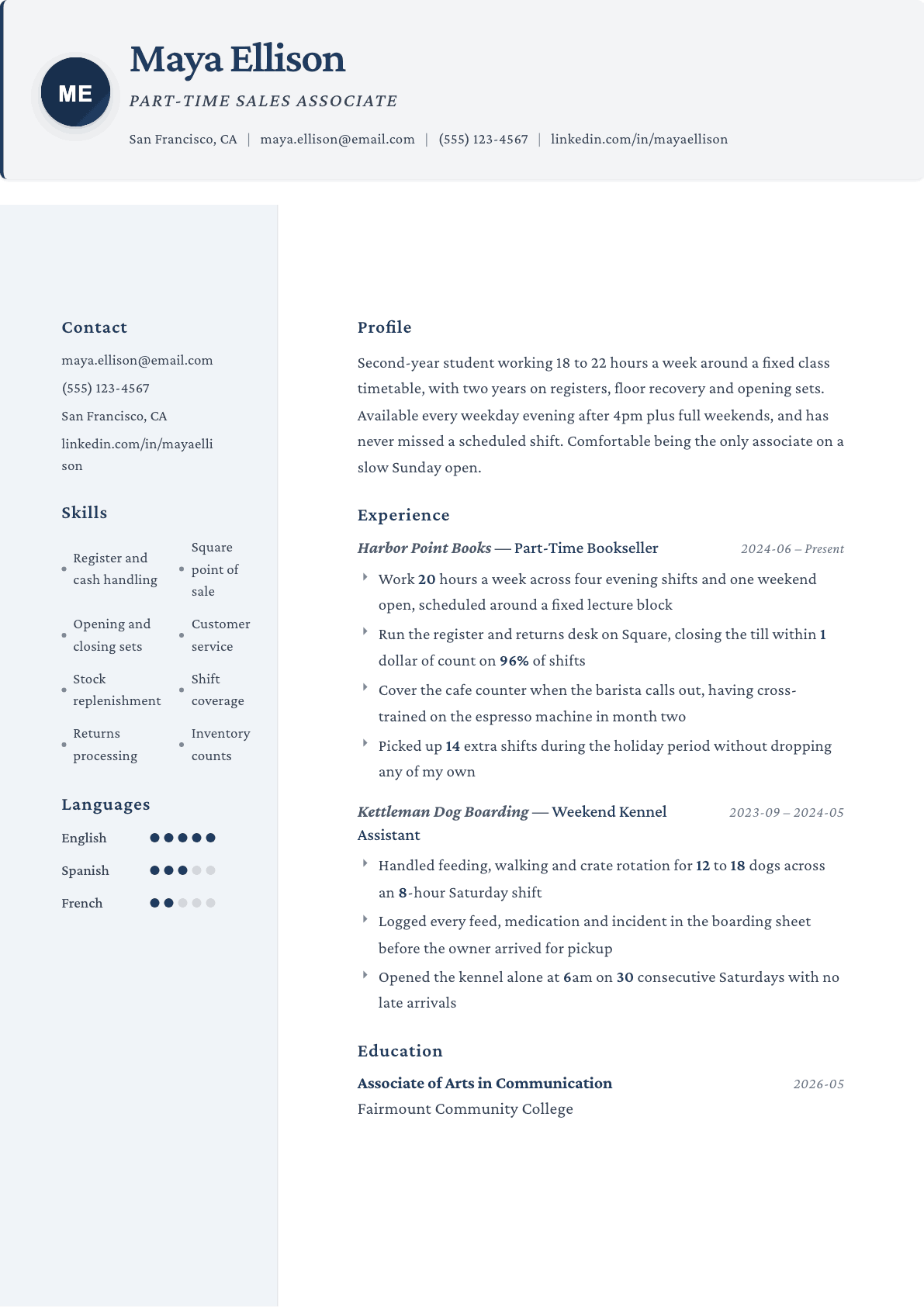
Example Part-Time Job summary
Student seeking part-time hours around a fixed class timetable, available weekday evenings after 4pm and both weekend days. Two years on registers and floor recovery in a bookstore and cafe, cross-trained on the espresso counter, and holds an unbroken attendance record across two school years. Comfortable running an open alone and closing the till to count. Can start within one week.
Skills to list on a Part-Time Job resume
- Availability and shift flexibility
- Cash handling
- Point of sale operation
- Opening and closing procedures
- Customer service
- Stock replenishment
- Returns and exchanges
- Inventory counting
- Food handling basics
- Team communication
- Time management around classes
- Cross-trained coverage
- Cleaning and reset routines
- Punctuality and attendance
What actually gets this resume read
- Put a plain availability block near the top with the days and hours you can actually work every week.
- Say how many hours a week you carried at each job, because a manager is filling a rota and not a title.
- Name the register or point of sale system you have used, since retraining someone on it costs a full shift.
- Show reliability with a fact: consecutive shifts worked, opens covered, or extra shifts you picked up.
- List cross-training by hand, so a manager knows you can move to the cafe or the stockroom when someone calls out.
- Give the date you can start and whether your availability changes when a new term timetable is published.
- Keep it to one page and put the job you can start soonest at the top of the experience section.
How to write a part-time job resume
The person reading a part-time job resume is almost never a recruiter. It is a store manager, a shift lead or a franchise owner with a blank grid on a screen and holes in it: Tuesday evening, Saturday open, the Sunday close nobody wants. She is not hiring a career. She is hiring the person who can stand in those specific squares for the next several months without calling out. In the UK the same page is usually called a CV for part time work, and the template below works under either name.
That changes what belongs on the page. Your degree program matters less than the sentence that says you are free every weekday after four and both weekend days. A hiring manager who cannot find your availability in the first eight seconds will move to the next application, because guessing costs her a phone call and she has thirty of these.
This guide covers the availability block, how to write shift work so it reads as reliability rather than a list of duties, what counts as experience when you have never had a paid job, and the questions people ask when they are trying to hold a part-time role together with a class timetable.
Format: one page, availability above the fold
One page, always. A part-time application is read on a phone in a stockroom between deliveries, and anything below the first screen is effectively invisible. Contact details, then a two-line availability block, then experience, then education, then skills. Nothing else earns its space.
Skip the objective statement. A line saying you are seeking a role that allows you to grow tells a shift lead nothing she can act on. Replace it with the hours you can work and the date you can start, which are the two facts she needs before she can decide anything.
- Availability block: the days and hours you can work, written as a schedule and not as the word flexible.
- A start date, plus a note if your availability changes when the next term timetable comes out.
- Experience with hours per week beside each job, because a rota is built in hours and not in titles.
- One line on transport if the site is hard to reach before the first bus or after the last one.
The availability block that decides your callback
Write availability as a manager would write a schedule. Weekdays after 4pm, Saturday and Sunday all day, unavailable Thursday evening for a lab. That is a block she can drop into the grid. The word flexible is worse than useless here, because every applicant writes it and half of them turn out to mean weekends only.
Be honest about the restrictions rather than hiding them. A candidate who says she cannot work Thursday evenings but can open every Saturday is easier to schedule than one who leaves it vague and then declines shifts in week two. Managers remember the second kind, and part-time hiring runs almost entirely on the reference call.
If you can cover the shifts nobody wants, say so directly. Sunday opens, holiday weekends, the closing shift on a weeknight, and the week between terms when the rest of the student staff goes home are the exact gaps that make a manager pick up the phone.
Experience: hours, systems, and the shift you covered
Each job gets the employer, your title, the dates, and the number of hours a week you carried. Then two or three bullets. The bullets should name the system you worked in, the volume you handled, and one fact about turning up. A register brand, a scheduling app, a drawer count accuracy, an unbroken run of opens: these are the details that separate a real employee from a duties list.
Attendance is the quiet metric of part-time hiring, and almost nobody writes it. If you worked forty consecutive Saturdays without a call-out, that belongs on the page. If you picked up shifts for other people during a holiday rush, say how many. Managers have been burned by no-shows and they read those lines closely.
Cross-training is the other lever. A worker who can move from the register to the cafe counter to the stockroom is worth two who cannot, because she absorbs a call-out instead of causing one. Name every station you were trained on and roughly when you learned it.
- Hours per week, written beside the dates rather than buried in a bullet.
- The point of sale or scheduling system by name: the specific register, the app the team clocks into.
- One volume figure: customers served on a busy shift, deliveries received, tables covered.
- One reliability fact: consecutive shifts, opens run alone, extra shifts picked up.
When you have never had a paid job
A first part-time application is not empty. Babysitting for a neighbor is scheduled work with a customer and a payment. So is mowing lawns, running a stall at a school fair, or minding a relative's shop on Saturdays. Give it a title, a period and a rough frequency, and it becomes a work history rather than a blank section.
School and club responsibilities work the same way when you write them like jobs. Equipment manager for a team means you turned up before everyone else and counted things. Running the concession stand at home games means cash handling in front of a queue. Write the behavior, not the club name.
What you must not do is inflate it. A manager will ask about a line on the page during a five-minute interview, and a candidate who cannot describe what she actually did loses the job right there. Small and true beats large and vague every time in part-time hiring.
Skills and words the posting will use
Part-time postings recycle a narrow vocabulary: cash handling, point of sale, customer service, stock replenishment, opening and closing procedures, food handler card, planogram, floor recovery, inventory count. If you have done the thing, use the employer's word for it once in the skills list and once inside a bullet where the work shows.
Keep the skills list to concrete, checkable items. Passionate about people is not a skill. Counting a drawer, handling a return without a receipt, resetting a display to a planogram and closing a store alone are skills, and each one is a question an interviewer can ask you about.
Part-time job CV template and resume sample: what the finished page holds
A part-time resume sample that gets a callback fits on one page and reads top to bottom in the order a store or cafe manager needs it. The sample on this page follows that order, and the lines below show what each block should hold so you can copy the structure rather than the words.
The test for any part-time job resume example is simple. Could a manager put you on the rota from the page alone, without phoning to ask when you are free? If the answer is no, the availability block is missing or vague, and no amount of polish elsewhere fixes it.
Here is the same template filled in as a UK CV for part time jobs, for an invented sixth form student. Name line: Chloe Barnes, Leeds, mobile, email. Availability: Monday, Wednesday and Thursday from 4pm to 9pm, all day Saturday, Sunday until 4pm; extra hours in the school holidays; can start in two weeks. Experience: Kitchen Porter, The Corner Bistro, Saturdays and Sundays, about 12 hours a week, eighteen months; ran the dish station through a Saturday service of around 90 covers; trusted to lock up the back door and log the fridge temperatures at close; never missed a shift. Education: A levels in Biology, Chemistry and English at Moor Lane Sixth Form, finishing next summer; Level 2 Food Hygiene certificate. Skills: food hygiene, cleaning schedules, stock rotation, cash handling, working under a busy head chef.
- Name, phone, email and town, on one line.
- Availability: days and hours as a schedule, plus a start date.
- Experience: employer, title, dates and hours per week, then two or three bullets with a system, a volume and a reliability fact.
- Education: school or college and expected finish date, with any food handler or first aid card.
- Skills: six to eight concrete items such as cash handling, point of sale, stock replenishment and opening procedures.
Part-Time Job resume summary examples
First paid job
High school junior available weekdays after 3:30pm and all day Saturday, seeking a first part-time role in retail or food service. Two years babysitting for three families on a standing weekly schedule, with cash handling and a reference from each. Punctual, quick to learn a register, and can start immediately.
Two years of shifts behind you
Student working 20 hours a week around a fixed class timetable, with two years of register, floor and stockroom work in a bookstore and cafe. Closes the till within 1 dollar on 96% of shifts, cross-trained on the espresso bar, and has never missed a scheduled shift across two school years.
Part-time shift lead
Part-time shift lead with four years across two stores, running opens and closes alone and holding keys for the past 18 months. Trains new hires on the register, builds the weekly break rota, and covered 14 extra shifts through the last holiday period. Available evenings and full weekends year round.
Work experience bullets: before and after
Before: Worked part-time at a bookstore.
After: Worked 20 hours a week across four evening shifts and a weekend open, scheduled around a fixed lecture block for two full school years.
The hours and the shift pattern let a manager see immediately where you fit on her grid.
Before: Handled money at the register.
After: Ran the register and returns desk on Square, closing the drawer within 1 dollar of count on 96% of shifts over 14 months.
Naming the system and an accuracy figure turns a duty into something a manager can verify.
Before: Was reliable and always on time.
After: Opened the store alone at 6am on 30 consecutive Saturdays with no late arrivals and no missed shifts.
Reliability means nothing as an adjective and everything as a count of shifts actually worked.
Before: Helped out in other departments when needed.
After: Cross-trained on the espresso counter in month two and covered the cafe on 22 shifts when a barista called out.
The specific station and the number of covers show a manager you absorb absences instead of creating them.
Before: Assisted customers with questions.
After: Served 90 to 120 customers on a Saturday shift, handled returns without a receipt under store policy, and pulled special orders from the back.
Volume plus the harder tasks tells a manager which shifts you can be trusted to run.
Hard skills
- Cash handling and drawer counts
- Point of sale operation
- Opening and closing procedures
- Returns and exchanges
- Stock replenishment and facing
- Inventory counting
- Food handler safety basics
- Scheduling app use
- Card and contactless payment handling
- Planogram resets
- Cleaning and closing checklists
- Order pickup and pulling
Soft skills
- Punctuality
- Working a rota around classes
- Calm handling of upset customers
- Taking direction on a busy floor
- Picking up shifts for teammates
- Clear handover at shift change
Certifications worth listing
- ServSafe Food Handler (National Restaurant Association)
- Adult and Pediatric First Aid/CPR/AED (American Red Cross)
Mistakes that cost part-time job candidates the interview
- Writing flexible availability instead of the actual days and hours, which forces the manager to call before she can even consider you.
- Leading with an objective statement about personal growth when the reader is trying to fill a Saturday open.
- Leaving hours per week off the experience section, so a rota builder cannot tell whether you worked six hours or twenty six.
- Listing duties copied from the job posting rather than the volume, the system and the shifts you actually covered.
- Hiding a hard restriction such as a Thursday lab, then declining shifts in week two and losing the reference.
- Padding a first resume with clubs you attended once, which falls apart in the first interview question.
- Sending two pages when the manager reads applications on a phone between deliveries.
Part-Time Job resume questions
How do I write a part-time resume when I have never been paid for work?
Use the unpaid work you already do. Babysitting on a standing schedule, minding a family shop, running a school concession stand or coaching a junior team all involve turning up on time and handling people or money. Give each one a title, a period and a frequency.
Should I put my class timetable on the resume?
Not the timetable itself, but the availability it produces. Write the days and hours you are free as a block a manager can read at a glance, and add a note that the pattern changes when a new term schedule is published so nobody is surprised later.
How long should a part-time job resume or CV be?
One page without exception, and often half of it. Store managers read applications between tasks and on a phone. If your history runs long because you have held several short roles, group the oldest ones into a single line rather than adding a second page.
What does a good part-time resume sample look like?
One page: contact line, an availability block written as a schedule, experience with hours per week beside each job, education, and a short skills list. Each job has two or three bullets naming the system you used, a volume figure and one reliability fact. For retail and food service, a short message replaces the cover letter.
How do I show reliability if I have no work history to prove it?
Use attendance you can document elsewhere. Perfect school attendance for a year, two seasons on a team where you never missed practice, or a volunteer shift you have held every Saturday all count, provided you name the period and someone who can confirm it.