Summer Job Resume Examples: free ATS score and gap list
Build a Summer Job Resume That Lands the Seasonal Hire
By Mustafa Tarabya, founder of CVBooster · Published · Updated
Summer job resume example with a start and end date block, seasonal keywords, and a guide to camp, pool, park and warehouse hiring.
Sample resumes for a summer job
The same summer job content laid out in three CVBooster templates, so you can see what the finished document looks like before you write a word.
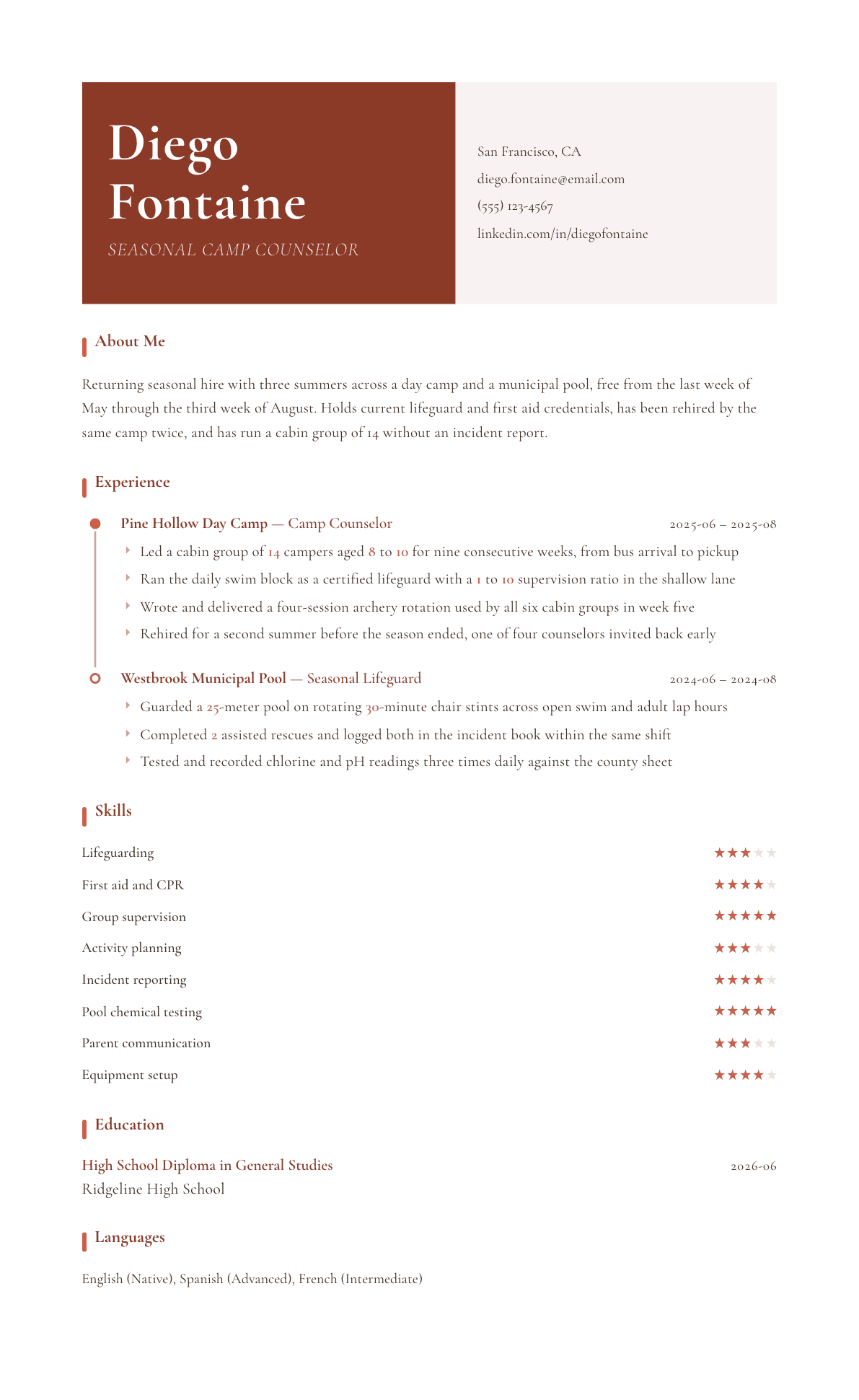
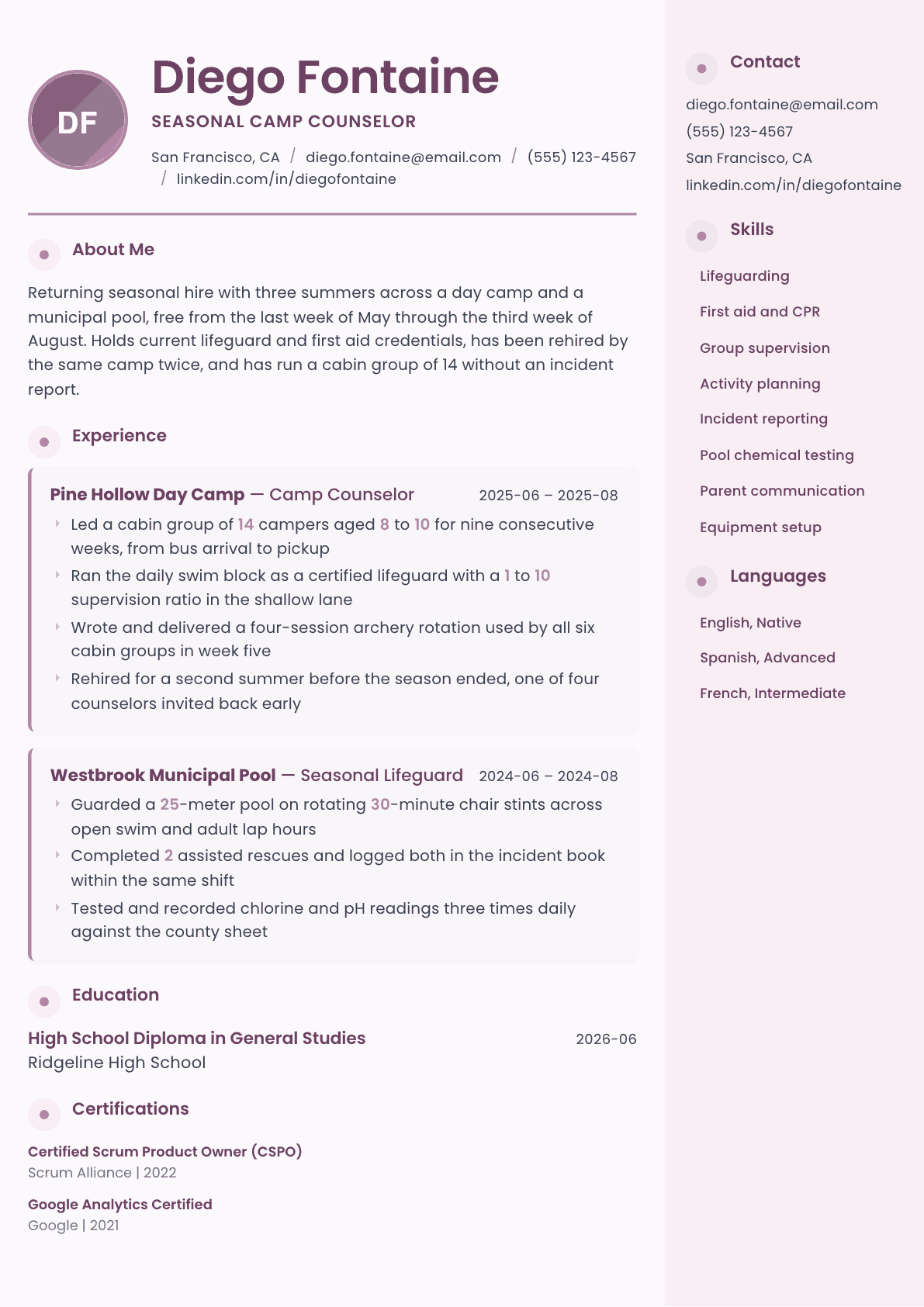
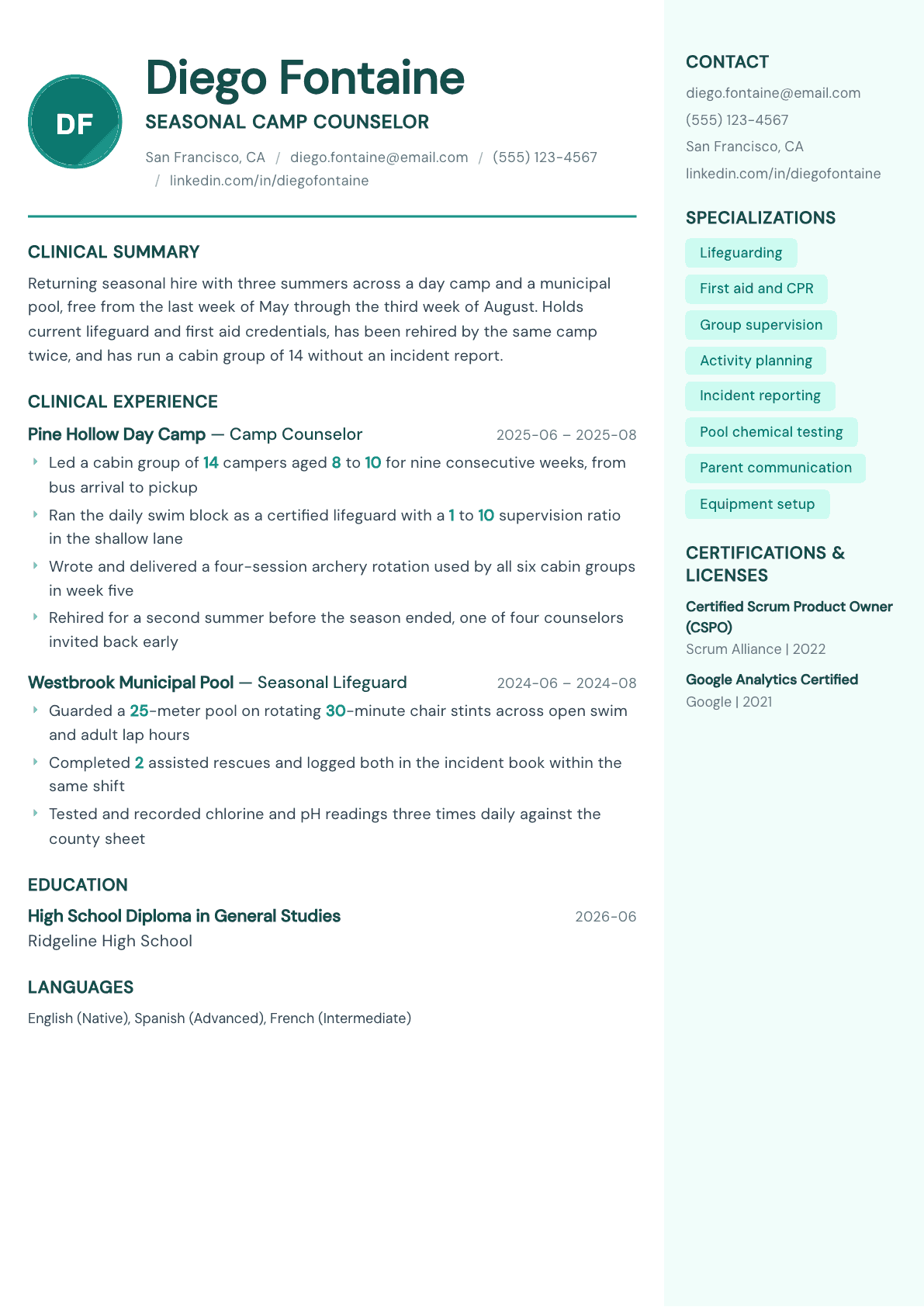
Example Summer Job summary
Seasonal worker free from the last week of May through the third week of August, returning for a fourth summer of camp and pool work. Certified lifeguard with current first aid, has run a cabin group of 14 for a full nine-week season, and was invited back by the same camp before the previous summer ended. Holds a driver license and can reach sites off the bus route.
Skills to list on a Summer Job resume
- Seasonal availability window
- Lifeguarding
- CPR and first aid
- Child supervision
- Activity and rotation planning
- Incident documentation
- Water chemistry testing
- Outdoor equipment handling
- Cash handling at concessions
- Crowd and line management
- Grounds and facility cleaning
- Parent and guardian communication
- Radio and whistle protocol
What actually gets this resume read
- Write your exact free window at the top: the first day you can start and the last day before term begins.
- Say whether you can work the whole season, because a manager fears a hire who leaves in the middle of August.
- List seasonal credentials with their expiry month, since a lapsed lifeguard card cannot be used in June.
- Show that you were rehired or asked back, which is the strongest signal a seasonal manager reads.
- Name the setting: day camp, overnight camp, pool, park district, festival, warehouse peak or landscaping crew.
- Add whether you have your own transport and can reach a site that has no bus route before 7am.
How to write a summer job resume
Seasonal hiring is a countdown. A camp director has to fill fifty counselor slots before orientation week, a park district has to certify its guards before the pool opens, and a distribution center has to have bodies badged before peak volume arrives. Every one of those managers is reading your resume against a calendar, not against a career ladder.
So the first question your page has to answer is a date question: when can you start, and can you stay until the season ends? A summer hire who leaves in the second week of August, three weeks before the season closes, costs a director more than never hiring anyone. She has to recruit again in the middle of her busiest month. Anything you can say to remove that fear belongs high on the page.
This guide covers the seasonal date window, the credentials that have to be current before day one, how to write camp, pool, park, festival and peak warehouse work so it reads as capability, and the questions people ask when they are applying for their second or third summer.
Format: dates first, credentials second, one page
Put a season line directly under your contact details: the earliest day you can start and the last day you are free. Available May 26 through August 22, full time, is a sentence a director can schedule against. Vague phrases like available over the summer get read as available for some of the summer, which is not the same offer.
Credentials come next, because half of seasonal work is gated on them. A lifeguard certificate, a food handler card, a bus driver endorsement or a first aid card either exists on the start date or you cannot be assigned. List each one with the issuing body and the month it expires, since a card that lapses in July is a card that fails in July.
Then experience, then education, and stop. A seasonal application is judged on availability, credentials and whether someone has hired you before.
- Season line: exact first and last day free, plus full time or a weekly hour range.
- Credential block: certificate, issuing body, expiry month, all in one place.
- Work permit note if you are under the age where one is required in your state.
- Transport and housing: whether you can reach a site off the bus route, or need staff housing.
Prove you will stay to the last day
The strongest line on a seasonal resume is that somebody asked you back. Rehired for a second season, invited to return before the previous season ended, promoted from counselor to unit lead in the second summer: each of these answers the director's real worry in one clause. If a camp or a park district took you twice, put it on the page in a way that cannot be missed.
If this is your first season, prove endurance some other way. A full sports season without missing practice, a school year of Saturday volunteer shifts, or a job you held for the whole of a previous summer all demonstrate that you finish what you sign up for. Say how many weeks it ran.
Be direct about the tail end of the season too. Many student applicants become unavailable when their own term starts, and a director who knows exactly which week you leave can build around it. Hiding it produces the mid-August scramble everyone dreads.
Write the season, not the job title
Seasonal work is measured in groups, ratios, hours and cycles. A camp counselor line should say the age band, the group size, the number of weeks and whether it was day or overnight. A pool line should give the pool length, the rotation length in the chair, and the swim programs you covered. A festival or park line should give the daily attendance you worked in front of and what you were responsible for when it went wrong.
The safety and reporting side is what separates a returning hire from a first-timer. Rescues assisted and logged, incident reports filed inside the shift, chemical readings recorded against the county sheet, a head count taken at every transition: these show a director you understand that seasonal work is mostly about not letting anything go wrong in front of a crowd.
Peak season warehouse and retail work follows the same logic with different numbers. Units picked per hour, the scanner system, the shift length, and whether you worked the overnight sort. Seasonal operations managers hire on rate and attendance, and both are countable.
- Age band and group size for anything involving children.
- Supervision ratio you worked at, especially in and around water.
- Number of weeks or days the season ran, not just the months.
- One incident or safety fact: what you logged, tested or reported, and how fast.
Credentials, permits and the paperwork that gates a start date
Seasonal roles have a paperwork tail that surprises first-time applicants. Depending on the setting you may need a lifeguard or water safety certificate, first aid and CPR, a food handler card, a background check, a work permit if you are under the qualifying age, or a physical before you can be assigned to a cabin. None of it is hard, but all of it takes time, and a candidate who already holds it can be hired this week instead of next month.
Say what you already hold and what you are willing to complete before the start date. A director will often pay for the certification, but she needs to know now, while she is still building the roster, and not after orientation has begun.
Skills and the vocabulary of seasonal postings
Read three postings from the same employer type and the shared words jump out: supervision ratio, camper, guest experience, rotation, incident report, water safety, activity block, grounds, concessions, peak volume, orientation week. Use the ones that are true of you once in a skills list and once inside a bullet.
Add the physical facts that seasonal work quietly requires, because they are real requirements rather than filler: comfortable working outdoors in heat for an eight-hour shift, able to lift a camp canoe with a partner, able to stand for a full concession rush. A director reading a stack of similar resumes uses those lines to decide who lasts to week nine.
Summer Job resume summary examples
First summer
High school student free from June 8 through August 20, applying for a first summer role at a day camp or park district. Certified in first aid and CPR, coached a junior soccer group of 12 through a full spring season, and has a work permit already filed. Available for early morning starts.
Third season
Returning seasonal worker free from the last week of May through the third week of August, with three summers across a day camp and a municipal pool. Certified lifeguard with current first aid, ran a cabin group of 14 for a nine-week season, and was rehired by the same camp before the previous summer ended.
Unit lead and returning staff
Seasonal unit lead with five summers at overnight camp, supervising 9 counselors and 70 campers across a seven-week season. Runs staff orientation on supervision ratios and incident reporting, holds lifeguard and wilderness first aid credentials, and has been invited back every year since the first.
Work experience bullets: before and after
Before: Worked as a camp counselor over the summer.
After: Led a cabin group of 14 campers aged 8 to 10 for nine consecutive weeks, from bus arrival through Friday pickup, at a day camp of 220 children.
Age band, group size and the full week count tell a director exactly what you can be assigned.
Before: Was a lifeguard at the local pool.
After: Guarded a 25-meter pool on rotating 30-minute chair stints across open swim and adult lap hours, completing 2 assisted rescues logged within the same shift.
The rotation, the programs and the logged rescues show a manager you have worked a real chair, not a training pool.
Before: Came back the following year.
After: Rehired for a second season before the first one ended, one of 4 counselors out of 31 invited back early by the camp director.
Being asked back answers the only question a seasonal manager truly cares about, and the ratio proves it was selective.
Before: Helped keep the pool safe and clean.
After: Tested and recorded chlorine and pH three times daily against the county sheet and closed the pool twice for readings outside range.
Naming the log, the frequency and the decision you made shows judgment rather than presence.
Before: Worked in a warehouse during the busy season.
After: Picked 140 to 165 units an hour on the overnight sort during peak season, working 5 nights a week for 11 weeks with no unplanned absences.
A rate, a shift type and an attendance run are the three numbers a seasonal operations manager hires on.
Hard skills
- Lifeguarding and water rescue
- First aid and CPR
- Child and youth supervision
- Activity block planning
- Incident and accident reporting
- Pool chemical testing and logging
- Concession cash handling
- Grounds and facility maintenance
- Radio and whistle protocol
- Head counts and transitions
- Scanner and pick systems for peak volume
- Equipment setup and teardown
Soft skills
- Staying to the end of a season
- Working outdoors in heat
- Keeping a group calm in a crowd
- Taking direction from a unit lead
- Communicating with parents at pickup
- Early morning starts
Certifications worth listing
- Lifeguarding with CPR/AED for the Professional Rescuer (American Red Cross)
- Basic Life Support Provider (American Heart Association)
- ServSafe Food Handler (National Restaurant Association)
Mistakes that cost summer job candidates the interview
- Writing available over the summer instead of the two dates a director needs to build a roster against.
- Hiding the week your own term starts, which turns into a staffing hole in the middle of the busiest month.
- Listing a safety certificate without the issuing body or the expiry month, so nobody can tell whether it is current on the start date.
- Describing camp work as supervising children without the age band, the group size or the number of weeks.
- Leaving out that you were rehired, which is the single most persuasive fact a returning seasonal candidate has.
- Ignoring the paperwork tail, then discovering during orientation that a permit or background check has not cleared.
- Using a full page of school clubs when the reader is only checking dates, credentials and whether you finish things.
Summer Job resume questions
When should I apply for a summer job?
Far earlier than most people expect. Camps and park districts interview through late winter and close their rosters before spring break, and peak season warehouse hiring runs its own calendar. Applying in May means competing for whatever was left after the good roles were filled.
What if I can only work part of the season?
Say so on the first line and name the exact weeks. Some employers genuinely need short cover for family vacation weeks or a festival run. Being upfront gets you into the pool for those roles instead of getting you dropped after an awkward call.
Do I need a lifeguard certificate before applying to a pool?
Not always. Many park districts run their own certification course and hire candidates who commit to completing it before opening day. Say clearly whether you already hold the card or are ready to certify, and give the month you could finish.
How do I write a resume for my very first summer job?
Build it from responsibility rather than employment. A spring sports season without a missed practice, a term of Saturday volunteering, or caring for younger siblings on a fixed schedule all show a manager that you turn up and stay. Give each one dates and a duration.
Should the same resume go to a camp and to a warehouse?
No. The date window and the credentials stay identical, but the experience bullets should lead with different numbers. A camp wants group sizes and ratios, while a distribution center wants pick rate, shift type and attendance. Reorder rather than rewrite.