Community College Student Resume Examples: free score
A Community College Student Resume Built Around Your Real Week
By Mustafa Tarabya, founder of CVBooster · Published · Updated
Community college student resume example and guide covering class schedules, part time work, transfer plans and an associate degree in progress.
Sample resumes for a community college student
The same community college student content laid out in three CVBooster templates, so you can see what the finished document looks like before you write a word.
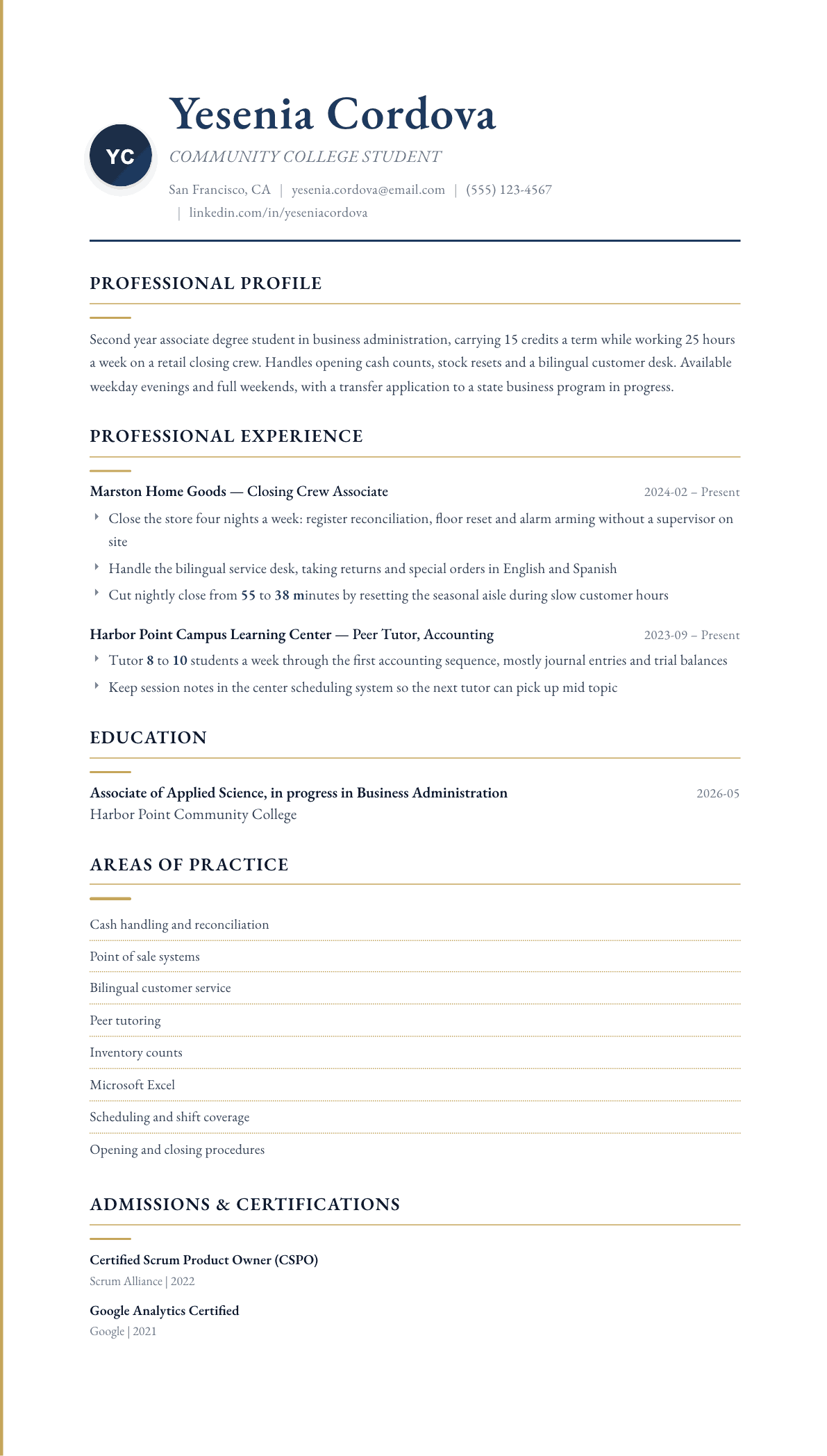
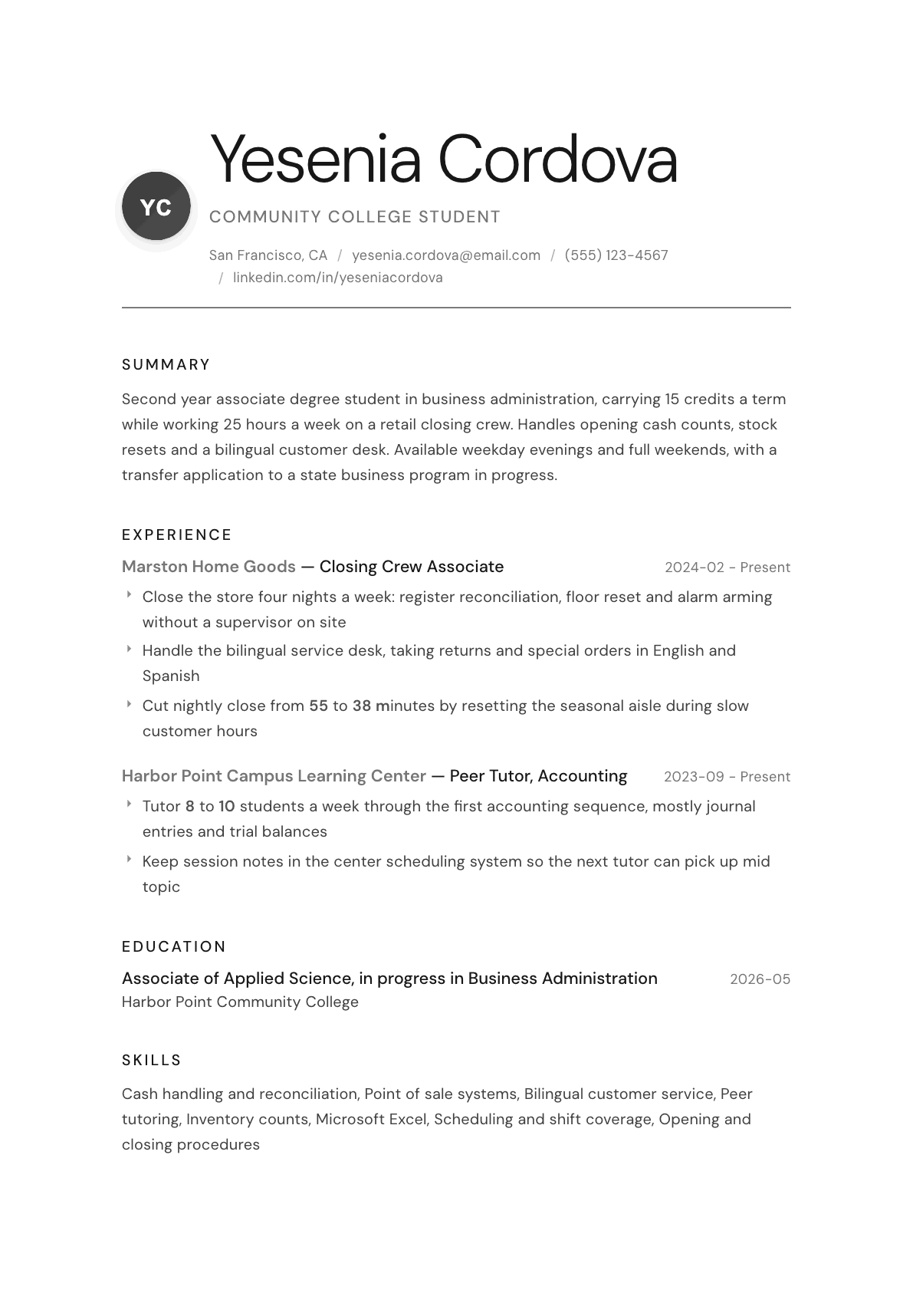
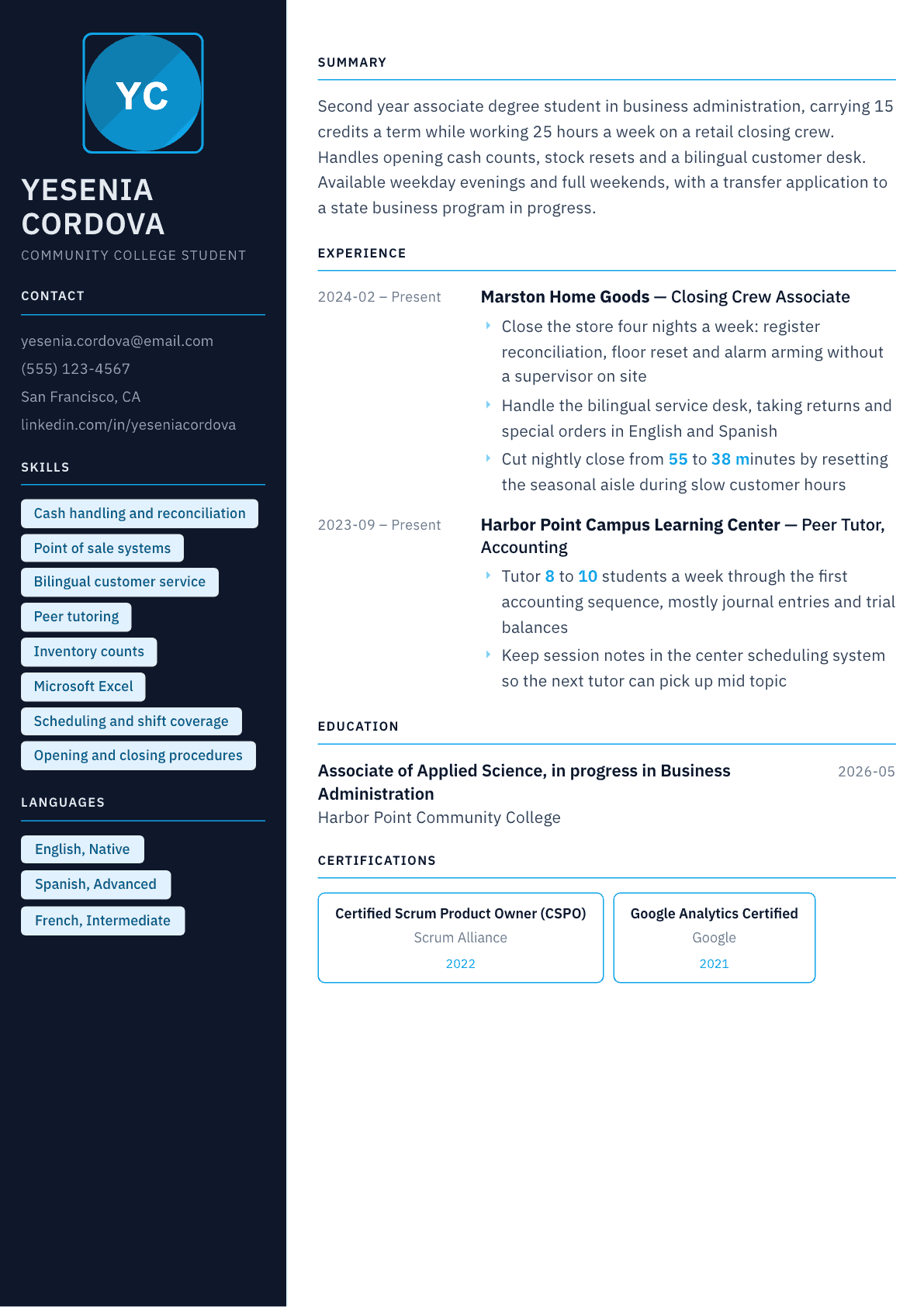
Example Community College Student summary
Second year community college student finishing an associate degree in business administration while holding a 25 hour closing crew job and a campus tutoring shift. Closes a store alone four nights a week, reconciles the drawer and runs a bilingual service desk. Available weekday evenings and weekends through the spring term, with a transfer to a state business program already filed and the same availability planned afterward.
Skills to list on a Community College Student resume
- Associate degree coursework
- Class and work schedule balancing
- Cash handling
- Point of sale operation
- Customer service
- Peer tutoring
- Spreadsheet basics
- Inventory and stock counts
- Written communication
- Time blocking
- Team shift coverage
- Transfer credit planning
- Bilingual service
What actually gets this resume read
- Put your expected graduation term and the exact degree name on the page so nobody has to guess what you are finishing.
- State your class block and the hours you can actually work, because a manager plans a schedule before she plans anything else.
- Treat paid work as the main event and coursework as support, since two years of steady shifts beats a course list.
- Name the campus jobs, tutoring or club roles that gave you responsibility, and say what you were trusted to do alone.
- If you are transferring, say where and when, because a manager would rather hire honestly for eighteen months than be surprised.
- List the software you were graded on, from spreadsheets to the point of sale system, since those are the transferable parts.
How to write a community college student resume
Almost nobody hiring a community college student is hiring for a degree. They are hiring for a schedule. A store manager needs somebody who can close four nights, a clinic needs front desk cover between nine and two, a warehouse needs a Saturday body. The single most useful thing your resume can do is make your real availability visible in the first ten seconds, and most applicants hide it entirely.
The second thing that reader wants to know is whether you are still going to be there next term. Community college enrollment moves. Students transfer, switch programs, go full time at a job, or stop out for a semester. A manager who has been burned twice will read your page looking for signs of a plan, and a candidate who states a graduation term and what happens after it is easier to say yes to than one who leaves the future blank.
This guide covers laying out a two-year degree in progress, writing part-time work so it reads as responsibility instead of filler, using campus jobs and tutoring properly, handling a transfer honestly, and the wording that gets an application through a filter built for people with more history than you have.
Format: availability high, degree in progress written correctly
Put a short availability line directly under your contact details. Days, hours, and the term it holds through. It feels blunt on a resume, and that is exactly why it works: the manager reading your page is holding a rota with holes in it, and you have just filled one of them without a phone call.
Then write the degree the way the college writes it, with the completion status attached. An associate of applied science is not the same document as an associate of arts, and a reader who works in that field knows the difference. Add the expected month and year of completion and, if it helps, the number of credits you have already banked.
- Availability line: the days and hour windows you can genuinely hold, not the ones you wish you could.
- Degree line: full award name, field, the college, in progress status and the expected completion term.
- Credits earned so far, which turns a vague in-progress line into measurable ground covered.
- Any certificate the program stacks along the way, since two-year colleges often award those before the degree.
Part-time work is the main section, so stop apologizing for it
A retail closing shift, a food service line, a call center queue and a warehouse pick route all involve money, equipment, deadlines and other people. Written properly they are as strong as an internship. Written as a duty list they read as filler, which is why so many student pages waste them.
Aim for the moments you were trusted alone. Closing a building. Counting a drawer nobody else checked. Covering a shift for a supervisor who called out. Training the person hired after you. Those lines say the same thing an employer wants from a first professional hire: this person can be left with something.
Numbers are available even in the smallest job. Customers served in a shift, tickets closed, dollars balanced without a variance, orders picked per hour, the size of the crew you were on. Give two or three of them per job and the section stops looking like everybody else's.
Campus work, tutoring and clubs, used the way employers read them
Community college campuses run on student labor: the learning center, the front desk, the lab tech bench, the childcare center, the student government office. These jobs are underrated on resumes because students think campus work is not real work. It is often the most relevant thing you have, because it happens in an office with software, records and confidentiality rules.
Tutoring is the strongest of them, and it is worth its own entry rather than a mention. Say the subject, how many students a week, and what you did when somebody arrived stuck. That is coaching, patience and explanation under pressure, and it is the same skill a manager needs when you train the next hire.
Clubs earn a place when you held an office or ran something with a budget, a room booking or a headcount. Membership alone belongs in a single line at the bottom, if at all.
The transfer question, answered on the page
If you are transferring to a four-year school, say so with the destination and the term. Hiding it does not help you. Managers who hire students expect movement, and one who knows your horizon can plan around it. What they cannot forgive is finding out in week three of training.
The version that lands well pairs the plan with continuity: naming the school, the term, and whether you intend to keep the same hours afterward or move to weekends only. If your transfer campus is nearby, that sentence turns a departure risk into a two-year hire.
If you are not transferring and intend to work in the field your associate degree trains for, say that too. Employers in trades, allied health and office administration actively prefer the student who is staying local over the one passing through.
Skills and keywords for jobs that screen by software
Applications for retail, clerical and health support roles frequently pass through a filter before a person sees them. Use the concrete nouns those postings use: point of sale, cash handling, scheduling, data entry, medical records, inventory counts, spreadsheets, phone triage. Write them as things you did in a job, not as a bare list, so the keyword sits inside evidence.
Add the software by name. The register system, the scheduling tool, the learning platform, the spreadsheet package you were graded on. Students routinely leave these off because the tools feel too ordinary to mention, and then lose to a candidate who listed the same three names.
Language skills belong high on the page if you have them. A bilingual student worker at a service desk saves a manager a real problem, and it is one of the few advantages that needs no experience to be worth something.
Community College Student resume summary examples
First term, first job hunt
First-year community college student in an associate of arts program, taking 12 credits and free weekday afternoons and all weekends. Two summers of camp and neighborhood work, comfortable with cash, schedules and customers. Looking for a steady part-time role near campus that holds through the academic year.
Second year, working through school
Second-year business administration student with 42 credits earned and two years on a retail closing crew, reconciling drawers and arming the building four nights a week. Runs a bilingual service desk and tutors first-year accounting on campus. Available weeknights and full weekends through the spring term.
Finishing the degree, moving into the field
Graduating community college student completing an associate of applied science in medical office administration, with 900 clinical office hours and a coding certificate already awarded. Handles scheduling, insurance verification and records requests. Staying in the area after graduation and available for full-time work from May.
Work experience bullets: before and after
Before: Worked part time at a store while attending classes.
After: Closed a home goods store four nights a week around a full class block, reconciling the drawer and arming the building with no supervisor on site.
Closing alone is a trust fact, and the class block shows the schedule actually held.
Before: Helped students with their homework at the tutoring center.
After: Tutored 8 to 10 students a week through the first accounting sequence, working mostly on journal entries and trial balances, and logged session notes so the next tutor could resume mid topic.
Subject, volume and a handover habit turn helping into a documented service role.
Before: Currently studying for an associate degree.
After: Completing an Associate of Applied Science in Business Administration with 42 of 60 credits earned, expected May, carrying 15 credits per term alongside a 25-hour work week.
Credits earned and the workload behind them make an in-progress degree measurable.
Before: Good at customer service and working with people.
After: Handled the bilingual service desk in English and Spanish, taking returns and special orders during the busiest evening block of the week.
A named language pair and a named counter beat any adjective about people skills.
Before: Plan to transfer to university next year.
After: Transferring to the state business program in fall, staying in the same city and available for the same evening and weekend hours afterward.
The plan stops being a resignation notice once continuity of hours is stated with it.
Hard skills
- Cash handling and drawer reconciliation
- Point of sale operation
- Opening and closing procedures
- Inventory counts and stock resets
- Spreadsheet formulas and sorting
- Data entry and records handling
- Appointment scheduling systems
- Peer tutoring in a named subject
- Written customer correspondence
- Bilingual service delivery
Soft skills
- Holding a fixed shift around a fixed class block
- Working the last hour of a closing shift at the same pace as the first
- Explaining a process to somebody who is stuck
- Swapping and covering shifts without dropping the rota
- Asking a supervisor early rather than guessing late
Certifications worth listing
- Adult and Pediatric First Aid, CPR and AED (American Red Cross)
- ServSafe Food Handler (National Restaurant Association)
- Microsoft Office Specialist (Certiport)
Mistakes that cost community college student candidates the interview
- Leaving availability off the page entirely, when it is the first thing a manager hiring students needs to know.
- Writing the associate degree without a completion term, so nobody can tell if you finish in four months or two years.
- Listing part-time jobs as duty lists rather than the moments you were trusted with the building or the money.
- Treating campus employment as not real work and cutting the most office-like experience on the page.
- Hiding a transfer, which turns into a broken trust in training week instead of a planned handover.
- Padding with a long course list when a hiring manager for an hourly role will not read a single course title.
Community College Student resume questions
Should I put my community college on my resume if I have not graduated yet?
Yes, always. Write the full award name, the field, the college and an in-progress status with the expected completion term. Add credits earned so far. An unfinished degree with a date attached reads as a plan, while omitting it leaves an unexplained gap the reader will fill in badly.
How do I make a part-time job sound impressive?
Stop describing the tasks and describe the trust. Name what you were left alone with, what you counted, who you trained, and any number you can attach to a shift. A closing shift written that way outperforms an internship written as a list of things somebody let you observe.
Do I include my grade point average?
Include it if it is strong and you are applying for an internship, a scholarship or a transfer-related role. Leave it off for hourly work, where nobody will use it. If a program requires a minimum and you clear it, list the figure rather than making a reader ask.
What if my only experience is babysitting, mowing lawns and helping in a family business?
Put all three on the page with dates, hours and what you were responsible for. Informal work still involves money, safety and other people relying on you. A family business entry is fine as long as you name the role honestly rather than inflating it into a management title.
How long should a community college student resume be?
One page. If you are struggling to fill it, add the availability line, credits earned, campus roles, volunteer hours and the software you have been graded on. If you are over a page, cut course titles and club memberships first, since those are the lines nobody reads.