Student Resume Examples: free score, then the gap list
Launch Your Career with a Student Resume
By Mustafa Tarabya, founder of CVBooster · Published · Updated
Student resume examples with expert tips, ATS keywords, and professional templates. See exactly what a winning student resume looks like.
Sample resumes for a student
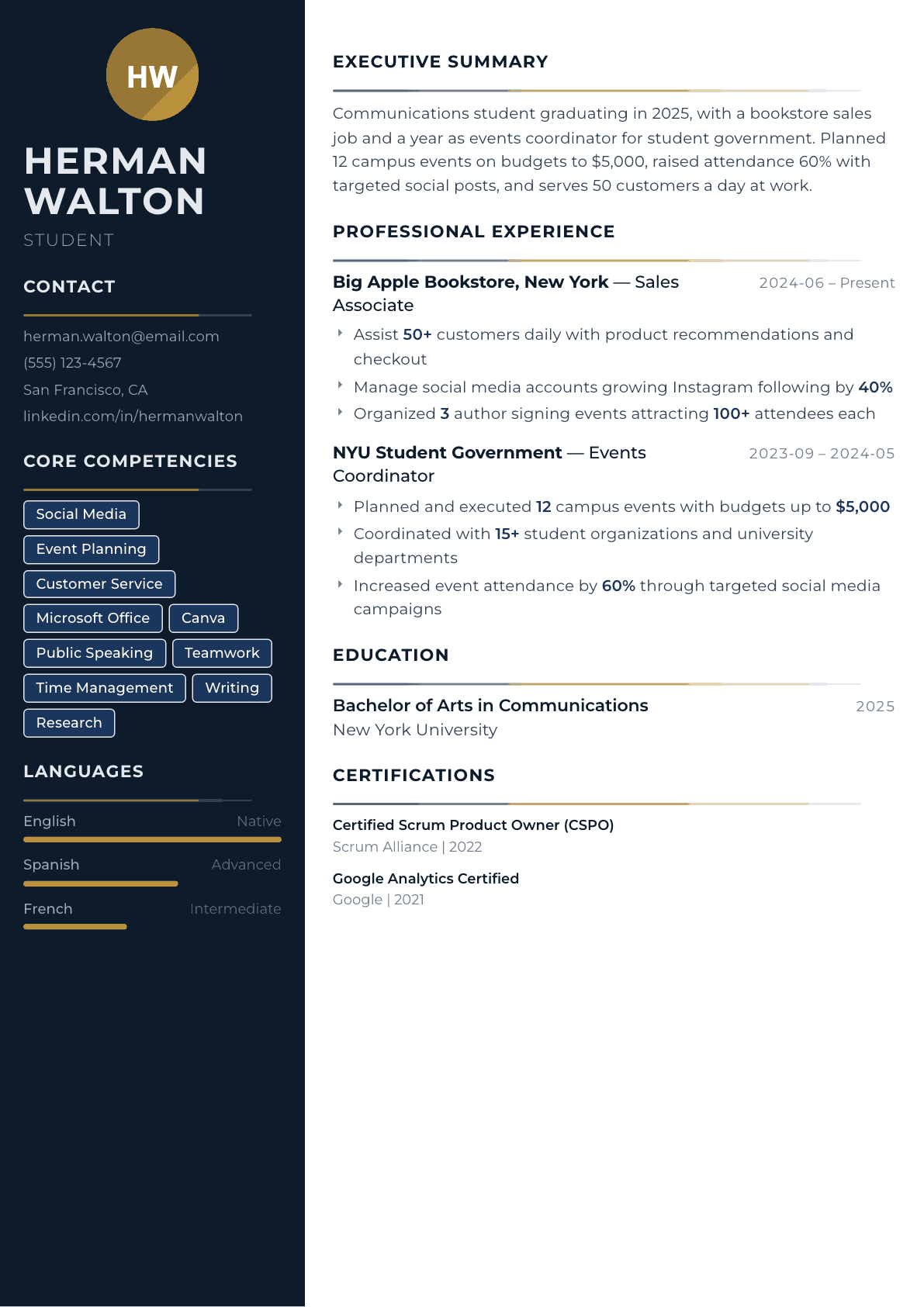
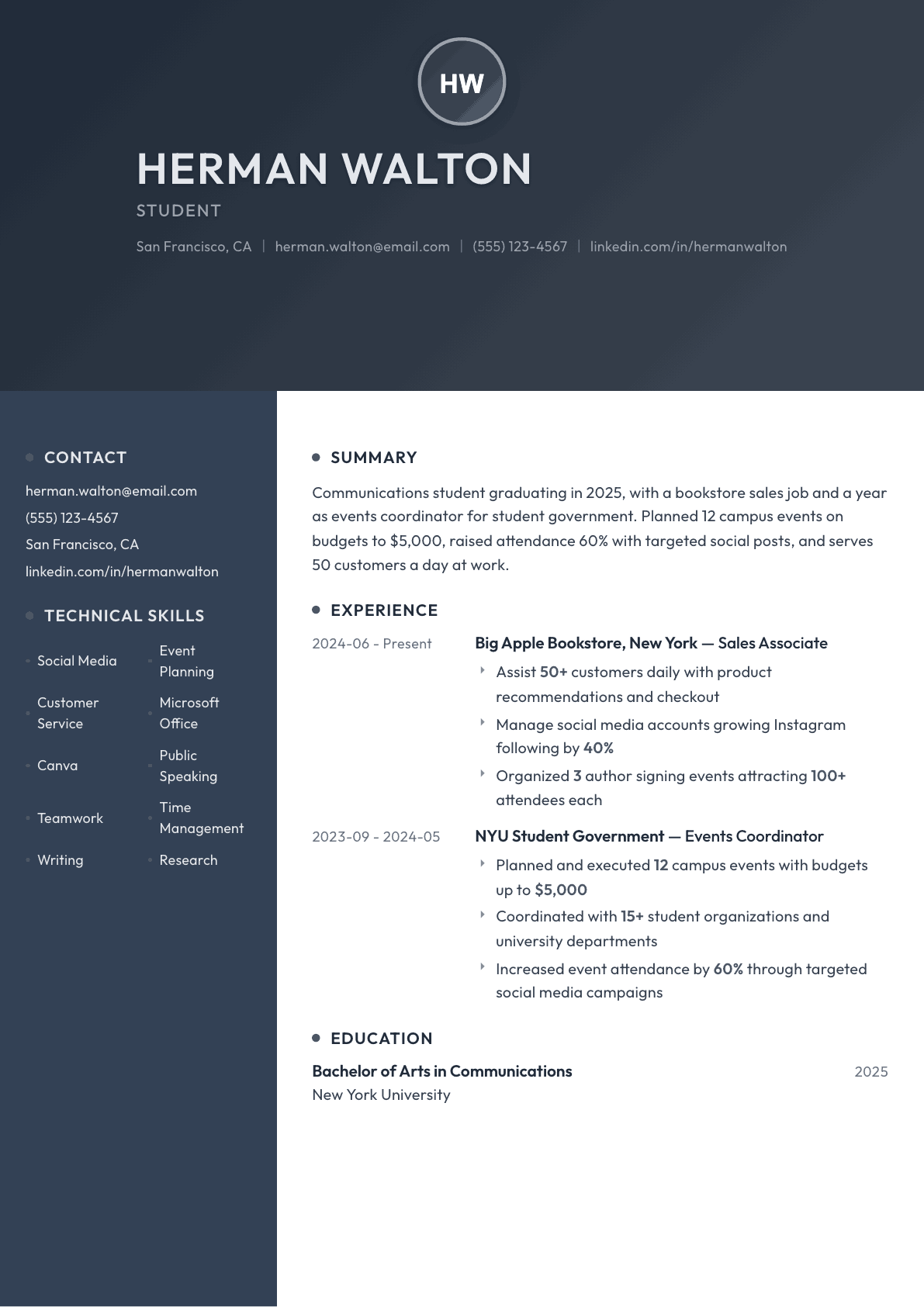
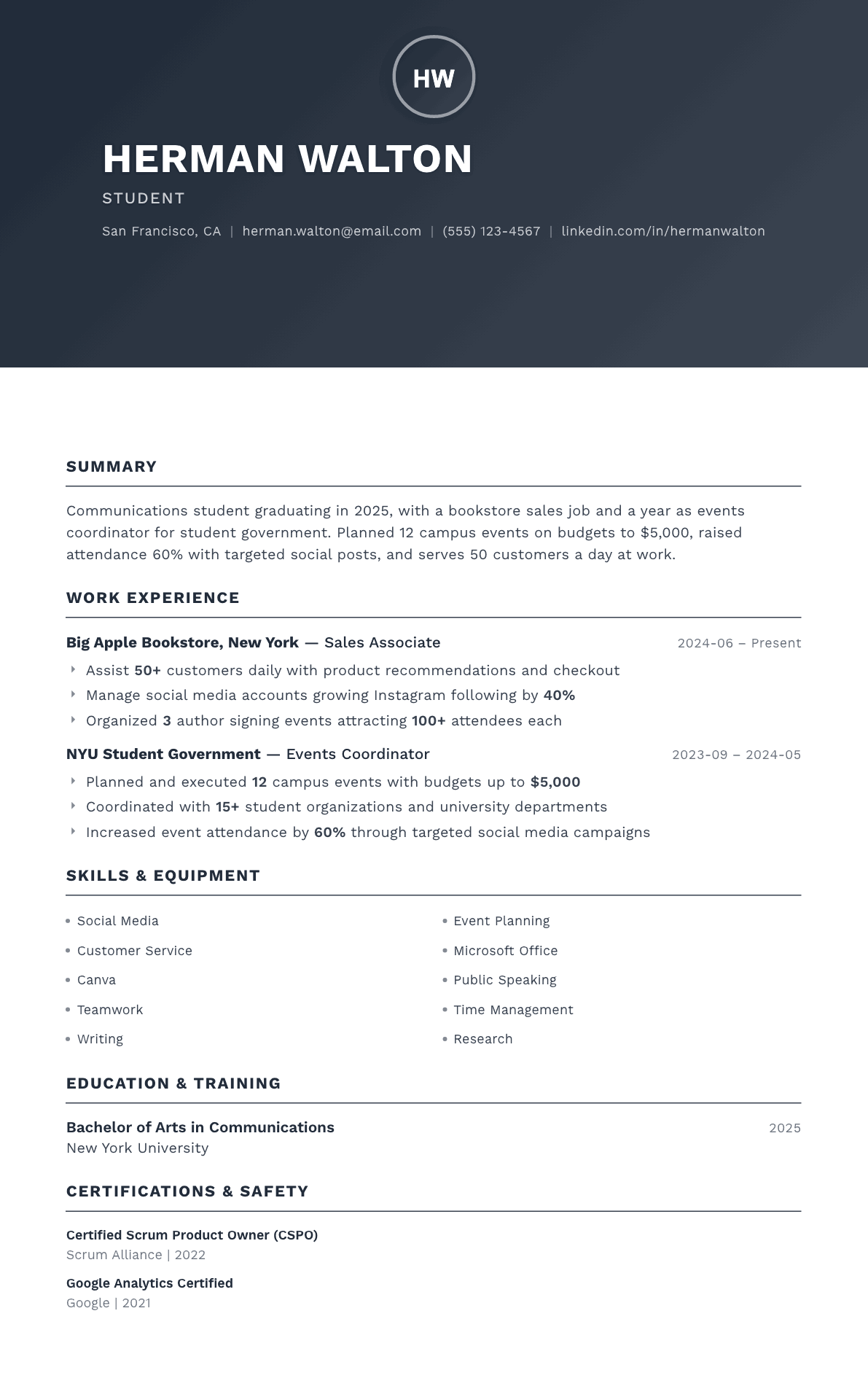
The same student content laid out in three CVBooster templates, so you can see what the finished document looks like before you write a word.
Example Student summary
Communications major graduating in 2025, currently balancing part-time retail with campus event work. Ran 12 student government events with 15 partner organizations, grew a bookstore Instagram account 40%, and organized three author signings drawing 100 people each. Looking for a communications or events internship.
Skills to list on a Student resume
- Social Media
- Event Planning
- Customer Service
- Microsoft Office
- Canva
- Public Speaking
- Teamwork
- Time Management
- Writing
- Research
What actually gets this resume read
- Lead with education since you have limited work experience.
- Include relevant coursework, projects, and academic achievements.
- Highlight extracurricular leadership and volunteer work.
- Quantify everything: people managed, events organized, followers grown.
- Tailor skills to the specific internship or entry-level role.
How to write a student resume
The word student covers people in very different positions: an undergraduate looking for a first part-time role, a graduate researcher applying outside academia, a vocational trainee finishing a trade program, an adult returning to study after a decade of work, and an international student who has to explain a qualification the reader has never seen. They all need the same underlying decision made first, which is whether education or experience sits at the top of the page.
The rule is simple. Education leads while your study is the strongest thing you have to offer or is the qualification the job requires. Experience leads the moment you have relevant paid work that outweighs the degree, which is often true for returning students and for anyone in a trade program with years on the tools. Getting that order wrong is the most common structural error on a student resume, and it changes what the reader believes about you within a few seconds.
This guide covers how to choose the structure, how to write academic work so a non-academic reader can judge it, what to do with a study gap or a career change, three summaries across undergraduate, graduate and returning students, before-and-after bullets, and the questions students ask when the usual advice does not fit their situation.
Choose the structure before you write a word
Ask two questions. Does the employer require the qualification you are studying, and is your work history relevant to the role. If the qualification is the requirement, education goes first. If you already have relevant experience, experience goes first and the in-progress degree sits directly under it so the reader still sees it early.
A resume and an academic curriculum vitae are not the same document, and mixing them is costly. An industry application wants one or two pages with results. An academic or research application wants a longer document with publications, conference presentations, teaching, funding and referees. Decide which one the posting is asking for before choosing a template.
- Header: name, city, phone, professional email, and a portfolio or profile link when the field expects one.
- Education-first order: summary, education, projects, experience, activities, skills.
- Experience-first order: summary, experience, education in progress, certifications, skills.
- Write the qualification the way the awarding institution writes it, then note the expected completion month.
Education: make an unfinished degree read as progress, not as a gap
Never hide that a program is in progress. Write the institution, the qualification, the field and the expected completion date, and add the phrase in progress or expected so nobody suspects an abandoned course. A part-time or evening program should say so, because studying alongside employment is an asset rather than a caveat.
Give the reader the parts of the program that are transferable: modules that map to the role, laboratory or clinical hours completed, a placement, a dissertation or thesis topic in plain language, and any assessed group work. A graduate student should describe the research question in a sentence a non-specialist can follow, since the person screening the application usually is one.
International students should name the country of study and, where a comparison is useful, the level of the qualification in terms the local reader knows. Add language levels honestly using a recognized scale, and note work authorization only if the posting asks.
Turn academic work into evidence a manager can weigh
Academic work is real work described badly. A thesis is a long project with a question, a method, a data set, a deadline and a defense. A laboratory rotation is technical training with instruments and protocols. A teaching assistantship is instruction, grading at volume and student support. Write each of them with the same elements you would give a job: scope, method, tools, numbers and result.
Numbers exist even in academic settings. Students taught, papers graded per term, participants recruited, samples processed, hours in placement, size of the data set, length of the field study, and grant or bursary amounts awarded to the project by an external body. These make the work legible to someone who will never read the thesis.
Group and supervised work should be described with your own contribution named. Employers ask about it, and precision here reads as integrity rather than modesty.
- Thesis or dissertation: the question in one line, the method, the data, the supervisor field, and the outcome or grade.
- Teaching assistantship: course, student numbers, sessions run per week, grading load, office hours.
- Placement or clinical hours: setting, hours completed, supervised tasks, competencies signed off.
- Vocational training: workshop hours, machines or systems operated, safety certifications earned, assessed practical tasks.
Returning students, career changers and gaps
A student who worked for years before enrolling should not bury that history. Lead with the experience, keep the older roles compressed into one or two lines each, and use the summary to connect the previous career to the field of study. A warehouse supervisor training as an electrician has managed people, schedules and safety, and every one of those transfers.
Treat gaps plainly. A year of caregiving, a period of illness, a relocation or an interrupted program can be shown as a short dated line with a neutral label, which stops a reader inventing a worse explanation. Any study, volunteering or freelance work during that period should appear.
When the previous career is unrelated, keep the older entries factual and short and put the weight on recent coursework, placements and projects in the new field. The resume should show a direction, not an apology.
Skills, references and the length question
Build the skills section from the posting and group it into tools, technical methods and languages. Include laboratory, workshop or clinical techniques with the instrument or system named, because those are the terms a specialist screener searches for. Keep soft qualities out of the list and demonstrate them in bullets instead.
Two pages are acceptable for a graduate student or a returning student with a real work history. One page is right for an undergraduate. In both cases, the test is whether every line earns its space, since a padded page is more damaging than a short one.
Line up two referees who can speak to recent work, usually a supervisor from a placement or job and an academic who has actually taught you rather than the most senior name available. Ask them before you list them and tell them which roles you are applying for.
Student resume summary examples
Undergraduate
Second-year communications student with campus event planning experience and a term running social media for a departmental society. Comfortable with content scheduling, basic design tools and audience reporting. Available 16 hours a week during term and full time over the summer, seeking a part-time marketing assistant role.
Graduate researcher
Final-year environmental science graduate student completing a thesis on urban water runoff, with a field data set of 1,400 samples collected over two seasons. Teaching assistant for two undergraduate courses totaling 180 students. Seeking an environmental analyst role applying field sampling and statistical modeling outside academia.
Returning student
Electrical apprenticeship student with nine years of prior warehouse supervision, including a team of 14 and full shift scheduling. Completed 900 workshop hours and a six-month site placement, with safety training current. Seeking an apprentice electrician position with a commercial contractor.
Work experience bullets: before and after
Before: Wrote a thesis for my degree.
After: Completed a thesis on urban runoff contamination, collecting 1,400 field samples across two seasons and analyzing them in R to model the effect of surface type on concentration.
The data set size, the method and the tool turn an unreadable academic line into work an employer can assess.
Before: Worked as a teaching assistant.
After: Taught two weekly lab sections of 30 students each, graded roughly 180 assignments per term and held office hours that a departmental survey ranked highest among six assistants.
Teaching load, grading volume and an outcome show scale and quality rather than a title.
Before: Studying part time while working.
After: Completed a part-time diploma over two years while working 32 hours a week, attending evening classes twice weekly and finishing with distinction in four of six modules.
Naming the hours and the schedule shows discipline that a bare mention of part-time study hides.
Before: Did a work placement as part of my course.
After: Completed a six-month placement with a commercial contractor, logging 900 supervised hours on conduit installation, panel terminations and testing, with each competency signed off by the site supervisor.
Hours, tasks and sign-off make a placement read as verified training instead of observation.
Before: Managed a team before going back to school.
After: Supervised 14 warehouse staff across two shifts, owning the rota, safety briefings and monthly stock counts before returning to full-time study.
Concrete prior responsibility is the strongest card a returning student holds, so it needs the detail of a real job entry.
Hard skills
- Academic research and literature review
- Data collection and analysis
- Statistical software such as R or SPSS
- Report and technical writing
- Microsoft Excel and spreadsheets
- Presentation and poster design
- Laboratory or workshop techniques
- Referencing and citation management
- Survey design
- Project scheduling
- Record keeping and documentation
Soft skills
- Independent study discipline
- Meeting fixed deadlines
- Explaining technical work simply
- Collaboration in assessed groups
- Taking supervision
- Balancing study with paid work
Certifications worth listing
- Human Subjects Research Training (CITI Program)
- Project Management Ready (Project Management Institute)
- Microsoft Office Specialist: Word Associate (Certiport)
- First Aid, CPR and AED (American Red Cross)
- IC3 Digital Literacy Certification (Certiport)
Mistakes that cost student candidates the interview
- Leading with education when years of relevant paid work would carry the page far better.
- Submitting an academic curriculum vitae to an industry job, or a one-page resume to a research post.
- Leaving a program looking abandoned by omitting the expected completion date.
- Describing a thesis in the language of the discipline so that no non-specialist reader can judge it.
- Ignoring the countable parts of academic work: students taught, samples processed, placement hours, participants recruited.
- Erasing a study gap instead of labeling it in a neutral dated line, which invites a worse assumption.
- Listing a famous professor as a referee who has never supervised your work.
Student resume questions
Should education or experience come first on a student resume?
Education comes first when the qualification is what the employer requires or is the strongest thing you have. Experience comes first once you hold relevant paid work that outweighs the degree, which is usually true for returning students and for trainees with time already on the tools.
How do I put an unfinished degree on a resume?
Write the institution, the qualification and field, and the expected completion month with the words in progress or expected. Add the modules, placement hours or research work already completed so the entry shows accumulated progress rather than an open-ended commitment.
What is the difference between a resume and an academic CV?
A resume is one or two pages aimed at an employer and organized around results. An academic curriculum vitae is longer, has no page limit, and lists publications, conferences, teaching, grants, supervision and referees. Send whichever the posting names, never a hybrid.
How do I explain a gap in my studies?
Give it a short dated line with a neutral label such as family care, medical leave or relocation, and include any part-time work, volunteering or courses from that period. A labeled gap closes the question, while a silent one leaves the reader guessing.
Can I use a resume from my home country when applying abroad?
Rewrite it. Expectations differ on length, photographs, date of birth, marital status and referees, and a document carrying details the local market never includes can be set aside. Keep the substance, adapt the conventions, and explain the qualification level in local terms.