Patent Agent Resume Examples: free ATS score and gap list
Write a Patent Agent Resume Prosecution Groups Respond To
By Mustafa Tarabya, founder of CVBooster · Published · Updated
Patent agent resume example with drafting and prosecution bullets, registration number placement, art unit keywords and technical background tips.
Sample resumes for a patent agent
The same patent agent content laid out in three CVBooster templates, so you can see what the finished document looks like before you write a word.
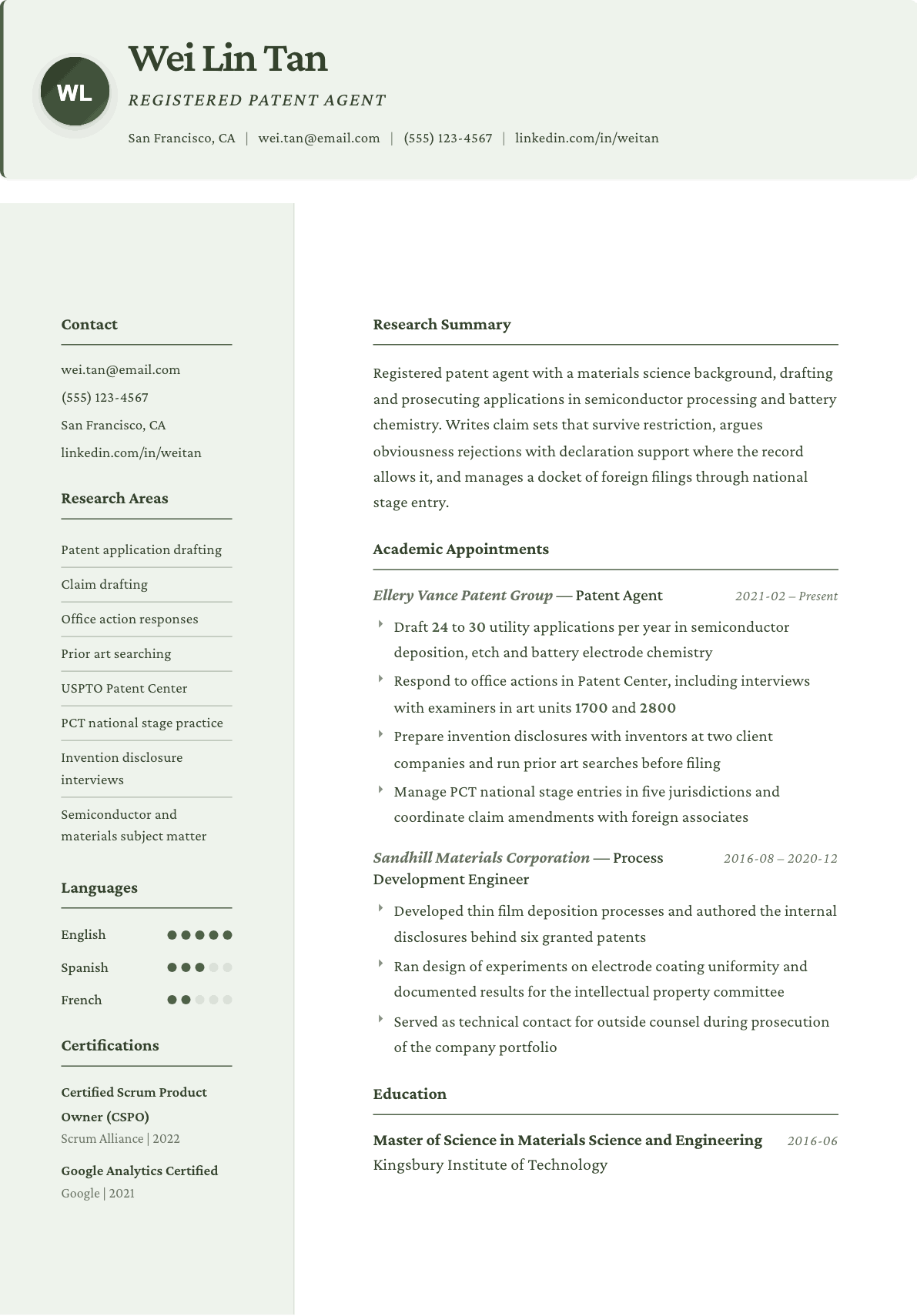
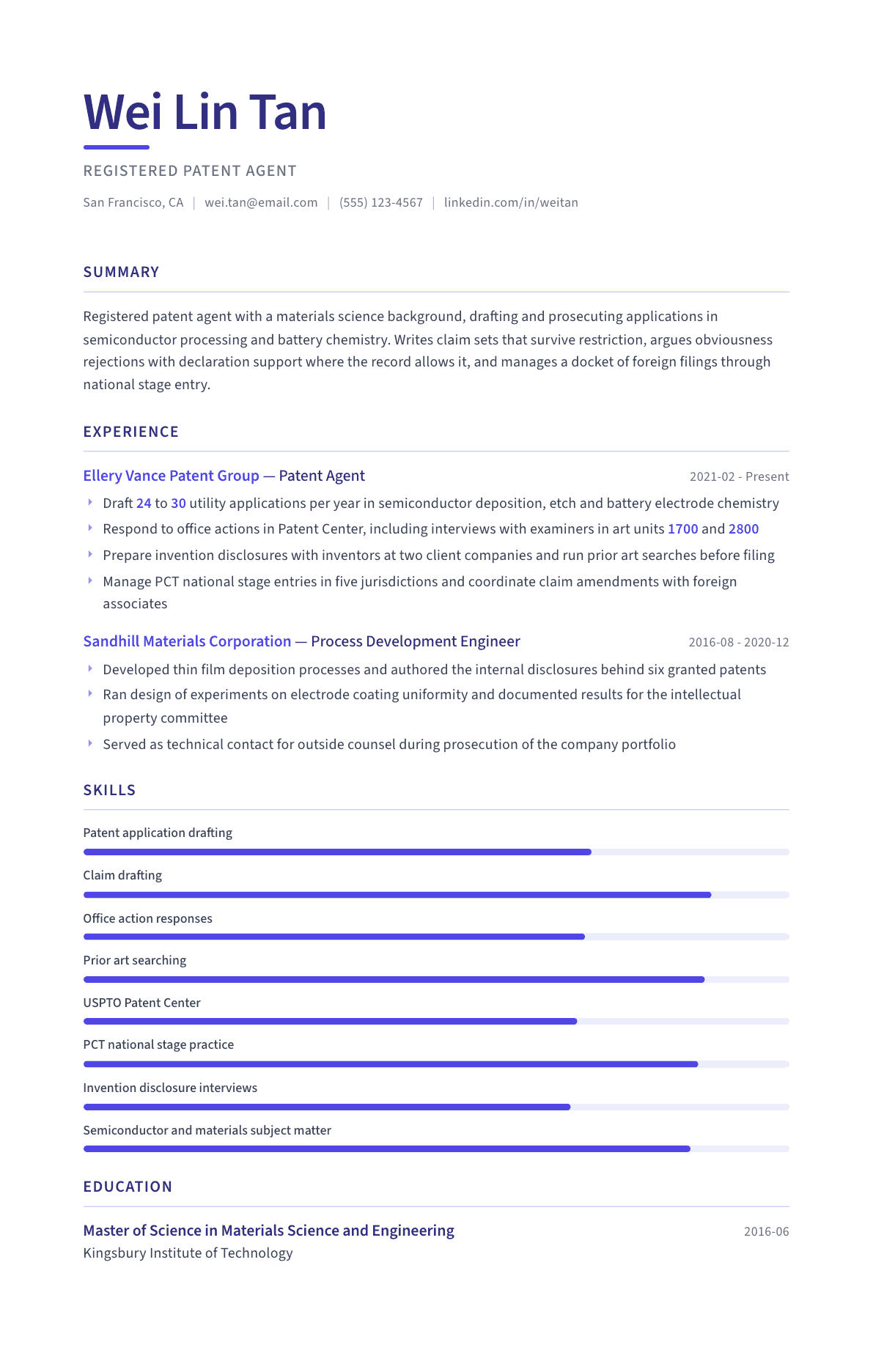
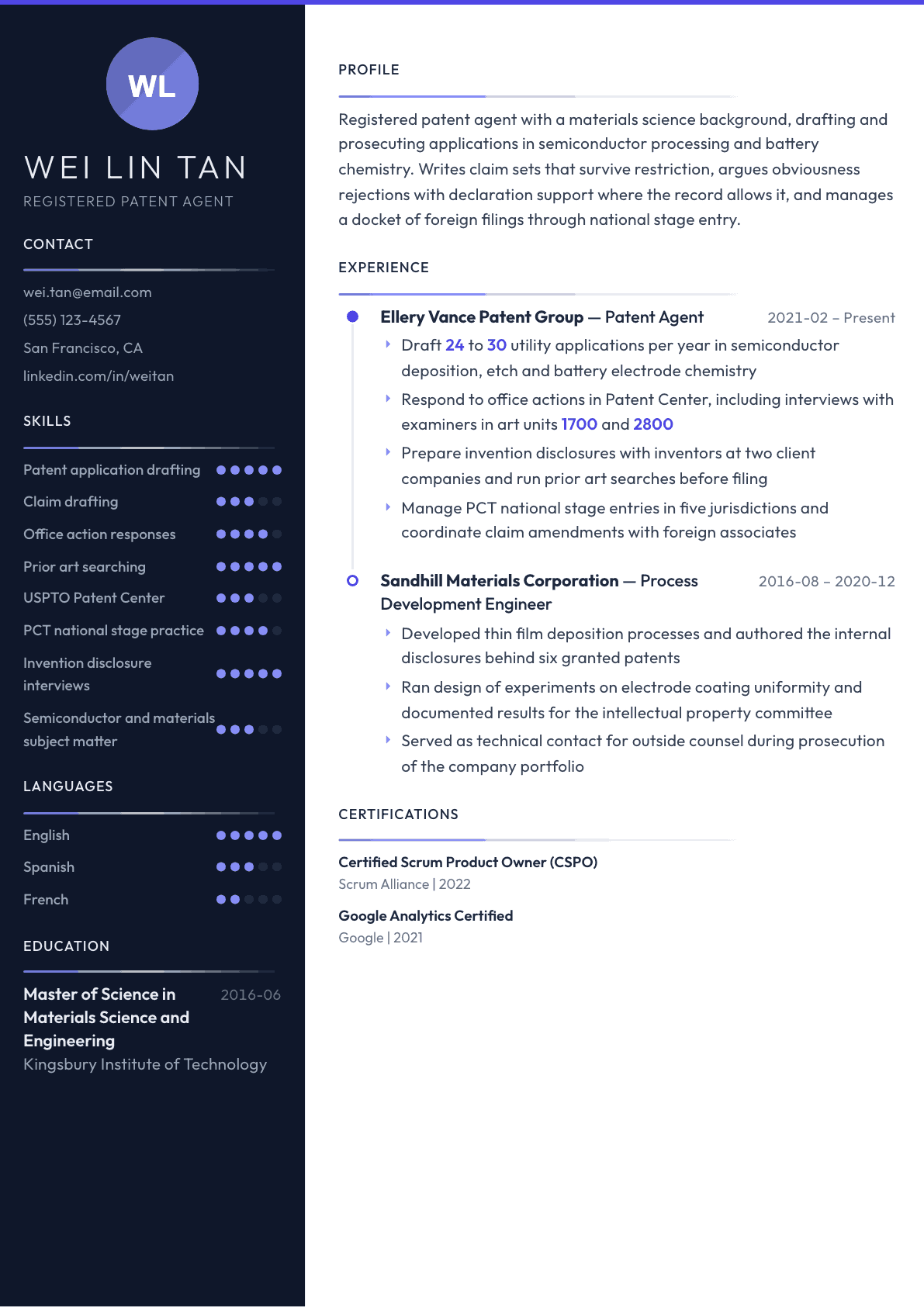
Example Patent Agent summary
Registered patent agent with a materials science graduate degree and four years of prosecution in semiconductor and battery technology. Drafts utility applications from inventor interviews, responds to office actions with examiner interviews where they help, and manages national stage entries across five jurisdictions. Seeking an agent seat in an electrical and materials prosecution group.
Skills to list on a Patent Agent resume
- Utility application drafting
- Claim construction and drafting
- Office action response
- Examiner interviews
- Prior art and patentability searching
- Freedom to operate review
- Invention disclosure capture
- PCT and Paris Convention filings
- National stage entry
- Provisional application practice
- Specification and figure preparation
- Docket management
- Information disclosure statements
- Patent Center filing
What actually gets this resume read
- Put your USPTO registration number in the header, because a prosecution group verifies it before reading anything else.
- Name your technical degrees and the art you practice in, since firms hire agents to fill a specific technology gap.
- Count the applications you draft a year and the office action responses you file, so the reader can gauge throughput.
- Show argument work: restriction requirements, obviousness rejections, examiner interviews and declaration practice.
- List foreign filing experience by treaty route and jurisdiction, since portfolios rarely stop at a domestic filing.
- Mention the inventors and industries you interview, because drafting quality depends on pulling detail out of engineers.
How to write a patent agent resume
Hiring a patent agent is a technical staffing decision dressed as a legal one. A prosecution group has a docket weighted toward certain technologies, and it hires the agent whose degree and industry background match that docket. Your registration number proves you may practice; your technical training decides which applications land on your desk.
That means a patent agent resume has to carry two resumes inside it. One is the scientist or engineer: degrees, research area, industry work, publications and patents where you were the inventor. The other is the practitioner: applications drafted, office actions answered, interviews conducted, foreign filings managed.
This guide covers how to arrange both, how to quantify prosecution work without breaching client confidence, and how to present a first move from the bench into a prosecution seat.
Format: registration number and technology in the header
Reverse chronological, two pages is accepted here because the technical background needs room. Put your registration to practice before the patent office directly under your name, with the registration number, then a one line technology statement naming the fields you prosecute in.
A publications and patents section belongs at the end rather than the top, unless you are applying straight from a graduate program with no prosecution behind you. Then it is evidence of technical depth and should be visible.
- Header: name, registration number, city and state, phone, email.
- Order: technology summary, prosecution experience, technical and industry experience, education, publications and inventorship, skills.
- Candidates moving from research lead with degrees and the patents they helped generate as inventors.
Summary: art, degree, and the docket you can carry
Name the technology first. Semiconductor processing, battery chemistry, medical devices, wireless communications, computational biology: firms search on these words because a docket gap is what created the opening. Then the degree, then the prosecution volume.
If your technical background is broader than your prosecution record, say so honestly. A firm may hire an agent with a strong materials background and light prosecution history precisely because the training investment pays off across a portfolio.
Experience: drafting, prosecution, and foreign filing
Drafting bullets should carry a number of applications per year, the subject matter, and where the disclosure came from: inventor interviews, invention disclosure forms, research reports. Add anything that shows claim strategy, such as writing method and apparatus claim sets in parallel or building continuation practice into the original filing.
Prosecution bullets should name the response work. Anticipation and obviousness rejections, restriction requirements and elections, enablement and written description issues, examiner interviews and after final practice. Naming the rejection types is how a partner tells a genuine practitioner from an agent who only files.
Foreign work deserves its own bullets. National stage entries, the jurisdictions, coordination with foreign associates on claim amendments, and any experience with regional offices. Portfolios rarely stop at one country and an agent who can manage that traffic saves attorney time.
Technical background: the part that gets you the interview
Do not compress the science. Give the research area, the techniques, the instruments and the industry problem you worked on. A partner reads this to judge whether you will understand an inventor without three meetings.
If you were an inventor on issued patents, list them by title and note your inventorship. If you authored papers, give the field rather than a full citation list. The purpose is depth, not a curriculum vitae.
Skills, systems and the vocabulary a firm searches
Match the practice language: utility application drafting, claim drafting, office action response, examiner interview, restriction election, information disclosure statement, provisional practice, continuation and divisional filings, national stage entry, patentability search, freedom to operate review.
Add the systems: the electronic filing system, the docketing platform, and the search databases you use for prior art. A firm buying your time wants to know you can file without a paralegal holding your hand.
Patent Agent resume summary examples
Newly registered
Registered patent agent with a doctorate in organic chemistry and 5 years of medicinal chemistry research, newly admitted to practice. Has drafted 6 provisional applications under supervision, runs patentability searches independently, and is seeking a prosecution seat in a life sciences group.
Four years prosecuting
Patent agent with a materials science graduate degree, drafting 24 to 30 utility applications a year in semiconductor deposition and battery electrode chemistry. Responds to office actions with examiner interviews where they help, and manages national stage entries across 5 jurisdictions.
Senior agent
Senior patent agent with 12 years prosecuting electrical and computing portfolios for two operating companies and a boutique firm. Runs invention harvesting sessions with engineering teams, owns continuation strategy on 3 portfolio families, and mentors junior agents on claim drafting and after final practice.
Work experience bullets: before and after
Before: Drafted patent applications for clients.
After: Drafted 24 to 30 utility applications a year in semiconductor deposition and etch, writing method and apparatus claim sets in parallel from inventor interviews and process development reports.
Volume, technology and claim strategy tell a partner what kind of docket you can absorb immediately.
Before: Responded to office actions.
After: Answered anticipation and obviousness rejections with claim amendments and specification support arguments, and cleared 4 restriction requirements through election with traverse.
Naming the rejection types demonstrates prosecution reasoning rather than the fact that responses were filed.
Before: Talked with examiners about applications.
After: Conducted examiner interviews in electrical and materials art units, narrowing issues before response and reaching allowance on 3 cases after a single interview.
Interviews with a stated outcome show an agent who moves cases instead of exchanging paper.
Before: Worked with inventors to understand inventions.
After: Ran invention disclosure interviews with process engineers at 2 client companies, converting bench notebooks and design of experiments data into filed disclosures.
The sources you work from prove you can extract an invention from engineers who have never written a claim.
Before: Handled international filings.
After: Managed national stage entries in 5 jurisdictions, coordinating claim amendments with foreign associates to fit local unity and clarity requirements before each deadline.
Jurisdiction count and the substantive coordination separate real foreign practice from forwarding instructions.
Hard skills
- Utility application drafting
- Claim drafting and claim strategy
- Office action response
- Examiner interview practice
- Restriction and election practice
- Patentability and prior art searching
- Freedom to operate review
- Invention disclosure interviews
- Provisional application practice
- Continuation and divisional filings
- National stage and treaty filings
- Information disclosure statements
- Electronic filing and docket management
Soft skills
- Explaining claim scope to inventors
- Written precision
- Deadline ownership
- Persistence with a difficult examiner
- Client and associate correspondence
Certifications worth listing
- Registration to Practice in Patent Cases before the United States Patent and Trademark Office (United States Patent and Trademark Office)
- Certified Licensing Professional (CLP) (Certified Licensing Professionals, Inc.)
Mistakes that cost patent agent candidates the interview
- Omitting the registration number, which a prosecution group verifies before it reads a single bullet.
- Hiding the technical degree on the second page when the technology match is the reason for the opening.
- Describing prosecution as filing paperwork instead of naming the rejections you argued and how you resolved them.
- Listing every patent you touched as if you were the inventor, which is checked easily and ends the process.
- Leaving foreign filing work off the page when portfolio management is much of the daily job.
- Writing the science so densely that a hiring partner outside your field cannot tell what you actually did.
Patent Agent resume questions
Can I apply for patent agent roles before passing the registration exam?
Yes, and many firms hire technical specialists on that basis. Say clearly that you are exam eligible or scheduled, and lead with your technical background, since that is what makes the training investment worthwhile for the firm.
How do I quantify prosecution work without naming clients?
Use counts and technology areas rather than client names: applications drafted per year, office action responses filed, interviews conducted, jurisdictions managed. Published applications are public, but the resume rarely needs to identify them.
Does an advanced degree matter more than years of practice?
It depends on the art. Life sciences prosecution often expects a doctorate, while electrical and mechanical groups hire bachelors and masters holders freely. Match your emphasis to the technology group you are targeting.
Should industry engineering work stay on the resume?
Keep it, with detail. Time in a fabrication plant or a development lab is exactly what lets you interview an inventor efficiently, and firms treat it as a differentiator against agents who came straight from school.
How do I show claim drafting quality on paper?
Point at outcomes and practice habits: allowance after a single interview, continuation families you planned at filing, or applications drafted with both method and apparatus coverage. Quality shows through strategy described, not adjectives.