Payroll Specialist Resume Examples: the lines they read
Payroll Specialist Resume Template and Payroll Resume Examples
By Mustafa Tarabya, founder of CVBooster · Published · Updated
Payroll resume template and examples for clerks, specialists and leads: headcount, pay groups, states, reconciliations and the system keywords.
Sample resumes for a payroll specialist
The same payroll specialist content laid out in three CVBooster templates, so you can see what the finished document looks like before you write a word.
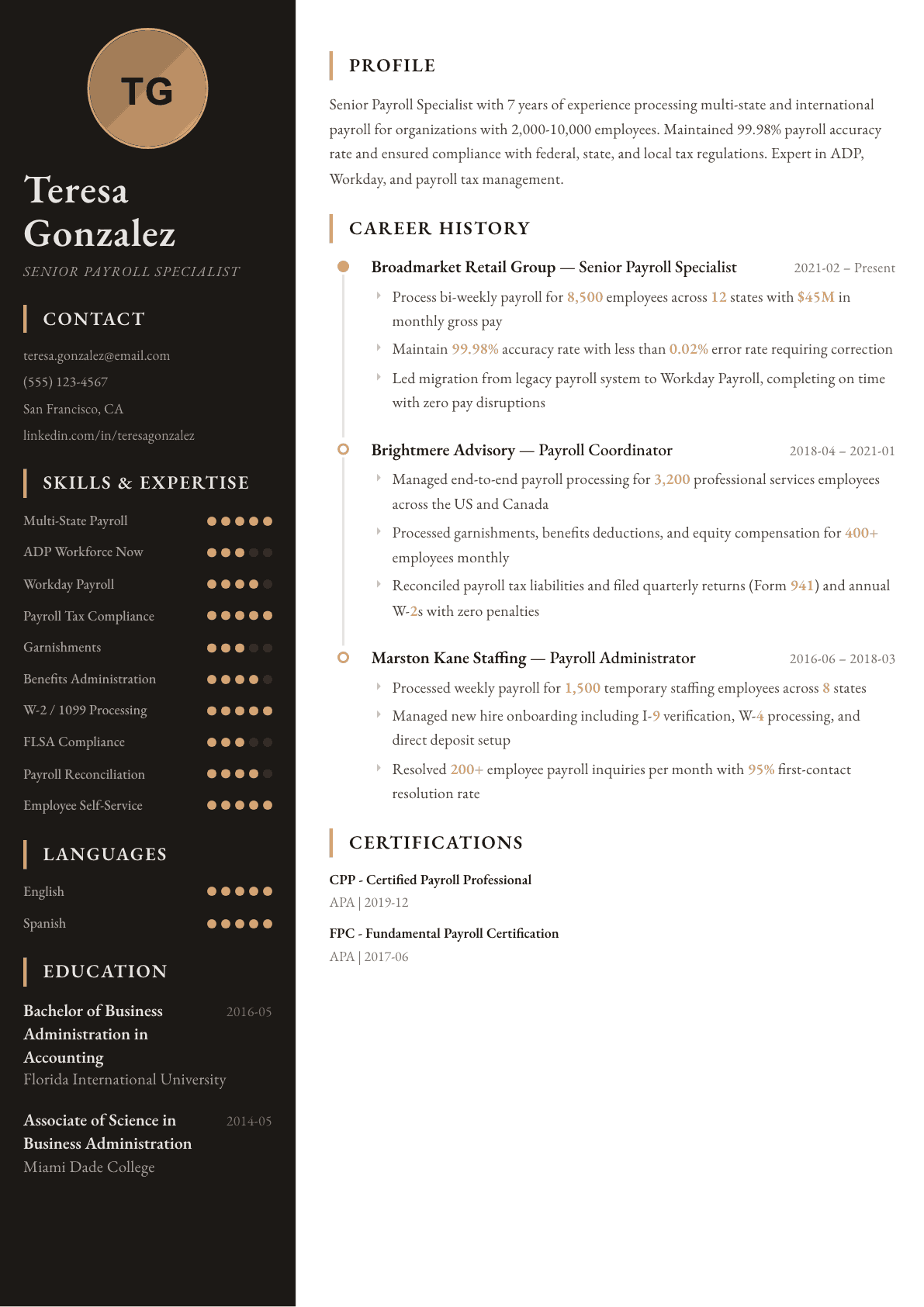
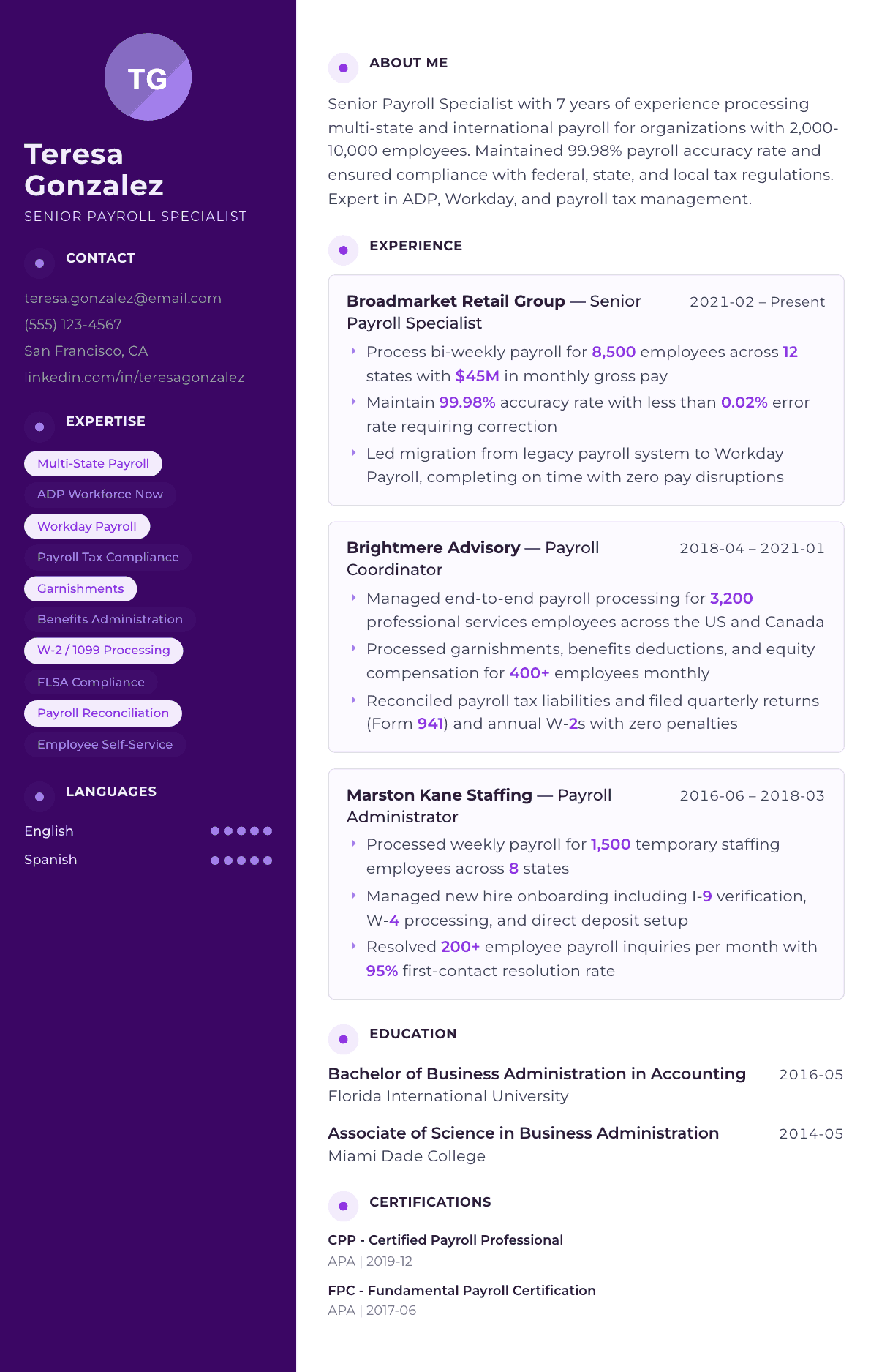
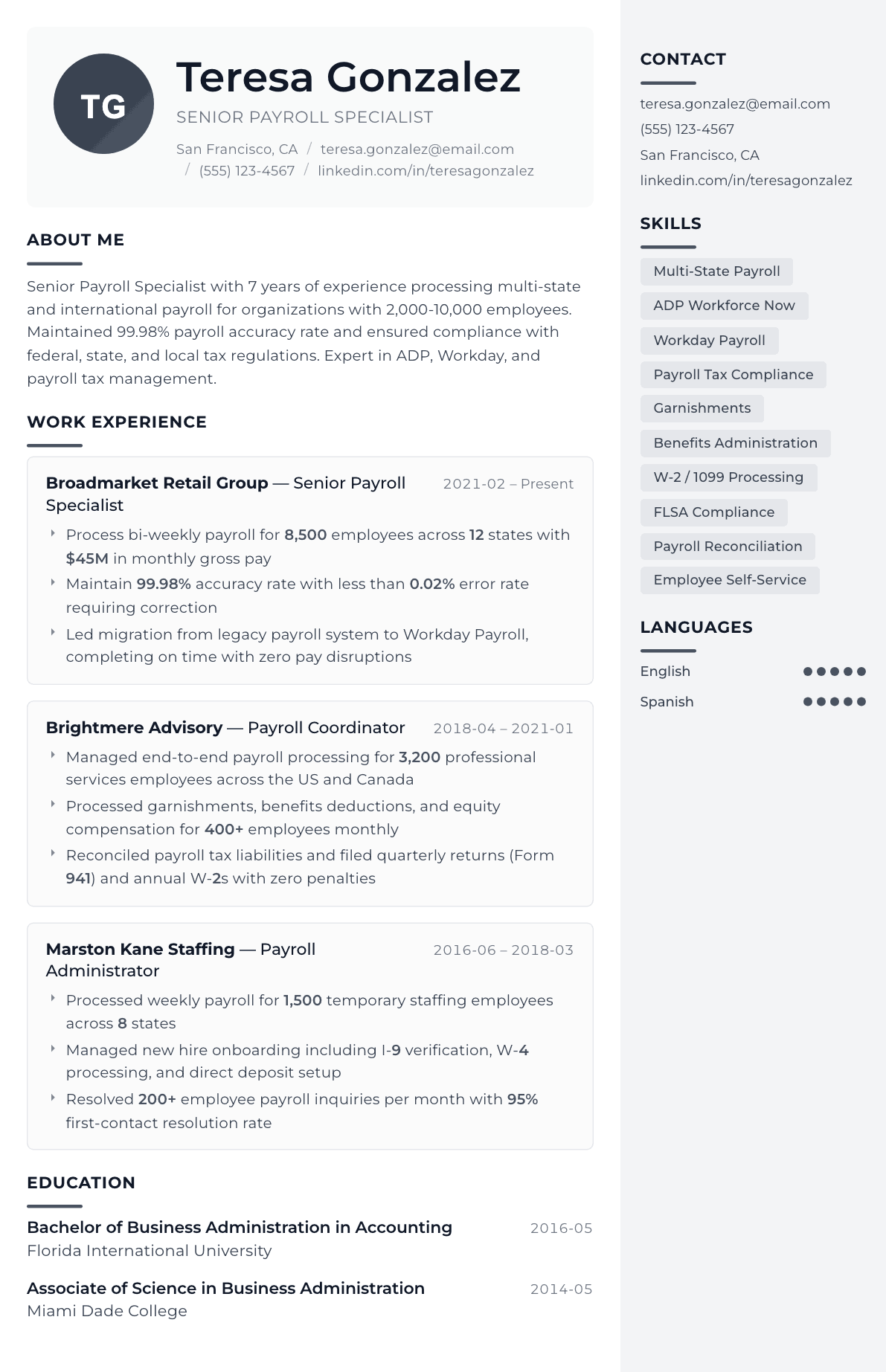
Example Payroll Specialist summary
CPP-certified Senior Payroll Specialist with 7 years of experience processing multi-state payroll for organizations with up to 10,000 employees. Maintained 99.98% accuracy while managing $45M in monthly gross pay. Expert in ADP, Workday, and payroll tax compliance. Seeking a Payroll Manager role to lead payroll operations at a growing organization.
Skills to list on a Payroll Specialist resume
- Multi-State Payroll Processing
- ADP Workforce Now
- Workday Payroll
- UKG Pro
- Payroll Tax Compliance
- Garnishments & Deductions
- W-2 / 1099 Processing
- FLSA Compliance
- Payroll Reconciliation
- Benefits Administration
- Employee Self-Service
- Quarter / Year-End Processing
What actually gets this resume read
- Quantify employee headcount, pay frequency, gross payroll amounts, and number of states.
- Highlight payroll accuracy rates and error resolution metrics.
- Include specific payroll systems: ADP, Workday, UKG, Paychex, SAP Payroll.
- Show compliance expertise: FLSA, state tax, garnishments, equity compensation.
- Demonstrate system migration and implementation experience.
- CPP certification is the gold standard; display it prominently.
How to write a payroll specialist resume
Payroll is the one accounting function where a mistake reaches every employee personally and often on the same day. The person hiring a payroll specialist is hiring against that risk, so she reads the resume looking for scale, complexity and evidence that you have closed cycles without incident. Headcount, pay frequency, the number of states or countries, union versus non union, hourly versus salaried, and whether the payroll ran in house or through a service bureau.
The second thing she reads for is where you sit on the spectrum from data entry to payroll owner. Entering timecards and pressing submit is one job. Reconciling the quarterly returns, resolving an agency notice, handling a multi state work arrangement, setting up a new state registration, calculating an off cycle for a terminated employee under a state final pay rule, and closing the year with clean forms is a completely different one. Most resumes never distinguish them and that is why they stall.
This guide covers the section order payroll managers expect, a payroll resume template filled in line by line, three summaries from clerk to lead, before and after bullets, and the compliance and system detail that gets a payroll resume shortlisted.
Format: scale facts near the top, one page until you run the cycle
One page for most payroll specialists, two once you have led a system implementation or supervised a team. Directly under the summary, give a short block of scale facts: employee count, pay groups, pay frequencies, states and localities, union agreements, and the systems. That block answers most of what a payroll manager needs and it prevents her from guessing.
Keep the layout parsable. Payroll roles are frequently filled through corporate applicant tracking systems, and a two column resume with icons often loses the system names, which are exactly the keywords the screen is filtering on.
- Header: name, credential such as CPP or FPC, city and state, phone, email.
- Order: summary, scale and systems block, experience, compliance expertise, certifications, education.
- Career changers from accounts payable or human resources add a line naming the payroll coursework or certificate completed.
Summary: headcount, pay groups, jurisdictions and the system
Write the summary around volume and complexity rather than adjectives. A payroll specialist running biweekly and semimonthly cycles for several thousand employees across a dozen states, with union dues and multiple garnishment types, is doing a harder job than one running a single state salaried population of similar size, and the reader needs both numbers to tell.
Name the system in the summary. Payroll hiring is unusually system specific, because a manager converting from one platform to another, or covering a gap on a live platform, is often screening for that name first. Say whether you ran it in house, through a full service provider, or in a co employment arrangement, since the daily work differs sharply.
Experience: the cycle, the exceptions, and the reconciliations
Structure the bullets around the payroll calendar. The regular cycle: timecard collection and approval chase, gross to net review, funding, and post payroll audit. The exceptions: off cycle checks, retroactive pay, final pay under state timing rules, bonus and commission runs with supplemental withholding, imputed income for benefits, stock compensation, and expatriate or multi state allocations. The periodic work: quarterly returns and their reconciliation to the general ledger, year end forms, and the annual open enrollment deduction load.
Reconciliation is where credibility lives. Say plainly that you reconcile gross to net, tie the quarterly filings to the payroll register, balance the year end forms before they issue, and clear the payroll clearing account with the general ledger team each period. Payroll managers hire people who catch their own errors.
Include the volume of exception work rather than only the headcount. Garnishment orders administered, agency notices resolved, employee inquiries answered within a service target, amended returns filed and closed. That is the daily reality of the job and it shows you have lived it.
Systems and the implementation experience that stands out
Name the platforms precisely: ADP Workforce Now or Vantage, Workday Payroll, UKG Pro or Ready, Paycom, Paylocity, Paychex, Ceridian Dayforce, or SAP and Oracle payroll modules for larger enterprises. Add the time and attendance system feeding them, since most payroll errors originate upstream in timekeeping rules rather than in the payroll engine.
If you have been through an implementation or a conversion, give it real estate. Say what you owned: parallel testing and the variance investigation, historical data mapping, earning and deduction code design, general ledger mapping, tax jurisdiction setup, and post go live stabilization. Very few payroll candidates have this and every payroll leader wants it, because a conversion done badly costs a year of clean up.
Compliance vocabulary and the keywords the screen uses
Show the regulatory areas you actually apply. Fair Labor Standards Act overtime calculation including the regular rate treatment of bonuses, exempt classification, state specific rules on final pay, meal and rest premiums and daily overtime, garnishment priority and disposable earnings limits under the Consumer Credit Protection Act, multi state and reciprocal withholding, wage and hour recordkeeping, and the Affordable Care Act reporting cycle if you handle it.
Job postings recycle a stable set of terms: multi state payroll, payroll tax, quarter end, year end, garnishments, reconciliation, general ledger interface, off cycle, retroactive pay, employee self service, and the platform name. Mirror the ones that are true of your experience and attach each to a concrete task somewhere in the experience section.
Payroll resume template, filled in
Most payroll resumes that reach an interview share one template: a header with the certification, a summary that states scale, a short systems line, then each job opened with a scope line before the bullets. Here it is filled in for an invented payroll specialist at a multi state employer. Keep the order and swap in your own headcount, pay groups, states and system.
For a payroll clerk, shrink the scope line to the part of the cycle you own, such as timecard audit and data entry for one pay group. For a payroll lead, add the people you supervise and the year end and audit work you sign off.
- Header: Daniel Kerr, FPC, Payroll Specialist, Columbus, OH, phone, email, LinkedIn.
- Summary: Payroll specialist with five years processing biweekly and weekly payroll for about 1,400 hourly and salaried employees across 6 states, in ADP Workforce Now. Owns quarterly tax reconciliations, garnishments and off cycle checks, and closes year end with clean W-2 forms.
- Systems: ADP Workforce Now, Kronos timekeeping, NetSuite general ledger, advanced Excel with pivot tables and lookups.
- Payroll Specialist, Ridgeway Logistics, current role. Scope: 2 pay frequencies, 6 states, union and non union groups. Bullets: reconciled payroll to the general ledger every cycle and cleared variances before close; set up two new state tax registrations when the company opened warehouses in Indiana and Kentucky; processed final pay for terminated employees within each state deadline.
- Payroll Clerk, Summit Home Health, previous role. Scope: weekly payroll for about 300 caregivers. Bullets: audited timecards against visit records before each run; answered pay questions from caregivers by phone and email.
- Certification and education: Fundamental Payroll Certification (FPC); Associate of Applied Science in Accounting.
Payroll Specialist resume summary examples
Payroll clerk
Payroll clerk supporting biweekly processing for 600 hourly employees in two states, handling timecard chase, deduction changes and employee inquiries in Paylocity. Completed the Fundamental Payroll Certification and reconciled the quarterly register with the payroll manager. Seeking a payroll specialist seat with year end ownership.
Five years in
Payroll specialist running semimonthly and biweekly cycles for 3,400 employees across 14 states in ADP Workforce Now, including union dues, multiple garnishment types and quarterly reconciliation to the general ledger. Certified Payroll Professional. Looking for a senior specialist role with multi entity responsibility.
Payroll lead
Payroll lead with nine years and a Certified Payroll Professional credential, owning end to end payroll for 9,000 employees across 26 states and two countries in Workday. Led a conversion from a service bureau, supervises three specialists, and closes year end forms with no amendments in the last three cycles.
Work experience bullets: before and after
Before: Processed payroll for employees on a biweekly basis.
After: Processed biweekly and semimonthly payroll for 3,400 employees across 14 states and three pay groups in ADP Workforce Now, including union dues, shift premiums and multiple garnishment types.
Headcount, pay groups, jurisdictions and complexity turn a routine duty into a measure of what you can handle.
Before: Ensured payroll accuracy and compliance.
After: Reconciled the payroll register to the general ledger every cycle and tied all four quarterly returns to the year end forms, closing three consecutive years with no amended filings.
Naming the reconciliations and the amendment record is verifiable evidence, where accuracy alone is a claim.
Before: Handled garnishments and deductions.
After: Administered roughly 180 active garnishment orders including child support, tax levies and creditor judgments, applying priority and disposable earnings limits and responding to every order within the statutory answer window.
Volume and the legal mechanics show you understand the rules rather than just entering the deduction.
Before: Assisted with a payroll system implementation.
After: Owned parallel testing during a conversion from a service bureau to Workday: mapped 140 earning and deduction codes, investigated every gross to net variance across four parallel cycles, and cleared all items before go live.
Conversion detail is rare on payroll resumes and it is the strongest single differentiator you can show.
Before: Answered employee questions about their paychecks.
After: Resolved employee payroll inquiries within one business day through a shared ticket queue, and cut recurring timecard questions by rewriting the manager approval instructions with the timekeeping team.
A service standard plus a fix to the upstream cause shows ownership beyond answering the question.
Hard skills
- Multi state payroll processing
- Gross to net review and audit
- Payroll tax filing and reconciliation
- Quarter end and year end processing
- Garnishment administration
- Off cycle, retroactive and final pay
- Fair Labor Standards Act overtime calculation
- General ledger interface and clearing
- ADP Workforce Now
- Workday Payroll
- UKG and Dayforce
- Time and attendance integration
Soft skills
- Confidentiality with pay data
- Calm under a hard funding deadline
- Explaining a deduction to an upset employee
- Checking your own work twice
- Coordinating with human resources and accounting
- Documenting a repeatable procedure
Certifications worth listing
- Certified Payroll Professional (CPP) (PayrollOrg)
- Fundamental Payroll Certification (FPC) (PayrollOrg)
- Certified Payroll Specialist in ADP Workforce Now (ADP)
- Workday Payroll Certification (Workday)
- Professional in Human Resources (PHR) (HR Certification Institute)
Mistakes that cost payroll specialist candidates the interview
- Giving the employee headcount with no jurisdiction count, when multi state complexity is the main thing a payroll manager is screening for.
- Writing processed payroll without ever naming the reconciliations, which leaves the reader unsure whether you audit your own output.
- Omitting the platform name, since payroll openings are frequently filled on system experience before anything else.
- Describing compliance in the abstract instead of naming the rules you apply, such as regular rate overtime or garnishment priority.
- Skipping implementation or conversion work when you have it. It is the rarest experience on the market and it belongs high on the page.
- Treating year end as one line. Quarter to year end reconciliation and a clean forms cycle deserve their own bullet with the amendment record attached.
Payroll Specialist resume questions
Is the CPP worth it for a payroll specialist?
Yes once you have the required experience. It is the recognized credential in the field, it appears as a filter on senior payroll postings, and it signals knowledge of tax and wage rules beyond the platform you happen to use.
How do I show payroll experience if a provider handled the tax filings?
Say so plainly and describe what you owned instead: the register review, funding, variance investigation, reconciling the provider returns to your records, and clearing agency notices. Managers value knowing exactly where your responsibility ended.
What numbers should a payroll resume include?
Employee headcount, pay groups and frequencies, the number of states or countries, gross payroll per period, garnishment order volume, and inquiry response time. Together these describe the complexity of the cycle you have carried.
How do I move from accounts payable into payroll?
Lead with the transferable half: reconciliation discipline, deadline driven cycles, deduction and vendor accuracy, and general ledger work. Then add the Fundamental Payroll Certification and any wage and hour coursework, because payroll rules are the part employers cannot assume.
Should I list every payroll system I have touched?
List the ones you actually processed a cycle in and mark your depth, since a manager will ask. Add systems you only viewed or reported from in a separate line, so a screening filter still finds the name without you overstating experience.
Related resume examples
- Accountant Resume example
- Bookkeeper Resume example
- Accounts Payable Specialist Resume example
- Payroll Manager Resume example
- Financial Controller Resume example
- Tax Accountant Resume example