Accounting Interview Questions and Answers: 7 Full Examples
By Mustafa Tarabya, founder of CVBooster · Published · Updated
9 min read
Accounting interview questions come in three kinds: technical questions that check you know how the statements, entries and methods work, process questions about the close and reconciliations, and behavioral questions about errors, deadlines and judgment. The best answers are short, use the right term once, and end with what you actually did in a real ledger. The one constraint: an interviewer can tell in two sentences whether you have done the work or memorized a list, so every answer below is tied to a task. Definitions are checked against the SEC and the IRS, the page has seven complete answers from entry level to senior, and a list of the questions behind them. Written by Mustafa Tarabya, who hired for his own company, read every application himself and now writes CVBooster's guides.
If you have ever been asked to "walk me through the financial statements" and heard yourself recite a textbook back at a controller who has closed a hundred months, this page is for you. Start with the question almost every first round opens with.
Walk me through the three financial statements
This is the warm up question for staff and entry roles, and the trap is length. Name the statements, say what each shows in one line, then link them.
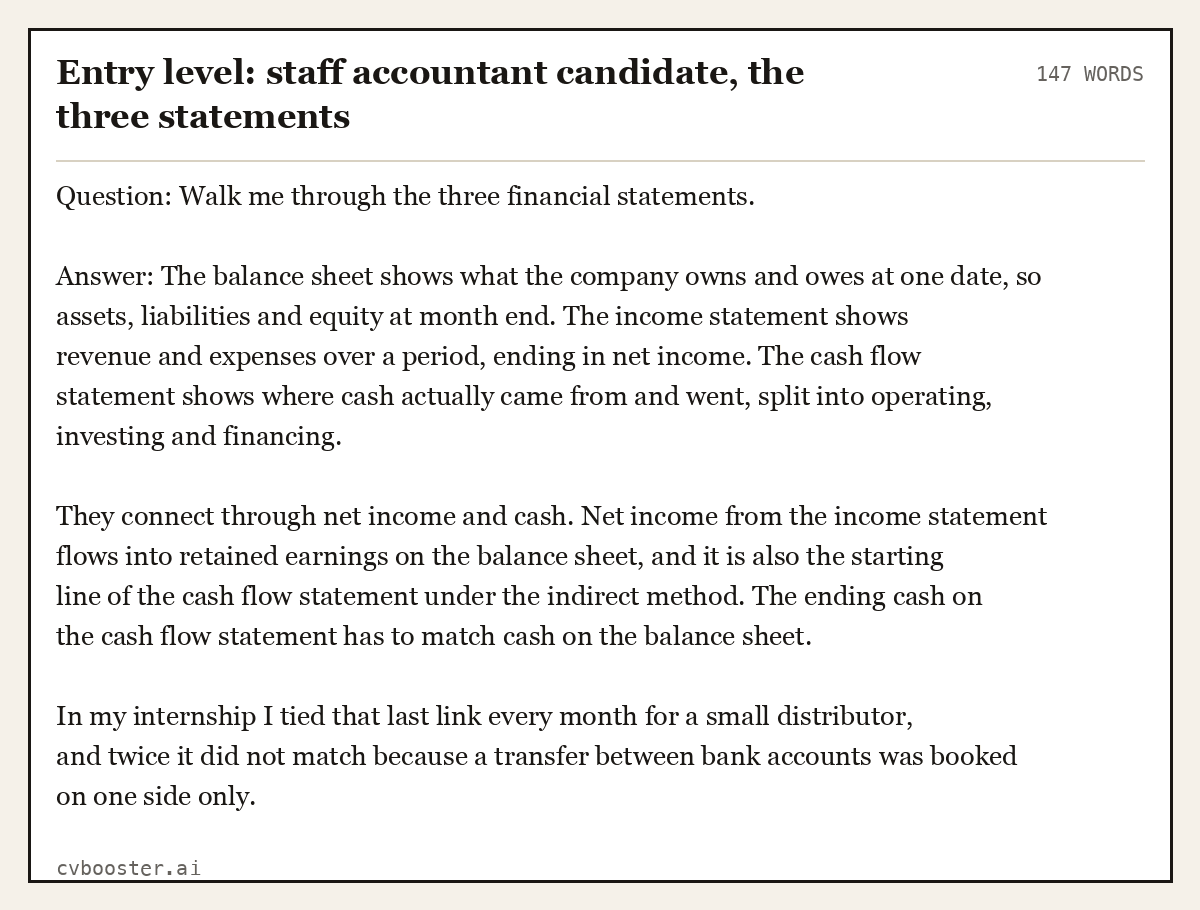
Entry level: staff accountant candidate, the three statements (147 words)
Question: Walk me through the three financial statements.
Answer: The balance sheet shows what the company owns and owes at one date, so assets, liabilities and equity at month end. The income statement shows revenue and expenses over a period, ending in net income. The cash flow statement shows where cash actually came from and went, split into operating, investing and financing.
They connect through net income and cash. Net income from the income statement flows into retained earnings on the balance sheet, and it is also the starting line of the cash flow statement under the indirect method. The ending cash on the cash flow statement has to match cash on the balance sheet.
In my internship I tied that last link every month for a small distributor, and twice it did not match because a transfer between bank accounts was booked on one side only.
The SEC's plain language guide is a useful check on your wording. It says "Balance sheets show what a company owns and what it owes at a fixed point in time" and adds that a balance sheet "does not show the flows into and out of the accounts during the period" (SEC, Beginners' Guide to Financial Statements). That second line is the reason the cash flow statement exists, and saying so is a clean way to show you understand the link rather than the list.
Technical accounting interview questions to expect
Most technical rounds draw from the same short list. Know a two sentence answer for each and one real example from your own work.
- What is the difference between the cash and accrual methods?
- How does depreciation affect the three statements?
- What is the journal entry for an accrued expense, and for prepaid rent?
- What is working capital, and what would make it fall?
- What is the difference between a debit and a credit to a liability account?
- How do you reverse an accrual at the start of the next month?
- What is deferred revenue, and when is it recognized?
Cash versus accrual: the question every round asks
Interviewers ask this because it shows whether you understand timing, which is most of accounting. The IRS puts it in two sentences in Publication 538: "Under the cash method, you generally report income in the tax year you receive it, and deduct expenses in the tax year in which you pay the expenses." And: "Under the accrual method, you generally report income in the tax year you earn it, regardless of when payment is received." (IRS Publication 538).
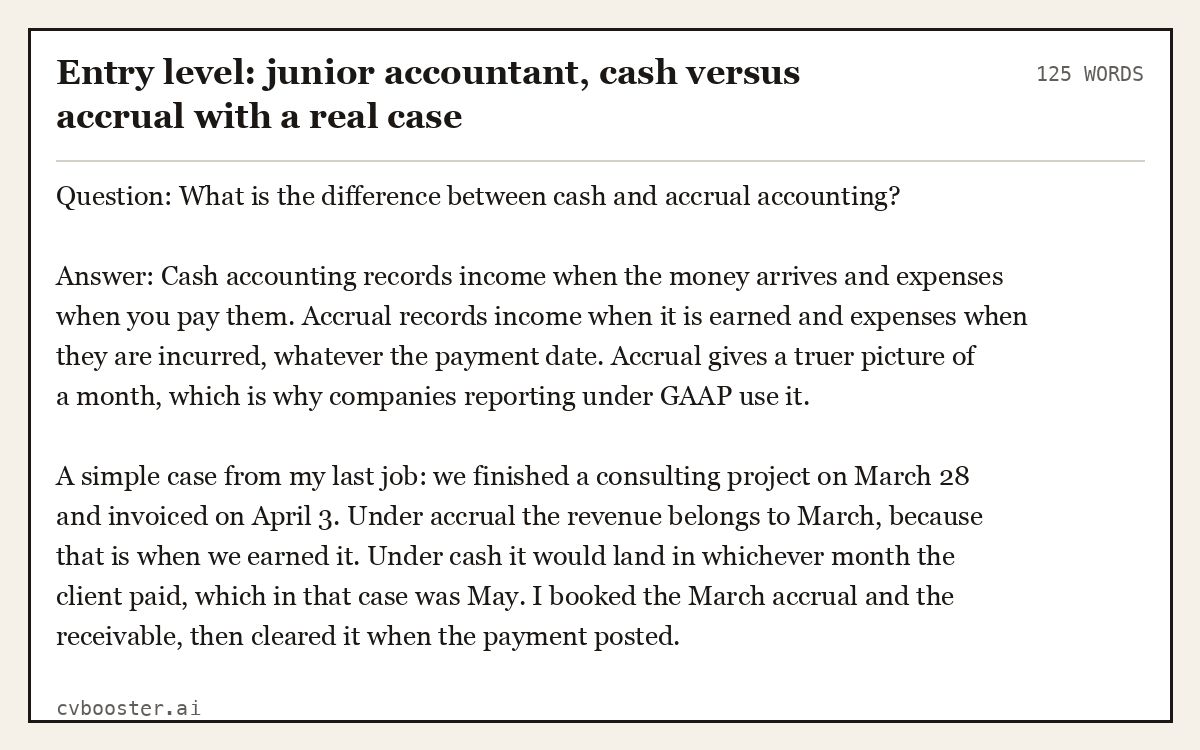
Entry level: junior accountant, cash versus accrual with a real case (125 words)
Question: What is the difference between cash and accrual accounting?
Answer: Cash accounting records income when the money arrives and expenses when you pay them. Accrual records income when it is earned and expenses when they are incurred, whatever the payment date. Accrual gives a truer picture of a month, which is why companies reporting under GAAP use it.
A simple case from my last job: we finished a consulting project on March 28 and invoiced on April 3. Under accrual the revenue belongs to March, because that is when we earned it. Under cash it would land in whichever month the client paid, which in that case was May. I booked the March accrual and the receivable, then cleared it when the payment posted.
Month end close and reconciliation questions
For staff and senior roles the conversation moves from definitions to process. The interviewer wants to hear the order you work in and what you do when a number does not tie.
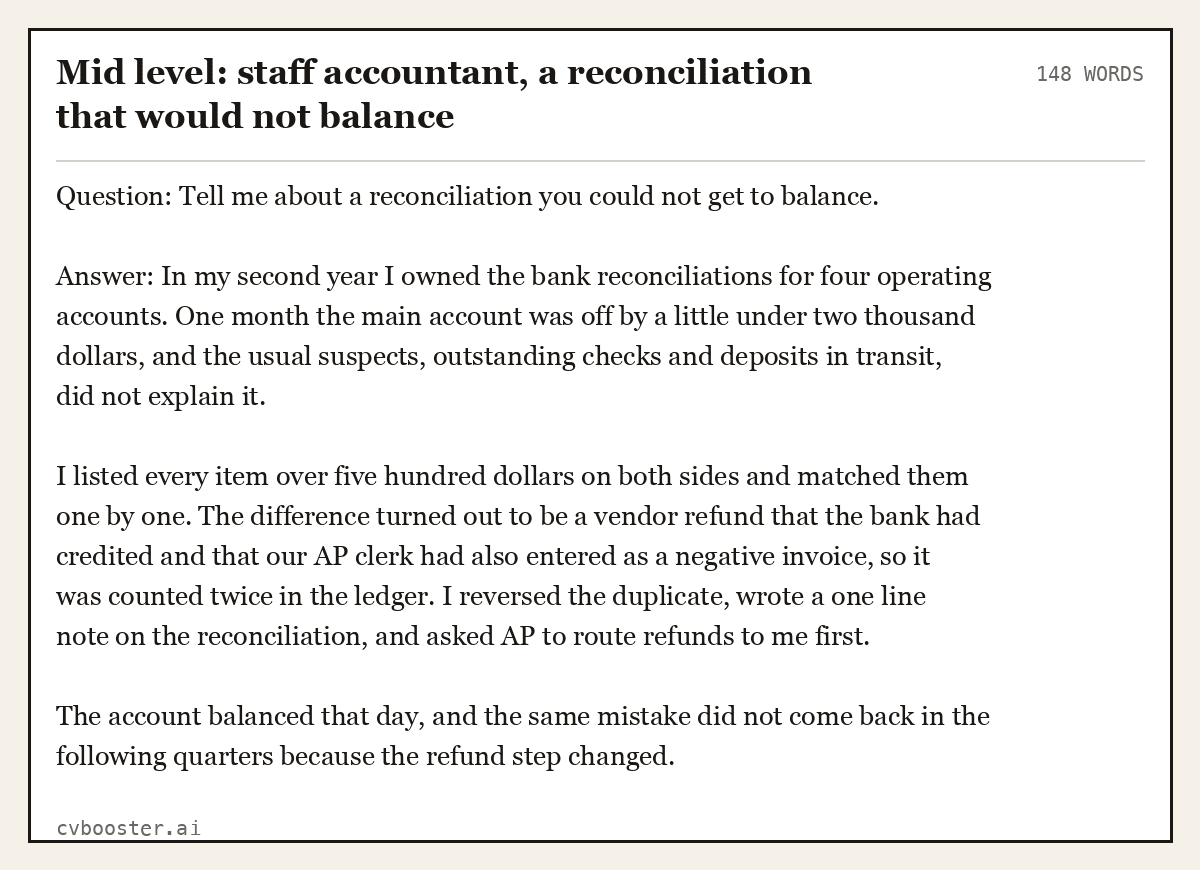
Mid level: staff accountant, a reconciliation that would not balance (148 words)
Question: Tell me about a reconciliation you could not get to balance.
Answer: In my second year I owned the bank reconciliations for four operating accounts. One month the main account was off by a little under two thousand dollars, and the usual suspects, outstanding checks and deposits in transit, did not explain it.
I listed every item over five hundred dollars on both sides and matched them one by one. The difference turned out to be a vendor refund that the bank had credited and that our AP clerk had also entered as a negative invoice, so it was counted twice in the ledger. I reversed the duplicate, wrote a one line note on the reconciliation, and asked AP to route refunds to me first.
The account balanced that day, and the same mistake did not come back in the following quarters because the refund step changed.
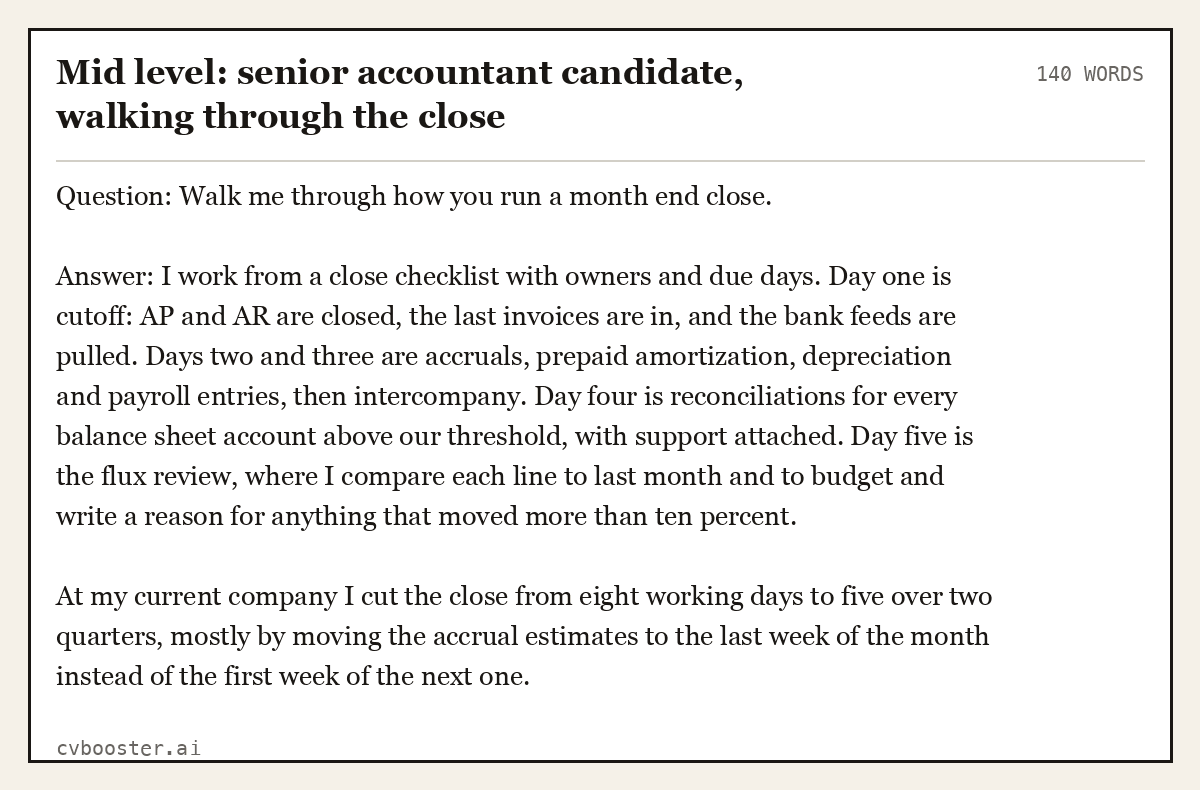
Mid level: senior accountant candidate, walking through the close (140 words)
Question: Walk me through how you run a month end close.
Answer: I work from a close checklist with owners and due days. Day one is cutoff: AP and AR are closed, the last invoices are in, and the bank feeds are pulled. Days two and three are accruals, prepaid amortization, depreciation and payroll entries, then intercompany. Day four is reconciliations for every balance sheet account above our threshold, with support attached. Day five is the flux review, where I compare each line to last month and to budget and write a reason for anything that moved more than ten percent.
At my current company I cut the close from eight working days to five over two quarters, mostly by moving the accrual estimates to the last week of the month instead of the first week of the next one.
Behavioral questions in an accounting interview
The behavioral round is where accounting candidates lose offers, because they answer with adjectives. Use a short STAR shape: the situation in one line, what you did, and the result in a number or a changed process. Our guide to STAR interview questions has the full method.
Mid level: accountant, telling a manager about your own error (127 words)
Question: Tell me about a time you made a mistake.
Answer: In my first quarter as a staff accountant I booked a quarterly insurance invoice entirely to one month instead of spreading it over three as a prepaid. I found it myself during the flux review two weeks later, because insurance expense had tripled with no new policy.
I told my manager before I fixed it, booked the correcting entry to move two thirds to prepaid insurance, and set up the amortization schedule. Then I added a line to my own checklist: any invoice covering more than one month goes to prepaids first.
The financials had not gone out yet, so nothing had to be restated, and the checklist line is still in our team close file.
Accounting interview questions for senior and tax roles
Senior candidates are asked about judgment, controls and people. Tax candidates are asked about credentials and representation. If a tax role mentions enrolled agents, know what the credential means. The IRS describes an enrolled agent as "a person who has earned the privilege of representing taxpayers before the Internal Revenue Service" and says enrolled agents, "like attorneys and certified public accountants (CPAs), have unlimited practice rights." (IRS, Enrolled Agent Information).
Senior: accounting manager candidate, improving controls after an audit finding (142 words)
Question: Tell me about a time you improved a process or a control.
Answer: Our external auditors raised a finding that journal entries over a set amount were being posted without documented review. As the senior accountant I owned the fix.
I set up an approval step in the ERP so that entries above the threshold could not post until a second person approved them, and I wrote a one page guide for the four people who post entries. For the backlog, I pulled every large entry from the year, attached support and had the controller sign off on the ones that lacked review.
At the next year's audit the finding was closed with no repeat comment. The new step added about a day to the close in the first month and almost nothing after that, once everyone attached support before submitting.
Entry level: graduate, why accounting and the CPA plan (115 words)
Question: Why do you want to work in accounting, and what are your plans for the CPA?
Answer: I like work where the answer can be checked. In my audit internship the moment I enjoyed most was tying a revenue sample back to contracts and delivery records and seeing it hold.
I plan to finish the credit hours my state board requires for licensure next spring, and I intend to start the CPA exam with the section closest to the work I would be doing here. I would rather learn the close properly in my first year than rush the exam, and I would ask for your advice on timing once I know the team.
Mistakes that cost accounting candidates the offer
- Reciting definitions with no example. The definition proves you studied; the example proves you worked.
- Saying "I am very detail oriented." Show a reconciliation you fixed instead.
- Guessing at a technical answer. Say what you know, say what you would check, and name the source you would check it in.
- Hiding an error story. Interviewers trust a candidate who found and fixed a mistake more than one who claims never to have made one.
- Forgetting the software. Name the ERP, the reconciliation tool and the spreadsheet functions you use every week.
Before the interview, make sure your page matches what you will say. The accountant resume and staff accountant resume guides show how to write the same close and reconciliation work as bullets, and our common interview questions and answers covers the general questions every round includes. Afterwards, send a short note using our thank you letter examples. For senior and leadership roles, the accounting executive resume examples show how controllers and chief accounting officers write the same work.
Frequently asked questions
What questions are asked in an accounting interview?
Expect technical questions on the three statements, cash versus accrual, journal entries, depreciation and reconciliations, then process questions about the month end close, and behavioral questions about errors, deadlines and teamwork. Senior roles add controls, audits and managing people. Tax roles add credentials and representation before the IRS.
How do I prepare for an accounting interview?
Write a two sentence answer for each common technical question and pair it with one real example from your own work. Rehearse your close process step by step, prepare three STAR stories about an error, a deadline and a process you improved, and check the company's industry so you can ask about its revenue recognition.
What are basic accounting interview questions for freshers?
Freshers are usually asked to walk through the financial statements, explain debits and credits, describe cash versus accrual, give the journal entry for an accrued expense, and say why they chose accounting. Interviewers expect textbook accuracy plus one example from an internship, a class project or a part time job.
How do I answer technical accounting interview questions if I do not know the answer?
Say what you do know, then say how you would find the rest and where you would look, such as the company's accounting policy or the relevant standard. Never invent an entry. Interviewers test this on purpose, and a calm "I would check before posting" is the answer they want from someone who will touch the ledger.
How long should my answers be in an accounting interview?
Aim for thirty seconds to a minute on technical questions and up to two minutes on behavioral ones. Give the definition, one example and stop. If the interviewer wants more depth they will ask a follow up, and those follow ups are where strong candidates show what they actually know.
Related articles
- Accountancy CV Example: 6 UK Accounts CVs by Career Level
- Activity Resume Example: 6 Samples for College Applications
- Administration CV Example: 6 Admin CVs from Entry to Senior
- Basis Interview Questions and Answers: 7 SAP Examples
More articles
Looking for a worked example for your job title? Browse the resume examples by job title.