Pet Sitter Resume Examples: free ATS score and gap list
A Pet Sitter Resume That Wins the Keys to the House
By Mustafa Tarabya, founder of CVBooster · Published · Updated
Pet sitter resume example and guide covering overnight stays, medication routines, species handled, key security and client references.
Sample resumes for a pet sitter
The same pet sitter content laid out in three CVBooster templates, so you can see what the finished document looks like before you write a word.
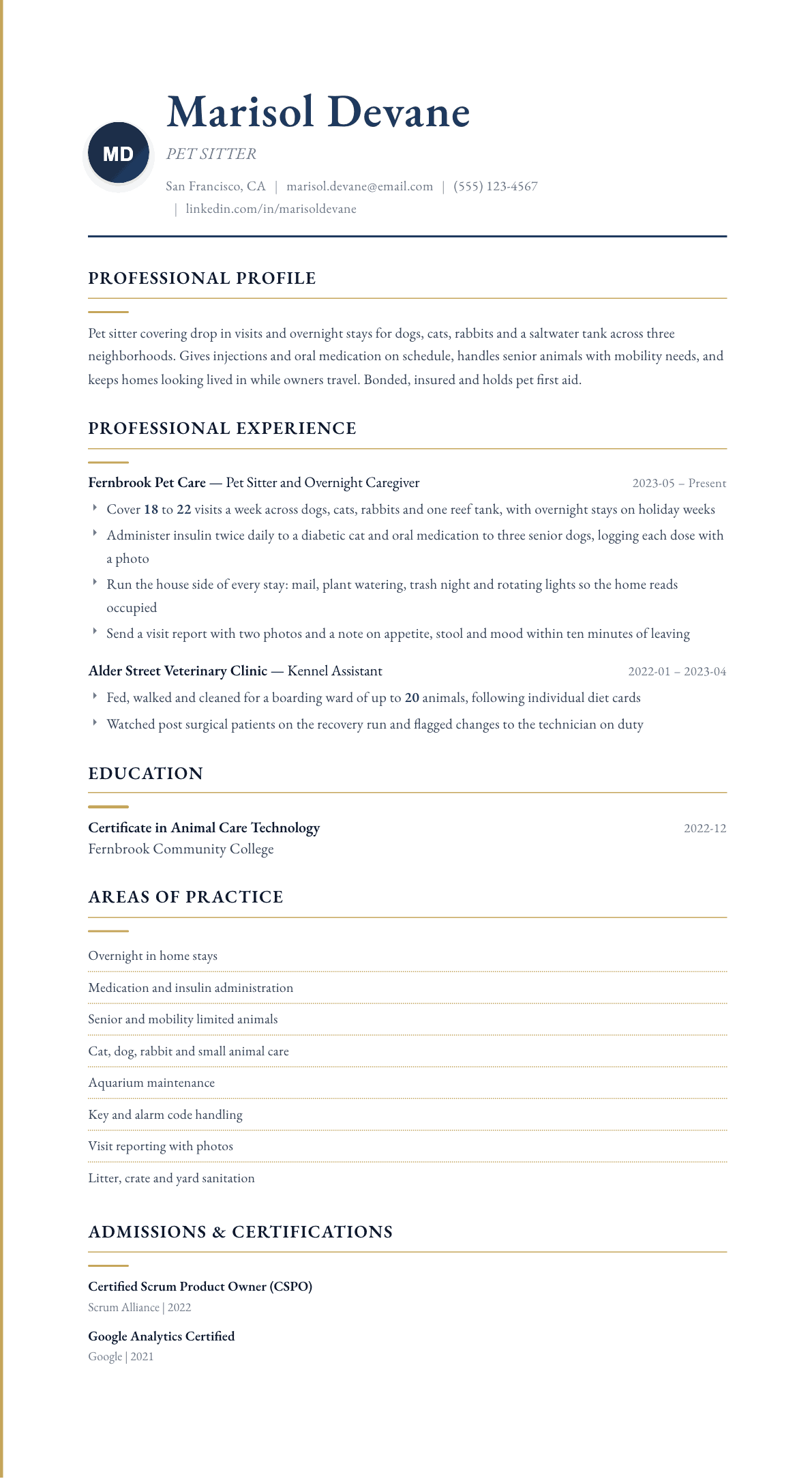
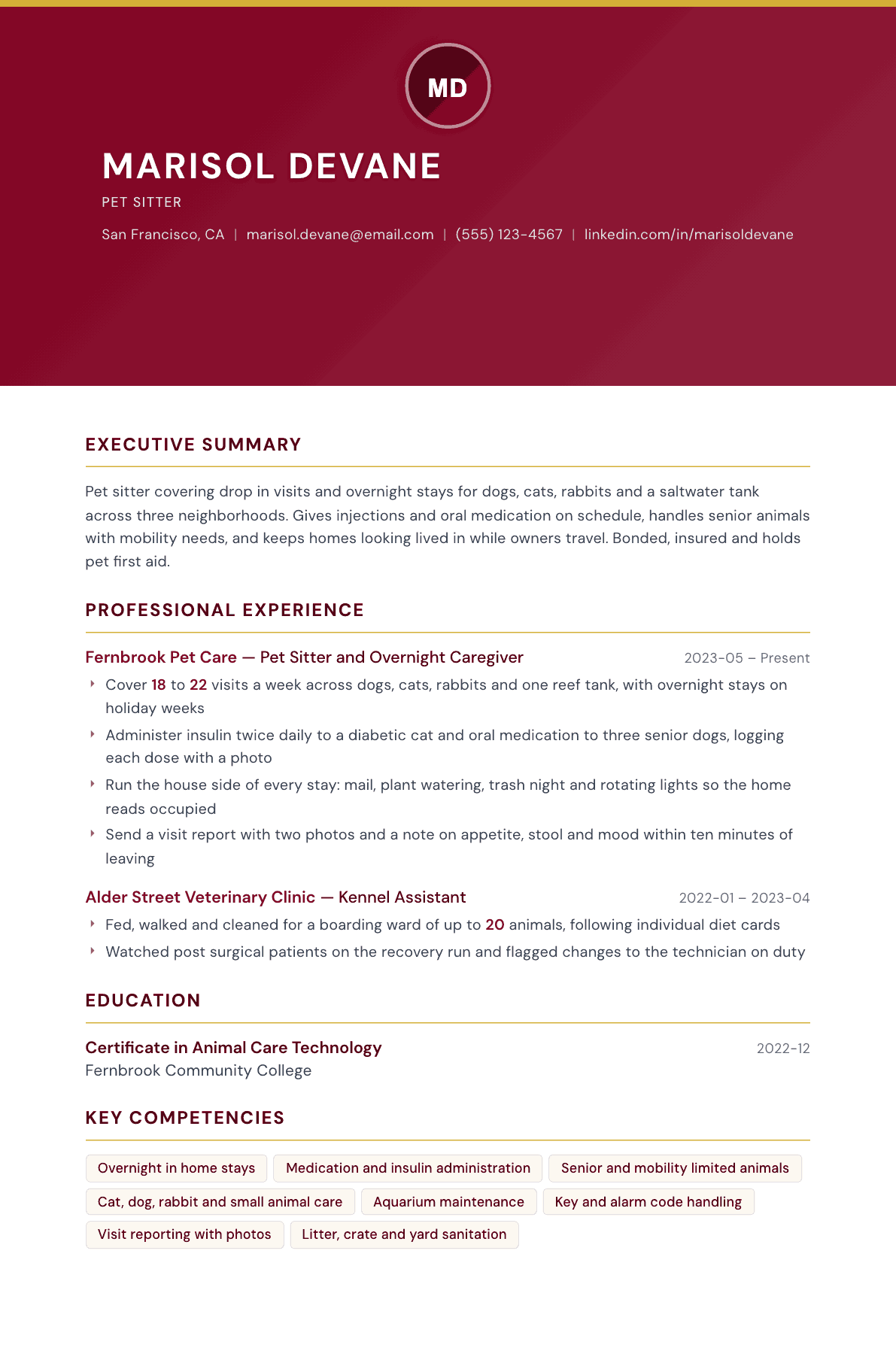
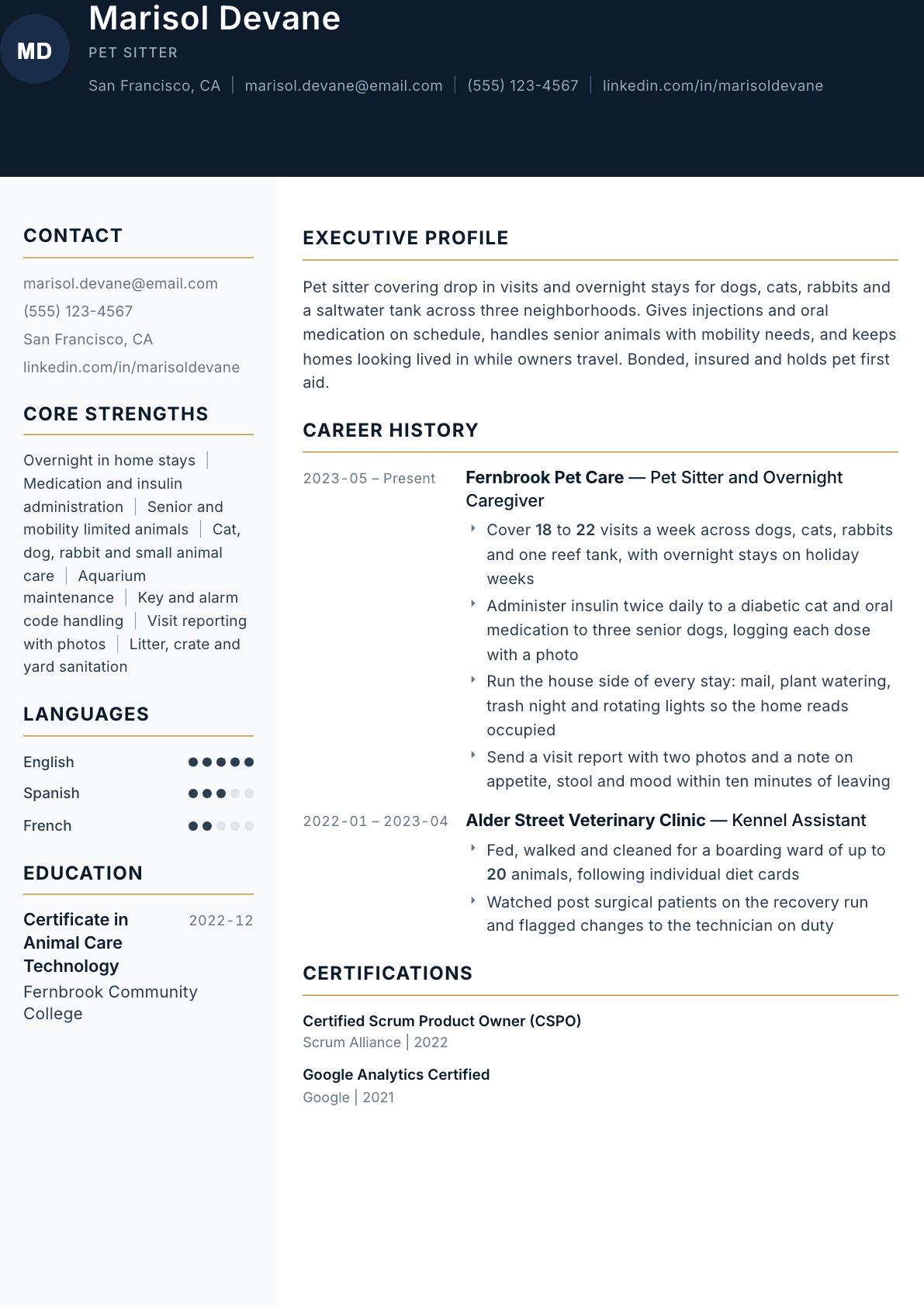
Example Pet Sitter summary
Pet sitter running drop in visits and overnight stays for dogs, cats, rabbits and a reef tank across three neighborhoods, covering twenty visits in a normal week. Administers insulin and oral medication on schedule with a photo log for every dose, handles senior animals with mobility needs, and keeps traveling clients homes looking occupied. Bonded and insured, holds pet first aid, and sends a photo visit report before leaving each door.
Skills to list on a Pet Sitter resume
- Drop in visits
- Overnight house sitting
- Dog and cat handling
- Small mammal and bird care
- Reptile and aquarium care
- Oral and injectable medication
- Senior animal care
- Feeding and diet card compliance
- Litter and crate sanitation
- Key, lockbox and alarm handling
- Home care while owners travel
- Emergency veterinary escalation
- Client visit reporting
- Booking and route scheduling
What actually gets this resume read
- List every species and temperament you have handled, because a reactive dog and a shy cat are different bookings.
- Say clearly whether you do drop ins, day care in your own home, or overnight stays inside the client house.
- Put medication experience in specifics: insulin, subcutaneous fluids, eye drops, pills hidden in food and the logging you keep.
- Mention bonding, insurance and how you handle keys, alarm codes and lockboxes, since you are trusted with an empty home.
- Describe your visit report habit, because owners away from home are buying reassurance as much as animal care.
- Give the emergency plan you follow: the vet on file, the backup sitter, and how fast you reach an owner in another time zone.
How to write a pet sitter resume
Hiring a pet sitter is really two hires at once. The client is handing over an animal she is attached to, and she is also handing over her front door, her alarm code, her mail and an empty house for a week. Most applicants write entirely about the first half. The sitters who get the repeat bookings and the referrals are the ones whose page shows they understand the second half too.
The reader might be a private owner, a sitting company owner building a route, or a veterinary practice keeping a referral list. All three are screening for the same failure modes: an animal that gets loose, a dose that gets missed, a house that gets left unsecured, and a client who cannot reach the sitter from another time zone. Your resume should shut each of those down before anybody asks.
This guide covers structuring the page around service types rather than employers, listing species and temperaments precisely, writing medication experience so a veterinarian would accept it, handling keys and insurance on paper, and turning platform ratings and private clients into evidence a stranger can trust.
Organize by service type, not by employer
Pet sitting work rarely comes from one place. It is a mix of private clients, an agency route, a stint at a boarding facility and a handful of platform bookings. Forcing that into a strict employment history makes a strong sitter look scattered. Lead instead with a services block: drop-in visits, overnight stays in the client home, daytime house sitting, and any boarding you have done in your own space.
Under each service, give the volume and the pattern. Visits per week, how many holiday weeks you have covered, the longest continuous stay you have done. Holiday coverage is worth calling out on its own, because the weeks around major holidays are the ones every client worries about and half the sitting supply disappears.
- Service list with the length of each visit you offer and whether overnights are in-home or in your own home.
- Weekly visit volume and the longest continuous house sit you have completed.
- Neighborhoods or radius you cover, since routing decides whether you can be booked at all.
- Bonding and insurance status, named as policy coverage rather than as a general assurance.
Species, temperament and the animals most sitters quietly avoid
List species properly: dogs and cats first, then rabbits, guinea pigs, ferrets, birds, reptiles, fish and any farm animals. Owners of anything outside dogs and cats are used to being turned down, and a sitter who names a bearded dragon or a saltwater tank on the page gets contacted immediately by people with nobody else to call.
Temperament matters as much as species. Say whether you have handled a fearful cat who hides for the first three visits, a dog with separation distress, a bird that needs out-of-cage time, or an animal that resource guards its food bowl. Naming those honestly signals experience, and it also protects you from a booking you should not take.
Senior and end-of-life care deserves its own line if you have done it. Mobility support, incontinence management, appetite monitoring and knowing when to call the owner about a decline are the hardest parts of this job, and the sitters who can do them are rare enough that it should never be buried.
Medication, feeding plans and the visit log
Write medication experience with the route and the frequency. Oral tablets hidden in food, liquid by syringe, ear and eye drops, topical treatments, subcutaneous fluids for a cat in kidney failure, insulin injections at fixed hours. Owners of a diabetic animal are searching for exactly those words, and a general claim about giving medication will not surface for them.
Then describe the record you keep. A dose logged with a timestamp and a photo is the difference between a client who worries all week and one who rebooks. Say what your visit report contains: food eaten, water level, elimination, mood, any limp or scratch you noticed, and two photos. Owners are paying for the animal to be fine and for the proof that it is.
Feeding is where most errors happen, so mention diet card compliance directly. Raw diets, prescription food, split portions between animals who steal from each other, and the household where one dog must be fed in a separate room. That level of detail tells a client you have met the problem before.
Keys, alarms and the empty house
Give a plain account of how you handle access. Keys tagged by a code rather than by an address, a lockbox routine, alarm codes stored somewhere other than a phone note, and what happens to the key when a client stops booking. Clients almost never ask this in the first message and almost always worry about it, so answering unprompted lands well.
The house side of a stay belongs on the page too: mail and packages brought in, plants watered, trash taken out on the right night, lights and blinds rotated so the home does not read as empty. Many owners choose a sitter over a boarding kennel for precisely this reason, and a sitter who does not mention it looks like one who only visits the animal.
Close it with an emergency plan. The vet on file, the emergency clinic you would drive to, the backup sitter who could cover if you were ill, and the target time for reaching an owner in a different time zone. That paragraph is often the reason a first-time client picks you.
Reviews, references and the words clients search
Platform ratings help only when they carry a count. A star average with the number of completed bookings behind it is evidence. A star average alone could be three visits. Add repeat client detail as well, because the share of your bookings that come from the same households is the strongest quality signal this work produces.
For keywords, use the terms owners and companies actually type: drop-in visit, overnight pet sitting, house sitting, medication administration, insulin, senior pet care, reactive dog, cat sitting, small animal care, bonded and insured, pet first aid. Put each inside a sentence that shows the work rather than in a bare list, so the term arrives with proof attached.
Pet Sitter resume summary examples
Building a first client list
Pet sitter starting a local client list after two years caring for neighborhood dogs and cats, plus a summer volunteering on the adoption floor of a rescue. Comfortable with cats who hide, oral medication and litter routines. Holds pet first aid and CPR, and covers drop-in visits within a two-mile radius.
Full route with overnights
Pet sitter running 20 visits a week across dogs, cats, rabbits and a reef tank, with overnight stays booked through every holiday week for two years. Gives insulin twice daily to a diabetic cat and oral medication to three senior dogs, logging each dose with a photo. Bonded, insured and pet first aid certified.
Senior sitter and team lead
Senior pet sitter with eight years across private clients and an agency route, covering 40 households including hospice and post-surgical cases. Administers subcutaneous fluids and injectable medication, trains new sitters on key security and visit reporting, and holds the on-call slot for emergency vet transport.
Work experience bullets: before and after
Before: Took care of pets while their owners were away.
After: Covered 18 to 22 visits a week across dogs, cats, rabbits and one reef tank, including overnight stays through every major holiday week for two years running.
Volume, species and holiday coverage describe a route a company could actually staff.
Before: Gave medication to pets as needed.
After: Administered insulin twice daily to a diabetic cat and oral medication to three senior dogs, logging each dose with a timestamped photo sent to the owner.
Route, frequency and the logging habit are what an owner of a medicated animal searches for.
Before: Sent updates to clients.
After: Sent a visit report within ten minutes of leaving each door covering appetite, water, elimination, mood and two photos, which drove a repeat booking rate the owner used as the company benchmark.
A defined report and a turnaround time make an update habit measurable.
Before: Trusted with clients house keys.
After: Managed access for 14 households using keys tagged by code rather than address, returned within 48 hours of a client ending service, and alarm codes kept off any phone.
Specific security practice answers the worry a client will not raise but always has.
Before: Handled an emergency with a sick dog.
After: Recognized bloat symptoms in a boarding client's dog on an evening visit, drove to the emergency clinic on the file within 20 minutes and reached the owner overseas before the exam started.
A named judgment call with a timeline proves the emergency plan is real, not written.
Hard skills
- Drop-in visits and overnight house sitting
- Oral, topical and injectable medication
- Subcutaneous fluid administration
- Diabetic and senior animal care
- Cat, dog and small mammal handling
- Bird, reptile and aquarium care
- Diet card and prescription feeding compliance
- Litter, crate and yard sanitation
- Key, lockbox and alarm code security
- Home care during owner travel
- Visit reporting with photo documentation
- Emergency veterinary transport and escalation
- Route and booking scheduling
Soft skills
- Patience with an animal that hides for the whole first visit
- Telling an owner about a decline before it becomes bad news
- Discretion inside a home you have unsupervised access to
- Holding a schedule through weather and holidays
- Turning down a booking you are not equipped for
Certifications worth listing
- Cat and Dog First Aid (American Red Cross)
- Certified Professional Pet Sitter (Pet Sitters International)
- Certified Professional Animal Care Provider (CPACP) (Professional Animal Care Certification Council)
Mistakes that cost pet sitter candidates the interview
- Writing only about animals and never about the house, keys and alarm the client is also handing over.
- Saying you can give medication without naming the route, the frequency and the record you keep.
- Leaving species outside dogs and cats off the page, which loses the clients who have nobody else to call.
- Quoting a star rating with no booking count behind it, so a strong record reads like three visits.
- Skipping bonding and insurance, which is the first thing a sitting company checks before a route interview.
- Presenting a scattered mix of private, agency and platform work as a broken employment history instead of a service list.
- Offering no emergency plan, leaving a first-time client to imagine what happens if something goes wrong at midnight.
Pet Sitter resume questions
How do I list private clients without publishing their names?
Describe them as private households with a neighborhood or a general area, the number of households, the species and the booking pattern. Names are unnecessary and most clients would rather not appear. Keep two or three who have agreed in advance to take a reference call, and mention that availability on the page.
Do I need to be bonded and insured to be a pet sitter?
A private client may never ask, but agencies and property managers usually require it, and it is often the deciding factor for an owner comparing two sitters. If you carry coverage, name it as a line item. If you do not yet, say you are willing to obtain it before the first booking.
How much detail should I give about medication?
Enough that a veterinarian would accept the description. Name the route, the frequency, the type of animal and any monitoring involved. Owners searching for a sitter for a diabetic cat or a dog on post-surgical pain control use those exact words, and a general statement about medication will never reach them.
Should I include ratings from a booking platform?
Yes, with the number of completed bookings and the share that came from repeat households. Repeat business is the honest measure in this work. If you are moving from a platform to private clients, that figure travels with you and is more persuasive than the star average on its own.
What should a pet sitter resume say about my own pets?
One line at most, and only if it is relevant to what you offer, such as a home free of other animals for a nervous boarder or a fenced yard. Long descriptions of your own animals read as a hobby page. What a client wants to know is whether her animal will be safe in your presence.